|
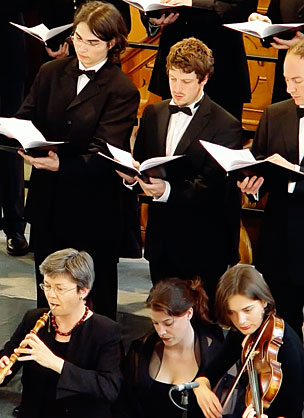
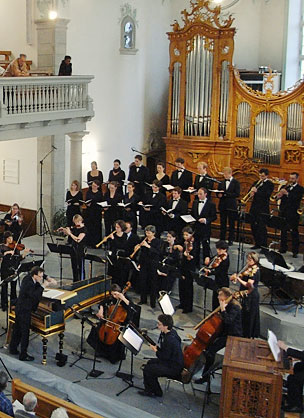
The Choir and Orchestra of the J.S. Bach Foundation (formerly: Schola Seconda Practica) was founded by Rudolf Lutz in 2006. The ensemble consists of professional musicians from the whole of Switzerland, southern Germany and Austria. All its members are experienced in historical performance practices and relish the challenge of exploring a contemporary and vital interpretation of J.S. Bach's cantatas. The Choir and Orchestra consists of regular members, with extra musicians being engaged according to the demands of the work performed. The choir's size varies in the range of up to 40 voices, and is made up of young professional singers. Individual members receive the opportunity to take on solo roles from time to time.
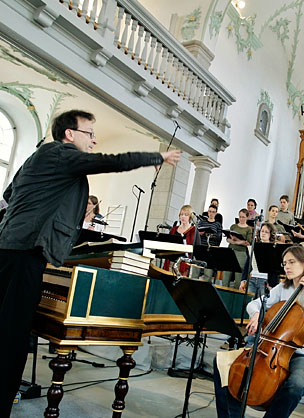
Conducted by Rudolf Lutz, the Choir and Orchestra has been performing J.S. Bach’s cantatas in a monthly concert cycle since October 2006. Throughout the ongoing work of this project, it has continually developed and matured. Today, the ensemble is distinguished by its homogenous, yet flexible sound and its wealth of experience in the interpretation of J.S. Bach’s works. The quality and of vitality of its performances have garnered the group notable critical acclaim. In recent years, the Choir and Orchestra has ventured beyond its home concert hall in Trogen, Switzerland, and now gives regular concerts both nationally and internationally. |
|
Violins: Monika Baer, Péter Barczi, Christine Baumann, Eva Borhi, Patricia Do, Claire Foltze, Judith von der Goltz, Elisabeth Kohler, Petra Melicharek, Dorothee Mühleisen, Ildikó Sajgó, Olivia Schenkel, Renate Steinmann, Lenka Torgersen, Salome Zimmermann
Violas: Sonoko Asabuki, Péter Barczi, Martina Bischof, Claire Foltzer, Susanna Hefti, Matthias Jäggi, Stella Mahrenholz, Sarah Mühlethaler
Violoncellos: Maya Amrein, Hristo Kouzmanov, Magdalena Reisser, Daniel Rosin, Martin Zeller
Violoncello piccolo: Martin Zeller
Violone: Markus Bernhard, Guisella Massa
Recorder/Flute: Sarah van Cornewal, Marc Hantaï, Tomoko Mukoyama, Kiichi Suganuma, Yukiko Yaita,
Oboes: Katharina Arfken, Clara Espinosa, Andreas Helm, Thomas Meraner, Philipp Wagner
Horns: Stefan Katte
Trumpets: Lukasz Gothszalk, Peter Hasel, Patrick Henrichs, Klaus Pfeiffer, Matthew Sadler, Alexander Samawicz;
Bassoon: Susann Landert. Gilat Rotkop
Timpani: Inez Ellmann, Martin Homann
Harpsichord: Thomas Leininger, Rudolf Lutz
Organ: Nicola Cumer |