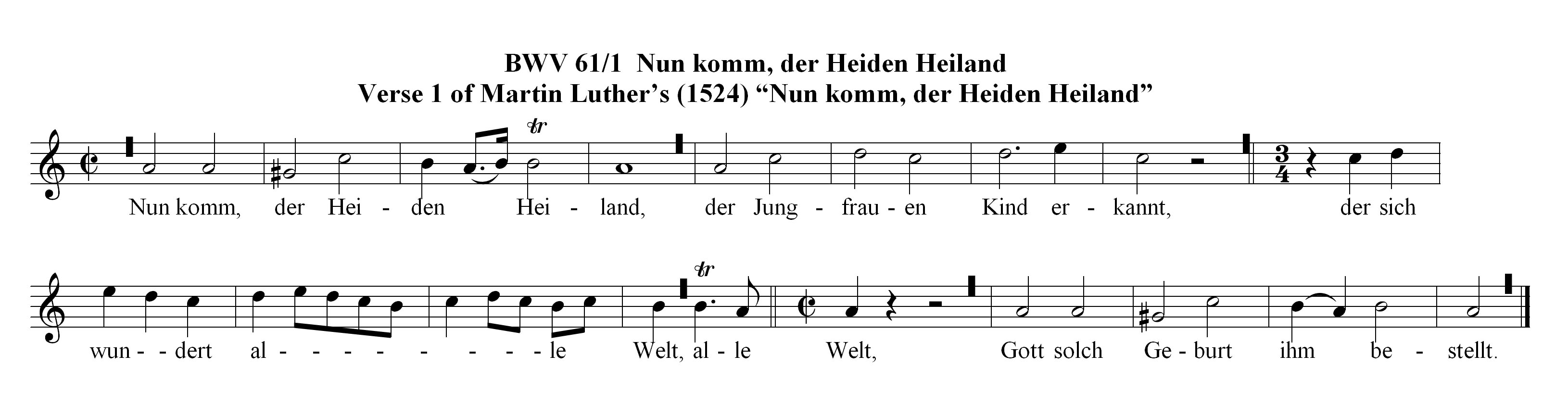
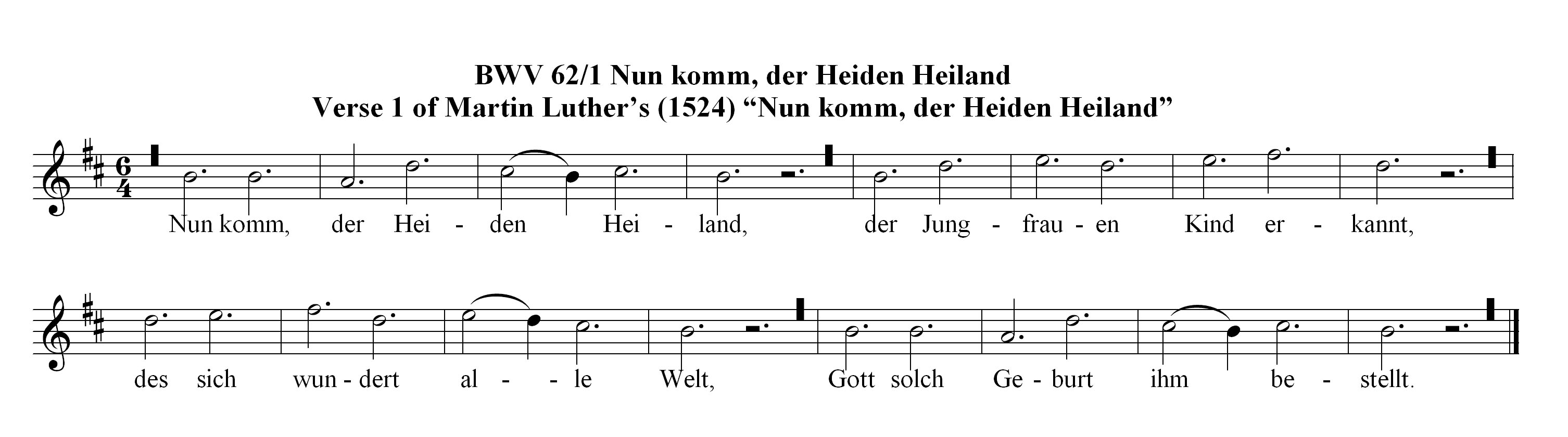
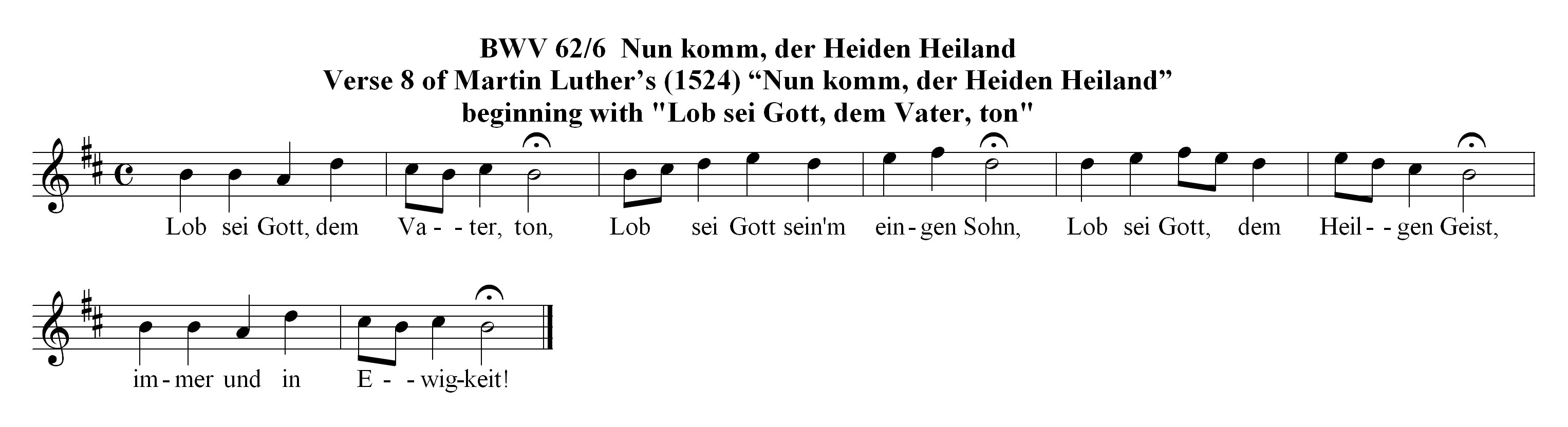
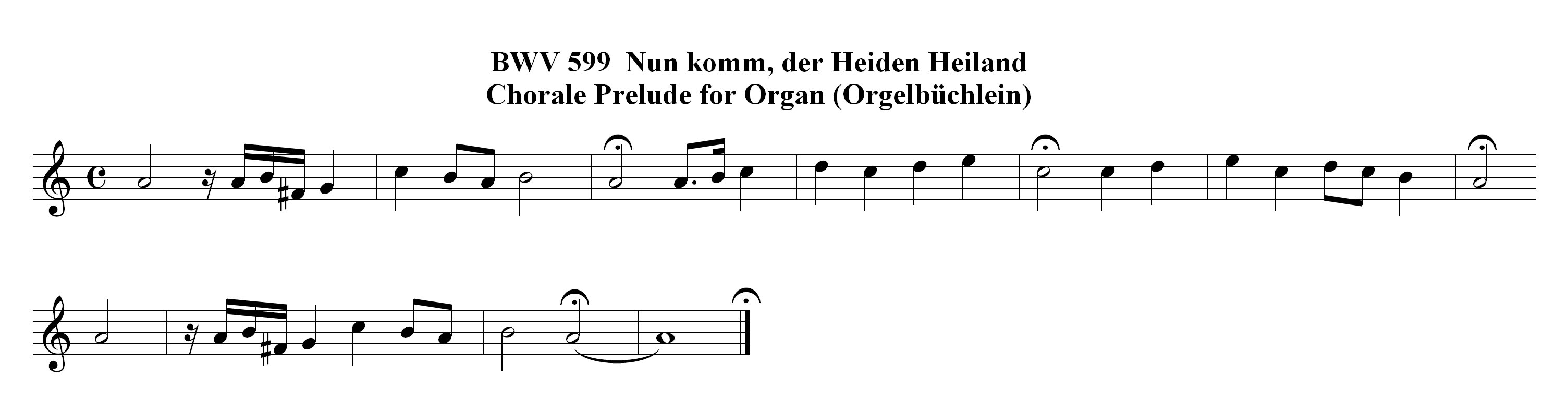
|
Chorale Melodies used in Bach's Vocal Works
Nun komm, der Heiden Heiland
|
|
Melody & Text | Use of the CM by Bach | Use of the CM by other composers | Arrangements/Transcriptions |
| |
|
Melody & Text: Zahn: 1174 | EKG: 1 |
|
Text: |
|
Martin Luther based his German chorale text for
Nun komm, der Heiden Heiland upon the second verse “Veni, redemptor gentium” of
Ambrosius [Ambrose of Milan]’s (c340-397) Advent Latin hymn text, “Intende qui regis Israel”.
Here is that portion from the Ambrosius original text:
Veni redemptor gentium,
Ostende partum virginis,
Miretur omne saeculum,
Talis partus decet deum. (or: Talis decet partus deum)
Luther’s adaptation:
Verse 1:
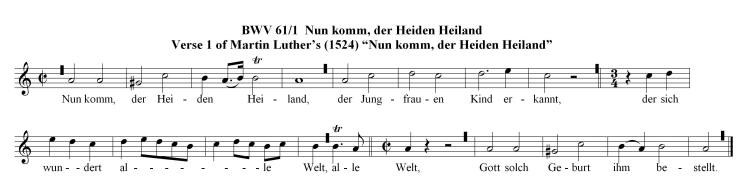
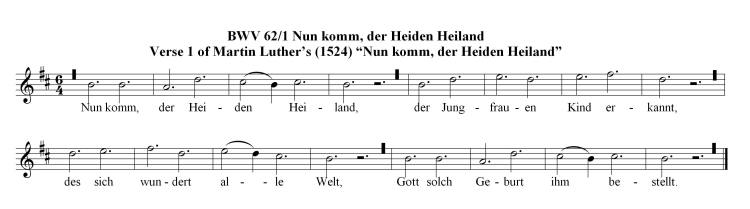
Nun komm, der Heiden Heiland,
der Jungfrauen Kind erkannt,
des sich wundert alle Welt,
Gott solch Geburt ihm bestellt.
Luther’s German chorale text first appeared in print in Erfurt, 1524. |
| |
|
Melody: |
|
This melody is first documented as a Roman Catholic Latin hymn based upon Gregorian chant in manuscript form in Einsiedeln (Schwyz) around 1120. The same melody source served as a basis for three important chorale melodies: “Nun komm, der Heiden Heiland”, ‘Verleih uns Frieden gnädiglich” (Luther’s CT based upon the antiphon ‘Da pacem Domine”) and Martin Luther’s CT,“Erhalt uns, Herr, bei deinem Wort”. |
|
>>The Lutheran Reformation in the early 16th century led to the creation of a new repertory of sacred music based on the chorale. Chorales were initially sung by the congregation in unison and unaccompanied. Most were adapted from chant, from German devotional songs (many of which were themselves reworkings of chant) and from secular songs, or were composed using conventional melodic types and formulae. Techniques of adaptation ranged from simple contrafactum to ingenious reworkings, such as Luther's reshaping of the Gregorian hymn Veni Redemptor gentium as the chorale Nun komm, der Heiden Heiland.<<
J. Peter Burkholder in Grove Music Online, ©Oxford University Press 2006, acc. 5/26/06
|
|
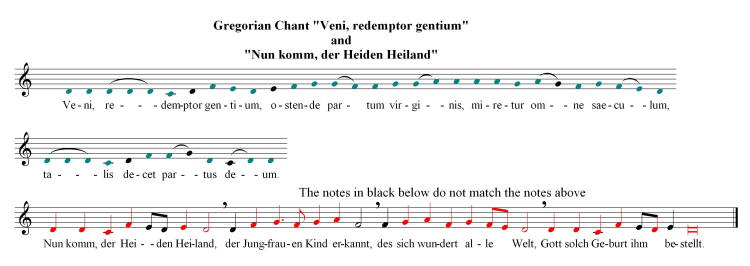
Burkholder presents examples of the Gregorian chant and “Nun komm, der Heiden Heiland” in close proximity so that the similarities and differences can become apparent: |
|
|
|
>>A good example of Luther’s procedures is his skilful adaptation of the melody of the hymn Veni Redemptor gentium to three different chorales, Verleih uns Frieden gnädiglich, Erhalt uns, Herr, bei deinem Wort and Nun komm, der Heiden Heiland, so that each was not only ‘correct’ but also had a character of its own. The prayerful and meditative character of the three texts common to most of Luther’s chorales set to Gregorian melodies doubtless prompted their common derivation and justified it aesthetically.<<
Robert L. Marshall/Robin A. Leaver in Grove Music Online, ©Oxford University Press 2006, acc. 5/26/06
|
|
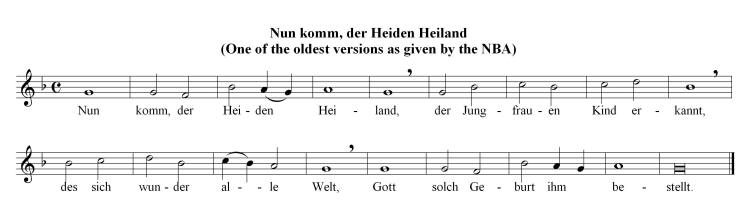
The CT “Nun komm, der Heiden Heiland” first appeared together with its melody in “Geystliche Gesangk Buchleyn” (edited by Johann Walter) in Wittenberg in 1524.
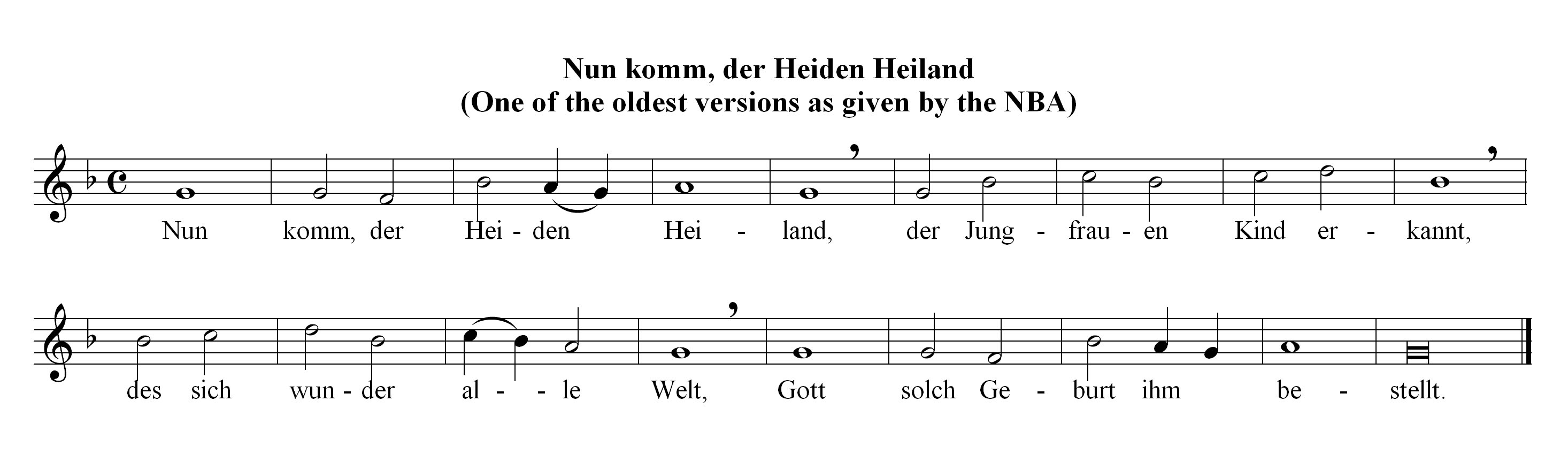
The CT and CM combined probably looked something like this in the hymnals of that time: |
|

|
|
or |
|
|
| |
|
Hymnal versions Bach may have known: |
|
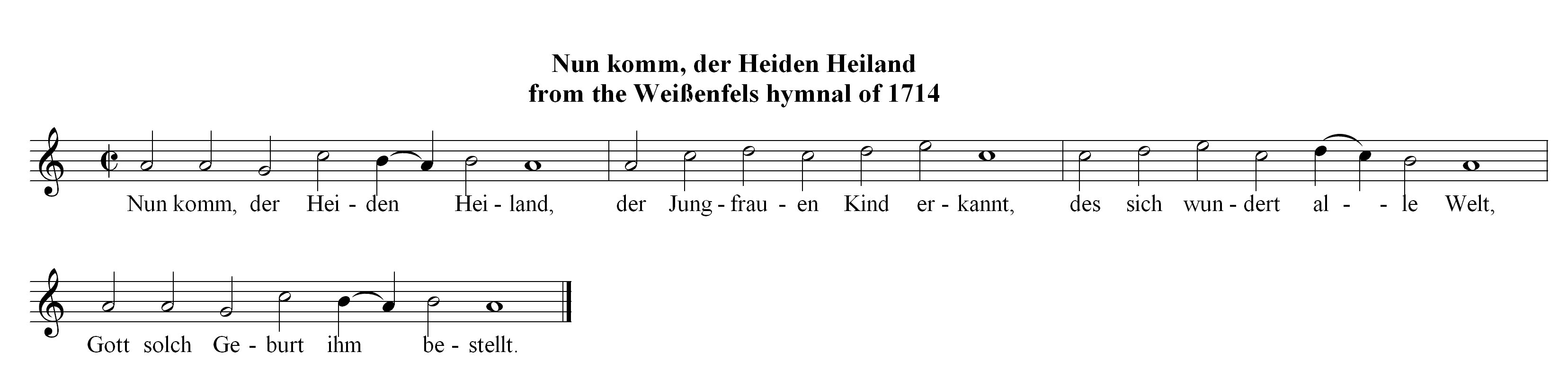
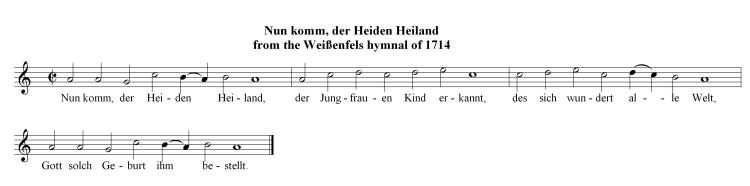
Bach very likely was acquainted with the melody in this form from the Weißenfels hymnal of 1714: |
|
|
| |
|
Use of the Chorale Melody by Bach: |
|
Text: Nun komm, der Heiden Heiland | EKG: 1
Author: Martin Luther (1524) |
|
Ver |
Work |
Mvt. |
Year |
Br |
RE |
KE |
Di |
BC |
Score |
Music Examples |
|
1 |
BWV 36 |
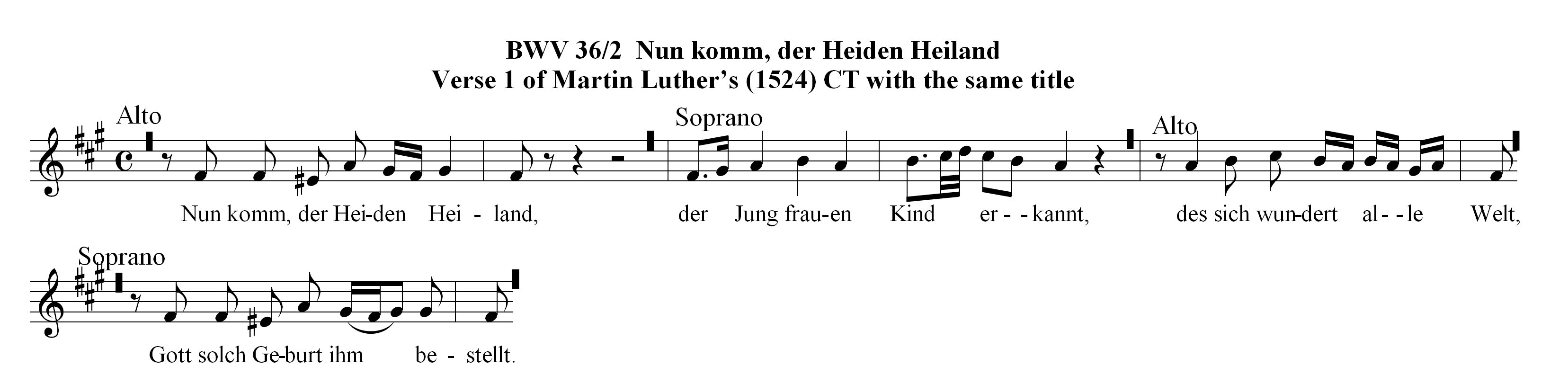
Mvt. 2 |
1731 |
- |
- |
- |
- |
A3:2 |
- |
Mvt. 2 (RMM) [midi] | Mvt. 2 (Leusink) [ram] |
|
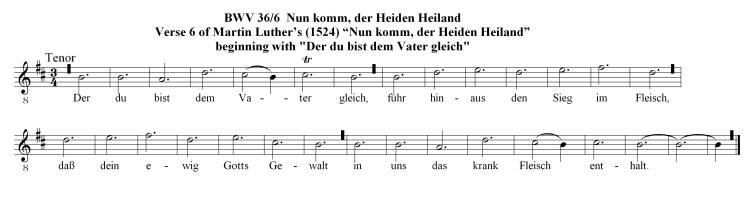
6 |
BWV 36 |
Mvt. 6 |
1731 |
- |
- |
- |
- |
A3:6 |
- |
Mvt. 6 (Leusink) [ram] |
|
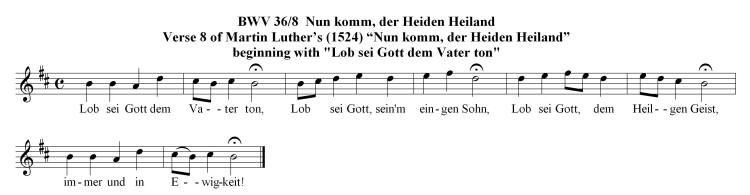
8 |
BWV 36 |
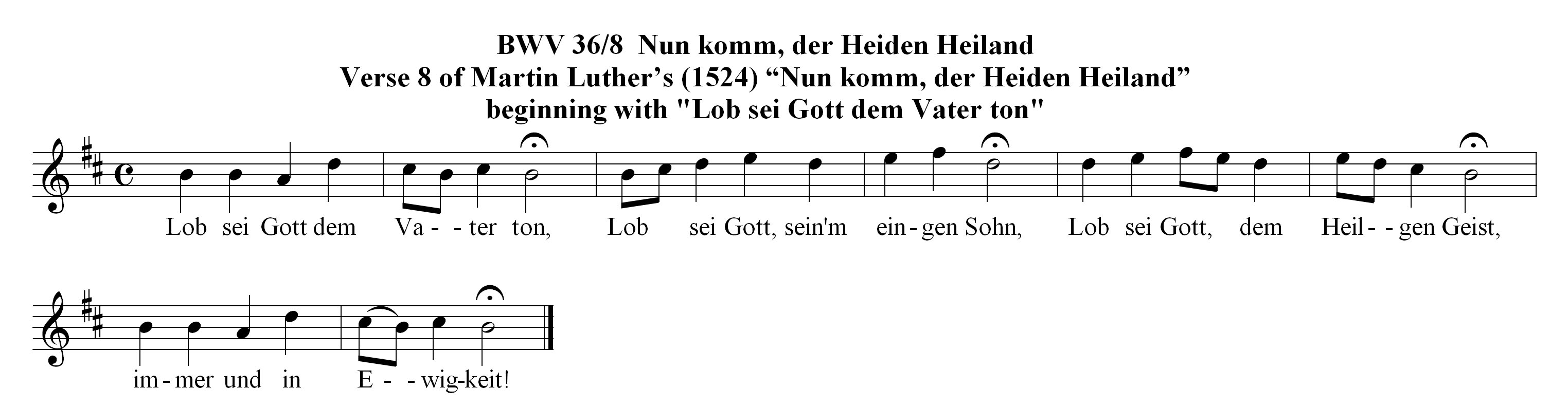
Mvt. 8 |
1731 |
28 |
264 |
28 |
- |
F151:1
A3:8 |
PDF |
Mvt. 8 (MG) [midi] | Mvt. 8 (Leusink) [ram] |
|
1 |
BWV 61 |
Mvt. 1 |
1714 |
- |
- |
- |
- |
A1:1 |
- |
Mvt. 1 (Leusink) [ram] |
|
1 |
BWV 62 |
Mvt. 1 |
1724 |
- |
- |
- |
- |
A2:1 |
- |
Mvt. 1 (Leusink) [ram] |
|
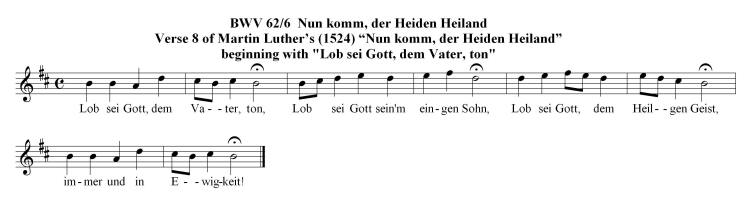
8 |
BWV 62 |
Mvt. 6 |
1724 |
170 |
265 |
170 |
96 |
A2:6 |
PDF
PDFv |
Mvt. 6 (MG) | Mvt. 6 ver (MG) [midi] | Mvt. 6 (Leusink) [ram] |
|
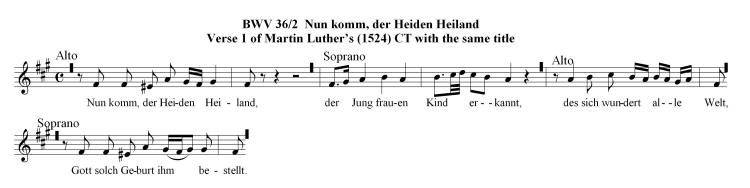
BWV 62/6: Breitkopf 170 (in a minor); Dietel 96. |
|
|
|
|
|
|
|
|
|
|
|
|
| |
|
Untexted: |
|
Ver |
Work |
Mvt. |
Year |
Br |
RE |
KE |
Di |
BC |
Score |
Music Examples |
|
- |
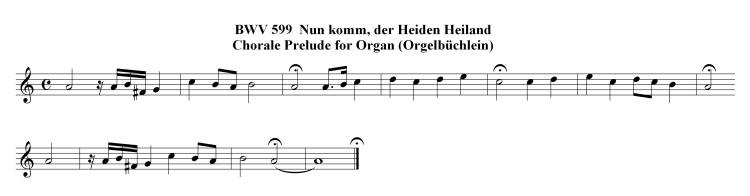
BWV 599 |
- |
1713/15 |
- |
- |
- |
- |
K28 |
- |
- |
|
- |
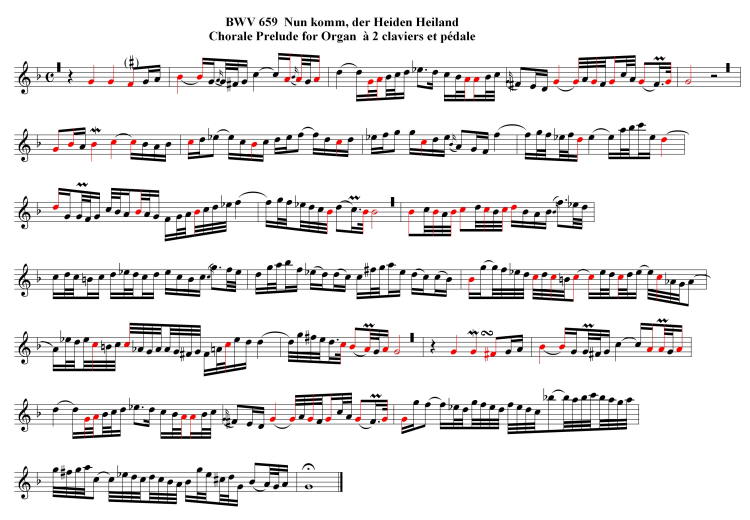
BWV 659a |
- |
Weimar |
- |
- |
- |
- |
K82 |
- |
Chorale Prelude (MG) [midi] |
|
- |
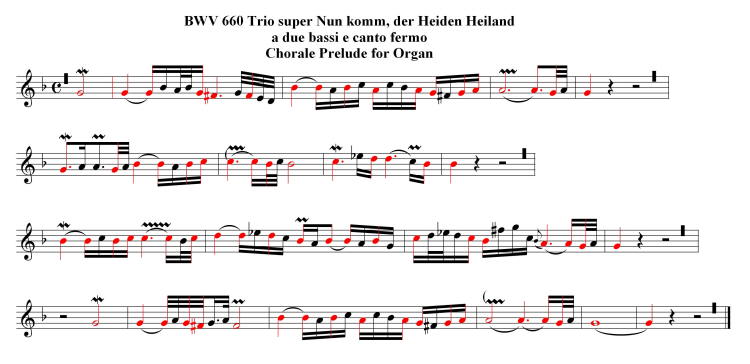
BWV 660a |
- |
? |
- |
- |
- |
- |
K83 |
- |
Chorale Prelude (MG) [midi] |
|
- |
BWV 661a |
- |
? |
- |
- |
- |
- |
K84 |
- |
Chorale Prelude (MG) [midi] |
|
- |
BWV 669 |
- |
1700/17 |
- |
- |
- |
- |
K155 |
- |
- |
|
BWV 599: Chorale Prelude for Organ (Orgelbüchlein No. 1).
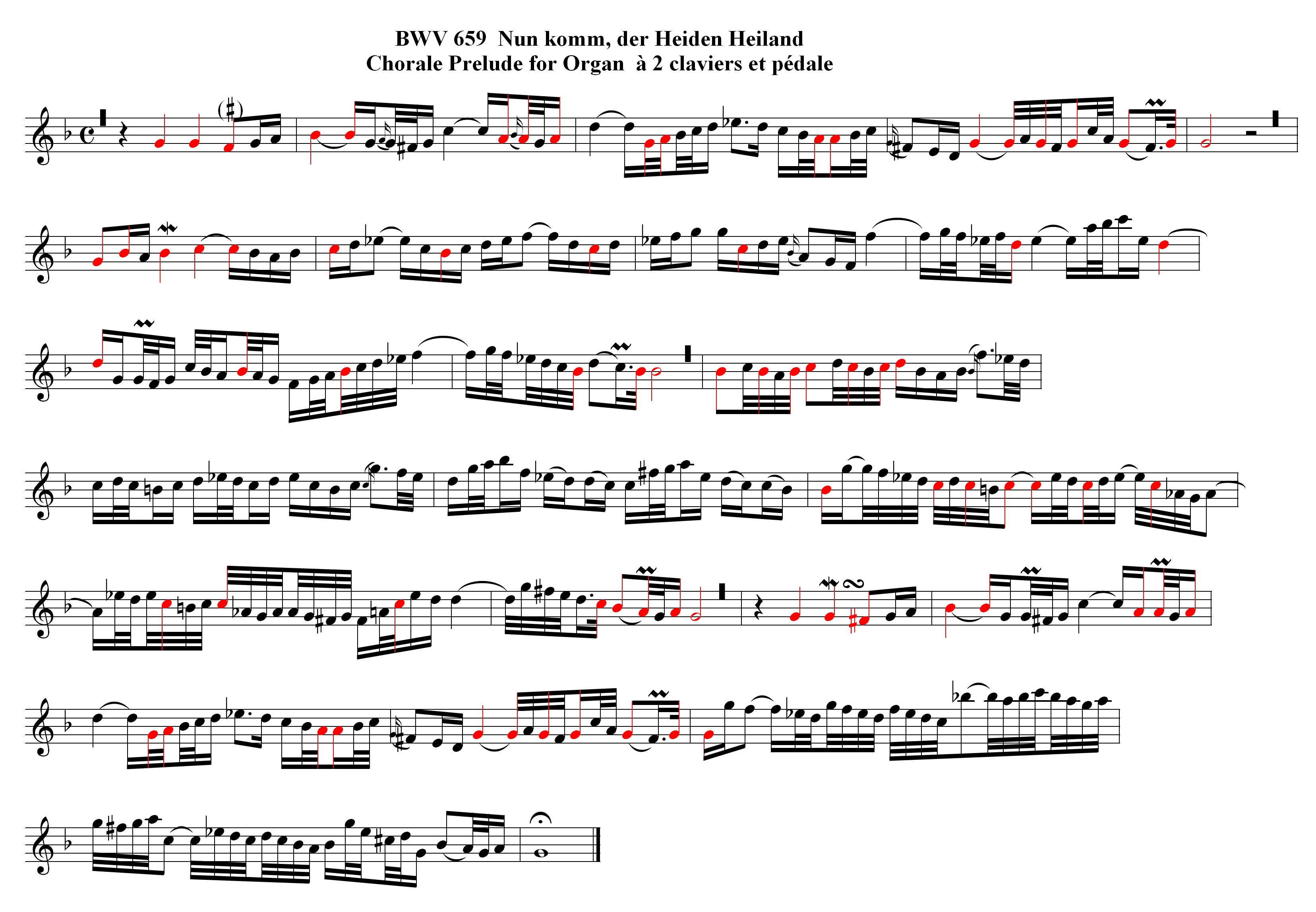
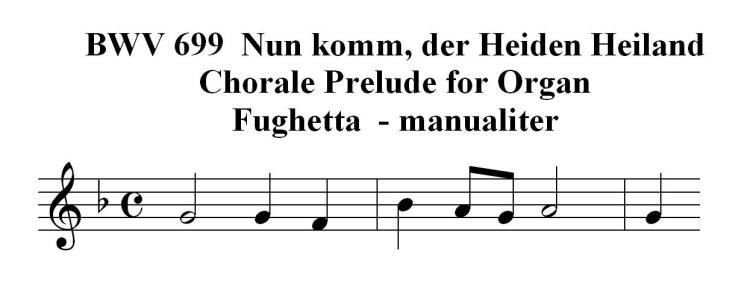
BWV 659(a): Weimar with later revisions in Leipzig 1739/1742, 1746/1747, 1750 (Achtzehn Choräle No. 8).
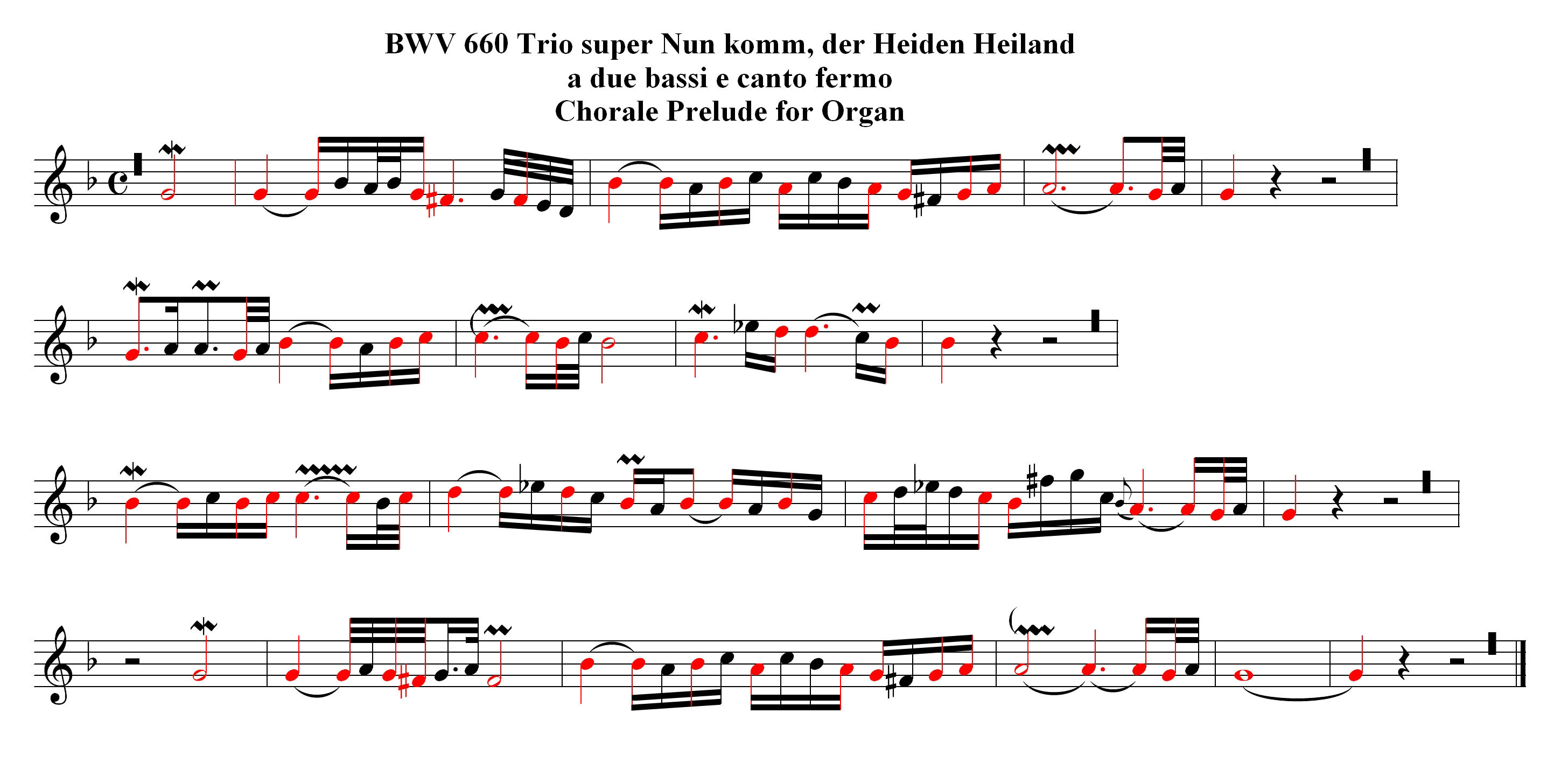
BWV 660: (Achtzehn Choräle No. 9).
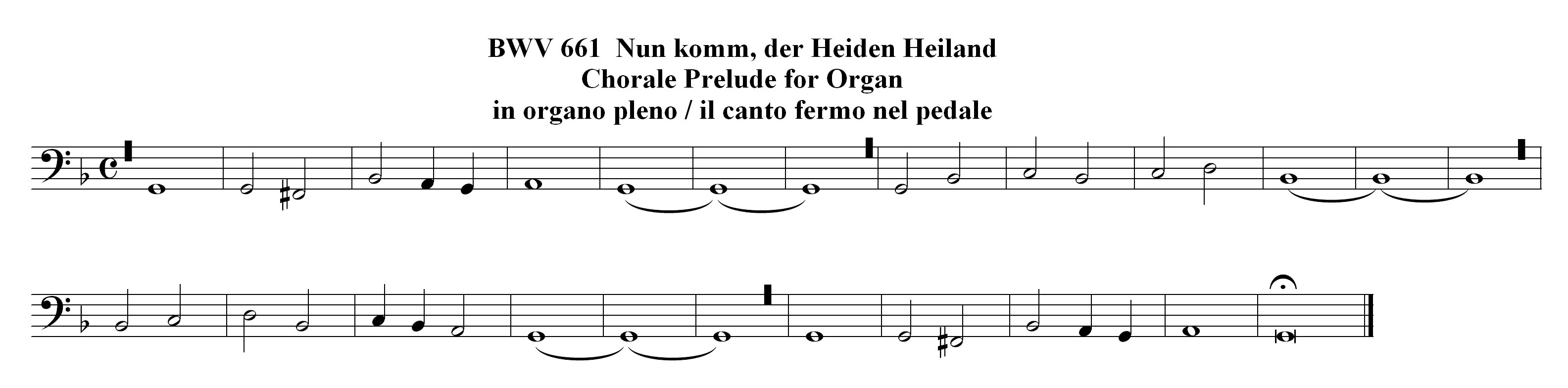
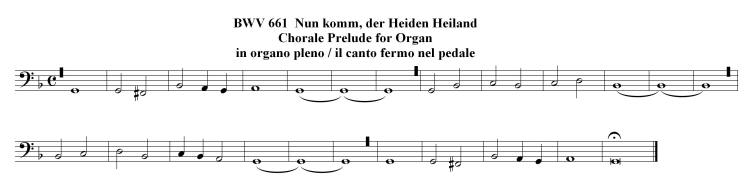
BWV 661: (Achtzehn Choräle No. 10). |
|
|
|
|
|
|
|
|
|
|
| |
|
Use of the Chorale Melody by other composers: |
|
Balthasar Resinarius (1485-1544):
Nun komm der Heiden Heiland, for voices |
|
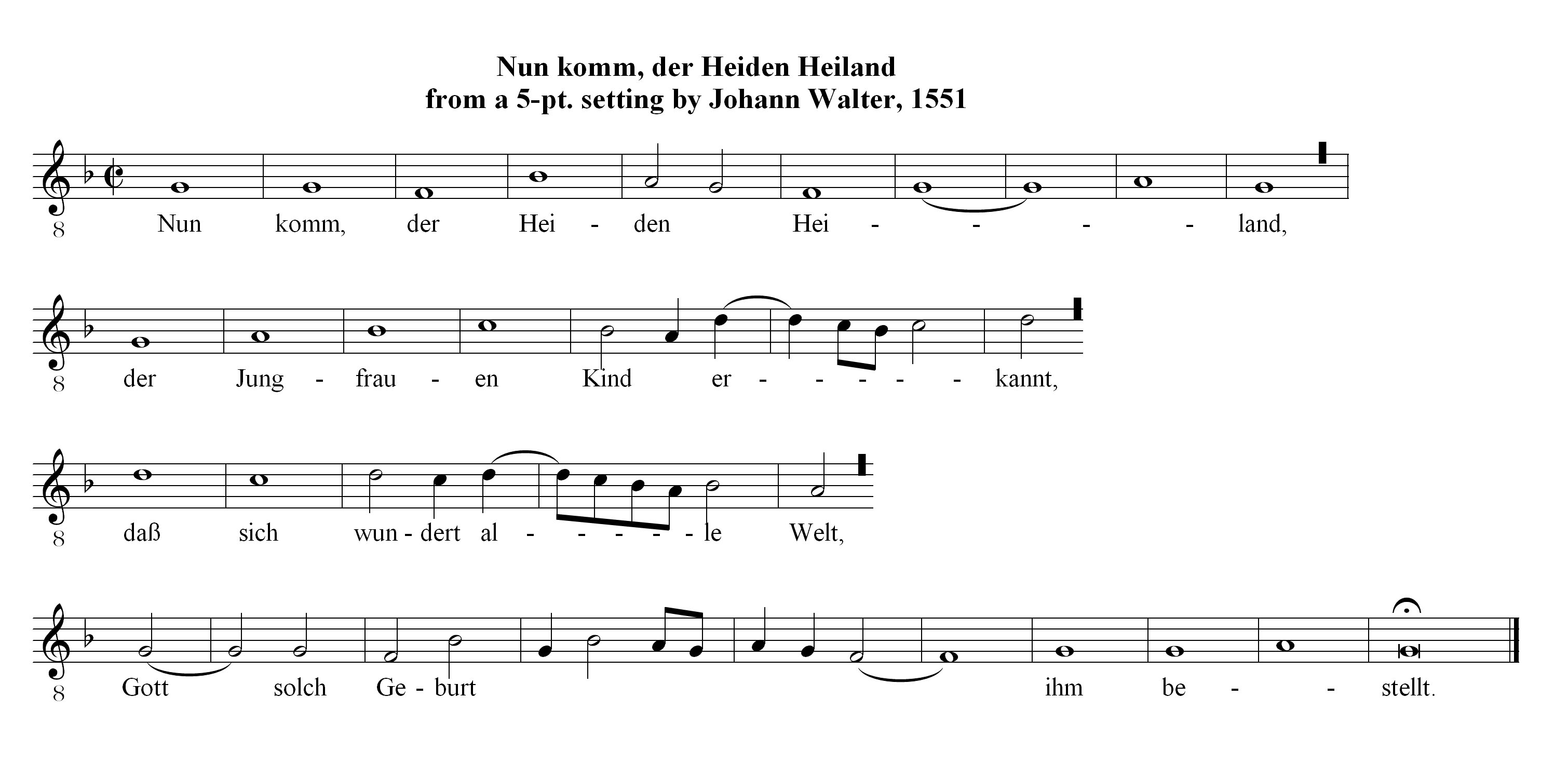
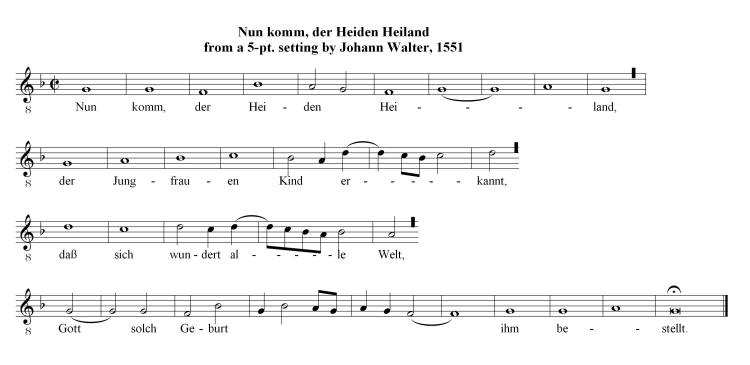
Johann Walter (1496-1570):
Nun komm, der Heiden Heiland, 5-pt. setting for voices |
|
|
|
Johannes Hartung (1505-1579):
Nun komm, der Heiden Heiland, A Bicinium |
|
Caspar Othmayr (1515-1553):
Nun komm der Heiden Heiland, for voices |
|
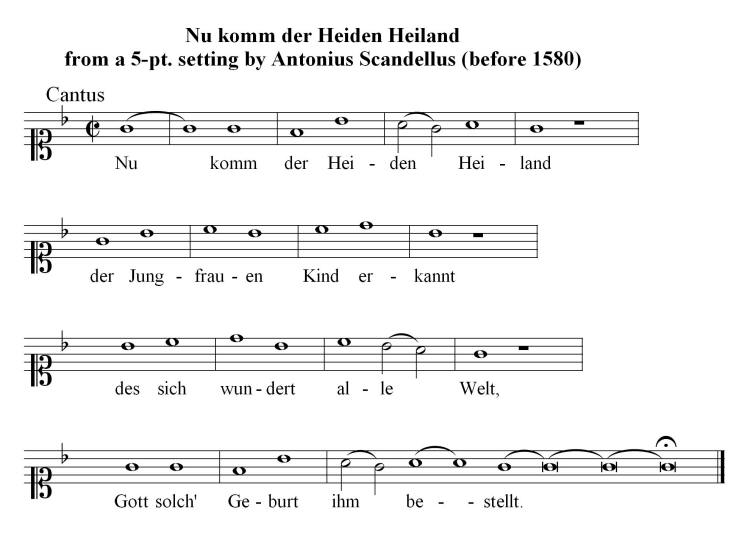
Antonio Scandello (1517-1580):
Nu komm der Heiden Heiland, 5-pt. Setting |
|
|
|
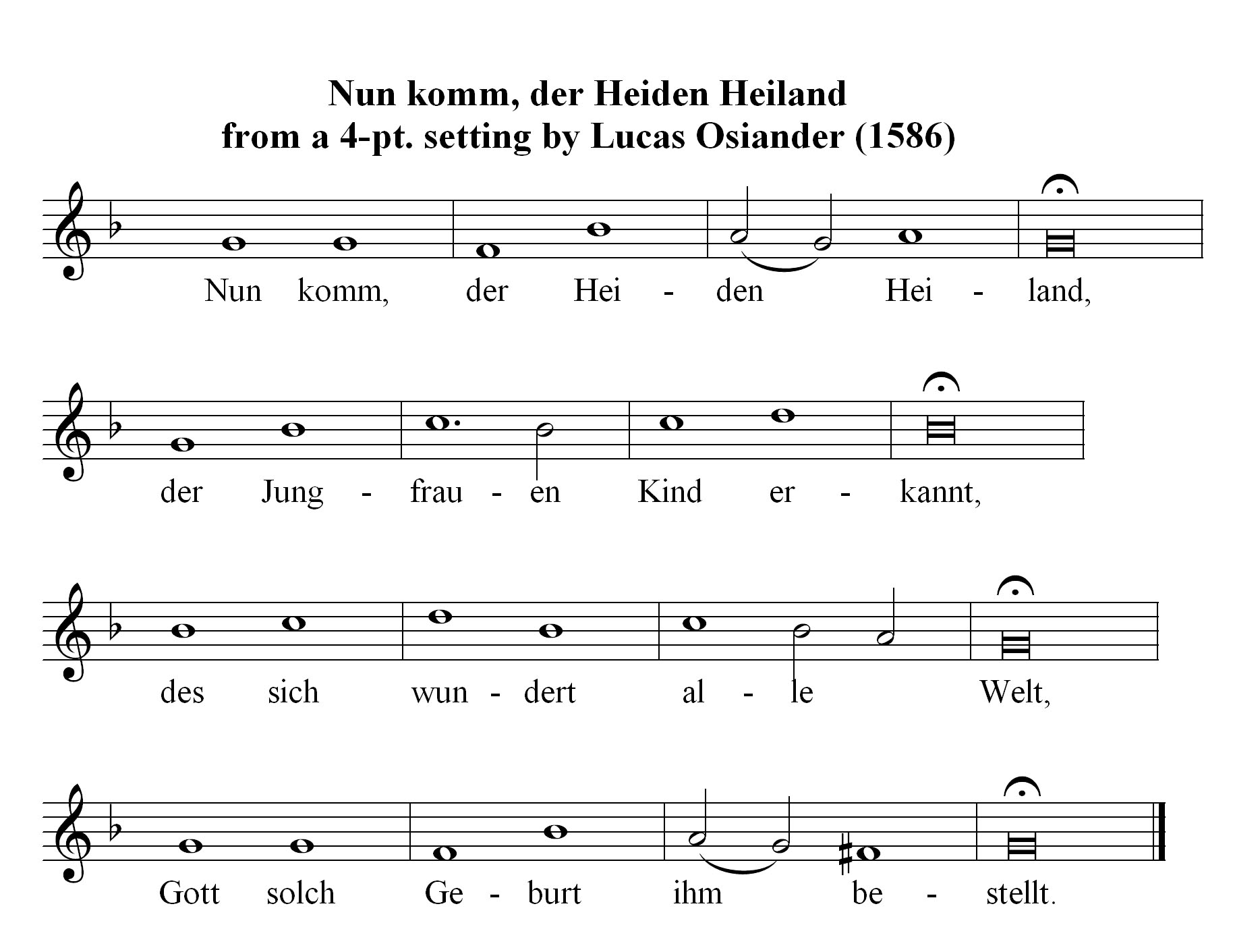
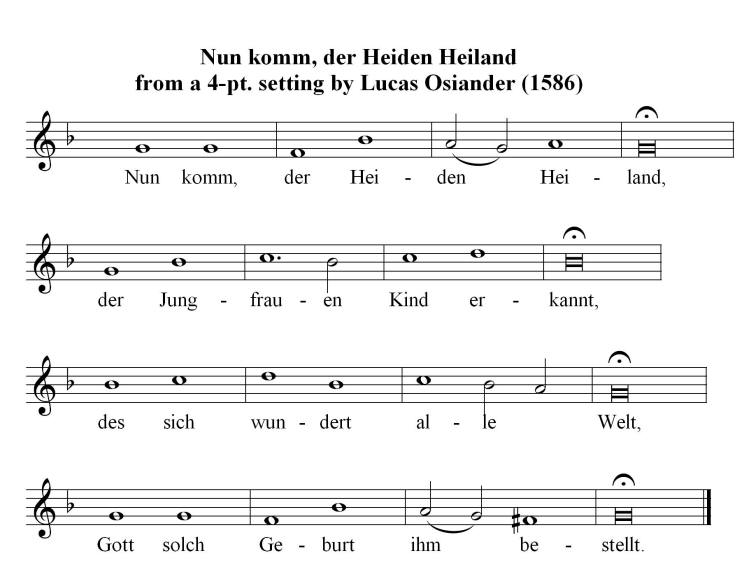
Lukas Osiander (1534-1604):
Nun komm, der Heiden Heiland, 4-pt. setting for voices |
|
|
|
Konrad Hagius (von Hagen) (1550-1616):
Nun komm, der Heiden Heiland, A Tricinium |
|
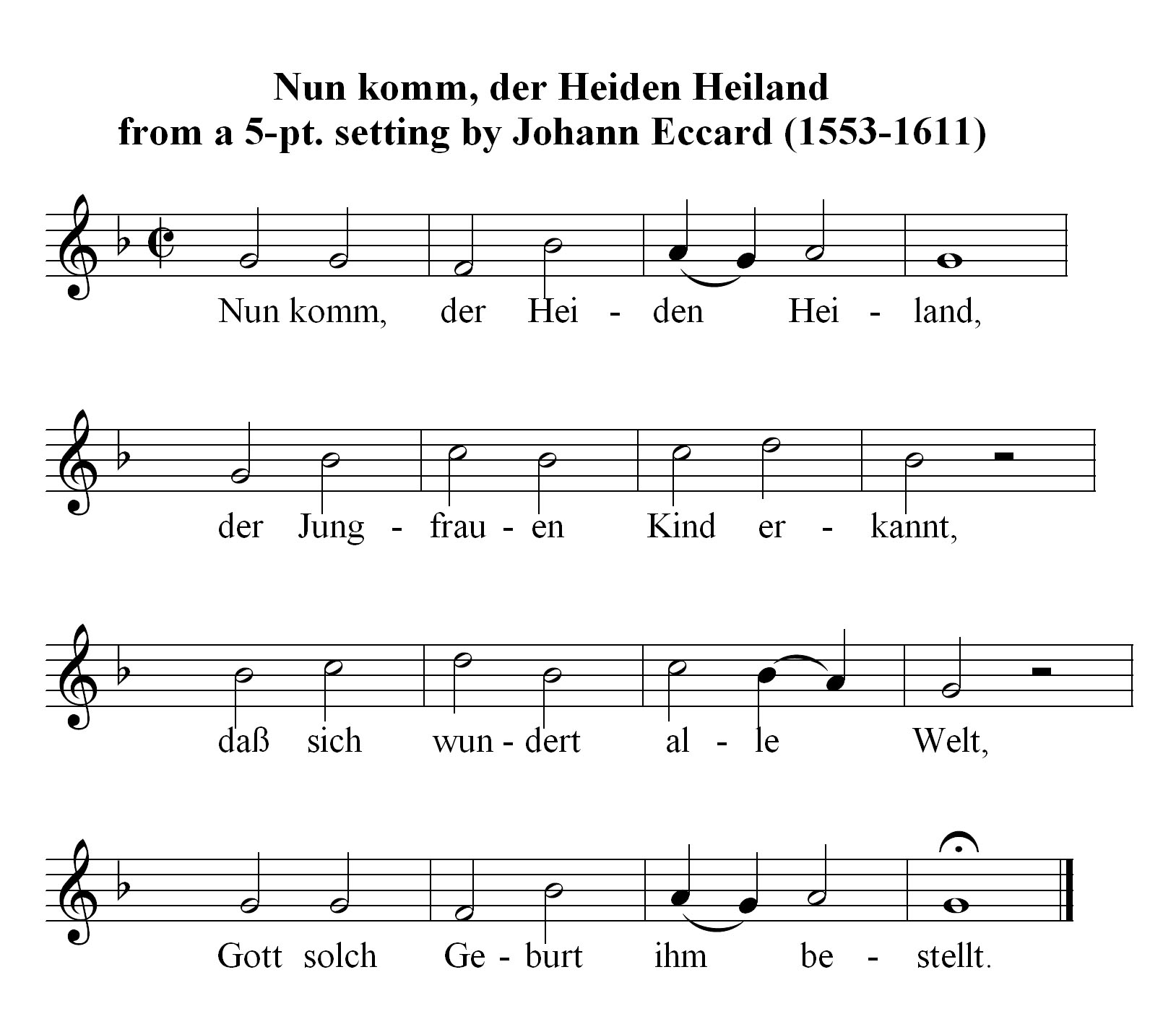
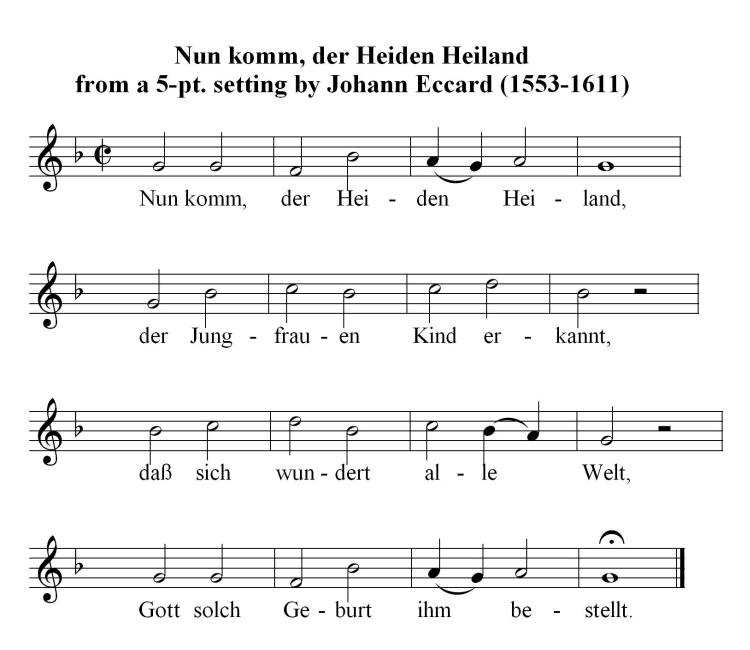
Johann Eccard (1553-1611):
Nun komm, der Heiden Heiland, 5-pt. setting for voices |
|
|
|
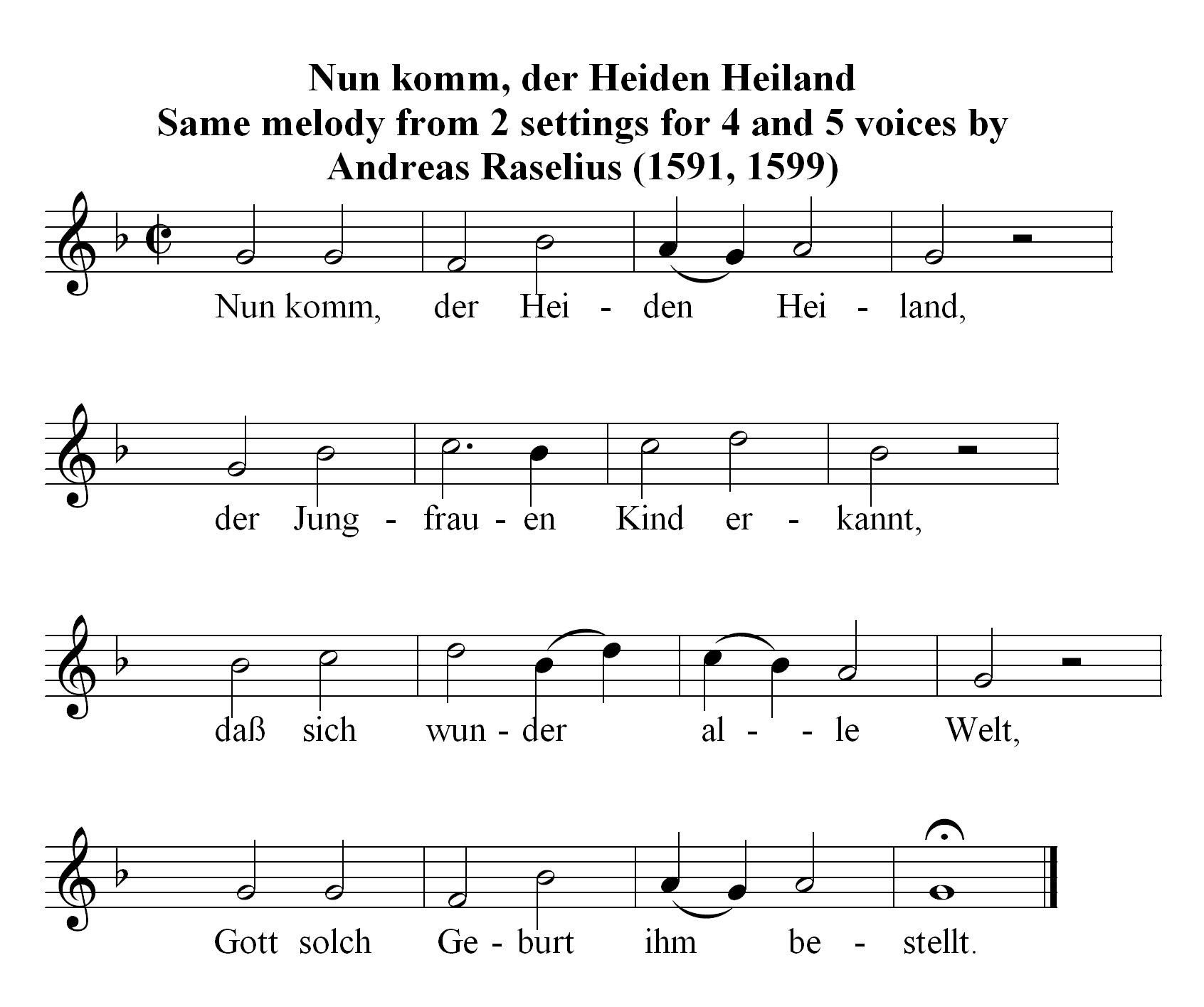
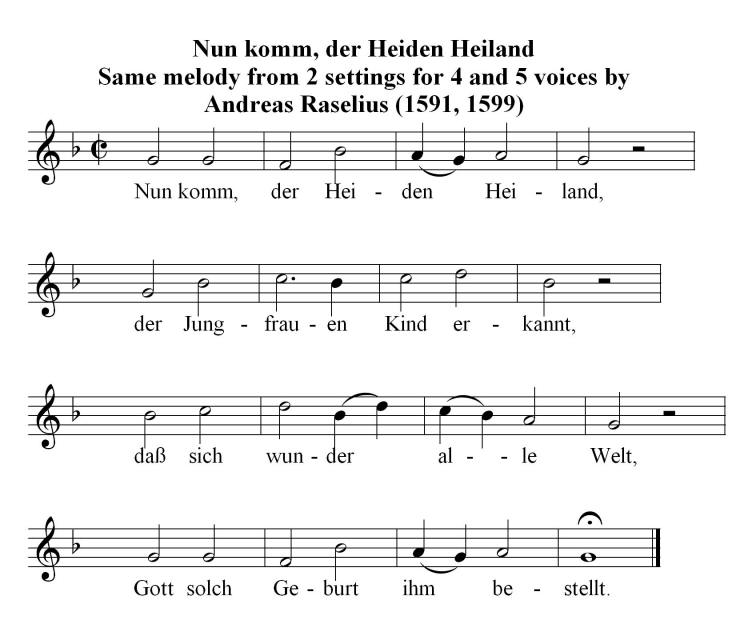
Andreas Raselius (c1563-1602):
Nun komm, der Heiden Heiland, 2 settings for voices, 4-pt and 5-pt. |
|
|
|
Hans Leo Hassler (1564-1612):
Nun komm der Heyden Heyland, setting for 4 voices (1608) |
|
Michael Praetorius (1571-1621):
Nun komm, der Heiden Heiland, for 4 voices (from Musae Sioniae 5) (1607)
Nun komm, der Heiden Heiland, for 6 voices (from Musae Sioniae 5) (1607)
Nun komm, der Heiden Heiland, a 3
Nun komm, der Heiden Heiland (from the Polyhymnia caduceatrix) |
|
Heinrich Schütz (1585-1672):
Nun komm, der Heiden Heiland, SWV 301, SWV 301a (1635, Dresden)
Vocal Composition, more details below:
Nun komm, der Heiden Heiland [Veni, Redemptor gentium], 2 S, 2 B, bc (org) (Lat. text added by Schütz to his copy); G vi, N xi, S |
|
The great contemporary of Schein and Scheidt (1587-1654):, indeed the leading German Protestant composer of the 17th century, Schütz, did not cultivate the chorale genres extensively or systematically, although more than 50 chorale settings are scattered among his works, mostly as isolated items in larger collections. But they range in style from the cantional harmonizations in his four-part setting of the Becker Psalter (Freiberg, 1628), to cantus firmus chorale concertos and freely composed chorale monodies cast in the contemporary Italian style in the Kleine geistliche Conzerte (Leipzig, 1636, and Dresden, 1639; e.g. Nun komm, der Heiden Heiland and Wann unsre Augen schlafen ein respectively); to retrospective a cappella chorale motets in the Geistliche Chor-Music (Dresden, 1648), in which, however, references to the traditional melodies are usually indirect or tenuous; as well as to the large-scale polychoral setting of Komm, Heiliger Geist for voices and instruments in Symphoniae sacrae, part iii (Dresden, 1650).
Robert L. Marshall/Robin A. Leaver in Grove Music Online, ©Oxford University Press 2006, acc. 5/26/06
|
|
Paul Siefert (1586-1666):
Nun komm der Heiden Heiland, Chorale Variations. (authenticity in question) |
|
Johann Hermann Schein (1586-1630):
Nun komm, der Heiden Heiland, SATB [bc] (1627); A ii/1, 3
Nun komm, der Heiden Heiland, SSATB [bc] (1627); A ii/1, 4
Nun komm, der Heiden Heiland, SST, bc (1618); A iv, 3, P v, 1 |
|
In the first part of his Opella nova, geistlicher Conzerten … auff italiänische Invention ( Leipzig, 1618), Schein appropriated this format for the chorale, also using the bold harmonic vocabulary of the Italian style. Schein’s chorale concertos, scored for two to four voices with basso continuo, also frequently reflect the influence of Praetorius’s ‘Clausul-Art’. In the opening composition, for example, a setting of Luther’s Nun komm, der Heiden Heiland for two sopranos, tenor and continuo, each line is presented as a cantus firmus in the tenor part with the two sopranos manipulating in alternation and imitation short motifs of the chorale melody cast in the typically free rhythms of the concertato manner.
Robert L. Marshall/Robin A. Leaver in Grove Music Online, ©Oxford University Press 2006, acc. 5/26/06
|
|
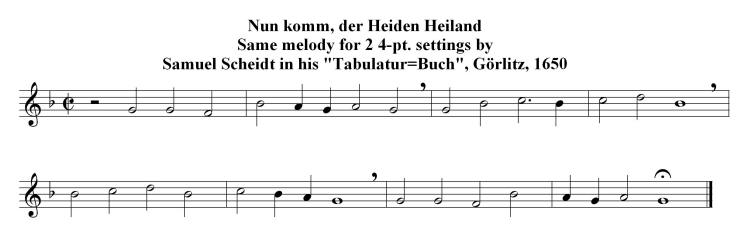
Samuel Scheidt (1587-1654):
Nun komm, der Heiden Heiland, Motet for 8 voices (Double Choir) (Cantiones sacrae Nr. 12; SSWV 12
Nun komm, der Heiden Heiland, STB and bc, SSWV 279 (1635)
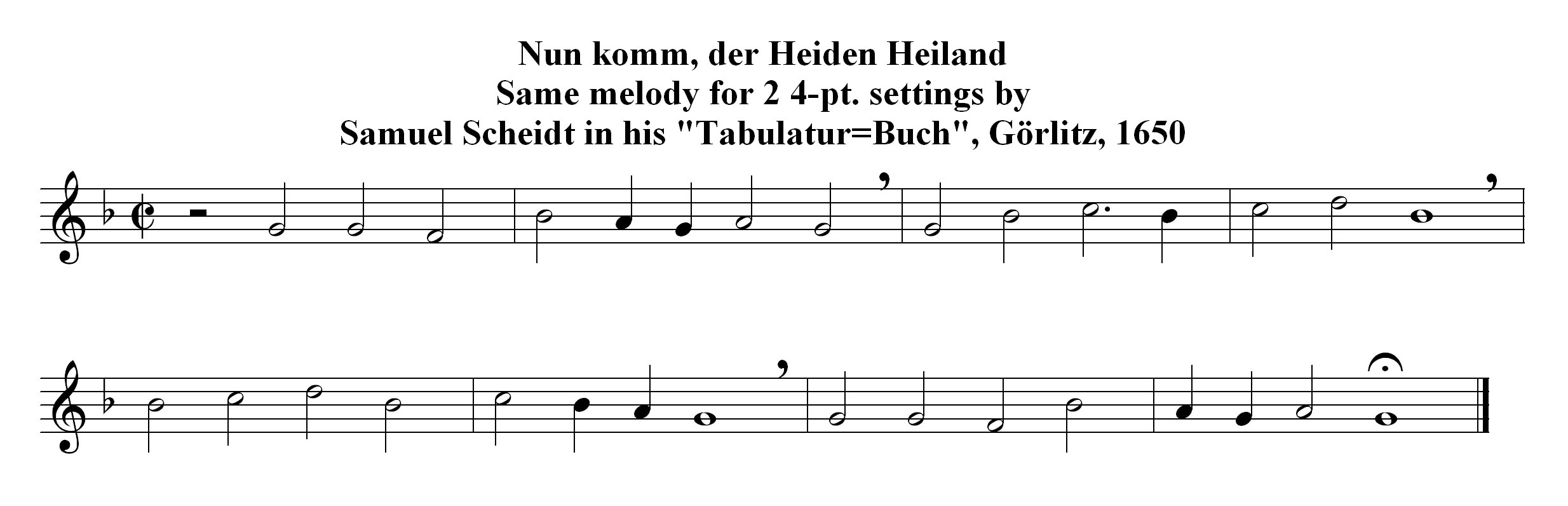
Nun komm, der Heyden Heyland, 2 4-pt. settings SSWV 441 |
|
|
|
Ján Šimbracký (?? - 1657):
Setting of Nun komm der Heiden Heiland, 8 voices, bc |
|
Johannes Crüger (1598-1662):
Nun komm, der Heiden Heiland |
|
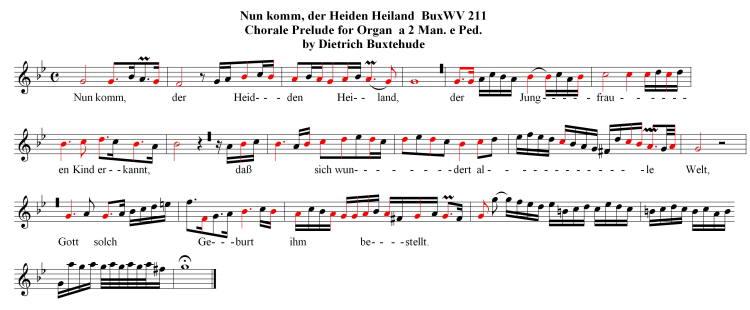
Dietrich Buxtehude (c1637-1707):
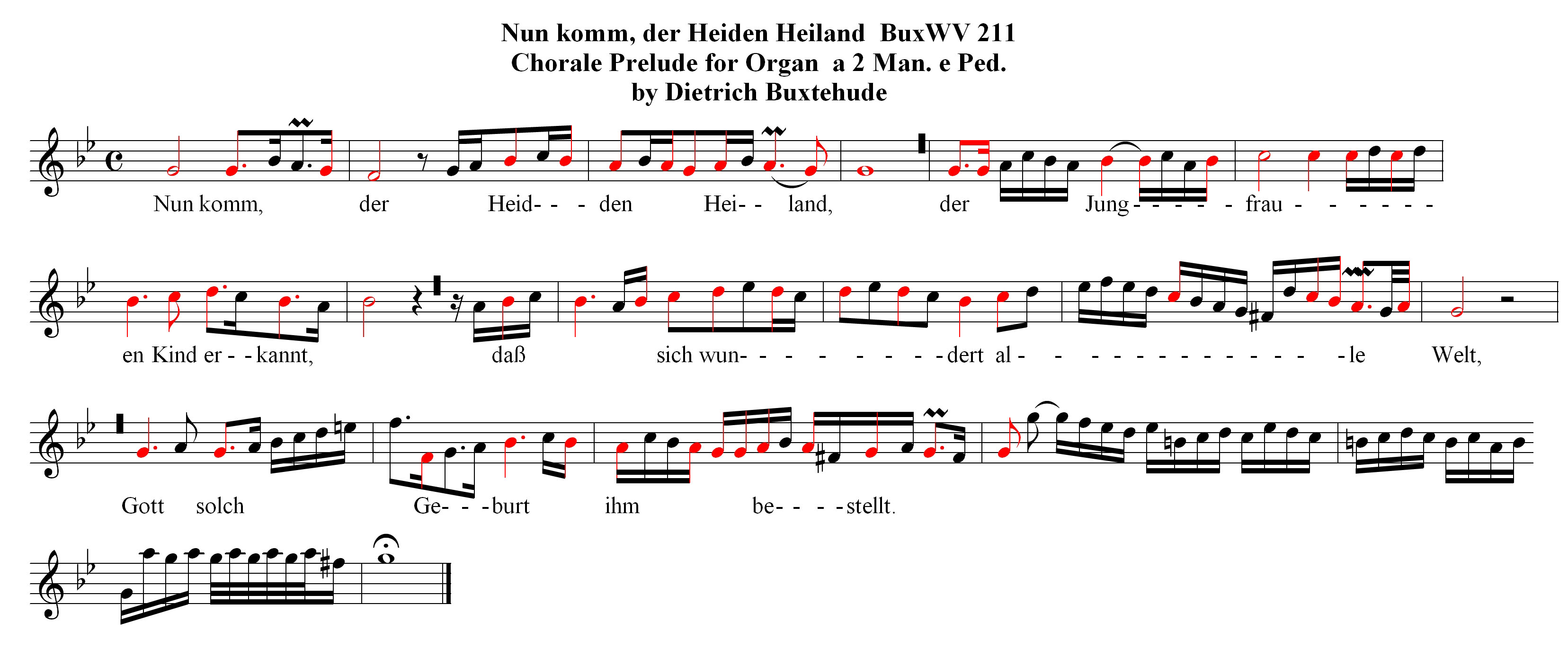
Nun komm, der Heiden Heiland, Chorale Prelude for Organ, BuxWV 211 |
|
|
|
Johann Michael Bach (1648-1694):
Nun komm, der Heiden Heiland, Chorale Prelude for Organ |
|
Johann Schelle (1648-1701):
Canon à 6 voices on Nun komm der Heiden Heiland |
|
Andreas Kneller (1649-1724):
5 Verses or Chorale Preludes for organ on Nun komm, der Heiden Heiland
Partita No 4 on Nun Komm, der Heiden Heiland for organ |
|
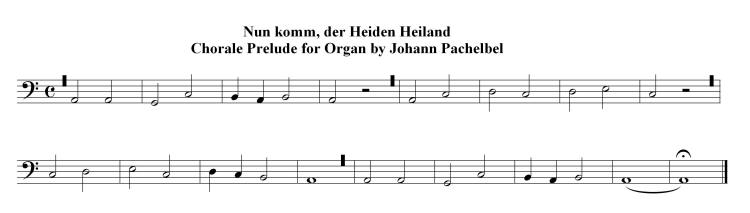
Johann Pachelbel (1653-1706):
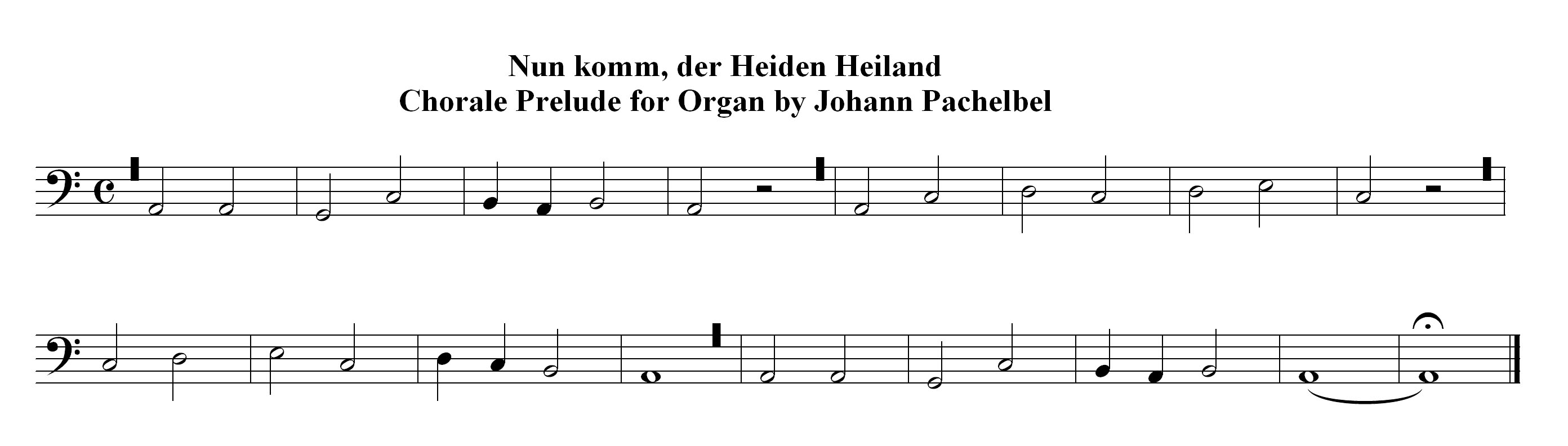
Nun komm, der Heiden Heiland, Chorale Prelude for Organ, T. 58 |
|
|
|
Christian Friedrich Witt (1660-1716):
Nun komm, der Heiden Heiland, Chorale Prelude for Organ |
|
Georg Böhm (1661-1733):
Nun komm der Heiden Heiland, Cantata for 5 voices, 3 trombones, 2 violins, bassoon, bc |
|
Friedrich Wilhelm Zachow (1663-1712):
Nun komm, der Heiden Heiland, A set of keyboard variations
Nun komm, der Heiden Heiland, 3 Chorale Preludes for Organ |
|
Nicolaus Bruhns (1665-1697):
Nun komm, der Heiden Heiland, Chorale Prelude (Fantasia) for Organ |
|
>>An elaborate chorale fantasia on Nun komm, der Heiden Heiland – the single surviving organ chorale by Buxtehude’s pupil Nicolaus Bruhns - is a remarkable combination of the obbligato part-writing of the older chorale ricercare with the free, multi-sectional chorale fantasia, incorporating the idiomatic passage-work characteristic of the north German genre.<<
Robert L. Marshall/Robin A. Leaver in Grove Music Online, ©Oxford University Press 2006, acc. 5/26/06
|
|
Andreas Nicolaus Vetter (1666-1734):
Nun komm, der Heiden Heiland, Chorale Prelude for Organ |
|
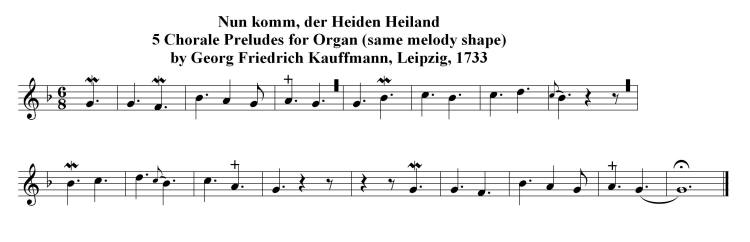
Georg Friedrich Kauffmann (1679-1735):
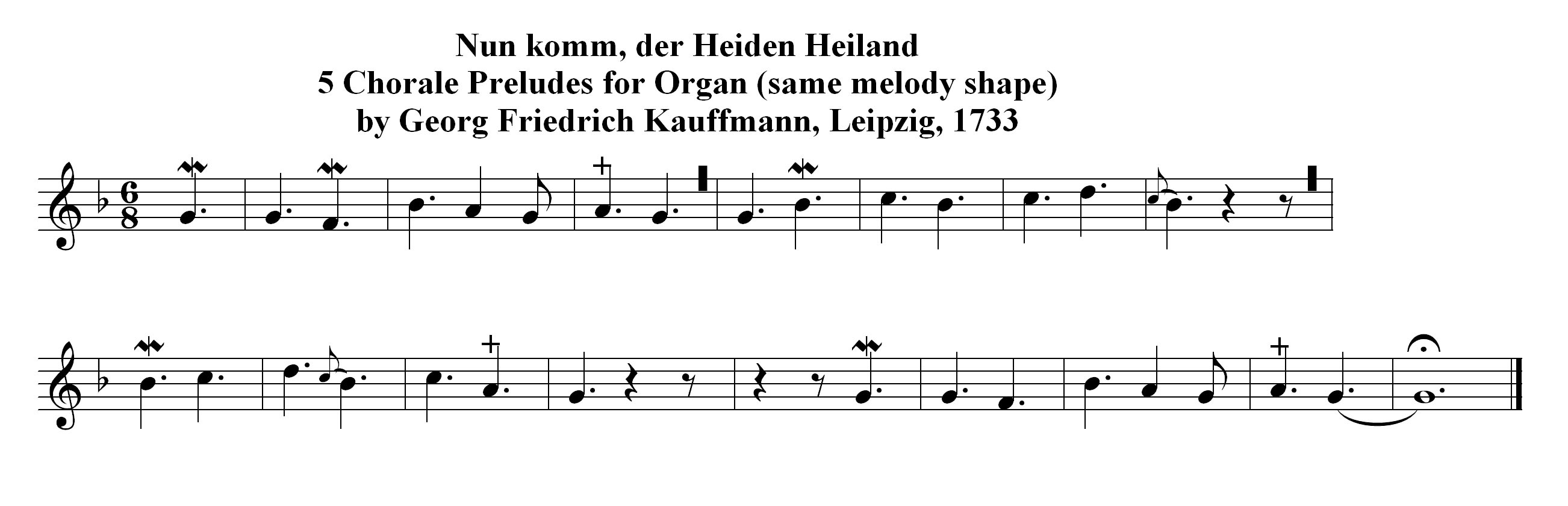
Nun komm, der Heiden Heiland, 5 Chorale Preludes for Organ |
|
|
|
Georg Philipp Telemann (1681-1767):
Cantata: Nun komm, der Heiden Heiland, for solo voice, choir and strings
Cantata: Nun komm der Heiden Heiland (Neumeister), 2 ob, 2 tpt, timp, str, bc, TWV 1:1174 (?1711)
Cantata: Nun komm der Heiden Heiland (Neumeister), 2 ob, 2 tpt, str, bc, TWV 1:1175 (1721)
Lost church cantata: Nun komm der Heiden Heiland, TWV 1:1176 (1722)
Cantata: Nun komm der Heiden Heiland (Neumeister), str, bc, TWV 1:1177
Cantata: Nun komm der Heiden Heiland (Neumeister), str, bc, TWV 1:1178 (Doubtful or Misattributed)
Cantata: Nun komm der Heiden Heiland (Neumeister), str, bc, TWV 1:1755 (?1711) |
|
Johann Friedrich Fasch (1688-1758):
Nun komm, der Heiden Heiland, Cantata |
|
Johann Tobias Krebs (1690-1762):
Nun Komm der Heiden Heiland, Chorale Prelude for Organ (also attributed to J.S. Bach, BWV 660b) |
|
Wilhelm Friedemann Bach (1710-1784):
Nun komm der Heiden Heiland, Chorale Prelude for Organ, F. 38/1/1 (BR A93) |
|
Gottfried August Homilius (1714-1785):
Nun Komm der Heiden Heiland, Choral Prelude for organ |
|
Heinrich von Herzogenberg (1843-1900):
Organ Fantasia on the melody Nun komm, der Heiden Heiland, op. 39 (1883) |
|
August Witteborg (1850-1912):
Nun komm, der Heiden Heiland, for organ |
|
Max Reger (1873-1916):
Nun komm, der Heiden Heiland, Chorale Prelude for Organ Op. 67/29 (1902) |
|
Helmut Bornefeld (1906-1990):
Nun komm, der Heiden Heiland, Chorale Partita for Organ (1949) |
|
Hugo Distler (1908-1942):
Nun komm, der Heiden Heiland, Partita for Organ, op. 81 (1933) |
|
Helmut Eder (1916-2005):
Prelude and Chorale on Nun komm, der Heiden Heiland, oboe, strings (1970) |
|
Anton Heiller (1923-1979):
Nun Kumm, der Heiden Heiland, for organ |
|
Aldo Clementi (b 1925):
Nun k, der Heiden Heiland, 3 trumpets, 2 trombones (1980) |
|
Siegfried Strohbach (b 1929):
Nunn komm, der Heiden Heiland (Now come the heathens' Saviour), for choir |
|
William Albright (1944-1998):
Chorale Prelude for Organ Nun Komm der Heiden Heiland (1997) |
|
Arnold Rosner (b 1945):
String Sextet (Nun komm' der Heiden Heiland), Op. 47 (1970) |
|
David Dahl (contemporary):
Nun komm der Heiden Heiland, Chorale for Organ |
|
Bram Beekman (contemporary):
Nun komm, der Heiden Heiland (Savior of the nations, come) for organ |
| |
|
Arrangements/Transcriptions of Bach's use of the Chorale Melody: |
|
Ferruccio Busoni (1866-1924):
Nun komm der heiden Heiland, transcription for piano (after J.S. Bach's BWV 659; Ten Chorale Preludes No. 3), KiV B27/3 |
|
Ottorino Respighi (1879-1936):
Arrangement: Bach's chorale Num komm der Heiden Heiland, for violin, cellos & basses, P. 118 (1918) |
|
Ignaz Friedman (1882-1948):
Nun komm der heiden Heiland, arrangement for piano (after J.S. Bach's Chorale Prelude BWV 659)
|
|
Otto Klemperer (1885-1973):
Transcription for orchestra of J.S. Bach's Chorale Prelude Nun Komm' Der Heiden Heiland BWV 599 |
|
Wilhelm Kempff (1895-1991):
Nun komm der heiden Heiland, transcription for piano (after J.S. Bach's Chorale Prelude BWV 659) |
|
Richard Yardumian (1917-1985):
Nun komm der heiden Heiland (1978), Arrangement of Chorale Prelude (J. S. Bach?) for Orchestra |
|
Mordechai Rechtman (b 1926):
J.S. Bach's Chorale Prelude Nun komm der heiden Heiland BWV 659, Arrangement for Woodwind Quintet (1981) |
| |
|
Sources: NBA, vols. III/2.1 & 2.2 in particular [Bärenreiter, 1954 to present] and the BWV ("Bach Werke Verzeichnis") [Breitkopf & Härtel, 1998]
The PDF files of the Chorales were contributed by Margaret Greentree J.S. Bach Chorales
Software: Capella 2004 Software, version 5.1.
Prepared by Thomas Braatz & Aryeh Oron (May 2006) |