|
|
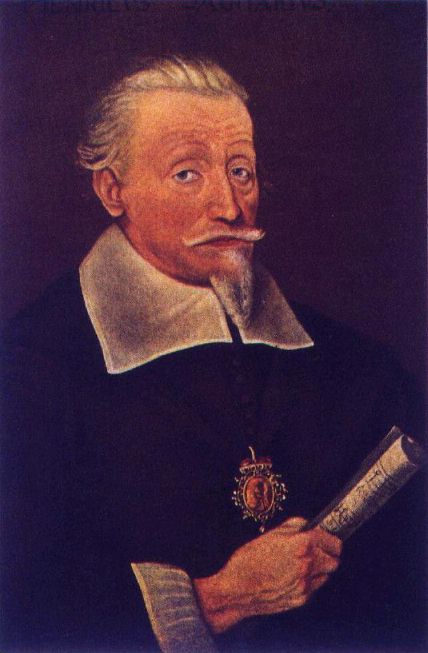
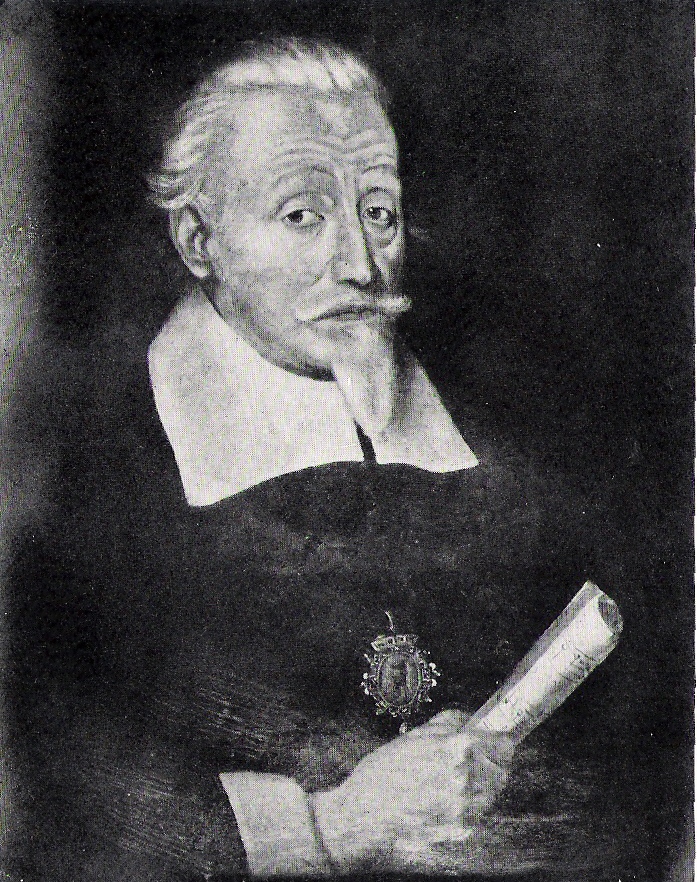
Heinrich Schütz (Composer) |
|
Born: October 9, 1585 - Köstritz, Germany
Died: November 6, 1672 - Dresden, Germany |
|
Heinrich [Henrich] Schütz was a German composer and organist, generally regarded as the most important German composer before J.S. Bach and is often considered to be one of the most important composers of the 17th century along with Claudio Monteverdi. He wrote what is thought to be the first German opera, Dafne, performed at Torgau in 1627; however, the music has since been lost. |
|
Life |
|
Heinrich Schütz's musical talents were discovered by Moritz von Hessen-Kassel in 1599. After being a choir-boy he went on to study law at Marburg before going to Venice from 1609 to 1613 to study music with Giovanni Gabrieli. He subsequently had a short stint as organist at Kassel before moving to Dresden in 1615 to work as court composer to the Elector of Saxony.
Heinrich Schütz held his Dresden post until the end of his life (sowing the seeds of what is now the Dresden Staatskapelle while there), but left Dresden itself on several occasions; in 1628 he went to Venice again, most likely meeting Claudio Monteverdi there - he may have studied with him - and in 1633, after the Thirty Years' War had disrupted life at the court, he took a post at Copenhagen. He returned full time to Dresden in 1641, and remained there for the rest of his life. He died from a stroke in 1672 at the age of 87. |
|
Style |
|
Heinrich Schütz's compositions show the influence of his two main teachers, Gabrieli (displayed most notably with Schütz's use of resplendent polychoral and concertato styles) and Monteverdi. Additionally, the influence of the Netherlandish composers of the 16th century is also prominent in his work. His best known works are in the field of sacred music, ranging from solo voice with instrumental accompaniment to a cappella choral music. Representative works include his three books of Symphoniae sacrae, the Psalms of David, the Sieben Worte Jesu Christi am Kreuz (the Seven Last Words on the Cross) and his three Passion settings. Schütz's music, while starting off in the most progressive styles early in his career, eventually grows into a style that is simple and almost austere, culminating with his late Passion settings. Practical considerations were certainly responsible for part of this change: the Thirty Years' War had devastated the musical infrastructure of Germany, and it was no longer practical or even possible to put on the gigantic works in the Venetian style which marked his earlier period.
Heinrich Schütz was one of the last composers to write in a modal style, with non-functional harmonies often resulting from the interplay of voices; contrastingly, much of his music shows a strong tonal pull when approaching cadences. His music makes extensive use of imitation, in which entries often come in irregular order and at varied intervals. Fairly characteristic of Schütz's writing are intense dissonances caused by two or more voices moving correctly through dissonances against the implied harmony. Above all, his music displays extreme sensitivity to the accents and meaning of the text, which is often conveyed using special technical figures drawn from musica poetica, themselves drawn from or created in analogy to the verbal figures of Classical Rhetoric.
Almost no secular music by Heinrich Schütz has survived, save for a few domestic songs (arien) and no purely instrumental music at all (unless one counts the short instrumental movement entitled "sinfonia" that encloses the dialogue of Die sieben Worte), even though he had a reputation as one of the finest organists in Germany.
Heinrich Schütz was of great importance in bringing new musical ideas to Germany from Italy, and as such had a large influence on the German music which was to follow. The style of the north German organ school derives largely from Schütz (as well as from Netherlander Jan Pieterszoon Sweelinck); a century later this music was to culminate in the work of J.S. Bach. |
|
Works |
|
The following are published works. Most of these contain multiple pieces of music; there are over 500 total surviving individual pieces by Schütz.
Il primo libro de madrigali (first book of madrigals) (Venice, 1611)
Psalmen Davids (Book 1) (Dresden, 1619)
Historia der frölichen und siegreichen Aufferstehung ... (History of the Resurrection of Jesus) (Dresden, 1623)
Cantiones sacrae (Freiberg, 1625)
Psalmen Davids (Book 2) (Freiberg, 1628)
Symphoniae sacrae (Book 1) (Venice, 1629)
Musicalische Exequien (Dresden, 1636)
Kleiner geistlichen Concerten (Book 1) (Leipzig, 1636)
Symphoniae sacrae (Book 2) (Dresden, 1647)
Geistliche Chor-Music (Dresden, 1648)
Symphoniae sacrae (Book 3) (Dresden, 1650)
Zwölff geistliche Gesänge (Dresden, 1657)
Psalmen Davids (revision of Book 2) (Dresden, 1661) |
|
|
|
Source: Wikipedia Website
Contributed by Aryeh Oron (January 2006) |
|
Works in J.S. Bach's Library |
|
Geistlich Chormusik [without bc] |
|
Use of Chorale Melodies in his works |
|
Ach Gott vom Himmel, sieh darein , for chorus & continuo, SWV 108 (Op. 5/12, Op. 14/12) (1628, CM: Ach Gott, vom Himmel sieh darein) |
|
Allein Gott in der Höh' sei Ehr , for 2 sopranos, 2 tenors & continuo, SWV 327 (Op. 9/22) (1639, CM: Allein Gott in der Höh sei Ehr) |
|
Christ ist erstanden von der Marter alle, S, A, T, 4 viole [III lost], 4 trbn, [2 cap. a 4], bc (+ lutes, org piccolo, org grande), Kl 52b [1614–15; bc and lute are autograph] (variant sinfonia in late bc part), SWV 470 (c1750, CM: Christ ist erstanden) |
|
Christ lag in Todesbanden for 5 voices and 5 instruments (CM: Christ lag in Todesbanden) |
|
The Musicalische Exequien SWV 279–81 (1636) was commissioned for the funeral of Prince Heinrich Posthumus of Reuss by his widow. The work is divided into three parts. 1. ‘Concerto in the form of a German burial Mass’; 2. Double-chorus motet Herr, wenn ich nur dich habe; 3. SSB trio of the chorus secundus - two seraphims and the ‘beata anima’ - provides an ‘angelic’ gloss on the solemn and registrally dark AATTB quintet of the Nunc dimittis (1636, CM: Das Nunc dimittis) |
|
The German Nunc dimittis SWV 352a, bears a dedication to Christoph Cornet (1635, CM: Das Nunc dimittis) |
|
Twin settings of the German Nunc dimittis SWV 432-3 (CM: Das Nunc dimittis) |
|
Gelobet sei der Herr for 5, 10, 11, 20 voices (Weimar, CM: Gelobet sei der Herr (O Gott, du frommer Gott - Melody 3) |
|
Meine Seele erhebt den Herren , Score and Parts (CM: Meine Seele erhebet den Herren [The German Magnificat]) |
|
Nun komm, der Heiden Heiland , SWV 301, SWV 301a (Dresden, 1635, CM: Nun komm, der Heiden Heiland) |
|
Nun komm, der Heiden Heiland , Vocal Composition (CM: Nun komm, der Heiden Heiland) |
|
Nun komm, der Heiden Heiland [Veni, Redemptor gentium], 2 S, 2 B, bc (org) (Lat. text added by Schütz to his copy); G vi, N xi, S (CM: Nun komm, der Heiden Heiland) |
|
Nun laßt uns Gott dem Herren, Setting for 6 voi(CM: Nun laßt uns Gott dem Herren) |
|
Von Gott will ich nicht lassen for 2 Sopranos, Bass, 2 Violins, bc (Organ, Violone), SWV 366 (CM: Von Gott will ich nicht lassen) |
|
Motet Was mein Gott will, das gscheh allzeit, for alto, tenor, 4 instruments & continuo, SWV 392 (Op. 11/24) from the collection Geistliche Chor-Music (1648, CM: Was mein Gott will, das g’scheh allzeit) |
|
Links to other Sites |
|
Heinrich Schütz (Wikipedia)
Heinrich Schütz (Classical Music Pages)
HOASM: Heinrich [Henrich] Schütz
Heinrich Schütz (MUH)
Schütz, Heinrich (1585-1672) (Naxos)
Heinrich Schütz (Karadar)
Schütz, Heinrich: Biography (Sojurn)
HEINRICH SCHÜTZ, Biography, Discography (Goldberg)
Internationale Heinrich-Schütz-Gesellschaft
American Heinrich Schütz Society
Heinrich-Schütz-Haus Bad Köstritz - Weiterleitung [German]
Heinrich-Schütz-Haus Weißenfels [German]
Heinrich Schütz: New Schütz Edition (New Schutz Edition)
Heinrich Schutz (1585-1672) Forum Frigate
Classical Net - Basic Repertoire List: Schütz |
|
Bibliography |
|
Manfred Bukofzer : Music in the Baroque Era. New York, W.W. Norton & Co., 1947. ISBN 0393097455
Basil Smallman: Heinrich Schütz, The Master Musicians, 2000
Tamsin Jones: "Passions in Perspective: An Analytical Discussion of the Three Passions of Heinrich Schütz (1585-1672) against their Historical and Stylistic Backgrounds" (Ph. D. thesis, University of Birmingham, 2000)
Heinrich Schütz: "Geistliche Chor-Music, Op. 11." Edited by Andrew Thomas Kuster. Ann Arbor, MI, 2005. ISBN 1411642430 |
|
|