|
|
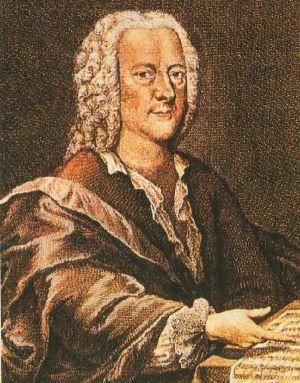
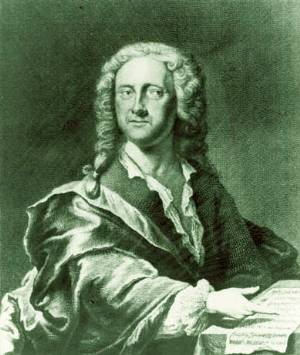
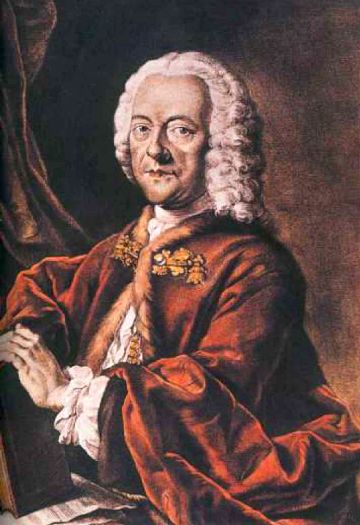
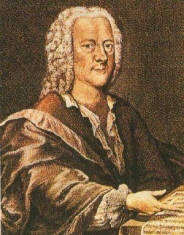
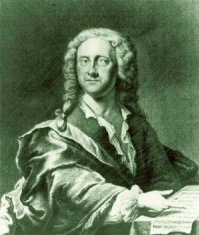
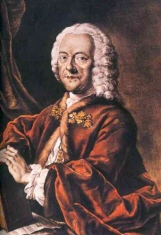
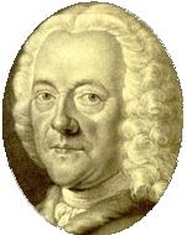
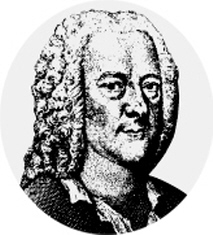
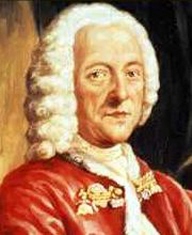
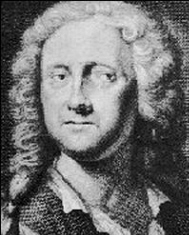
Georg Philipp Telemann (Composer) |
|
Born: March 14, 1681 - Magdeburg, Saxony-Anhalt, Germany
Died: June 25, 1767 - Hamburg, Germany |
|
The German composer, Georg Philipp Telemann, belonged to a family that had long been connected with the Lutheran Church. His father was a clergyman, his mother the daughter of a clergyman, and his elder brother also took orders, a path that he too might have followed had it not been for his exceptional musical ability. As a child he showed considerable musical talent, mastering the violin, flute, zither and keyboard by the age of ten and composing an opera (Sigismundus, on a text by Postel) two years later to the consternation of his family (particularly his mother's side), who disapproved of music. However, such resistance served only to reinforce his determination to persevere in his studies through transcription and modeling his works on those of such composers as Agostino Steffani, Johann Rosenmüller, Arcangelo Corelli and Antonio Caldara. After preparatory studies at the Hildesheim Gymnasium, he matriculated in law (at his mother's insistence) at Leipzig University in 1701. That he had little intention of putting aside his interest in music is evident from his stop at Halle, en route to Leipzig, in order to make the acquaintance of the young George Frideric Handel.
It was while he was a student at Leipzig University that a career in music became inevitable. At first it was intended that he should study language and science, but he was already so capable a musician that within a year of his arrival he founded the student Collegium Musicum with which he gave public concerts (and which J.S. Bach was later to direct), wrote operatic works for the Leipzig Theater, and in 1703 became musical director of the Leipzig Opera and was appointed organist at the Neue Kirche in 1704. While at the University he involved fellow-students in a great deal of public performance, to the annoyance of the Thomaskantor, Bach's immediate predecessor, Johann Kuhnau, who saw his prerogative now infringed.
No doubt bored with the complaints of Johann Kuhnau and impatient to make something more of his life, Telemann did not stay long in Leipzig. In 1705 he accepted an appointment as Kapellmeister to the cosmopolitan court of Count Erdmann II of Promnitz at Sorau (now Zary), where the vogue for the French and Italian styles provided him with a new challenge. His association with the Sorau Kantor and theorist Wolfgang Caspar Printz and the reformist poet Erdmann Neumeister as well as the proximity to Berlin and contact with Polish folk music all proved stimulating. But Telemann's tenure was cut short by the imminent prospect of invasion by the Swedish army, causing the Court to be hurriedly disbanded. He visited Paris in 1707. His next appointment was at Eisenach as court Konzertmeister in charge of singers, with Pantaleon Hebenstreit as leader of the orchestra. His appointment there (some time between 1706 and 1708) just overlapped with the presence of Bach, who left in 1708 to take up posts at the Weimar court. Telemann had every reason to assume that this would be a period of relative stability and accordingly plunged into composing church cantatas, occasional pieces, orchestral and instrumental chamber music. His marriage ended tragically with his wife's death in 1711.
A change of scene became necessary and so he went to the free imperial city of Frankfurt-am-Main to take up duties as Director of Municipal Music and also as Kapellmeister of the Barfüßerkirche. Together with his activities as director of the "Frauenstein", a musical society in that same city, which presented weekly concerts, Telemann's new posts suited his talents very well. He composed occasional music for civic ceremonies, five year-long cycles of church cantatas, oratorios, orchestral music and a wealth of chamber music, much of which was published; only the opportunity to produce opera was lacking, though he continued to supply works to the Leipzig Opera. During this period he was also appointed Kapellmeister to the Prince of Bayreuth. He married again (gaining citizenship through marriage) and became a family man.
While on a visit to Eisenach in 1716, he was honored with an appointment as a visiting Kapellmeister (he continued to send new works until 1729); he also served the court as a diplomatic correspondent. Further acknowledgment of his increasing stature came the following year when Duke Ernst of Gotha invited him to become Kapellmeister of all his various courts. This in turn forced improvements in his situation at Frankfurt. A trip to Dresden in 1719 for the festivities in honor of the newly married Prince Elector Friedrich August II and Archduchess Maria Josephia of Austria made possible a reunion with G.F. Handel, the opportunity to hear operas by Antonio Lotti and the dedication of a collection of violin concertos to the Konzertmeister and virtuoso violinist Johann Georg Pisendel.
Then in 1721, the coveted post of Kantor of the Hamburg Johanneum, a post that traditionally carried with it teaching responsibilities and the directorship of Hamburg's five principal churches, became vacant, and Telemann was invited to succeed Joachim Gerstenbüttel. Here, at last, was a prestigious post that would provide him with seemingly unlimited opportunities to compose and perform. As Kantor, he would be stretched as never before: he was required to compose two cantatas a week, annually to produce a new Passion, and to provide occasional works for church and civil ceremonies. And such was his vitality and creative impetus that, in spite of heavy responsibilities, he apparently eagerly sought and fulfilled additional commissions from home and abroad.
The prospect of being actively involved in the Hamburg Opera - his opera Der geduldige Socrates, had already been performed there earlier that year - was perhaps over-optimistic, for there was strong opposition among the city fathers to his participation. Telemann reacted characteristically by threatening to resign: he applied for the post of Kantor of the Thomaskirche in Leipzig, and in 1722 was chosen over J.S. Bach, Christoph Graupner and three other candidates. While the Hamburg City Council refused to grant his release, they were obliged to improve his salary and withdraw their objections to his association with the Hamburg Opera. Telemann thereupon redoubled his activities at Hamburg, increasing the number of public concerts given at the churches, the Drill-Hall and at a tavern known as the 'Lower Tree-House', at which a wide variety of sacred and secular music was performed. They were patronized by prominent Hamburg citizens and supported by paid admission. More to the point, he was made music director of the Hamburg O, remaining in that capacity until its closure in 1738. He produced both serious and comic works, many of which have been lost, or survive only as excerpts published in Der getreue Musikmeister. In addition to Telemann's own operas and those of Reinhard Keiser, G.F. Handel's London operas were performed there during Telemann's tenure.
Der getreuer Musikmeister ("The Faithful Music Master") was founded in 1728 by Telemann and J.V. Görner (not to be confused with J.G. Görner, organist at Leipzig and J.S. Bach's contemporary). Intended as a "home music lesson", this German music periodical, the first of its kind, appeared every two weeks in the form of a four-page Lection meaning a reading or a lesson. It consisted of actual music, new music just composed and given its first circulation in this unusual fashion. Much of it was by Telemann himself, but other contemporary composers were also represented, such as R. Keiser, Christian Pezold, Görner, Francesco Antonio Bonporti, Jan Dismas Zelenka, Ritter and Stoltzer. Unfortunately the individual issues were not dated, nor is it known how long the periodical appeared for. 25 of these periodicals have come down to us with their contents.
G.P. Telemann remained in Hamburg until his death in 1767, being succeeded in that position by his godson, Carl Philipp Emanuel Bach, son of Johann Sebastian. Though it is with Hamburg that we customarily associate his name, Telemann traveled widely, making many trips to Berlin where he was exposed to strains of Polish music imported from the East, and to Paris in 1737 where he absorbed much of the French idiom then current.
G.P. Telemann's friendship with G.F. Handel continued: Händel corresponded with him on several occasions, and in 1750 went to the trouble of sending him from London "a crate of flowers, which experts assure me are very choice and of admirable rarity". His name appears (as 'Mr. Hendel, Docteur en Musique, Londres') on the list of subscribers to the most ambitious publication of Telemann's music during his lifetime, the Musique de Table, which appeared in three installments during the course of 1733. An interesting side-note is that Telemann supervised the preparation of the engraved plates from which the parts were printed, these being made of pewter as opposed to the more usual and more expensive copper, by a new process apparently first employed in London about 1710 by Walsh and Hare, and introduced into Germany by Telemann himself. Further proof of Händel's esteem for Telemann's music is provided by the fact that Händel used ideas from no less than sixteen movements in the Musique de Table in his own compositions. Händel would jokingly relate that Telemann "could write a church piece in eight parts with the same expedition another would write a letter".
As a composer G.P. Telemann was indeed prolific, providing an enormous body of work, both sacred and secular. This included 1,043 church cantatas, and settings of the Passion for each year that he was in Hamburg, 46 in all. In Leipzig he had written operas, and he continued to involve himself in public performances in Hamburg, later taking on additional responsibility as musical director of the Hamburg opera. He was also commercially active in publishing and selling much of the music that he wrote.
A musical form which G.P. Telemann practiced with remarkable assiduity was the orchestral suite - the Ouverture and its succession of dance movements, which originated with Lully in France but which was in fact cultivated almost exclusively by German composers. A contemporary German critic, Johann Adolph Scheibe, even declared in 1745 that Telemann was chiefly responsible for the enormous popularity of the orchestral suite in Germany, having begun by imitating the French style but soon becoming more expert in it than the French themselves. In an autobiographical article written in 1740 Telemann estimated that he had already composed six hundred suites - about a quarter of which have survived, nearly all in manuscript.
Key factors in G.P. Telemann's meteoric rise to power and wealth as the most famous musician in Germany were his sense of humor and likable personality. He had the good fortune to be admired and envied, rather than resented, for his relentless pursuit and acquisition of major Court and Church positions. Telemann's self-confidence and productivity from an early age are extraordinary by any standard. Not only did he have the courage to challenge his superiors when they interfered with his plans to gain frequent performances and publication of his works, but there seemed to be no limit to the number of commissions he was willing and able to fulfill as composer. His salaried income at Hamburg was about three times what J.S. Bach earned at Leipzig, and he made a substantial profit on his many works published for sale to music enthusiasts. |
|
J.S. Bach Connection |
|
J.S. Bach's personal connections with Georg Philipp Telemann were numerous. He first met him while Telemann was Konzertmeister (later Kapellmeister) in Eisenach, at the same time that J.S. Bach was court organist in nearby Weimar. A manuscript, dating from c1709, of Telemann's Concerto in G major for two violins, Kross 2 V.G(1), survives in J.S. Bach's hand, and J.S. Bach also arranged Telemann's G minor Violin Concerto, Kross V.g. for keyboard in about 1713. In 1714 Telemann, by this time in Frankfurt, stood godfather to Carl Philipp Emanuel Bach (hence the second name, 'Philipp'). J.S. Bach was made Kantor in Leipzig in 1723 only after Telemann, by then director of music in Hamburg, and Christoph Graupner turned the post down. In 1729 J.S. Bach took over the directorship of the Leipzig collegium musicum founded by Telemann while a student at the university in 1702. Telemann was succeeded in Hamburg by his godson C.P.E. Bach.
J.S. Bach's interest in, and respect for, Telemann's music is described by C.P.E. Bach in a letter to J.N. Forkel: 'In his last years he esteemed highly: Johann Joseph Fux, A. Caldara, George Frideric Handel, Reinhard Keiser, both Grauns, Telemann, Zelenka, Franz Benda, and in general everything that was worthy of esteem in Berlin and Dresden. Except for the first four, he knew the rest personally. In his youngyears he was often with Telemann, who also held me at my baptism.' J.S. Bach performed various cantatas by Telemann in Leipzig (some of which were mistakenly included in the BG edition); performances of two of Telemann's Passions have been posited but not confirmed. J.S. Bach's name appears among the subscribers to Telemann's 'Paris' quartets (1738), and works by Telemann survive in several keyboard manuscripts from the J.S. Bach circle. J.S. Bach supplied a puzzle canon for Telemann's music magazine Der getreue Music-Meister (1728-1729). Telemann was probably the first German composer to apply ritornello form to the sonata and the concerted French ouverture, genres taken up by J.S. Bach, and was the first to set Erdmann Neumeister's cantata texts, which served as a model for J.S. Bach's cantata librettists. J.S. Bach also shared Telemann's interest in combining national styles and genres. |
|
|
|
Source: Baroque Music Club Website; Malcom Boyd, editor: Oxford Composer Companion J.S. Bach (Oxford University Press, 1999, Article author: Jeanne Swack)
Contributed by Aryeh Oron (December 2005, November 2008) |
|
Georg Philipp Telemann : Short Biography | G.P. Telemann - Use of Chorale Melodies in his works | G.P. Telemann - His Autobiography (Hamburg, 1740) | Georg Philipp Telemann & Bach - Discussions: Part 1 | Part 2 | Part 3
Cantata BWV 141 | Cantata BWV 160 | Cantata BWV 218 | Cantata BWV 219 | Passions-Pasticcio BWV 1088 | Motet Jauchzet dem Herrn, alle Welt, BWV Anh 160 | Cantata Hier ist mein Herz, geliebter Jesu, TWV 1:795 | Cantata Ich freue mich im Herren, TWV 1:826 | Cantata Machet die Tore weit (I), TWV 1:074 | Cantata Der Herr ist König, TWV 8:6 | Brockes Passion, TWV 5:1 | Passions-Oratorium Seliges Erwägen, TWV 5:2 | Music |
|
Works previously attributed to J.S. Bach |
|
Cantata Das ist je gewißlich wahr, for 3rd Sunday in Advent, BWV 141 (Anh. III 157), TVWV 1:183 (1719-1720)
Cantata Ich weiß, daß mein Erloser lebt, for Easter Sunday, BWV 160 (Anh. III 157), TVWV 1:877 (1725 ?)
Cantata Gott der Hoffnung erfulle euch, for Whit Sunday, BWV 218 (Anh. III 157), TVWV 1:634 (1717)
Cantata Siehe, es hat uberwunden der Lowe, for Feast of St Michael, BWV 219 (Anh. III 157), TVWV 1:1328 (1723)
Motet Sei Lob und Preis mit Ehren, BWV 231 (J.S. Bach (from BWV 28) & G.P. Telemann) (After 1724)
Suite for keyboard in A major (fragment), BWV 824, TWV 32:14
Courante for keyboard in G minor (from Notenbuch der Zeumerin), BWV 840, TWV 32:13,2
Some movements of Passions-Pasticcio, BWV 1088
Cantata Geseget ist die Zuversicht, for 7th Sunday after Trinity, BWV Anh 1, TVWV 1:617 (1723) [Music Lost]
Chorale Prelude for organ Herr Jesu Christ dich zu uns wend, BWV Anh 56, TWV 1:19
Cantata Herr Christ der ein'ge Gottessohn, for Annunciation, BWV Anh 156, TVWV 1:732 (1722)
Cantata BWV Ich habe Lust zu scheiden, for Purification, BWV Anh 157, TVWV 1:836 (1724)
Motet Jauchzet dem Herrn, alle Welt, BWV Anh 160, TVWV 8:10 (by J.S. Bach & G.P. Telemann) (not before 1723) |
|
Vocal Works arranged / performed by J.S. Bach |
|
Cantata Ich hab' Lust zu Scheiden, for Purification, BWV Anh 157, TVWV 1:833/4 (by G.P. Telemann ?), w bc by J.S. Bach - performed by J.S. Bach in Leipzig 1723-35?
Cantata Siehe, es hat uberwunden der Lowe, for Feast of St Michael, BWV 219 (Anh. III 157), TVWV 1:1328 - performed by J.S Bach in Leipzig on September 29, 1723 [Speculation]
Motet Jauchzet dem Herrn, alle Welt, BWV Anh 160, TVWV 8:10 (by J.S. Bach & G.P. Telemann) - performed by J.S Bach in Leipzig 1725-1750 ? [Speculation]
Cantata Der Herr ist König, TWV 8:6, for Easter Sunday ?, - performed by J.S Bach in Leipzig on April 1, 1725
Cantata Gelobet sei der Herr, der Gott Israel, ), for Feast of St John or 4th Sunday after Trinity, TVWV 1:596 (Text: Erdmann Neumeister - performed by J.S Bach in Leipzig on June 24, 1725
Cantata Der Segen des Herrn machet reich ohne Muhe, for 5th Sunday after Trinity, TVWV 1:310 (Text: Erdmann Neumeister) - performed by J.S Bach in Leipzig on July 1, 1725
Cantata Wer sich rachet, an dem wird sich der Herr wider rachen, for 6th Sunday after Trinity, TVWV 1:1600 (Text: Erdmann Neumeister) - performed by J.S Bach in Leipzig on July 8, 1725
Cantata Ich freue mich im Herren, TWV 1:826 (Text: Georg Christian Lehms) ? or Cantata Hier ist mein Herz, geliebter Jesu, TWV 1:795 (Text: Georg Christian Lehms) ?, for Epiphany - performed by J.S Bach in Leipzig on January 6, 1726 [Speculation]
Passions-Oratorium Seliges Erwägen, TWV 5:2 (Text: G.P. Telemann) - performed by J.S Bach in Leipzig on Good Friday 1732-1735 (?)
Cantata Machet die Tore weit (I), TWV 1:1074, for 1st Sunday in Advent, (Text: Johann Friedrich Helbig) - performed by J.S Bach in Leipzig on November 28, 1734
Brockes Passion, TWV 5:1 (Text: Barthold Heinrich Brockes) - performed by J.S Bach at Nikolaikirche in Leipzig on Good Friday March 27, 1739 |
|
Instrumental Works arranged / performed by J.S. Bach |
|
Trio for organ in G major, BWV 586 ( after G.P. Telemann)[Doubtful]
Concerto for solo keyboard No. 14 in G minor (after G.P. Telemann, TWV 51:g21), BWV 985
Concerto in G major for 2 violins & orchestra - performed by J.S. Bach & Johann Georg Pisendel soloists with the court capelle in Weimar 1709 ?
“Paris” Quartets (1738) - performed by J.S. Bach & Collegium Musicum in Leipzig c1738 |
|
Works in J.S. Bach's Library |
|
Missa brevisae [unpublished] |
|
Use of Chorale Melodies in his works, |
|
See: G.P. Telemann - Use of Chorale Melodies in his works |
|
Links to other Sites |
|
Georg Philipp Telemann
Georg Philip Telemann - a detailed biography (Baroque Music Club)
Georg Philipp Telemann (Uni-Magdeburg) [English/German]
Georg Philipp Telemann, Biography, Discography (Goldberg)
Georg Philipp Telemann - Wikipedia, the free encyclopedia
Telemann, Georg Philipp: Biography (Sojurn)
Classical Net - Basic Repertoire List - Telemann |
HOASM: Georg Philip Telemann
Georg Philipp Telemann (1681-1767) Forum Frigate
George Philipp Telemann (Fugue Masters)
Georg Philip Telemann (Karadar)
Allmusic: Georg Philipp Telemann > Overview
Georg Philipp Telemann (1681-1767) (Naxos)
The Georg Philipp Telemann Mp3 Page on Classic Cat |
|
Bibliography |
| |
|
Georg Philipp Telemann :
Short Biography
| G.P. Telemann - Use of Chorale Melodies in his works
| G.P. Telemann - His Autobiography (Hamburg, 1740)
Discussions:
Georg Philipp Telemann & Bach:
Part 1
| Part 2
| Part 3
Works:
Cantata BWV 141
| Cantata BWV 160
| Cantata BWV 218
| Cantata BWV 219
| Passions-Pasticcio BWV 1088
| Motet Jauchzet dem Herrn, alle Welt, BWV Anh 160
| Cantata Hier ist mein Herz, geliebter Jesu, TWV 1:795
| Cantata Ich freue mich im Herren, TWV 1:826
| Cantata Machet die Tore weit (I), TWV 1:074
| Cantata Der Herr ist König, TWV 8:6
| Brockes Passion, TWV 5:1
| Passions-Oratorium Seliges Erwägen, TWV 5:2
Original German Texts of Telemann's Vocal Works:
Sorted by TVWV Number
| Sorted by Title
| Sorted by Date
| Sorted by Event
| Music
|
|
|