|
|
Masaaki Suzuki (Harpsichord, Organ)
Bach’s Clavier-Ubung III from Masaaki Suzuki
|
R-1 |
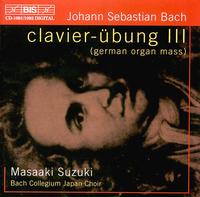
J.S. Bach: Clavier-übung III |
|
|
Prelude and Fugue in E flat major ("St. Anne, BWV 552: Prelude [8:56], Fuga [6:31]
Chorale Preludes BWV 669-689 [3:09, 4:21, 4:29, 1:16, 1:11, 1:20, 2:56, 4:25, 1:14, 4:57, 2:06, 3:05, 1:46, 8:26, 1:06, 3:36, 1:22, 5:13, 4:44, 3:29, 4:08]
Chorales BWV 371 [0:47], BWV 371 [1:04], BWV 371 [0:56], BWV 260 [0:58], BWV 298 [0:42], BWV 437 [1:52], BWV 416 [0:54], BWV 280 [1:07], Cantata BWV 38/ Mvt.6 [1:06], BWV 363 [ 0:45]
Duets BWV 802-805 [1:58, 3:22, 2:32, 2:46] |
|
Masaaki Suzuki (Organ) |
|
BIS |
Mar-Apr 2000 |
2-CD / TT: 104:35 |
|
Recorded at Sougakudo Concert Hall, Tokyo National University of Fine Arts and Music Tokyo, Japan.
Buy this album at: Amazon.com |
|
Part 1 |
|
Donald Satz wrote (June 6, 2001):
Bach's Clavier-Ubung III consists of the Four Duets BWV 802-805, the Prelude & Fugue BWV 552, and twenty one Chorale Preludes BWV 669-689. Other titles for these works that have frequently been used include the German Organ Mass and the Great Organ Mass. Recordings of Clavier-Ubung III have not been frequent, but the Bach Anniversary period has seen at least three representations on disc:
Channel Classics 13498 - This 2-CD set is performed by Leo van Doeselaar on organ. However, the set only has ten of the chorale preludes and none of the Four Duets. Instead, we are given short choral works of other baroque and pre-baroque composers which are interspersed among Bach's chorale preludes. The singing is accomplished by the Choir of the Netherlands Bach Society directed by Jos van Veldhoven.
Hanssler 92101 - Also a 2-CD set, this issue contains all of the organ music to the Clavier-Ubung III plus the Four Duets. There are no choral pieces, and the performances are provided by Kay Johannsen.
BIS 1091/1092 - The 2-cd set has the entire Clavier-Ubung III and ten accompanied chorales from cantata movements sung by the Bach Collegium Japan Choir. So, Suzuki's set would appear to have the advantage of "everything" one would expect plus about ten minutes of choral singing - all the basics plus the concept. I would like to point out that the total timings of the Hanssler and BIS sets are similar. That fact obviously reveals that Suzuki is consistently quicker than Kay Johannsen.
Some time back, I did short reviews of the Hanssler and Channel Classics sets. My preference was for the Johannsen performances which I felt conveyed more emotion and greater detail of part playing. The Channel Classics set had a richer sound which sometimes obscured detail. However, I also advised that the concept of interspersing short choral works would likely be very appealing to some listeners. Again, at first blush, Suzuki's set seems to consist of the the best of both worlds.
In reviewing Suzuki's new recordings, I'll be comparing them to the two above sets, Lionel Rogg's performances on his recently reissued 12 CD set of Bach's organ works on Harmonia Mundi, and Werner Jacob's readings on his 16 cd EMI set. The order of review will be the Prelude BWV 552, the twenty one chorale preludes, the Four Duets, and the Fugue BWV 552; this is the order generally used in recordings. I'll be commenting on the ten chorales as they appear on Suzuki's set.
I have another preliminary matter to bring up which would pertain to any reviews I do of Bach sacred works, although I'm only going to mention it in this particular review since Suzuki's performances don't usually correspond to the devotional/pious category.
Prelude in E flat major, BWV 552 - This well known and majestic Prelude has three basic sections: the first expresses the heroic, the second expresses prayer and meditation, the third expresses action and accomplishment. If any piece of music is perfect for the organ, the Prelude in E flat major is it. The double-dotted first section has as much ceremony as any other Bach music, and the third section's propulsion and determination are awe-inspiring. The music gives me images of a hero's funeral, final prayer, and journey to Vanhalla.
Each of the comparative versions is excellent, particularly the Rogg performance which has the most mediative second section and a deliciously detailed and propulsive third section. A high level of lyricism is evident in these versions. Suzuki has a different approach than the others which is most noticeable in the prayerful second section. Suzuki has no time or inclination for meditation; like a bull, he powers his way through this music, just itching to get on with the journey. I can't deny that there's a stern quality to the reading which could well turn off many listeners, but there are other sides to the performance. The levels of determination and inevitability are invincible. When the journey begins, you feel and join it. This is a "take no prisoners" version with sufficient poetry to be a great alternative to Rogg. Suzuki's hero is tough and posesses a no-nonsense attitude.
Choral Preludes BWV 669 to 671 - "Three" is a number at the foundation of the German Mass. We have heard it in the Prelude BWV 552, and here it is again as the choral preludes begin. In Latin liturgy, these three preludes form a unified and progressive entity. So it is with Bach's music. Each successive prelude is more intense and inevitable than the previous. Although hardly happy music, a strong uplifting quality also intensifies with each prelude. There is much beauty and determination in the music, and Lionel Rogg brings it all to center stage. Suzuki again places higher
priority on determination than Rogg and is not as uplifting. Suzuki is dealing from strength; he just keeps coming at me non-stop. Up to this stage, he has me totally in his grasp. I want to make the point again that poetry is not absent by any means in Suzuki's performances. Also, there are three vocal chorales, one before each prelude. They are very nice, but I don't find they add anything to enjoyment. In fact, they tend to telegraph what type of prelude is coming next. Fortunately, they can be programmed out or placed at the conclusion of the German Mass.
Choral Preludes BWV 672 to 674 - These three are considered the "minor Kyries" to the three previous "major" Kyries. Although of much shorter duration than BWV 669-671, each prelude delivers great poetry and hope. They get successively faster with BWV 674 being an energetic gigue. The two previous preludes are rather serene.
This series represents a cross-roads for Suzuki. Does he continue his strength/power regimen with music that wouldn't seem able to absorb this approach, or does he adapt to the nature of the music? Suzuki adapts and does so beautifully. The first two preludes are gorgeous creations in his hands, and he even tempers the power he conveys in BWV 674. Werner Jacob gives Suzuki a major challenge, but it's the Suzuki series which easily wins my affection. Up to this point in the German Mass, Suzuki's is the best version I know, and the flexibility he displays in the BWV 672-674 series should bode very well for the rest of his performances.
Choral Preludes BWV 675 to 677 - These three are different settings of the German Gloria. They are also joined at the hip by their swirling motions and deeply happy and satisfying themes. Bach arranged the Preludes in ascending scale order and gives them an ascending degree of exuberance. Most impressive is BWV 677 which is a double fugue providing a glorious outpouring of life's juices.
Suzuki just keeps getting better like a fine bottle of wine. He has no problem adapting to the music's nature. His first Prelude is the most joyous I've heard, and the inevitability Suzuki delivers is magnificent. The second Prelude swirls its satisfaction in a mesmerizing fashion. In these two Preludes, Suzuki also gives the most tender readings available, and this from the man of steel. There inothing tender about Suzuki's BWV 677; he's back to strong emphasis and provides one of the greatest performances of any one minute piece of music ever recorded. Where to begin? The pacing is out of this world and greatly aided by a moderate staccato which contrasts so well with the legato element as they swirl around one another. Suzuki has no peer for investing the music with urgency and ceremony. Most important, he gives me the feeling that every ounce of joy and satisfaction in the world is blazing into my bloodstream.
Not content with the magical music-making in the three Preludes, Suzuki also offers a gorgeous and comforting vocal chorale to start off the proceedings. I harped some on the three vocal chorales earlier in the review; the situation is far different now. Those three telegraphed the emotional themes of each applicable Prelude. The one at hand, BWV 260, represents the introduction to a journey to supreme enlightenment. Also, the contrast between the calm vocal chorale and the first Prelude is very effective.
Previously, my favorite set for BWV 675-677 was Werner Jacob's, but Suzuki leaves that outstanding performance in the shade and that's a very hard thing to do. Jacobs is great in each Prelude and ties them together effectively. If you have the opportunity, I also recommend two other wonderful recordings of BWV 677: Johannsen on Hanssler and Hans Otto on Berlin Classics. Otto's reading is full of joy and has great determination; Johannsen's pristine performance can't be beat for highlighting all the
delightful details of the music and voices. As good as these referenced versions are, Suzuki is the master. He is increasingly reminding me of the novelist Joyce Carol Oats. They are both highly unpredicatable and unusual; you never know what's coming next except that you know it will be treasureable.
Next are six pairs of catechism chorales, each pair consisting of a 'major-pedaliter' and 'minor-manualiter' setting:
Choral Preludes BWV 678 & 679 - BWV 678 is the major setting and a magnificent one. Its long pedal creates a relatively serene mood while the two upper parts are developed canonically. In BWV 679, we are given a happy gigue whose fugue subject makes ten appearances to conform to the ten commandments.
While listening to some great versions of BWV 678, it struck me that the Great Organ Mass might well be the most spritually satisfying work Bach ever composed. Jacobs and Rogg provide wonderfully uplifting performances within the mainstream. As is Suzuki's penchant, strength is highlighted in his BWV 678 without any sacrifice of poetry or depth of feeling. The same applies to BWV 679 where Suzuki presents strong attacks which I find irresistable; he gives the piece a weight which I woulnd't have thought the music could absorb. A vocal chorale precedes these two Preludes; it's lovely but not as effective as BWV 260 in ushering in the applicable Preludes.
Choral Preludes BWV 680 & 681 - These two Preludes refer to the Credo. God is praised as the Protector and Almighty Power. BWV 680 is a swirling and sweeping three-voice fugue with the pedal providing a powerful underpinning. It's interesting to listen how the different versions handle the swirling, powerful, and uplifting elements of the music. Rogg's is a superb version with great optimism and sweep. Other versions such as Jacob's get so caught up in the sweep of the music that most details are obscured. And then there's Suzuki; he doesn't as much sweep and swirl as hammer his way through the Prelude. Beats are emphasized powerfully and with a determination of great intensity. Whatever a soft and gentle approach might be, Suzuki's is the opposite. But again, he does not abandon lyricism or optimism. The reading just has altered priorities, and I feel the music responds well to the distinctive treatment.
With BWV 681, we enter the world of the French Overture, dotted rhythms, heroism, and nobility. I've not heard a better interpretion than the one from Hans Otto on Berlin Classics; his nobility is supreme. And it is the strong nobility which is missing from Suzuki's reading, and this time he has nothing advantageous to replace it with - definitely a competitive performance, but the first time in the review when Suzuki is not at the top level.
Update: Suzuki's German Mass is quite distinctive and would likely elicit a wide range of opinions. So far, it's a powerful reading which will not be to everyone's taste. As you are probably aware from my previous comments, the interpretation feeds into my musical preferences. Suzuki's power is very compelling, but he offers much more. He's tender when needed and rejoices at all the right moments. What he isn't is highly reverential, and that suits me just fine. I am greatly impressed up to this point. |
| |
|
Feedeback to the Review |
|
Kirk McElhearn wrote (June 6, 2001):
Donald Satz wrote:
< Bach's Clavier-Ubung III consists of the Four Duets BWV 802-805, the Prelude & Fugue BWV 552, and twenty one Chorale Preludes BWV 669-689. >
Glad to see this review, Don, and this incites me to raise a question. How should this be listened to? Since it is clear that there are, for many of the pieces, two versions, should one listen to it in two ways – one version containing the manualiter, the other the pedaliter? If so, where do the duets fit in? |
|
Donald Satz wrote (June 6, 2001):
(To Kirk McElhearn) In some recordings the manualiter settings are separate from the pedaliter ones; in others, like the Suzuki, they are presented in pairs. I guess the best thing is to try it both ways and decide which you musically prefer.
As for the Duets, I personally play them after the Fugue, but in most recordings they are presented before the Fugue. |
| |
|
Part 2 |
|
Donald Satz wrote (September 23, 2001):
First, I apologize for taking so long to complete this review. Back in June, I eagerly started Part 2 but found Suzuki's performances far less effective than in Part 1. I decided to put the project on the shelf for a few weeks, but that turned out to be many weeks. As it happens, the wait didn't alter my original opinion.
Chorale Preludes BWV 682 & BWV 683 - A five voice trio sonata, BWV 682 definitely deserves the 'major' designation. It is one of Bach's most complex creations and also one of tremendous grandeur and majesty. Kay Johannsen and Werner Jacob give exceptional readings fully conveying the great sweep of the Prelude; Suzuki does not. He leaves me with a flat feeling largely due to his decision to dispense as much as he can with sustaining notes. Essentially, he shortens his horizons, exhibits lumpy phrasing, and loses much sweep and grandeur. I think he has made a tactical error, the first one in the recording. Further, his slow tempo makes for heavy treading. In the short BWV 683, Suzuki is surprisingly light in texture, and I found his performance somewhat wispy. Much preferred is the Kay Johannsen issue which has greater weight and beauty. Overall, this series is a low point for Suzuki.
Chorale Preludes BWV 684 & BWV 685 - The text for this series concerns the baptism of Jesus and its subsequent impacts. Obviously, the subject is a serious one. In BWV 684, the faster and more vivacious performances tend to stray from the mood of the text. However, I still very much enjoy a version like Herrick's which is quite fast and played as 'good time' music; I can't deny that I easily get the image of Jesus' head being snapped backwards so vigorously that he could, through accident, incur damage to his spinal column. With Suzuki, it wouldn't be an accident but a premediated snap. As fast as Herrick, Suzuki is heavy and foreboding. Musically, I'll go with Herrick for a fast version. My overall favorite is Jacob's; he best conveys the river's flow during the baptism, and his mix of optimism and weight is very satisfying. In BWV 685, Suzuki again is low on poetry.
Update: Something is going wrong with Suzuki's performances. By the conclusion of Part 1, I was starting to think that the recording might end up being one of the finest Bach recorded performances ever. Whether strong or not, Suzuki always was conthe music's inner beauty. However, in the last two series of preludes, the beauty and poetry are lacking and the results are not advantageous. For these four preludes, just about every other version I've heard is preferable. Here's hoping that Suzuki's slump ends very soon.
Chorale Preludes BWV 686 & BWV 687 - Based on Psalm 130, "Out of the depths I cry to Thee", one would expect the 'major' prelude to have strong emotions and BWV 686 is one powerful fugue with dense counterpoint. Lionel Rogg delivers the power and great optimism as well. Although a little less uplifting, Suzuki is in his element with a level of strength and anguish that has to be heard. Unfortunately, when he hits BWV 687, he falls apart. BWV 687 is much softer music that needs little power but a great amount of poetry and subtle nuance. Suzuki dispenses with the power which is fine; however, he just replaces it with a straight-forward, slow, and bland interpretation that's miles behind the uplifiting Rogg version.
Chorale Preludes BWV 688 & BWV 689 - BWV 688 is a monothematic fugue with the cantus firmus in the pedal. The music is majestic, spacious, and has an eerie tension. Most versions take it at a fast clip well under four minutes; I feel the majesty tends to decrease at a quick pace. Leo van Doeslaar on Channel Classics takes over 4 1/2 minutes; he gives the music a majesty to savor with an infectious bounce. Suzuki is among the quick paced set and as good as most, but his reading likely would have benefited from a slower tempo. Lionel Rogg was very surprising here with little of his usual gusto, delivering as benign a performance as I've ever heard.
BWV 689 is more stately than majestic and leaves me me with a great feeling of contentment. Rogg gives a slow and glowing performance. Suzuki gives more angularity to the piece, and the music easily absorbs it. Overall, I'd be hard pressed to choice between these two superb readings.
The Four Duets, BWV 802-805, are more frequently performed on piano or harpsichord. Suzuki makes a fine case for them on organ with the exception of BWV 802 where he is much too fast with little time for emotion-based priorities.
Clavier-Ubung III concludes with the Fugue BWV 552, the partner to the opening Prelude. This is one of Bach's greatest and most heroic fugues, and it comes in three fantastic sections. The first is the epitome of majesty and heroism, the second swirls with increasing intensity, and the third is supremely majestic. Suzuki can't match Helmut Walcha's magical reading; he can't even match the excellent version from Gabor Lehotka on Laslerlight. Suzuki is too fast and pushy in the second section; the third section again finds him very fast and sounding not majestic, but just loud.
Don's Conclusions: Through BWV 681, I thought that Suzuki's performance constituted one of the best organ discs ever. He was very strong and muscular but also adapted beautifully to the gentle and tender pieces. Suzuki had this work in the palm of his hand, but he let it go starting with BWV 682. Poetry became lost, phrasing sounded lumpy, and Suzuki was generally either harsh/loud or routine. Also, the slow tempos he employed in the first half of the work were often taken over by fast ones in the second half, and fast tempos are not elements in the strengths that Suzuki brings to Bach's music.
I certainly recommend purchase of Suzuki's German Mass; much of it is magical especially if you like your Bach organ music played through strength. However, the promise of a superb recording does not reach fruition in the second half of the work; therefore, Suzuki's version can't be given an essential designation. |
| |
|
|
|