|
|
General Topics:
Main Page
| About the Bach Cantatas Website
| Cantatas & Other Vocal Works
| Scores & Composition, Parodies, Reconstructions, Transcriptions
| Texts, Translations, Languages
| Instruments, Voices, Choirs
| Performance Practice
| Radio, Concerts, Festivals, Recordings
| Life of Bach, Bach & Other Composers
| Mailing Lists, Members, Contributors
| Various Topics
|
|
Bach Composing
Part 7 |
|
Continue from Part 6 |
|
Compositional process... |
|
Bradley Lehman wrote (June 14, 2007):
< Albert Schweitzer wrote a very good book (in two volumes) about Bach called 'J. S. Bach by Albert Schweitzer'. If you get a chance to get ahold of these volumes you will have a very good reference for the works and the time and place of writing, plus many clues into lots of musical distinctions in his writings. >
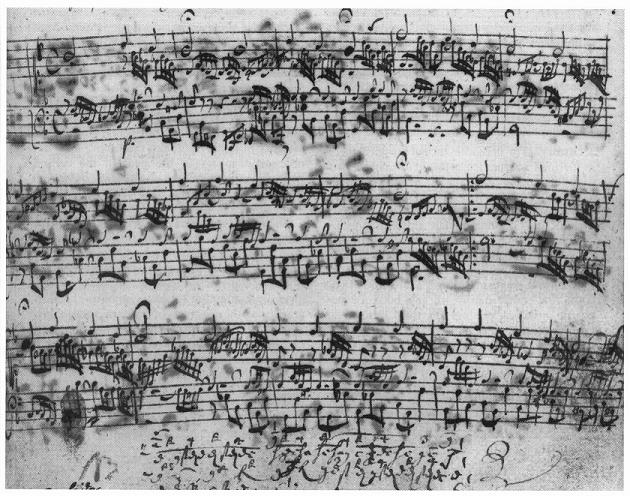
I would put in another plug for a book I mentioned some months ago: the classic two-volume set by Robert Marshall, The Compositional Process of J.S. Bach (Princeton 1972) as a published revision of his dissertation. It goes through the autograph composing scores of dozens of the cantatas, teasing apart the different layers of revision: cross-outs, note head enlargements, faster-moving figuration added in later on top of a skeleton, etc etc. Bach did revise things quite a bit (while not as much as, say, Beethoven), which implies that he did have some time to consider and reconsider ideas.
In reading this set I, for one, was especially surprised by the amount of keyboard tablature extant in his sketches, even for pieces that weren't ultimately destined for keyboard. These are vocal parts, and obbligato instruments in arias. Apparently for part of his process he noodled things out at the keyboard (presumably clavichord and/or harpsichord, rather than hiring an organ pumper), wrote them down, and then worked out all the orchestrational details and elaboration later. Certainly makes sense to me, the usefulness of that method! (If Bach were alive and working on such music today, would he improvise into a tape recorder instead?)
I've been trying to track down how late into his life Bach continued to use keyboard tablature notation, as a working habit. In addition to the 30 or more cantatas that have tablature examples in Marshall's set, I found in the NBA that one of Bach's fresh compositions from 1735 or later also uses it: the Prelude/Fugue/Allegro BWV 998, where some of the last page is done in tablature instead of starting a fresh sheet of staff paper.
And we just saw BWV 1040 a couple of days ago, still up at: http://launch.groups.yahoo.com/group/BachCantatas/files/
It was apparently composed around 1712-16, like cantata BWV 208 where it fills out an unused page of its manuscript. This is a three-voiced instrumental trio where the end of the continuo part got done in letters instead of notes.
As for the beginning of his career, a source discovered last year is from his organ lessons as a teenager: where he wrote out copies of other people's compositions and did it entirely in keyboard tablature, instead of score notation. Intriguing. It's a differently practical way of thinking about notation, for one thing. Note releases and articulation aren't written down, but are judged by taste, experience, harmonic context, and contrapuntal awareness.
There's also an interesting article by Marshall about the typical sequence of events in composing four-part Bach chorales. "How Bach Composed Four-Part Chorales", Musical Quarterly, April 1970.
These things of course don't (and can't) say definitively how long a composition took, from first thoughts through performance(s); but it least we can see some of the working strategies as first-hand evidence in the scores. Play some of the passages on keyboard first, then start putting things onto paper, then come back to it later and keep tinkering until it's good.
It also doesn't (can't) say how many days/weeks/months ahead anything got finished, whether it looks like quick work or not. If something looks like a rush--which is already difficult to judge in itself, as Bach maybe just had lots of other things happening at the same time and diverting attention--was it a rush before performance date, or to get ready for some other deadlines altogether? For instance: approval of the music, or study by the musicians (in lessons or otherwise), or handing out the copying assignments, or just to have enough personal time to go over it again himself for revisions? We don't know.
What if Bach had some of his musicians learn as much by memory/rote/demonstration, as by reading anything? Let's just hope it wasn't to the extreme end like "The Think System" for Harold Hill's Iowa boys, in "The Music Man". :) At least Bach could play orchestral/vocal music as demonstration on the keyboard, if he'd wanted to teach it that way by example, while Harold Hill (of zero credentials and nearly-zero musical ability) could barely hum the melody. |
|
Jean Laaninen wrote (June 14, 2007):
[To Bradley Lehman] Thanks, Brad. I will follow through on this information. |
|
Thomas Braatz wrote (June 14, 2007):
Bradley Lehman wrote:
>> Bach did revise things quite a bit (while not as much as, say, Beethoven), which implies that he did have some time to consider and reconsider ideas.<<
The question remains, in regard to the cantatas and their subsequent repeat performances, whether he had ample time to consider and reconsider ideas for changes, or whether this usually amounted to a similar situation to the one he encountered when he first composed the cantata: waiting until only a day or so before the actual performance, assessing which singers and/or instrumentalists were best able to perform the solo/obbligato parts, making as few changes as necessary so that most of the original materials could be used as is, and perhaps quickly copying out such a 'new' part himself.
BL: >>These [inserted tablature additions instead of writing out the notes entirely] are vocal parts, and obbligato instruments in arias. Apparently for part of his process he noodled things out at the keyboard (presumably clavichord and/or harpsichord, rather than hiring an organ pumper), wrote them down, and then worked out all the orchestrational details and elaboration later.<<
Bach's main reasons for using tablature (there are still many of his sketches written with normal notation in the margin or where there is available space as well) in the composing scores of his sacred music compositions are:
1. As a space-saver. Perhaps normal notation will no longer fit at the end of a page. Bach ran out of space or perhaps squeezing in another staff between two existing ones would make it even more difficult to read. Bach is notorious for the methods he used to make use of any available space on the page of a score. Clean copies of a score, particularly for those from the 1st 3 Leipzig cantata cycles, are rare among cantata compositions, since most of them were left as they were as composing scores thus indicating that he did not have much time to prepare such a score before the actual performance and often did not even bother to create one for a later performance (nor did he go back to the score to make any obvious corrections which he made to the parts).
2. To avoid an unnecessary page turn. This could be because he would conduct from the composing score or make things easier for himself when he copied out the parts: less paper shuffling - seeing the entire mvt. at a glance rather than having to turn the page for just a few bars which were missing.
3. As a time saver. Instead of taking a rastral to create a new staff in the available space, Bach uses keyboard tablature as a form of shorthand to write his ideas down quickly. BWV 1040 would appear to be part of a situation where Bach ran out of time as he hurriedly assembled the score so that the parts could be copied from it as quickly as possible.
The notion that Bach, as a "Klavierritter" ("Knight of the Keyboard"), would first 'plink' out the notes on a keyboard before writing them down in keyboard tablature, sounds like an episode lifted from a biography of Bach written for little children. An entirely different matter, of course, is the report that Bach, after having composed certain partitas for harpsichord (without recourse to a keyboard while composing), would subsequently, late at night, work out fingerings at the keyboard to masure the compositions were playable. This would not detract from the notion that many, or at least most of his keyboard compositions may have undergone a two-stage composition process: first as improvisations, then in writing down and modifying what he had originally improvised. For the latter he would not need to have a keyboard present. However, once he had completed this improvisation-followed-by-writing-down process, he would return to the keyboard to determine if what he had ultimately 'composed' as resulting from improvisations was playable or not. Hence, we have this report about 'working out the fingerings' of pieces at the keyboard of music freshly composed on paper. This may have led him to change certain notes or the placement of these (Oktavbrechung, etc.) as well. This, of course, is a far cry from 'plinking' out the notes and notating them immediately, whether in normal notation or keyboard tablature, whenever a musical idea came to his mind, |
|
Bradley Lehman wrote (June 14, 2007):
Quoting Thomas Braatz::
< 3. As a time saver. Instead of taking a rastral to create a new staff in the available space, Bach uses keyboard tablature as a form of shorthand to write his ideas down quickly. BWV 1040 would appear to be part of a situation where Bach ran out of time as he hurriedly assembled the score so that the parts could be copied from it as quickly as possible.
The notion that Bach, as a "Klavierritter" ("Knight of the Keyboard"), would first 'plink' out the notes on a keyboard before writing them down in keyboard tablature, sounds like an episode lifted from a biography of Bach written for little children. (...) >
Yes, that would be a silly oversimplification, and a trivialization of the point. It's rather like the 'plink' of stabbing the straw man you've set up here for the purpose. Nobody here has accused Bach of being any Klavierritter, or of 'plinking' out any notes he otherwise wouldn't have been able to imagine or assemble without a keyboard.
As I said, the tablature was just a handy and quick way of writing down full-textured ideas; or occasionally (as in BWV 1040) to save space on a single line of notes instead of drawing a new staff. And you even confirmed that part, before going on to make up the rest of it that starts a dispute.
The situation in BWV 1040, which you've given a bizarre interpretation here, does not imply any hurry (or lack of it!) one way or the other. Nor does it say that Bach was pressed on any copying tasks for BWV 208, where this page with BWV 1040 happens to be; he could have written that little trio after any performance(s) of BWV 208, completely at leisure and just using up space, and it would look exactly the same to us as it does! It only demonstrates that Bach ran out of space on that page for whatever reason, and then wrote in letters for the last bit instead of notes (sort of like what he also did in Orgelbüchlein and elsewhere).
Here's an example from BWV 612, of Orgelbüchlein, where there is again no implication of being in a rush about anything; he merely ran out of space when working within an already-bound book, underestimating the number of staves his composition (already in his fingers!) would take to write down in ink: http://www-personal.umich.edu/~bpl/larips/bwv612-tablature.JPG
All this other "hurriedly" business has been thrust in there as a premise, by you on all kinds of cantatas left and right (now including 208 also, 10 years before his Leipzig job!!), pressing the sources to say things they don't necessarily say. You're the one who somehow needs Bach to have been in some alleged rush about every little thing, whenever he wrote vocal pieces, and somehow forcing the evidence to say that. Well, the evidence doesn't unequivocally say the things you impute to it in these interpretations. You're only bringing up one possibility (i.e. Bach being in a perpetual panic about deadlines at school and church, which suits some fantasy scene in your head, apparently), and then moving ahead as if it's necessarily true. |
|
Casimir Vetter wrote (June 15, 2007):
[To Thomas Braatz] Mr Braatz you still did not answer my easy 5 minute question from a couple days ago. It would help understand your idea better. What instrument do YOU teach or play, at what school, where people sight read the music like you say Bach did? Did you write any music yourself for a school group or whatever, or church, and then have them do it without practice? How hard was it?
I don't get why you say Bach was always in a hurry about everything, it's like every 3rd sentence. (I also looked up more or your web postings where you say the same thing over and over.) Why do you think he didn't just plan ahead better?
Thank you |
|
Thomas Braatz wrote (June 15, 2007):
Bradley Lehman wrote:
>>Yes, that ["plinking out the notes on a keyboard before writing them down in keyboard tablature] would be a silly oversimplification, and a trivialization of the point. It's rather like the 'plink' of stabbing the straw man you've set up here for the purpose. Nobody here has accused Bach of being any Klavierritter, or of 'plinking' out any notes he otherwise wouldn't have been able to imagine or assemble without a keyboard.<<
but this is what Brad Lehman had written in the previous message:
>>These are vocal parts, and obbligato instruments in arias. Apparently for part of his process he noodled things out at the keyboard (presumably clavichord and/or harpsichord, rather than hiring an organ pumper), wrote them down, and then worked out all the orchestrational details and elaboration later.<<
According to your statement, first comes the 'plinking' or 'noodling' out at the keyboard, and after that Bach writes them down on paper. This is what I consider to be in the manner of the Knight of the Keyboard: first hit the notes on the keyboard and if they sound right, write them down in notation.
BL: >>As I said, the tablature was just a handy and quick way of writing down full-textured ideas; or occasionally (as in BWV 1040) to save space on a single line of notes instead of drawing a new staff.<<
However, in regard to the vocal or obbligato instrumental parts for which Bach sometimes used keyboard tablature for reasons already stated, these are not 'fully textured musical ideas' but simply a single line of notes.
BL: >>You're the one who somehow needs Bach to have been in some alleged rush about every little thing, whenever he wrote vocal pieces, and somehow forcing the evidence to say that.<<
BL: >>Well, the evidence doesn't unequivocally say the things you impute to it in these interpretations. You're only bringing up one possibility (i.e. Bach being in a perpetual panic about deadlines at school and church, which suits some fantasy scene in your head, apparently), and then moving ahead as if it's necessarily true.<<
Not at all 'some fantasy scene', but one that experts like Alfred Dürr confirm when they, from their experience in working directly with the original materials, state that the process from composition to performance was one that took place under great pressure of time [this latter observation pertains particularly to the Leipzig period during the 1720s]:
[from Alfred Dürr's "Bachs Werk vom Einfall bis zur Drucklegung", Breitkopf & Härtel, 1989, p. 14.]
1. Bach very likely used few sketches. It is observable that he modified themes at almost the same time when he wrote them down.
2. The preparation of performance materials is accomplished in the shortest possible period of time. ".denn jede Minute ist kostbar: Bach gibt die tintenfrische Partitur einem Thomaner." ("for every minute is precious: the ink is not even entirely dry when Bach gives his score to a Thomaner..").
Seldom does Bach take the time to enter the corrections and additions that he makes to the parts into his original composing score.
"Freilich, bei Zeitknappheit kann dieser Revisionsprozeß auch entfallen oder verkürzt werden. So kommt es, daß ein letzter Reifungsprozeß oft unterbleibt und daß uns ein Wnicht in derjenigen Vollkommenheit überliefert ist, die es erreicht hätte, wenn mehr Zeit verfügbar gewesen wäre." ("To be sure, due to this lack of time, this process of revision also may be omitted or be shortened. Thus it often happens that a final maturation process can fail to take place and that we will not be the recipients of a composition in such a state of perfection which it might have attained if more time had been available.")
Living in a fantasy world based upon current methods of composition and performance are those who believe that this hurried process based upon observable facts (the original composing scores and the copy process sequence used by Bach in the 1720s in Leipzig where and when the bulk of the cantatas was composed) could possibly have taken place weeks before a first performance of the music so that musicians could study their parts and have rehearsals in sectionals and as an entire group over a period of weeks in order to prepare themselves properly for the cantata performances in church. Such a fantasy cannot be reasonably related to the observations based upon the evidence that we do possess. |
| |
|
Bach, the well-regulated composer |
|
Douglas Cowling wrote (March 30, 2008):
William L. Hoffman wrote:
< Exhibit 2: Motive. Besides the reference to contentment above, Bach is finishing writing cantata cycles. He's free to go wherever he wants. This intimate, deep work with charming recitatives and attractive arias (WGW) comes at the end of this amorphous, patchwork Cycle 3.
The next work Bach presents, on Good Friday, April 11, 1727, is probably the first version of the SMP (BWV 244). A content composer on the way to a well-regulated church music? >
I like this notion of Bach having an over-arching trajectory which culminates in the composition of the SMP. So often we fix on Bach's work load and give the impression that he worked (I was going to write "stumbled") from week to week in a Rossini-like panic -- "Oh no, my choir is exhausted -- I better write a solo cantata!"
I just don't believe it. Bach asked for a "well-regulated" church music and that began with himself. When he arrived in Leipzig, he clearly planned to write cantatas for about five years until he had a basic collection of new music which would provide his core repertoire. He didn't get bored with cantatas or find new opportunities for composition outside the church. He had successfully completed a well-regulated plan.
Were the two Passions part of that plan? In the months before he came to Leipzig, did he make the decision to write these monumental works? If so, five years makes perfect sense to me as the gestation time for what the Bach family called "The Great Passion". Well-regulated indeed. |
|
Jean Laaninen wrote (March 30, 2008):
[To Douglas Cowling] Thanks for sharing your opinion, Doug. |
|
William L. Hoffman wrote (March 31, 2008):
Douglas Cowling wrote:
< Were the two Passions part of that plan? In the months before he came to Leipzig, did he make the decision to write these monumental works? If so, five years makes perfect sense to me as the gestation time for what the Bach family called "The Great Passion". Well-regulated indeed. >
William L. Hoffman replies: I think Bach's Passion plan began in the summer of 1707 when he composed two amazing mourning cantatas, BWV 106, and BWV 131, containing the seeds of his lyrical passion music. Since Lutheran service music (cantatas & passions) were considered as "musical sermons," I think Bach's template is the five-elements of the Lutheran sermon: exordium (introduction), Cantatas BWV 106 and BWV 131; proposito (key statement), the Weimar/Gotha Passion of 1717; tractacio (investigation of proposito), St. John Passion (BWV 245) of 1724; applicatio (application), St. Matthew Passion (BWV 244) of 1727 & 1729; and conclusio (final statement), St. Mark Passion (BWV 247) of 1731 with Picander again as the lyricist. My inspiration is Robin A. Leaver's booklet, "J.S. Bach as Preacher, His Passions and Music in Worship," where he says the Great John and Matthew Passions contain all five elements of the sermon. |
|
Jean Laaninen wrote (March 31, 2008):
[To William L. Hoffman] Very interesting insights, here. |
|
Bradley Lehman wrote (March 31, 2008):
[To William L. Hoffman] That's not only for Lutheran sermons; it's from principles of rhetoric by Quintilian, Cicero, et al: the basic art of expressing one's points with sufficient organization to be convincing.
One of my classmates, years ago, wrote her thesis on Bach's use of exordium, proposito, etc etc in the Italian Concerto and the Prelude/Fugue BWV 894, going through them section by section to show the construction of music like a good speech.
The first chapter of Laurence Dreyfus's book Bach and the patterns of invention (which see) opens up the question: did Bach really know classical rhetoric solidly himself, or was he just relying on little bits of Latin stuff learned by rote as a boy? |
|
Kim Patrick Clow wrote (March 31, 2008):
Bradley Lehman wrote:
< The first chapter of Laurence Dreyfus's book Bach and the patterns of invention (which see) opens up the question: did Bach really know classical rhetoric solidly himself, or was he just relying on little bits of Latin stuff learned by rote as a boy? >
What did Mr. Dreyfus come up with as a conclusion to the question? I know Philip Pickett and others make a great case for the use of rhetoric in baroque music, far beyond the simple case of musical instruments representing things (e.g. the flute = the Holy Spirit). Considering the context of Bach's peers and the use of rhetoric and their heavy university training in law, I can't believe Bach just had a superficial exposure to rhetoric as a school boy.
Thanks |
|
Jean Laaninen wrote (March 31, 2008):
[To Bradley Lehman] Thanks, Brad. Interesting additions. |
|
Jean Laaninen wrote (March 31, 2008):
[To Kim Patrick Clow] I would tend to concur with your opinion. Bach would likely have known of the uses of rhetoric simply from being so involved with the work of a church, in my opinion. |
|
William L. Hoffman wrote (April 2, 2008):
[To Jean Laaninen] William L. Hoffman replies: I just dug out the Dreyfus book (1996) with all my penciled notes in the first chapter, "What Is an Invention?" My cursory summary: Using invention as a "mechanism for discovering good ideas" (P.2), the author "propose(s) that analyzing inventions as structured repetitions reveals aspects of the composer's thinking that are not otherwise apparent"(p.5). Also, Dreyfus (p.13): ...I have preferred Mattheson's divisions of rhetoric (five, 1737), which allow me to interpret Bach's inventions as mechanisms ensuring their own transformations." The question is Brad Lehman's and Dreyfus, writing in 1996, had no answer. I offer these points: Bach was thoroughly competent in Latin (altho he hated to teach it), Leipzig probably had the leading German university then, and Bach had a theological library that would have been the envy of any Lutheran pastor. Lastly, Christoph Wolff's powerful Bach biography explores in depth its subtitle and perspective: "The Learned Musician." |
|
Jean Laaninen wrote (April 2, 2008):
[To William L. Hoffman] Thank you, William--very interesting. |
|
Bradley Lehman wrote (April 2, 2008):
[To William L. Hoffman] What do you make of Dreyfus's page 9, and the endnote #30 springing from the middle of it?
With regard to your remark, "Bach was thoroughly coin Latin (altho he hated to teach it)":
What's the evidence that Bach knew Latin at any academically-useful level (let alone being "thoroughly competent" in it), as he outsourced his own teaching responsibility in it? When did he ever use any Latin, other than occasionally sprinkling isolated words into his German, writing obsequious title pages (for which he could have enlisted help), and setting the standard Magnificat and Mass texts? I'd like to learn further about this if it's something beyond unsupported assertions.... |
|
Stephen Benson wrote (April 2, 2008):
Bradley Lehman wrote:
< What do you make of Dreyfus's page 9, and the endnote #30 springing from the middle of it? >
This was the same section that I marked when I first encountered it. It might be helpful for those following the discussion who don't have Dreyfus in front of them to see at least part of Dreyfus's argument, and I do apologize for arbitrarily selecting only a few sentences which contain what I think is his main point.
He says in part: "One is on uneasy ground, therefore, when suggesting that a traditional German Capellmeister such as Bach had anything more than passing familiarity with or interest in the nitty-gritty of rhetorical theory. (Bach's education in rhetoric at the Luneburg Lateinschule has now been shown to consist, not of the likes of Quintilian, but of a poor boy's pocket compendium of Latin terms to be memorized tout court by the pupils for rote recitation.)" The parenthetical material here is footnoted, the source being a 1985 article entitled "Bach und die Tradition der Rhetorik" by Arno Forchert.Further down the page he summarizes: "For a composer like Bach, what remained, then, from the actual musical annexation of rhetorical territory was a far less analogical but far more metaphorical notion of musical invention, a notion, to be sure, with its own rules and practices."
Again, I apologize for any oversimplification that might occur from selection of these brief excerpts. They do represent, however, what I see as the core of Dreyfus's thinking about Bach's use of rhetoric. |
|
William L. Hoffman wrote (April 3, 2008):
[To Stephen B] William L. Hoffman replies: Mea maxima culpa! I had not underlined any text on Page 9. Thank you, Brad, for pointing it out, and Stephen Benson, for your concise explication. I agree wholeheartedly that this at the time was a reasoned view from Dreyfus. I would only add that subsequent to 1996, Christoph Wolff's Bach biography, subtitled "A Learned Musician" (2000), especially Chapter 9, "Musician and Scholar," sheds considerable light on Bach's learning and the intellect behind this most amazing composer. By analogy, I think that Bach had a generous, inquiring, conservative spirit, particularly in the Lutheran theological realm where he came to see and embrace competing, sometimes conflicting perspectives, from the Enlightenment, to Pietism, to Orthodoxy, all actively converging intensely in Leipzig as nowhere else in Protestant Europe. He was at the crossroads, quick on his feet, far more than an eyewitness, and firm in his resolve and application. Also, I don't think Bach needed to steep himself in the original Latin, as Mattheson did (now there's a Learned musician!), to understand and apply the principles of rhetoric, as crude as the results may have been. |
|
Jean Laaninen wrote (April 3, 2008):
[To William L. Hoffman] Well put, William.
Thanks for the continued thoughts. |
| |
|
How fast could and did Baroque composers compose cantatas? |
|
Aryeh Oron wrote (September 22., 2008):
How fast could and did Baroque composers compose cantatas?
Thomas Braatz has contributed a short article:
http://www.bach-cantatas.com/Articles/Speed-Composition[Braatz].htm
The article contains additional evidence that describes the speed at which Baroque composers like J. S. Bach could compose and perform cantatas. The Baroque composer Thomas Stolzenberg (1690-1764) resembles in many aspects what J. S. Bach was capable of doing with the circumstances he faced in Leipzig during his most productive period. |
|
William L. Hoffman wrote (September 23., 2008):
[To Thomas Braatz] Thank you, Thomas, for a fascinating glimpse at the milieu of the Baroque cantata composer. I think, on the positive side, that there were many skilled, talented, trained musicians who seemed to pursue composition as s "sixth sense," almost intutively. It helps, I think to have comprehensive treatises on music and other extensive, systematic writings as well as comprehensive collections of music. On the negative side, there may have been an excess of formula and patterning, where some baroque music became a sort of mannerism (like Ars Subtilior, Gesualdo, opera pasticcio, and perhaps the Mannheim School's stile galant excesses). Of course, the term "baroque" originally had a negative connotation.
In the next two cantatas for discussion, we will look at the Anatomy of Bach Composition, with the shortness of time in BWV 215 through Stephen Crist's Bach Perspectives 2 article, "The Question of Parody," and then the studies of Robert Marshall and Gerhardt Herz in the three-stage composition of Chorale Cantata BWV 97, "In allen meinen Taten." |
|
William Rowland (Ludwig) wrote (September 23., 2008):
[To Aryeh Oron] <>
As far as JS Bach speed in composing---I have my doubts that he did all that my himself. He probably composed like Mozart did---melody sketched out ---one of the family helped fill in harmony,.another counterpoint and returned it all to JS for editing and final copying.t
This is also the way Rembrant van Rijn and other painters worked. |
| |
|
Bach's Almanac |
|
Douglas Cowling wrote (October 3, 2010):
In our continuing debate about the chronological sequence of Bach's compositional method, I have always felt that the telescoped model of Bach forever composing and performing in frantic haste does not mesh with his own attestation to a "well-regulated" church music and the state of his manuscript scores and parts which do not suggest last-minute frenzy.
If Bach did have a more expansive creative model, he must had an informed professional awareness of the church calendar as it morphed and changed from year to year. The calculations of the date of Easter and the number of Sundays after Trinity can be calculated with the right numbers, but it would be interesting to know if Bach had a printed source which allowed him to see the annual schedule of several years.
I asked the noted Lutheran historian, Frank C. Senn ("Lutheran Identity: A Classical Understanding") about the printed reference books available to Bach. He responded on another forum:
"The 18th century was the great age of the almanac. Benjamin Franklin's "Poor Richard's" made him rich. Whether or not the church officially published one, someone did. In the marriage of religion and culture in Lutheran Saxony, even secular almanacs would include the dates of the major (and some minor) church festivals and days of devotion. Whether that included counting the number of Sundays after Trinity each year, I don't know. But you can bet that someone in the Leipzig consistory (or maybe even in the Church Province of Saxony) prepared a church calendar each year so that all the churches in the city or province would be on the same page in terms of lectionary and collects.
One thing that was done in some of the hymnals (remember, these were entrepreneurial, not ecclesiastical products) was including a table of the date of Easter and related major days (e.g. Ash Wednesday, Pentecost) for years to come. There were also tables of moveable festivals based on the date of Easter from March 22 through April 25."
Has any scholarship be done on the kinds of almanacs, both secular and ecclesiastical, which Bach and his Saxon colleagues used? Was there a civic or academic calendar printed? |
|
Julian Mincham wrote (O3, 2010):
Douglas Cowling wrote:
< In our continuing debate about the chronological sequence of Bach's compositional method, I have always felt that the telescoped model of Bach forever composing and performing in frantic haste does not mesh with his own attestation to a "well-regulated" church music and the state of his manuscript scores and parts which do not suggest last-minute frenzy. >
Frankly I have never subscribed to the 'last minute frenzy' idea although I think the evidence is that Bach composed consistently and regularly over some 40+ years.
I think an important factor when it comes to the cantata schedule lies in the 2 questions---how far in advance did he need to have the texts approved and---how far in advance were the texts published? On the latter point, in dealing with the (possibly now discredited) Stübel theory, Wolff claims that when he died (Jan 27) it was just after he would have received the printings of cantatas BWV 92, BWV 125, BWV 126, BWV 127 and BWV 1 (p 278). Some of these must then have been approved and sent for printing ar least 6 weeks before they were performed----probably more. This may suggest that Bach had a window of two months for the composition of at least some of the required cantatas---obviously not a last minute scramble for a well organised composer. (There may also be more evidence of these printings coming from Russian research sources in the near future of which I am not yet aware).
What interests me though, is what may be deduced from the internal evidence of the first 2 cycles---cycle 1 consisted of just over 60 cantatas at least half of which had been precomposed. Compare that with the first 40 of cycle 2 where there is, as far as I am aware, no evidence of any paraphrasing (there is a limlited amount of it after BWV 1). Bach certainly would have been kept busy during that first year--there may have been revisions of and additions to the Magnificat and the SJP (BWV 245). and there were also some secular works. But why, if he had a grand plan such as eventuated in the second cycle, did he not hit Leipzig with in from his appointment in 1723? He had reasonable notice of it.
One answer may lie in the fact that, having been appointed too late to announce himself with the SJP (BWV 245) at Easter of 1723, he decided to 'make do' generally with the first year, get the gauge of the performers and the politics and unfold his grand cycle of' well appointed' church music the following year. If this is the case it would make sense for him to recycle quite a bit from exisiting works in the first year----as he did----- and there is every likelihood that, at the same time, he was composing a number of cantatas for the chorale/fantasia cycle well in advance ---this depends, of course on his getting the approvals well ahead for he is unlikely to have embarked upon such an important venture on spec. But as far as we know there is no reason why he should not have sought and received them a full 12 months before they were scheduled to be performed.
Such a timetable makes sense to me, and fits well with what we know of Bach's planning, ambitions and 'well regulated' character. i reckon he still worked fast and consistently---but not at panic or frenzy levels. |
|
Ed Myskowski wrote (October 3, 2010):
Julian Mincham wrote:
< I think an important factor when it comes to the cantata schedule lies in the 2 questions---how far in advance did he need to have the texts approved and---how far in advance were the texts published? On the latter point, in dealing with the (possibly now discredited) Stübel theory, Wolff claims that when he died(Jan 27) it was just after he would have received the printings of cantatas BWV 92, BWV 125, BWV 126, BWV 127 and BWV 1 (p 278). >
What evidence (or absence of evidence) is there to discredit the Stübel hypothesis? It remains viable, endorsed by Wolff, and mentioned as possible (specifically not discredited) by Geck, previous statements to the contrary on BCW notwithstanding.
I was struck by the internal consistency of the scenario proposed by Will Hoffman, with the following (also consistent with Wolff):
(1) Bach had been publishing texts and writing new music until the death of Stübel.
(2) At that time, he needed to come up with new texts for publishing, in a hurry. Hence the reliance on available compositions for the five performances in the Easter season, subsequent to BWV 1. This buys a bit of time to retain the option of continuing reuse of existing compositions/texts, or
(3) To come up with a new source of texts in order to continue fresh compositions for the continuation of Jahrgang II. The onset of collaboration with Marianne von Ziegler, with the schedule proposed by Will, performances beginning with BWV 103 for the Third Sunday after Easter 1725, is consistent, although certainly not proven.
Note that enough published text booklets exist, so that a consistent block of time can be considered firm evidence, even if no actual booklet exists for that particular interval. This is the logic Will has used so effectively (IMO). Absence of text booklets for any specific group of compositions and time interval is not equivalent to absence of evidence. Not even close. |
|
Douglas Cowling wrote (October 4, 2010):
Julian Mincham wrote:
< I think an important factor when it comes to the cantata schedule lies in the 2 questions---how far in advance did he need to have the texts approved and---how far in advance were the texts published? >
Is there any direct or collateral documentary evidence of a formal censorship process to which Bach was expected to submit his texts? Given the attitudes of 18th century ecclesiastical authorities to creative control, it makes sense that Bach, even though he was a significant figure in the Lutheran establishment, required a pro forma imprimatur for his cantatas. In many countries, a printer would require an official written letter of imprimatur before proceeding to publish a political or religious document. Even his close colleagues in the Leipzig consistory would require sufficient time to read the libretto or delegate the task to another official to write the letter. I would think that the city council might well have had a say in texts used when it officially attended services and when a secular cantata celebrated a royal worthy. |
|
William L. Hoffman wrote (October 4, 2010):
Doug Cowling wrote:
< Is there any direct or collateral documentary evidence of a formal censorship process to which Bach was expected to submit his texts? Given the attitudes of 18th century ecclesiastical authorities to creative control, it makes sense that Bach, even though he was a significant figure in the Lutheran establishment, required a pro forma imprimatur for his cantatas. In many countries, a printer would require an official written letter of imprimatur before proceeding to publish a political or religious document. Even his close colleagues in the Leipzig consistory would require sufficient time to read the libretto or delegate the task to another official to write the letter. I would think that the city council might well have had a say in texts used when it officially attended services and when a secular cantata celebrated a royal worthy. >
William L. Hoffman replies:
We have two clear pieces of evidence re. matters of dating, printing, and permission, both dealing with required annual Good Friday Passion performances:
NBR 115: Council proceeding April 3, 1724, Bach required to present St. John Passion (BWV 245) repeat at St. Nicholas, which took place on April 7.
NBR 116: "Flier announcing the change of a performance site, 1724: Since, after completed printing of the Passion texts," the council announces that the performance will be at St. Nicholas. Bach required to bear expenses for printing of flier confirming performance site.
BNR 208: From Town Council Archives, clerk, dated March 17, 1739. Council Clerk tells Bach Good Friday music cannot be performed "until regular permission for the same is received." Good Friday fell just
10 days after clerk's notice, on March 27.
Those are pretty tight deadlines, for whatever reasons.
As to Bach's compositional methods, most Bach authorities, particularly the NBA KB, accept Robert Marshall's source critical studies of <The Compositional Process of JSB: A Study of the Autograph Scores of the Vocal Works> 2 volumes (1972).
I also personally believe that Christian Weiss Sr. ran interference for Bach with church authorities (he was Bach's representative and liaison during the 1723 probe and contract process; read NBR) and as Smend emphasized, Bach never had complaints with church authorities, rather with secular ones, particularly the Town Council, although Bach still presented his own works annually for the Council's installation, as well as the Passion. |
|
Juliam Mincham wrote (October 4, 2010):
Ed Myskowski wrote:
< What evidence (or absence of evidence) is there to discredit the Stübel hypothesis? It remains viable, endorsed by Wolff, and mentioned as possible (specifically not discredited) by Geck, previous statements to the contrary on BCW notwithstanding. >
The point is that there is no evidence to support it apart from the coincidence of his death. There is nothing that indicated who wrote the texts for the first forty cantatas of the cycle----Stübel or AN other.. Nor is there any evidence to indicate that bach did other than to set out initially to compose a set of 40 chorale cantatas. Some later additions could fill some of the slots of the cycle--------but some of them don't!
So basically, as is so often the case with Bach, there is no hard evidence either way. |
|
Douglas Cowling wrote (October 4, 2010):
Julian Mincham wrote:
< The point is that there is no evidence to support it apart from the coincidence of his death. There is nothing that indicated who wrote the texts for the first forty cantatas of the cycle----Stübel or AN other.. Nor is there any evidence to indicate that bach did other than to set out initially to compose a set of 40 chorale cantatas. >
The paucity of documentation is never so striking as with Handel and his oratorio librettists. There are many accounts of their working relationship, and hilarious anecdotes of Handel's struggles with the English lanaguage.
Collateral question: what is the evidence for Telemann, Fasch or even Kuhnau? |
|
Douglas Cowling wrote (October 4, 2010):
A suggestion from another list about Bach's calendar resources:
"You might want to check as another possible source:
Martini, Johann Jacob. "Neu- und wohl eingerichteter historischer Kirchen-calender". Erffurth : J.M. Funcken, [1744?]" |
|
Ed Myskowski wrote (October 4, 2010):
Stubel hypothesis [WAS: Bach's Almanac]
Julian Mincham wrote:
< So basically, as is so often the case with Bach, there is no hard evidence either way. >
I agree completely. I would not have bothered to write, other than choice of the word discredited. I suggest unproven is more accurate, and more in keeping with support by Wolff, among other scholars. As I noted, the Stubel hypothesis is also consistent with Will Hoffmans suggested timing for Bachs collaboration with Marianne von Ziegler, but that timing could also be consistent with a completely planned (if a bit convoluted) layout for Jahrgang II. I did not mean to imply that Will Hoffman took any position on this detail, one way or the other, in his recent post. |
| |
|
Bach's Choral Demands
Bach's Grand Plan |
|
Julian Mincham wrote (October 25, 2010):
Bach's Choral Demands
Julian Mincham wrote:
<< Is there not the possibility that if Bach wrote the cantatas for OVPP that he did in fact write for choirs of differing abilities, choosing from his pool of singers the four that would do most justice to any particular work? >>
Douglas Cowling wrote:
< This assumes a much grander architecture to Bach's compositional calendar than the Rossini Rush of weekly production. If the technical difficulty of choral music indicates different ensembles, it would suggest multi-tasking in composition and rehearsal. It makes logical sense but there isn't a shred of evidence to indicate how Bach deployed his resources beyond the division into four choirs. >
I must admit to feeling a bit jaded when faced with the ‘there’s not a jot of evidence for…..’ sort of statement which comes across (although I am sure it’s not the intention) as if to say ‘we have no definitive proof in this area so it’s not even worth discussing’. If all that was stated about Bach (and many other past artists for that matter) required definite proof, there would be very little written about them!
The point is that much that is interesting, stimulating and may have influence on performers and listeners alike can be inferred from a combination of what is known in terms of established historical fact and a knowledge of the scores and the internal evidence they provide. In fact, it is the bringing together of these two areas as the basis for further deduction that I find the most interesting.
The present discussion provides us with a case in point. What we know of Bach is
1 He was, in order to run the school, the music for four churches, compose much of it and lead a busy life as a performer, teacher and organ expert and assessor, an extremely well organized individual.
2 We know that he had a pool of singers available and about how big it was.
3 We know that he had a clear idea of the capabilities of the singers within the school.
4 We know that he was well aware of the particular difficulties of his own music
(I am not going to bother to reference these individually—simply go to the New Bach Reader)
5 From observation of the scores, a point made by Douglas, he wrote choruses with a wide range of difficulty.
Add to this the notion, not entirely proven but having gained acceptance generally in recent years that he wrote for a very small choir—probably no more that eight at any one time, it hardly seems to me that he might well have had certain of his available singers in mind when composing new works. It is equally valid to assume that he had a virtuoso flautist in mind when he wrote some of the flute obligato parts. No we don’t have a film of Bach’s choirs showing how big they were and how often the personnel changed but we can make some quite persuasive inferences from the evidence and observations we do have.
As an aside, and from a more personal viewpoint, I have come very much to the view (that I did not hold for most of my life) that the majority of the religious music was composed for either 4 solo or 8 (with ripieno) singers. This is based not just on the research of recent years but of the experience of hearing works such as the Magnificat (BWV 243), the SJP (BWV 245), BWV 150, BWV 106, BWV 202, BWV 75, BWV 225 etc. done in Bach spaces (Mühlhausen, Köthen, Leipzig et alia) with different vocal resources. There is no doubt in my mind that the OVPP groups win hands down both in terms of balance with the instruments and effectiveness in the acoustic spaces.
It might not be definitive evidence, but I found these experiences to be pretty compelling!
On the particular point of choir size I refer those who are interested in the issue to the comments made in the essay on BWV 195 on my web site.
Finally I wrote a long message on list a short while ago arguing against the ‘Rossinian rush’ and suggesting that Bach may well have been planning and even composing some of the second cycle chorale cantatas during his first year at Liepzig (no definitive evidence though!) |
|
Ed Myskowski wrote (October 25, 2010):
Julian Mincham wrote:
< Finally I wrote a long message on list a short while ago arguing against the ‘Rossinian rush’ and suggesting that Bach may well have been planning and even composing some of the second cycle chorale cantatas during his first year at Liepzig (no definitive evidence though!) >
A hint, a shred of evidence if you will (though certainly not definitive!) in this direction lies in the two cantatas under discussion last week and this, BWV 166 and BWV 104, from the first and second Leipzig cycles, both for Easter 4, both opening with bass solo aria.
From Doug Cowlings previous post:
< It makes logical sense but there isn't a shred of evidence to indicate how Bach deployed his resources beyond the division into four choirs. >
Note the distinction between Julian’s reference to definitive evidence and Doug’s to shred of evidence. |
|
Douglas Cowling wrote (October 25, 2010):
Bach's Grand Plan
Julian Mincham wrote:
< Finally I wrote a long message on list a short while ago arguing against the ‘Rossinian rush¹ and suggesting that Bach may well have been planning and even composing some of the second cycle chorale cantatas during his first year at Liepzig (no definitive evidence though!) >
If we are going to encourage speculation without hard evidence, let me indulge my fantasy of Bach's plan for his Leipzig cantorate. "Well-regulated" indicates advanced planning to me, and I see no reason to doubt that Bach -- of all composers in history! -- did not have an over-arching plan for his work in Leipzig.
The first planning period was the six months before he arrived in Leipzig.The early persistence of the rumour that he planned a five-year cycle of cantatas might very well have originated in this preliminary period. That he did not complete the five cycles is not important. Circumstances change and Bach left other encyclopedic projects incomplete, most notably the Orgelbüchlein.
Once installed in Leipzig, Bach's year had three principal festival clusters for which the compositional and performance demands were especially demanding:
1) The Three Days of Christmas to Epiphany
2) Good Friday and the Three Days of Easter
3) Ascension Day, the Three Days of Pentecost and Trinity Sunday
The provision of Passion music was clearly the nexus of his working year, but each of these festivals required cantatas, and concerted settings of the Missae (Kyrie & Gloria) and Sanctus. It is not beyond the realm of possibility that Bach planned the overall design of these three principal clusters for several years during his preliminary pre-appointment period. Once in harness, it would have been eminently reasonable that, say after the Christmas week, he looked ahead to the following year and set up the works-in-progress which would be required. The schema for the Christmas Oratorio, tied as it is to one particular year, argues for advanced planning. Rather than viewing the "closed" seasons of Advent and Lent as compositional times, a more practical perspective would see them as intensive rehearsal periods.
Outside of the three principal festival clusters, there are three secondary cycles:
1) The 5-8 Sundays after Epiphany
2) The 5-8 Sundays after Easter
3) The 22-28 Sundays after Trinity
These periods are well-defined in the lectionary of readings, and Bach paid special attention to the Easter sequence when his most "unusual" cantatas were written. At a minimum, Bach would probably have made the calendrical calculations or consulted a printed almanac to ascertain the varying number of Sundays for the coming year. Trinity 28 only occurred once while he was at Leipzig: his advanced planning would tell him it was coming and he chose to celebrate its arrival with one of his greatest works, "Wachet Auf". For these three cycles, the compositional scheme was probably shorter and more flexible to provide for various exigencies. If the libretto publication is any indicator, the librettos must have been produced at least three months in advance which gave Bach a generous period time for composition, copying and rehearsal.
Outside of the Primary and Secondary Cycle, Bach had the annual Festival Cycle of days such as Michelmas, Reformation and the three Marian festivals. These could occur on any day of the week, and Bach must have at least looked ahead a year to see if there were any approaching collisions with Sundays (Annunciation fell on Palm Sunday one year) or whether the performance schedule would be complicated by a Saturday or Monday occurrence. These festivals probably included concerted Missae and Sanctus as well. It is not hard to imagine the music (often among Bach's most demanding works) for these festivals in the Works-in-Progress drawer.
None of this is to suggest that Bach couldn't work swiftly and brilliantly with the clock ticking. A request from a rich family for a wedding cantata, the sudden death of a royal personage or municipal worthy, or a state visit required quick work, although Bach must always have had generic works to hand for these inevitable occasions (the music for the Queen Mother's recent funeral was chosen and written 20 years ago!)
This type of "well-regulation" is consonant with both Bach's upbringing which was closely tied to the rhythm of the calendar and to his own encyclopedic impulses. |
|
Ed Myskowski wrote (October 25, 2010):
Douglas Cowling wrote:
< Once installed in Leipzig, Bach's year had three principal festival clusters for which the compositional and performance demands were especially demanding:
1) The Three Days of Christmas to Epiphany
2) Good Friday and the Three Days of Easter
3) Ascension Day, the Three Days of Pentecost and Trinity Sunday
Outside of the three principal festival clusters, there are three secondary cycles:
1) The 5-8 Sundays after Epiphany
2) The 5-8 Sundays after Easter
3) The 22-28 Sundays after Trinity >
My understanding of the Liturgical Year is that the period from Easter (Resurrection) to Ascension is fixed, so that while the calendar date of Easter is variable, the number of Sundays from Easter to Pentecost (and Trinity the following week) is not variable. There are five Sundays after Easter, followed by the Sunday after Ascension (Exaudi), Whitsun (Pentecost), and Trinity (always the 8th Sunday after Easter). Variations in the Sundays after Epiphany are exactly compensated by the Sundays after Trinity, because the date of Christmas is fixed to the solar calendar, but the date of Easter varies in a complicated reconciliation of solar-lunar calendars. I suppose, to be absolutley precise, there can occasionally be a variance of one between the Sundays added/subtracted after Epiphany and Trinity, because there are not exactly an even number of weeks in one year (1.25 days extra). Perhaps someone can report one how often this occurs? Dougs secondary cycles (1) and (3) are
accurate, but secondary cycle (2) is not variable in length. Confusing? For sure, by design! No need to think for yourself, just let the boss take care of it.
Kuijken (Vol. 10) makes inspiring and informative listening and reading on this topic, beginning with our current work for weekly discussion (BWV 108) for Easter 4 (Cantate), followed by Easter 5 (BWV 86, Rogate), Ascension Thursday (always) (BWV 11, Himmelfahrtes Oratorio), and concluding with the Sunday after Ascension (BWV 44, Exaudi).
Note the symmetrical relation of Mardi Gras and Ash Wednesday, forty days before theCrucifixion, with Ascension Thursday, forty days after the Resurrection. In the Northern Hemisphere (where Bach lived and where this calendar was developed) we now call this entire period Winter Going, approximately coincident with Spring. |
|
Douglas Cowling wrote (October 25, 2010):
Ed Myskowski wrote:
< The number of Sundays from Easter to Pentecost (and Trinity the following week) is not variable. There are five Sundays after Easter, followed by the Sunday after Ascension (Exaudi), Whitsun (Pentecost), and Trinity (always the 8th Sunday after Easter). >
Thank you for saying it more accurately than I.
The date of Easter determines the number of Sundays after Epiphany and after Trinity: if Easter is early, shorter Epiphanytide and longer Trinitytide; if Easter is late, longer Epiphanytide and shorter Trinitytide.
I wonder if there were rural pastors and organists who got it all balled up.
"Pass the Almanch, Fritz" |
|
Julian Mincham wrote (October 25, 2010):
Julian Mincham wrote:
< If we are going to encourage speculation without hard evidence, let me indulge my fantasy of Bach's plan for his Leipzig cantorate. >
[To Douglas Cowling] I would differentiate between speculation for which there is a degree of supporting evidence which may be infered from historically establlshed data and that which is exptrapolated from internal sources, and that for which 'there is not a shred of evidence'. A lot of this is relative. Wolff's major book contains many well based inferences, Dürr's much less so. Both are invaluable sources---but which makes for the more stimulating read? |
|
Ed Myskowski wrote (October 26, 2010):
Douglas Cowling wrote:
< Outside of the three principal festival clusters, there are three secondary cycles:
1) The 5-8 Sundays after Epiphany
2) The 5-8 Sundays after Easter
3) The 22-28 Sundays after Trinity >
I responded quickly to Dougs post, intending to separate calendar details from more specualtive thoughts (no less interesting). Alas, I responded so quickly that I now realize there are additional calendar details which I question:
As I noted previously, the number of Sundays after Easter, numbered as such, is fixed at five, followed by three Sundays from Ascension, concluding with Trinity, for a total of eight (always).
DC
< Trinity 28 only occurred once while he was at Leipzig: his advanced planning would tell him it was coming and he chose to celebrate its arrival with one of his greatest works, "Wachet Auf". >
EM:
I believe the last possible Sunday after Trinity is number 27, to which Dougs comment otherwise applies accurately. I also believe there are always a minimum of 23 Sundays after Trinity, so the proper range is 23-27. This corresponds to a normal range of 2-6 for the Sundays after Epiphany. Note that a year with only two Sundays after Epiphany corresponds to, and is equally rare, as a year which includes Trinity 27. I find it curious that Bach did not compose cantatas for Sundays after Epiphany beyond number 4, whether the possible maximum is 6 or 8. Any explanations?
To add to the difficulty in understanding this complexity, note that the Roman (Catholic) calendar counts from Pentecost (Whitsun), rather than from Trinity, so that the last possible Sunday in that calendar is indeed the 28th Sunday, but after Pentecost.
DC:
< None of this is to suggest that Bach couldn't work swiftly and brilliantly with the clock ticking. A request from a rich family for a wedding cantata, the sudden death of a royal personage or municipal worthy >
EM:
Stop me if you have heard this before:
What is the difference between a wedding and a funeral, to a musician?
You get longer notice for the wedding. |
|
Ed Myskowski wrote (October 26, 2010):
Douglas Cowling wrote:
< Outside of the three principal festival clusters, there are three secondary cycles:
1) The 5-8 Sundays after Epiphany
2) The 5-8 Sundays after Easter
3) The 22-28 Sundays after Trinity >
I responded quickly to Dougs post, intending to separate calendar details from more specualtive thoughts (no less interesting). Alas, I responded so quickly that I now realize there are additional calendar details which I question:
As I noted previously, the number of Sundays after Easter, numbered as such, is fixed at five, followed by three Sundays from Ascension, concluding with Trinity, for a total of eight (always). [After writing this, but before getting it sent, I see that Doug has replied and agreed.]
DC:
< Trinity 28 only occurred once while he was at Leipzig: his advanced planning would tell him it was coming and he chose to celebrate its arrival with one of his greatest works, "Wachet Auf". >
EM:
I believe the last possible Sunday after Trinity is number 27, to which Dougs comment otherwise applies accurately. I also believe there are always a minimum of 23 Sundays after Trinity, so the proper range is 23-27. This corresponds to a normal range of 2-6 for the Sundays after Epiphany. Note that a year with only two Sundays after Epiphany corresponds to, and is equally rare, as a year which includes Trinity 27. I find it curious that Bach did not compose cantatas for Sundays after Epiphany beyond number 4, whether the possible maximum is 6 or 8. Any explanations?
To add to the difficulty in understanding this complexity, note that the Roman (Catholic) calendar counts from Pentecost (Whitsun), rather than from Trinity, so that the last possible Sunday in that calendar is indeed the 28th Sunday, but after Pentecost.
DC:
< None of this is to suggest that Bach couldn't work swiftly and brilliantly with the clock ticking. A request from a rich family for a wedding cantata, the sudden death of a royal personage or municipal worthy >
EM:
Stop me if you have heard this before:
What is the difference between a wedding and a funeral, to a musician?
You get longer notice for the wedding. |
|
Ed Myskowski wrote (October 26, 2010):
Apologies for my duplicate mailing I expect musicians will be clamoring for the funeral gig. |
|
Douglas Cowling wrote (October 26, 2010):
Ed Myskowski wrote:
< I find it curious that Bach did not compose cantatas for Sundays after Epiphany beyond number 4, whether the possible maximum is 6 or 8. Any explanations? >
We had a little exchange about this lacuna in late Epiphany cantatas earlier this year with no resolution.
And yes, Trinity 27 is the last possible Sunday after Epiphany.
"Reread before clicking SEND" |
|
Julian Mincham wrote (October 26, 2010):
Ed Myskowski wrote:
< Apologies for my duplicate mailing I expect musicians will be clamoring for the funeral gig. >
Only if they ar well paid!! |
|
Ed Myskowski wrote (October 27, 2010):
Douglas Cowling wrote:
< If we are going to encourage speculation without hard evidence, let me indulge my fantasy of Bach's plan for his Leipzig cantorate. >
Hmm. I must have overlooked that encouragement. Nevertheless, I find the fantasy properly labeled, enjoyable, and most important, likely within BCW guidelines.
DC:
< "Well-regulated" indicates advanced planning to me, and I see no reason to doubt that Bach -- of all composers in history! -- did not have an over-arching plan for his work in Leipzig.
The first planning period was the six months before he arrived in Leipzig. >
EM:
Perhaps even longer, since he early-on reused works spanning fifteen years or so?
DC:
< The early persistence of the rumour that he planned a five-year cycle of cantatas might very well have originated in this preliminary period. That he did not complete the five cycles is not important. Circumstances change and Bach left other encyclopedic projects incomplete, most notably the Orgelbüchlein. >
EM:
This is the point that I find most enjoyable. I think many artists start out with a vision of a grand architecture, but for one reason or another, get bogged down in the working out of details. I know that Julian has a special place in his heart for the Chorale Cantata Cycle (Leipzig second, Jahrgang II), and we all have a special place in our ears for the music. But creating the music may (or may not!) have been subject to external, unpredictable, imponderable circumstances. The untimeley death of the still anonymous librettist. If he did not die, wdid he go?
DC:
< Once installed in Leipzig, Bach's year had three principal festival clusters for which the compositional and performance demands were especially demanding: >
EM:
I commented separately on fine-tuning the details of these periods, I wish to emphasize that I agree with Doug on the importance of understanding Bachs creative output in relation to this annual, predictable, but not exactly fixed cycle. Needless to say, not so easy to figure out, either.
DC:
< Rather than viewing the "closed" seasons of Advent and Lent as compositional times, a more practical perspective would see them as intensive rehearsal periods. >
EM:
Wny not both? These are not mutually exclusive options.
DC:
< If the libretto publication is any indicator, the librettos must have been produced at least three months in advance which gave Bach a generous period time for composition, copying and rehearsal. >
EM:
Generous is perhaps a stretch, given his overall work load, but the minimum overall time available for any particular composition to be in process is accurate. Libretto publication is certainly an indicator. Not just a shred of evidence, but virtually definitive.
DC:
< A request from a rich family for a wedding cantata, the sudden death of a royal personage or municipal worthy >
EM:
I had a reminder that it would not be enough for musicians to wish me dead, someone would still have to pay the fiddler. |
|
Julian Mincham wrote (October 27, 2010):
Ed Myskowski wrote:
< But creating the music may (or may not!) have been subject to external, unpredictable, imponderable circumstances. The untimeley death of the still anonymous librettist. If he did not die, where did he go? >
Hi Ed he certainly did die at that time but there is not a shred of evidence that he wrote the texts for even one of the chorale/cantata series, let alone 40 of them. |
|
Thérèse Hanquet wrote (October 27, 2010):
[To Julian Mincham] Maybe these are stupid questions, but if the librettist is anonymous, how do we know when he died?
And if there is not a shred of evidence that he wrote the texts of cantatas, how can we consider him a librettist? |
|
Continue of this part of the discussion, see: Bach’s Librettists [General Topics] |
| |
|
Bach's weekly schedule |
|
Continue of discussion from: Joshua Rifkin - General Discussions Part 2 [Performers of Bach’s Vocal Works] |
|
Douglas Cowling wrote (May 11, 2013):
David Jones wrote:
< I thought this article was interesting: http://www.guardian.co.uk/music/2005/dec/12/jsbach.classicalmusicandopera >
Gardiner is quoted:
""He had a rigid deadline. They were sung twice on every Sunday. They rehearsed on a Saturday. He prepared the boys on a Thursday and a Friday. The chances are that the parts were completed by Wednesday evening or Thursday at the latest, though there may have been changes of mind – the sudden presence in town of a particularly good virtuoso who he wanted to draft in might change things. He wrote straight into score,so he probably started composing on a Monday and finished by Wednesday.That's my feeling but there's no way of proving it.'
We've flamed over this question before but is there any documentary evidence a tall for this hypothetical weekly schedule?
If there isn't, it is just as likely that Bach was a consummate multi-tasker and was composing multiple works in multiple genres and overseeing multiple rehearsals all the time. |
|
William Zeitler [Glass Harmonica] wrote (May 11, 2013):
Douglas Cowling wrote:
< * We've flamed over this question before but is there any documentary evidence a tall for this hypothetical weekly schedule?
If there isn't, it is just as likely that Bach was a consummate multi-tasker and was composing multiple works in multiple genres and overseeing multiple rehearsals all the time. >
I'm not sure which work ethic is more impressive. |
|
Kim Patrick Clow wrote (May 11, 2013):
[To William Zeiter] That's a fascinating website: http://glassarmonica.com/ |
|
William Zeiter [Glass Harmonica] wrote (May 11, 2013):
[To Kim Patrick Clow] I'm working up one of the Bach solo violin suites on the glass armonica. Not exactly historical (grin!) but it's pretty darn magical!:-) |
|
Kim Patrick Clow wrote (May 11, 2013):
[To William Zeiter] Fascinating! You know there is some baroque music for the glass harmonica's predecessor? Gottfried Heinrich Stölzel was the director of music for the Duke(s) of Gotha, Bach performed several of Stölzel's cantata cycles and passion settings in Leipzig. Stölzel wrote an obbligato aria for what is called in the source as "musical glasses." I'm in the process of editing that piece.
I'm sure everyone would love to hear a mp3 of your work with the Bach too (I certainly would ;) |
|
William Zeiter [Glass Harmonica] wrote (May 11, 2013):
Glass music
[To Kim Patrick Clow] Sorry this a little off topic (I fixed the topic subject), but perhaps it is still consonant with the general treachery of trying to establish musical practices at that time?
The musical glasses (goblet style, tuned with water) start appearing in England 1730-ish (due to the English development of inexpensive and musically usable wine glasses); Gluck played them in London and likely brought that idea back with him when he returned to the continent c.1746/7. Franklin's glass armonica was invented 1761. Mozart composed both his works for the armonica in 1791.
I would love to see the score to the Stoezel piece and know more about it in general. Any idea when it was composed? The historical data about early glass music is terribly murky at best--a piece for musical glasses on the continent before c.1745 would be of great interest to me.
Perhaps we should continue this conversation off-line? <> |
| |
|
Bach's composing practice... |
|
William Zeiter wrote (December 11, 2013):
Do we know what Bach’s composing practice was? E.g. composed from 6am to 8am every day except odd Tuesdays? Or … ?
Of course this likely varied over time… |
|
Julian Mincham wrote (December 11, 2013):
[To William Zeitler] The question I have always wondered about is that with his family, teaching, rehearsals, running the school (from 1723) how the hell did he find time and energy to compose anything let alone the huge bulk of work produced in the years 1723-6.
My guess is that he required very little sleep and when he had completed his working day he went to his desk and composed with candleligh----there was likely to be little noise in the house then, ideal conditions for composing. t. The fact that he had sight problems later in life (as did Handel) might be indicative of working in poor conditions for many years.
And when he had finished, maybe 3-4 oclock in the morning, did he retire to the marital bed? with the time honoured phrase "err---are you awake darling?" |
|
Claudio Di Veroli wrote (December 11, 2013):
Julian Mincham wrote:
< And when he had finished, maybe 3-4 oclock in the morning, did he retire to the marital bed? with the time honoured phrase "err---are you awake darling?" >
Indeed. Having fathered 21 births only proves the fertility and good health of him and his wives. He could have done it by honouring the marital bed perhaps a dozen times a year!
:-)
Surely he worked very fast, joining the club with Telemann, Mozart and Rossini.
Most other composers would need a lifetime just to compose 200 high-quality Cantatas and not doing anything else in life. |
|
Julian Mincham wrote (December 11, 2013):
[To Claudio Di Veroli] It's another of those many things we will never know about JSB. But if a man with all that energy only did it a dozens times a year I would be surprised! |
|
Norma Stelingson wrote (December 11, 2013):
[To Claudio Di Veroli] When I consider the possibility o just COPYING all Bach’s output, using modern staff paper and pens, I cannot imagine doing even that in a lifetime. Like Mozart, the music must have already been “in his head.” And then those quills: dip-write-dip-write. And kids running around. And other kids to teach... It boggles the mind. |
|
Kim Patrick Clow wrote (December 11, 2013):
[To Norma Stevlingson] From some writings (either by the composers themselves, or their children or friends), we know a bit of their habits. I think Telemann would get up and start composing immediately through the morning hours. Bach's output is amazing, but some of his peers' output is just extraordinary.
Telemann and Stoelzel's productivity is jaw dropping. Stoelzel's twelve cantata cycles, over 100 serenatas written for birthdays, weddings, anniversary celebrations of ducal patrons (and he wrote a lot of the texts he set to music, so there's yet another level of work, to what had to been grinding series of deadlines), 18 orchestral suites. All the music had to be copied out, rehearsed, performed. Then in addition to that, there were the normal administrative duties that went with such a position, managing what had to be some difficult personalities with singers and instrumentalists, tip toeing around whatever political fights between the musicians, and either the church authorities or court, keeping the employer happy, the composer never straying from whatever religious orthodoxy was the flavor of the day.
Telemann did that plus he engraved on copper plate his own compositions, was a diplomatic correspondent for several German courts, a botanist, and wrote annual passions, and admiralty music for the city of Hamburg. Graupner was just as productive in Darmstadt (but no passions or civil music). Fasch's 12 cantata cycles in Zerbst with nearly 70 orchestral suites and 25 birthday cantatas/serenatas for Anhalt-Köthen. And unfortunately, what survived the ravages of time is variable. Dr. Wolff believes about half of Bach's music was lost forever. Most of Fasch's cantata music was destroyed, Stoelzel's suffered huge losses at the hands of his successor Georg Benda, while a lot of Telemann survives, his grandson was responsible for destroying a lot of it too. Graupner's has music survived intact, but that was only through some good luck, it was nearly destroyed in WW2. But we're the fortunate ones that are able to enjoy so many of these musical treasures that DID survive.
But still, I do wonder if some of these baroque composers were workaholics. Having looked a lot of Christoph Graupner's autographs, I you have to speculate if suffered from OCD. Graupner also was a self publisher too, like his friend Telemann. It's pretty remarkable all these composers had families and social lives to manage in addition to their heavy work requirements. |
|
Linda Gingrich wrote (December 11, 2013):
Hmm, I thought there were only 20 children. Perhaps you are including PDQ? |
|
Julian Mincham wrote (December 11, 2013):
[To Linda Gingrich] Well if you are constantly at it---what's one kid difference?? Who'd notice?? |
|
William L. Hoffman wrote (December 12, 2013):
I am just now reading John Eliot Gardiner's Chapter 7, "Bach at His Workbench," in his musical biograhy, <Bach: Music in the Castle of Heaven>. The Birnbaum defense and the Gessner working description, plus Bach's focus on hard work, help define the working Bach. Then there are the mind, the spirit, and the tool kit. Also, besides PDQ Bach, MM, North by South Dakota State at Hoople, don't forget Brunhilde Wilhelmena Victoria. |
|
Eric Schissel wrote (December 12, 2013):
Unsurprisingly there are articles and probably books with conjectures at some length, at least, on this very topic (a quick search of Google Books confirms this, for instance and for example). That not every work had to be entirely an original composition and free of borrowings from earlier works by himself and others (as was more the case in later eras) probably helped, mind... (do not take this as any sort of criticism of the Baroque and earlier eras; for myself I find the emphasis on originality-in-all-things to be a lot much. Especially given how wonderfully the new versions of older pieces were often re-imagined, reorchestrated, given new contexts - even if hurry played a role, inspiration did surely too (and yes, not just when JS Bach was involved, I know). ...Anyway!)
Just a quick comment- hopefully more later... |
|
William L. Hoffman wrote (December 14, 2013):
John Eliot Gardiner's new Bach musical biography, Bach: Music in the Castle of Heaven (New York: Alfred A. Knopf, 2013) devotes one of 14 chapters to "Bach at his Workbench (Chapter 7). Focusing on Bach's creation of two Passions and two back-to-back cycles in Leipzig, Gardiner finds Bach at his best, despite all manner of challenges. Gardiner examines all three compositional stages: inventio, elaboratio, and executio. In the first, Bach sought out literary partners and had a reservoir of possibilities, usually engaging in collaboration; he determined the overall structure with the chorale positioning crucial; and the make-up of his performing ensemble, "always conscious of the seasonal and liturgical calendar." Bach drew on "a common stock of material," "worked from preliminary drafts," and utilized every motive and gesture. At this point, Bach got caught up in the process of elaboratio, where his works thrived through hard work, the "hallmark" being the "intricacy and connectedness of his methods," "far more refined and distinctive than those of his contemporaries." Both he and Handel borrowed musical ideas "as a spur to greater invention," the difference being Bach's reliance on self-borrowing. Bach's transformation of texts through imaginative richness, versatility and transferability came from the highest of standards. Bach also had the greatest concern for the "act of performance itself," executio. A supreme performer, Bach found that this act "influenced the creative" process." He rigorously employed scribes and closely oversaw them. In rehearsal, Bach used all his powers to elicit the best performing possible. Gardiner finds that the rehearsal process for him in the Bach Cantata Pilgrimage of 2000 is "similar to baking a cake." The next chapter (9), Cantatas and Coffee," looks at Bach's public music-making in Leipzig, followed by Chapter 10, "Cycles and Seasons," which is the heart of Gardiner's book and shows the culmination of the fruits of Bach's labors and Gardiner's understanding. |
| |
|
Bach Composing: Part 1 | Part 2 | Part 3 | Part 4 | Part 5 | Part 6 | Part 7 |
|
General Topics:
Main Page
| About the Bach Cantatas Website
| Cantatas & Other Vocal Works
| Scores & Composition, Parodies, Reconstructions, Transcriptions
| Texts, Translations, Languages
| Instruments, Voices, Choirs
| Performance Practice
| Radio, Concerts, Festivals, Recordings
| Life of Bach, Bach & Other Composers
| Mailing Lists, Members, Contributors
| Various Topics
|
|
|