|
Chorale Melodies used in Bach's Vocal Works
Wo soll ich fliehen hin
Auf meinen lieben Gott |
|
Melody & Text | Use of the CM by Bach | Use of the CM by other composers
| Arrangements/Transcriptions |
| |
|
Melody & Text: Zahn: | EKG: |
|
Melody: Zahn: 2164 | EKG: 289 (“Auf meinen lieben Gott”), 418 (“Wo soll ich fliehen hin”) |
|
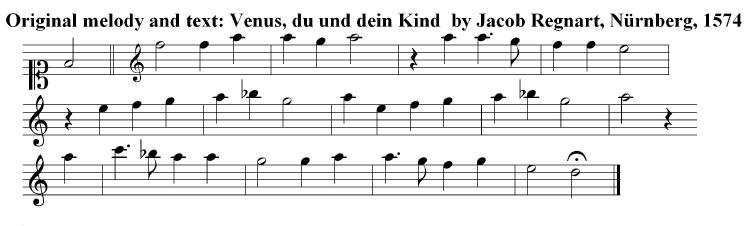
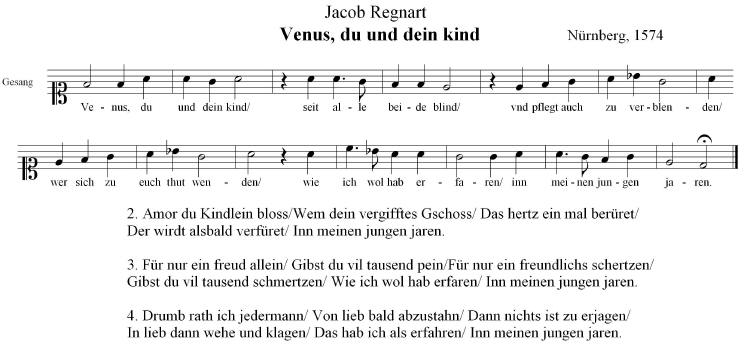
The chorale melody source is a secular composition by Jacob Regnart (1540{?} - 1599) with the song title “Venus, du und dein Kind seid alle beide blind” [“Venus, both you and your child {Cupid} are blind”] contained in the collection of “Kurtzweilige teutsche Liedlein / nach Art der Neapolitanen oder welschen Villanellen” [Nürnberg, 1574.] |
|
|
|
|
|
English translation (by Thomas Braatz) of the original German text of “Venus, du und dein kind” by Jacob Regnart [The German text is included in the score above]
1. Venus, both you and your child are completely blind and you also tend to blind as well anyone who turns to both of you, just as I have personally experienced in my young years.
2. Cupid (Amor), you are just a little child; that person whose heart is once touched by your poisoned arrow will soon be bewitched/tempted as I have had a lot of experience with this when I was younger.
3. For just one joy/pleasure, you give much suffering; in return for only one friendly moment of teasing and joking about, you give me many thousands of pains/aches, as I have found out perfectly well in my younger days.
4. For this reason I advise everyone to renounce (stand away from) love, for there is, while being in love, nothing to be obtained as reward for the chase than a lot of pain and grief. That is what I have determined from personal experience while I was still younger. |
|
Regnart stated in the foreword that these “little, entertaining German songs” were ‘in the style of ‘napolitane’ or Italian villanellas.’ The public response to these compositions, including important musicians like Michael Praetorius who praised them, was overwhelming and led to numerous editions and even rivalry between printing firms. These 3-pt. songs were continually in print for more than 35 years. Orlando di Lasso (1532-1594) used “Venus, du und dein Kind seid alle beide blind” in 1583 as the basis for a 4-pt. composition with a different text: “Die Genad kombt oben her” [“Blessings come from above”], a contrafactum (switch from secular to sacred music.) Similarly, also, in 1583, Francesco Rovigo (1530?-1597) based a “Magnificat” on “Venus, du und dein Kind.”
“Auf meinen lieben Gott” and also “Befiehl du deine Wege” were included and set to music by Bartholomäus Gesius (born between 1555 and 1562, died in 1613) in his “Christliche Haus- und Tisch-Musica…” for 4 voices [Wittenberg, 1605] The text for “Auf meinen lieben Gott” is anonymous and can only be traced to the city of Lübeck before 1603.
Melchior Vulpius (c, 1570 – 1615) has a setting of “Auf meinen lieben Gott” published in his collection, “Ein schön geistlich GesangBuch...” [Jena 1609.]
Johann Hermann Schein (1586-1630), a predecessor of Bach’s at St. Thomas Church in Leipzig, published in his “Cantional oder GesangBuch Augspurgischer Confession 4,5,6 vc.” [Leipzig,1627] and continued using this contrafactum of Regnart’s “Venus, du und dein Kind…,’ as “Auf meinen lieben Gott,” which now had become part of a hymnal.
There is a lost work by Heinrich Schütz using the same text as Regnart, “Venus, du und dein Kind” which appeared in Weimar (date unknown.) Was it another setting (more than 3 pts.) with the same music, or was it an original composition?
The association of Regnart’s melody with “Wo soll ich fliehen hin” is somewhat more difficult to determine. Johann Heermann (1585-1647) is the poet among whose most famous chorale texts is “Herzliebster Jesu, was hast du verbrochen” (used by Bach in his Passions.) The chorale text for his “Wo soll ich fliehen hin” appeared in print in his collection of hymns published in 1630. [This fact confirmed by the NBA KB editors.] There are still 14 chorale texts by Heermann being used in the current German hymnal for the Evangelical-Lutheran Church.
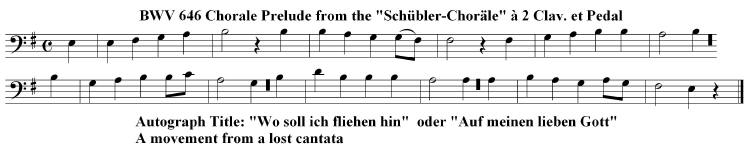
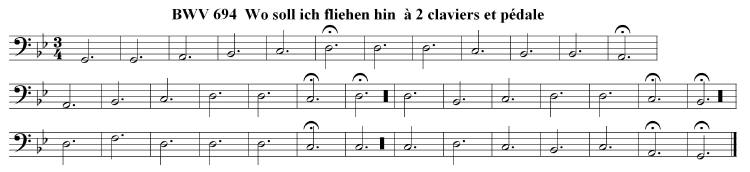
From the standpoint of hymnals generally and the references to the chorale text “Auf meinen lieben Gott” in vocal settings and chorale preludes, it would appear that the most important association of Regnart’s melody is with this chorale text, but based upon Bach’s use of this melody, the more important or preferred choice would be “Wo soll ich fliehen hin.” This is based also upon the fact that when Bach identifies the melody in his organ works, “Wo soll ich fliehen hin” appears first at the very top of the page under which the secondary title “Auf meinen lieben Gott” is also mentioned (BWV 646) or with only “Wo soll ich fliehen hin” in BWV 694. |
| |
|
Alternate Melody: Zahn: 2177 |
|
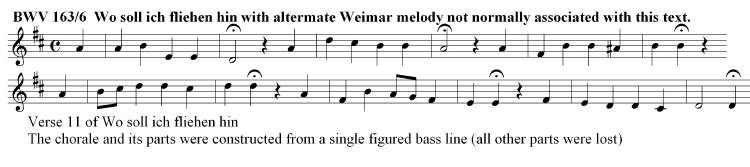
This variant melody was used by Bach in BWV 199/6 and most likely in BWV 163/6.
Alfred Dürr explains that this variant of the normal melody associated with Johann Heermann’s chorale text “Wo soll ich fliehen hin” is very likely limited in its use to particularly Thuringia. The NBA editors relate this melody to Zahn 2177 which is documented not before the end of the 17th century. This melody, as used by Bach here, apparently appears in Middle Germany and was used there in place of the melody normally associated with “Wo soll ich fliehen hin,” the 3rd verse of which is used in BWV 199/6. The same melody also seems to be used in BWV 163/6, but this is based upon reasonable conjecture since some key parts are missing (Bach simply wrote: “Choral. simplice stylo” and notated only the figured bc part.) The NBA editors based their choice of the final verse of “Wo soll ich fliehen hin” upon Salomo Franck’s indication in his printed text. This different melody is documented in
Christian Friedrich Witt’s collection of chorale texts and melodies: “Psalmodia sacra, Oder: Andächtige und schöne Gesänge…” [Gotha, 1715, p. 173]
Here are the results of some recent research on this particular melody:
In the Grove Music Online [Oxford University Press, 2005, acc. 8/14/05], John H. Baron has written an article which is important to understanding more about this melody. The entire text is included because there are numerous places and associations which may be important for establishing some kind of connection to Bach: |
|
>> Caspar von Stieler (born Erfurt, March 1, 1632; died Erfurt, June 24, 1707).
German poet and playwright. He studied theology and medicine in Leipzig, Erfurt and Giessen between 1648 and 1650, when he went to Königsberg for further study in philosophy and theology. He was a secretary to a Prussian cavalry regiment from 1654 to 1657 and saw action in the Polish–Swedish war. He then bega four-year period traveling, first in north Germany and then in Holland, France, Spain, Italy and Switzerland. In 1662, a year after he returned to Germany, he studied law in Jena. In 1663 he was chamber secretary in Schwarzburg-Rudolstadt, and from 1666 to 1676 he was in Eisenach as secretary to the Duke of Saxe-Weimar; at this period he was enrolled as ‘Der Spate’ in the society known as the "Fruchtbringende Gesellschaft" and under that name wrote his aesthetic treatise Die Dichtkunst des Spaten (MS, 1685, DK-Kk; ed. H. Zeman, Vienna, 1975). For the last 30 years of his life he held various appointments in Jena, Weimar, Holstein, Hamburg and finally Erfurt, where he worked as writer, lawyer and private tutor.
Stieler's importance for music lies primarily in his "Die geharnschte Venus, oder Liebes-Lieder im Kriege gedichtet" (Hamburg, 1660/R1968 with edn), which until recently was wrongly ascribed to Schwieger. This collection of 70 strophic songs contains solo lieder with basso continuo by six composers indicated by initials only which may be interpreted thus: J.K. (Jakob Kortkamp or Johann Kruss), C.B. (Christoph Bernhard), JS. (Johann Schop), M.C. (Martin Köler [Coler] and possibly a second composer too), J.M.R. (Johann Martin Rubert) and C.S. (Stieler himself). Five other pieces are taken from French ballets and four more from other French works; one lied is a madrigal. Stieler also figures in the history of German dramatic music before the opening of the Hamburg Opera; he included music during his plays and between the acts, but it has been lost. He is the probable composer of the chorale "Wo soll ich fliehen hin," which appeared in his "Der bussfertige Sünder, oder Geistliches Handbuchlein" (Jena, 1679) and was later revised by J.S. Bach in the cantata "Mein Herze schwimmt im Blut" BWV 199.<<
|
|
[What present readers do know is that Mr. Baron is not referring to the melody of the main chorale "Wo soll ich fliehen hin" but rather to a very special melody with very limited use in Bach's repertoire.
[Nonetheless, it is important to consider that the composer of this special variant melody has possibly been identified and that this melody came into existence in the latter half of the 17th century.] |
| |
|
Text 1: Wo soll ich fliehen hin | EKG: 418 |
|
The chorale text for Wo soll ich fliehen hin was written by one of the most important chorale-text poets, Johann Heermann (1585-1647), who can be placed on the same level of Martin Luther and Paul Gerhardt as he takes his place chronologically between these two important figures. The chorale text is listed under the categories of “Die Beichte” [“Confession”] and “Bußlieder” [“Songs of Penance.”] See above for more information on Johann Heermann. |
| |
|
Text 2: Auf meinen lieben Gott | EKG: 289 |
|
The author of this text is unknown with the time and place of its first appearance being in Lübeck before 1603.
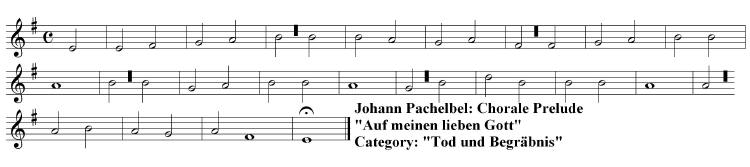
This chorale text, in hymnals, sacred song collections, and chorale prelude collections, has been placed into various categories: EKG: General category: “Psalmen, Bitt- und Lobgesänge für jede Zeit” [“Psalms, Songs of Petition and Praise for Any Time of the Year”], subcategory: “Gottvertrauen,” [“Trust in God”], Kreuz und Trost [“Bearing one’s cross in troubling times and Comfort.’] Samuel Scheidt, 1650: “Vom Kreuz und Verfolung” [Songs about following a path of difficulty and persecution.”] Johann Pachelbel: “Tod und Begräbnis” [“Death and Burial.”] |
| |
|
Use of the Chorale Melody by Bach: |
|
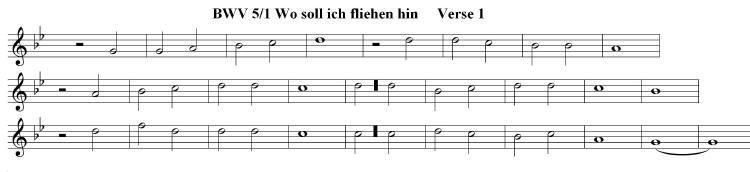
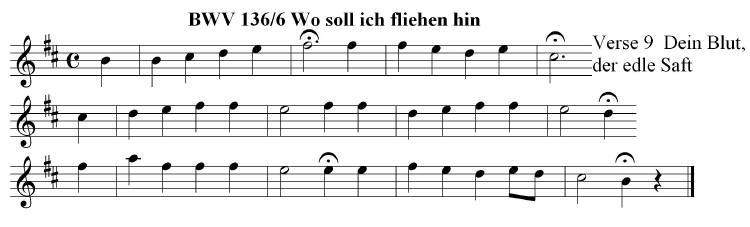
Text 1: Wo soll ich fliehen hin | EKG: 418
Author: Johann Heermann (1630) |
|
Ver |
Work |
Mvt. |
Year |
Br |
RE |
KE |
Di |
BC |
Score |
Music Examples |
|
1 |
BWV 5 |
Mvt. 1 |
1724 |
- |
- |
- |
- |
A145:1 |
- |
Mvt. 1 (CCARH) [midi] | Mvt. 1 (Leusink) [ram] |
|
11 |
BWV 5 |
Mvt. 7 |
1724 |
303 |
28 |
304 |
93 |
A145:7
F20:1 |
PDF |
Mvt. 7 (CCARH) [midi] | Mvt. 7 (MG) [midi] | Mvt. 7 (Leusink) [ram] |
|
7 |
BWV 89 |
Mvt. 6 |
1723 |
281 |
26 |
281 |
- |
A155:6 |
PDF |
Mvt. 6 (MG) [midi] | Mvt. 6 (Leusink) [ram] |
|
9 |
BWV 136 |
Mvt. 6 |
1723 |
330 |
27 |
331 |
- |
A111:6 |
PDF |
Mvt. 6 (CCARH) [midi] | Mvt. 6 (MG) [midi] | Mvt. 6 (Leusink) [ram] |
|
|
|

|
|

|
|
|
| |
|
A completely different melody than normally associated with this chorale text: |
|
Text 1: Wo soll ich fliehen hin | EKG: 418
Author: Johann Heermann (1630) |
|
Ver |
Work |
Mvt. |
Year |
Br |
RE |
KE |
Di |
BC |
Score |
Music Examples |
|
11 |
BWV 163 |
Mvt. 6 |
1715 |
- |
- |
- |
- |
A158:6 |
- |
Mvt. 6 (Leusink) [ram] |
|
3 |
BWV 199 |
Mvt. 6 |
1714 |
- |
- |
- |
- |
A120:6 |
- |
Mvt. 6 (Leusink) [ram] |
|
|
|

|
| |
|
Text 2: Auf meinen lieben Gott | EKG: 289
Author: Anon (Before 1603) |
|
Ver |
Work |
Mvt. |
Year |
Br |
RE |
KE |
Di |
BC |
Score |
Music Examples |
|
1 |
BWV 188 |
Mvt. 6 |
1728 |
- |
25 |
- |
|
A154:6 |
PDF |
Mvt. 6 (MG) [midi] | Mvt. 6 (Leusink) [ram] |
|

|
| |
|
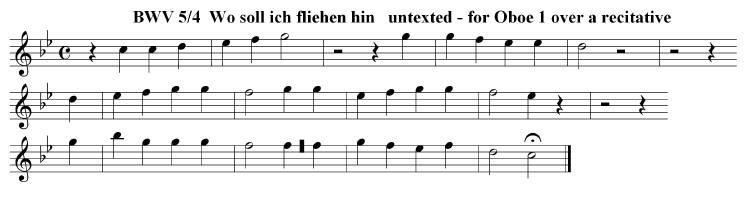
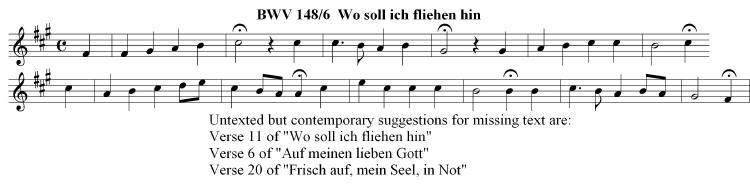
Untexted: |
|
Ver |
Work |
Mvt. |
Year |
Br |
RE |
KE |
Di |
BC |
Score |
Music Examples |
|
- |
BWV 5 |
Mvt. 4 |
1724 |
- |
- |
- |
- |
A145:4 |
PDF |
Mvt. 4 (CCARH) [midi] |
Mvt. 4 (Leusink) [ram] |
|
* |
BWV 148 |
Mvt. 6 |
1723 |
25 |
350 |
- |
- |
A140:6 |
PDF | PDF |
Mvt. 6 (MG) [midi] | Mvt. 6 Ver (MG) [midi] | Mvt. 6 (Leusink) [ram] |
|
1** |
BWV 646 |
- |
1748/49 |
- |
- |
- |
- |
- |
PDF |
Chorale (MG) [midi] |
|
1** |
BWV 694 |
- |
1700-17 |
- |
- |
- |
- |
- |
- |
Chorale (MG) [midi] |
|
* This is the current state of affairs regarding BWV 148/6 according to the NBA:
1. The melody and Bach's setting thereof is for "Wo soll ich fliehen hin"
2. The are no reliable indications by Bach to make clear which words (verse and name of chorale text) were to be sung - it has remained untexted until now.
3. The only previous critical edition of this cantata appeared in volume 30 of the BGA, editor: Paul Graf Waldersee, dated in the foreword: Eisenach, August of 1884. It appears that Waldersee was swayed by Spitta's argumentation in making his decision regarding the text. Many questions were still left open which the NBA attempted to resolve.
The final chorale appeared with various titles after Bach's death:
- Breitkopf 1765 and 1784 "Wo soll ich fliehen hin" in F minor
- Becker 1831 No. 25, p. 18 with the same title
- Becker 1841-1843 as No. 45, p. 25 as "Auf meinen lieben Gott" in G minor with a note that it had been transposed from F minor to G minor
- Erk I 1850 No. 13, p. 8 "Auf meinen lieben Gott" in F# minor with the text added "Amen zu aller Stund..." This is the text tentatively suggested for use by the NBA.
After examining carefully and rejecting the argumentation by Spitta for assuming Picander (Henrici) as the probable librettist for the entire cantata and his choice of the final verse "Führ auch mein Herz und Sinn" of the chorale text for "Wo soll ich fliehen hin" (Waldersee for the BGA followed Spitta in his reasoning), the NBA, after considering the counter arguments by Erk, Wustmann ("Joh. Seb. Bachs Kantatentexte" [Leipzig, 1913]), Neumann ("Sämtliche Bach Texte... " [Leipzig, 1974), decided upon the more suitable (better fitting) text chosen by the latter, more recent Bach scholars: the final verse: "Amen zu aller Stund" of "Auf meinen lieben Gott."
** unless otherwise stated, the assumption is that the 1st verse, although not directly stipulated by Bach, might be assumed to be the most important. |
|
|
|
|
|
|
|
|
|
|
|
Use of the Chorale Melody by other composers: |
|
Additional composers using the same chorale melody with the two titles given above. They are organized by title and as chronologically as possible. |
|
Wo soll ich fliehen hin |
|
Dietrich Buxtehude (c.1637-1707):
Cantata Wo soll ich fliehen hin SATB, 2 violins 2 violas, violone, bc, BuxWV 112
Georg Feder, writing for the MGG1 [Bärenreiter, 1986] describes this cantata as follows:
This is a fully mature, dialogue cantata, beautifully illustrated in the manner in which the ideas are developed in form of a dialogue beginning with the question “Wo soll ich fliehen hin” [“Where should I flee to?”] The soprano, using the words of the chorale text directly, complains of being entangled in sin. Christ, always sung by a bass in these cantatas, answers in the form of an arioso using the words of the Gospel: Sinners should always come to him for he will comfort them. The soprano once again answers using another verse of the chorale but singing the same cantus firmus mvt. as before, that he/she will follow his advice and request mercy. Christ answers with an aria-like solo using passages from the Old and New Testaments: he does not desire the death of the sinner, but rather that he/she should convert, for then the requests made will be granted. The sinner, now being presented by the tenor voice sings a 3-verse aria in which he assures Christ that he does believe and confidently desires to request help. Again the soprano voice appears as the sinner, singing before God a verse from a different chorale and now asks for forgiveness of sins and a blissful death. The final tutti Amen is the expression of God’s mercy which had already been promised. [a summary of Feder’s observations] |
|
Johann Ludwig Krebs (1713-1780):
Wo soll ich fliehen hin, Chorale Prelude for Organ |
|
Georg Philipp Telemann (1681-1767):
Two sacred cantatas on Wo soll ich fliehen hin, One for voice(s), flute, 2 oboes, bassoon, strings, bc (1724) and another for soprano, 2 violins, bc (1725) |
|
Christian Heinrich Aschenbrenner (1654-1732):
Choral setting for 12 voices on Wo soll ich fliehen hin |
|
Johann Georg Conradi (1645-1699):
Wo soll ich fliehen hin, Chorale aria for soprano solo, soprano, alto, tenor and 2 basses, 5 violas and organ |
|
Johann Friedrich Meister (1638-1697):
Cantata Wo soll ich fliehen hin SSB, 3 instruments, bc |
|
Joachim Gerstenbüttel (1647-1721):
Cantata Wo soll ich fliehen hin SSATB, 2 violins,2 violas, bassoon, bc |
| |
|
Auf meinen lieben Gott |
|
Heinrich Grimm (1592/1593 – 1637):
Setting for 4 voices Auf meinen lieben Gott (1625) |
|
Johann Hermann Schein: (1586-1630):
Setting of Auf meinen lieben Gott SATB, bc. (1627) |
|

|
|
Samuel Scheidt (1587-1654):
SSWV 213 Auf meinen lieben Gott a chorale for STB, bc appeared printed in “Geistlicher Concerten…Ander Theil” [Halle, 1634].
A 4-pt. setting of “Auf meinen lieben Gott” in “Das Görlitzer Tabulaturbuch” (1650). |
|

|
|
Franz Tunder (1614-1667):
3 variations on the chorale Auf meinen lieben Gott manualiter. |
|
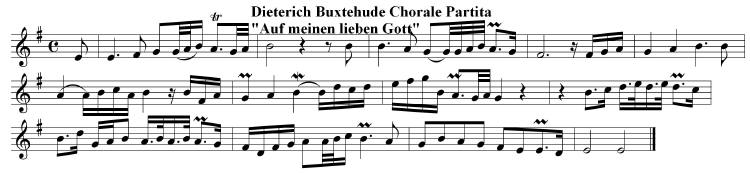
Dietrich Buxtehude (c 1637-1707):
BuxWV 179 Chorale variations on Auf meinen lieben Gott |
|
|
|
>>A speciality of the north German organist lay in the imaginative presentation of Lutheran chorales, and Buxtehude’s 47 chorale settings constitute the major part of his organ works. They fall into three groups – chorale variations, chorale fantasias and chorale preludes – each showing a distinctive approach to the chorale. Sets of chorale variations had been cultivated extensively by Sweelinck and Scheidt but do not figure very prominently in Buxtehude’s output. Consisting of only three or four verses, they are often restricted to the manuals alone and sometimes to only two voices (as in the traditional bicinium) and the cantus firmus frequently appears unornamented (e.g. buxwv213). In terms of variety and keyboard technique they do not match the variations of Pachelbel and Böhm. The variations on “Auf meinen lieben Gott” (BuxWV 179) form an exception; as a dance suite on a chorale tune, however, they were more likely intended for performance on the harpsichord.<< written by Kerala J. Snyder in Grove Music Online [Oxford University Press, 2005, acc. 8/12/05.] Also reporting from the same source are Robert L Marshall and Robin A. Leaver who state: >>There are over 40 surviving organ chorales by Buxtehude, Tunder’s successor at Lübeck, and they constitute the most important contributions to the genre in the 17th century. His settings include chorale variations, chorale ricercares, chorale fantasias and chorale preludes. Buxtehude’s chorale variations are mostly conservative, cast in the forms of bicinia and tricinia. The cantus firmus in these settings, however, is usually not presented in the traditional long notes but in normal rhythms, and the counter-voices are not mechanically patterned but rather freely spun out in the manner of Scheidemann (1595-1663):
Buxtehude’s variation ‘suite’ on Auf meinen liebenGott, in which the individual verses or variations are set respectively in the forms of allemande and double, sarabande, courante and gigue, is unique in the history of the organ chorale (indeed, the keyboard style and the absence of an independent pedal part strongly suggest that the work was intended for the harpsichord).<<
|
|
Johann Michael Bach (1648-1694):
Auf meinen lieben Gott, Cantata for SATB, 2 violins, bc [Lost, listed in Schweinfurt inventory, 1689] |
|
Johann Pachelbel (1653-1706):
Auf meinen lieben Gott, Chorale Prelude for Organ |
|
|
|
Friedrich Wilhelm Zachow (1663-1712):
Auf meinen lieben Gott, Chorale Prelude for Organ |
|
Georg Böhm (1661-1733):
Auf meinen lieben Gott, Chorale Partite for Organ |
|
Johann Nicolaus Hanff (1665-1711/1712):
Auf meinen lieben Gott, Chorale Prelude for Organ |
|
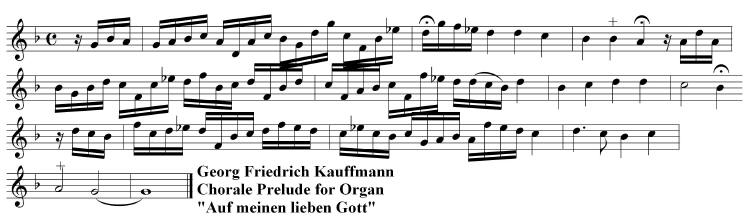
Georg Friedrich Kauffmann (1679-1735):
Chorale prelude on Auf meinen lieben Gott (Leipzig, 1733) |
|
|
|
Johann Theodor Römhild (1684-1756):
Solo cantata Auf meinen lieben Gott for soprano, 2 violins, and bc. |
|
Johann Friedrich Doles, sr.(1715-1797):
Various chorale preludes for organ on Auf meinen lieben Gott |
|
Arnold Ludwig Mendelssohn (1855-1933):
Chorale Cantata Auf meinen lieben Gott, op. 61 (Leipzig, 1914) |
|
Ernst Pepping (1901-1981):
Auf meinen lieben Gott, composition using 2-5 voices (1934) |
|
Camillo Carlsen (1876-1948):
10 chorale variations for organ on Auf meinen lieben Gott, Op. 48 (1938) |
| |
|
Arrangements/Transcriptions of Bach's use of the Chorale Melody: |
|
See list of Piano Transcriptions of BWV 646 by various composers/arrangers at:
Piano Transcriptions of Bach's Works - Index by BWV Number Part 4: Chorale Preludes for Organ |
| |
|
Sources: NBA, vols. III/2.1 & 2.2 in particular [Bärenreiter, 1954 to present] and the BWV ("Bach Werke Verzeichnis") [Breitkopf & Härtel, 1998]
The PDF files of the Chorales were contributed by Margaret Greentree J.S. Bach Chorales
Software: Capella 2004 Software, version 5.1.
Prepared by Thomas Braatz & Aryeh Oron (August 2005, March 2008) |

