|
Chorale Melodies used in Bach's Vocal Works
Herr Gott, dich loben wir
Das Deutsche Tedeum ("The German Te Deum") |
|
Melody & Text | Use of the CM by Bach | Use of the CM by other composers | | Arrangements/Transcriptions |
| |
|
Melody & Text: |
|
Composition: Zahn: 8652 | EKG: 137 |
|
This melody is based upon an early Christian Te deum laudamus, which in turn is derived from an evening song of the Greek church, the melody of which appears to come from either an evening song of the late Jewish synagogue or from very early Christian rites. The melody probably goes back to 3rd or even 2nd century AD. Martin Luther modified/transformed it into its present form which first appeared in “Geistliche Lieder” edited and published by Joseph Klug in Wittenberg, 1529. This particular first edition is no longer available for inspection as no copy has been found anywhere in modern times.
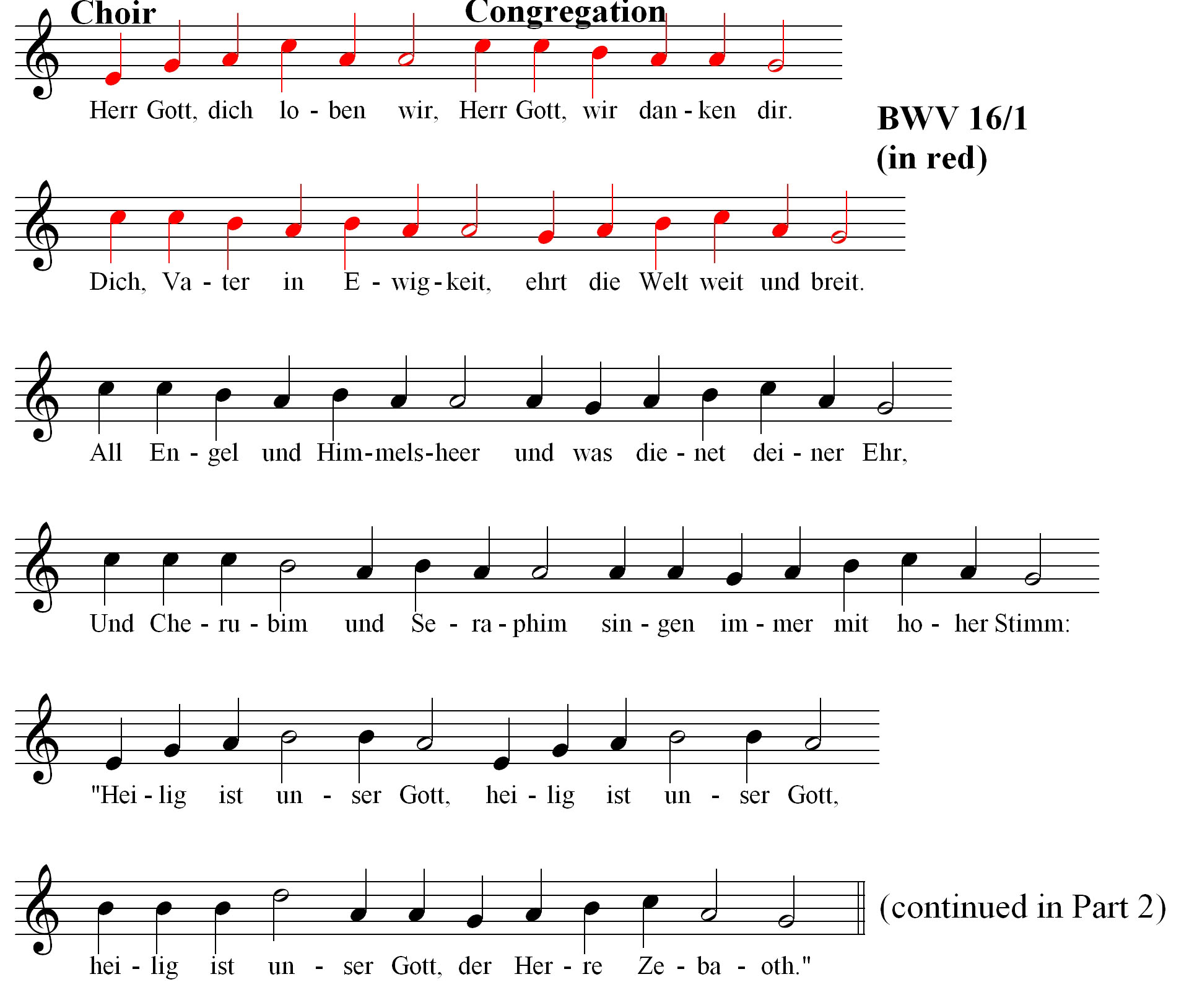
Das Deutsche Tedeum ("The German Tedeum"), or sometimes referred to as Der Ambrosianische Lobgesang (“the Song of Praise of St. Ambrose”) according to a traditional belief during the Middle Ages, is generally included in a special section of German hymnals devoted to Liturgische Gesänge (“liturgical songs/chants”) and consists of antiphony between a choir and the congregation which only sing together in two places: 1. “heilig ist unser Gott, der Herre Zebaoth” and 2. the final “Amen.”
Although most Te Deum settings in various European countries (Italy, France, England, primarily) go back to a generally common sources, the Luther version of the “Te Deum” is quite distinctive and diverges in numerous ways from chants used elsewhere in various settings. Here is what John Caldwell states regarding this matter: |
|
>> Luther’s version, Herr Gott dich loben wir, also based on the Gregorian melody, gave rise to such widely diverse settings as the six by Michael Praetorius, the organ settings of Scheidt (Tabulatur-Buch, 1650), Buxtehude and J.S. Bach, and Bach’s four-part chorale version in the edition of C.P.E. Bach.<< [Grove Music Online, Oxford University Press, 2005, acc. 9/14/05]
|
|
It becomes important to distinguish the melody of Martin Luther’s Das Deutsche Tedeum from that of other equally important, but differing versions: Carl Heinrich Graun (1704/1704-1759), for example, composed a Te Teum on a grand scale in Berlin for King Frederick the Great based upon the Italianate version with which he (Graun, who never served directly as music director and/or organist in a traditional German Lutheran church) was primarily acquainted. For this reason John Caldwell, in the article referred to, comments as follows on the ‘grand Te Deum tradition’: |
|
>>A new tradition of festive settings was inaugurated in the Baroque era with the large-scale works of Benevoli, Lully, C.H. Graun and others, and continued in the later 18th century with the settings by Giuseppe Sarti, Michael Haydn (who wrote six) and the two by Joseph Haydn. Joseph Haydn’s second work is a remarkably fine piece from 1800 or shortly before, the first of a number of striking compositions of the 19th and 20th centuries. These include works by Berlioz (written for the Paris Exhibition, 1855), Bruckner (1885), Dvořák (1896), Verdi (1898, Paris) and Kodály (1936, written to celebrate the 250th anniversary of the relief of Buda from Turkish occupation).<<
|
|
There is also an English tradition for which Georg Friedrich Händel composed a Te Deum which also can not be directly compared with the version with which Bach was acquainted and for which Bach offered some equally festive settings, albeit often only fragmental sections of Luther’s German Tedeum.
Caldwell continues: |
|
>>The tradition of festal settings in English begins with Purcell’s of 1694 (for St Cecilia’s Day, with Jubilate) and continues with those of Handel (‘Utrecht’, 1713, and ‘Dettingen’, 1743), Sullivan (1900), Parry (1911), Stanford (B , 1898) and Walton (1953). Parry and Stanford also wrote Latin works (1898, 1900) and Parry revised his Latin setting to English words for performance in 1913. Walton’s piece, a distinguished contribution to the genre, was written for the coronation of Queen Elizabeth II.<<
|
|
Not even Johann Christian Bach, Bach’s own son, set The German Tedeum in the manner of his father, but rather composed a Tedeum in 1759 in Milan for performance in Milan. An English version of another Tedeum was composed by this Bach in England in 1762.
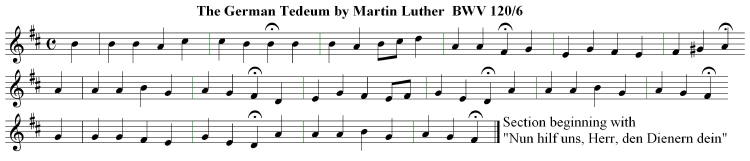
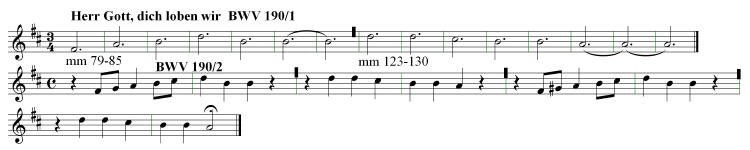
And yet, the portions of the Luther German Tedeum which Bach, Praetorius and others did set were no less festive than those mentioned by Caldwell, with many of these German Tedeum settings involving 8 vocal parts broken into two choirs along with instrumental accompaniment. BWV 190/1 requires 3 trumpets and timpani, 3 oboes, bassoon, strings + continuo to ‘accompany’ the 4 vocal parts. As will be clear from the listing of Bach’s works using this melody given below, Bach often set only portions of this rather lengthy liturgical chant.
It will be an arduous task based upon examining only the titles of compositions to separate the non-German Tedeums from the even greater number of festive Tedeum settings that abound throughout Europe. The following guidelines, certainly not 100% fool-proof, were used to sift the settings based upon Luther’s version of the Tedeum from all the others:
1.) The use of the words Das Deutsche Tedeum or the incipit Herr Gott dich loben wir make quite clear that Luther’s version was used in the setting
2) The use of simply Tedeum, even by German composers, usually points away from the Luther version unless it can be determined that the composer composed it for use in a Lutheran church that adhered closely to the established regulations of a Lutheran church service. (C.H. Graun serves as an example of such a composer who composed and performed an Italianate version using original Latin text in a German church in Berlin which King Frederick the Great visited in order to hear a Tedeum on a grand scale in a large-scale setting.)
3) The use or inclusion of the Latin incipit Te Deum laudamus in the title frequently indicates that Luther’s Das Deutsche Tedeum was not used as a basis for the composition. |
| |
|
Original Melody Source: |
|
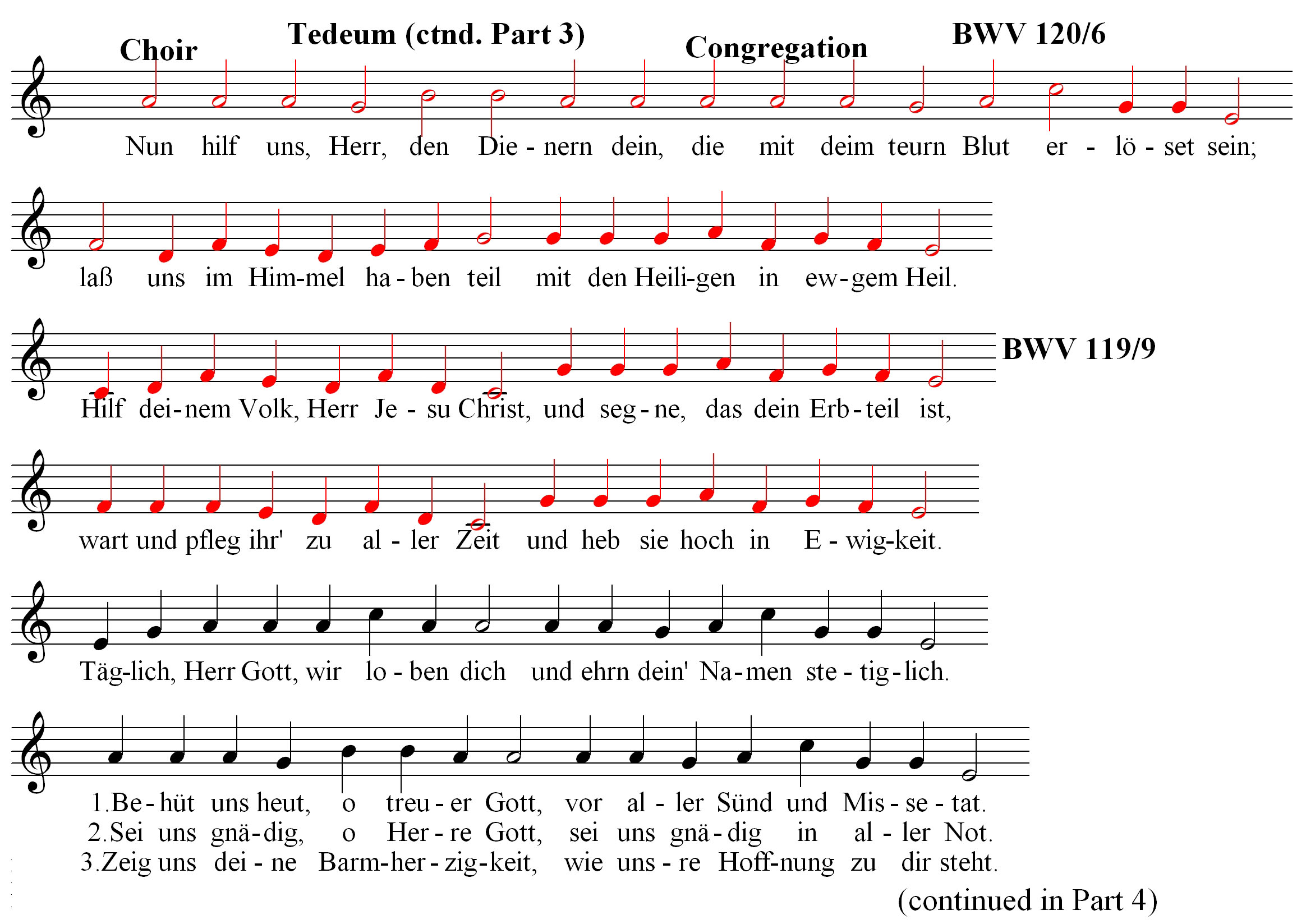
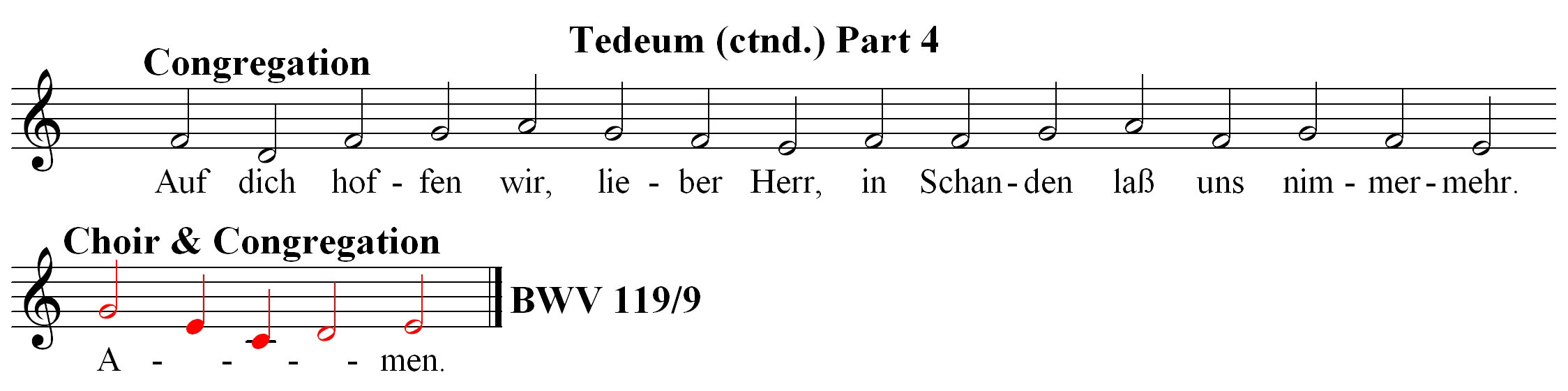
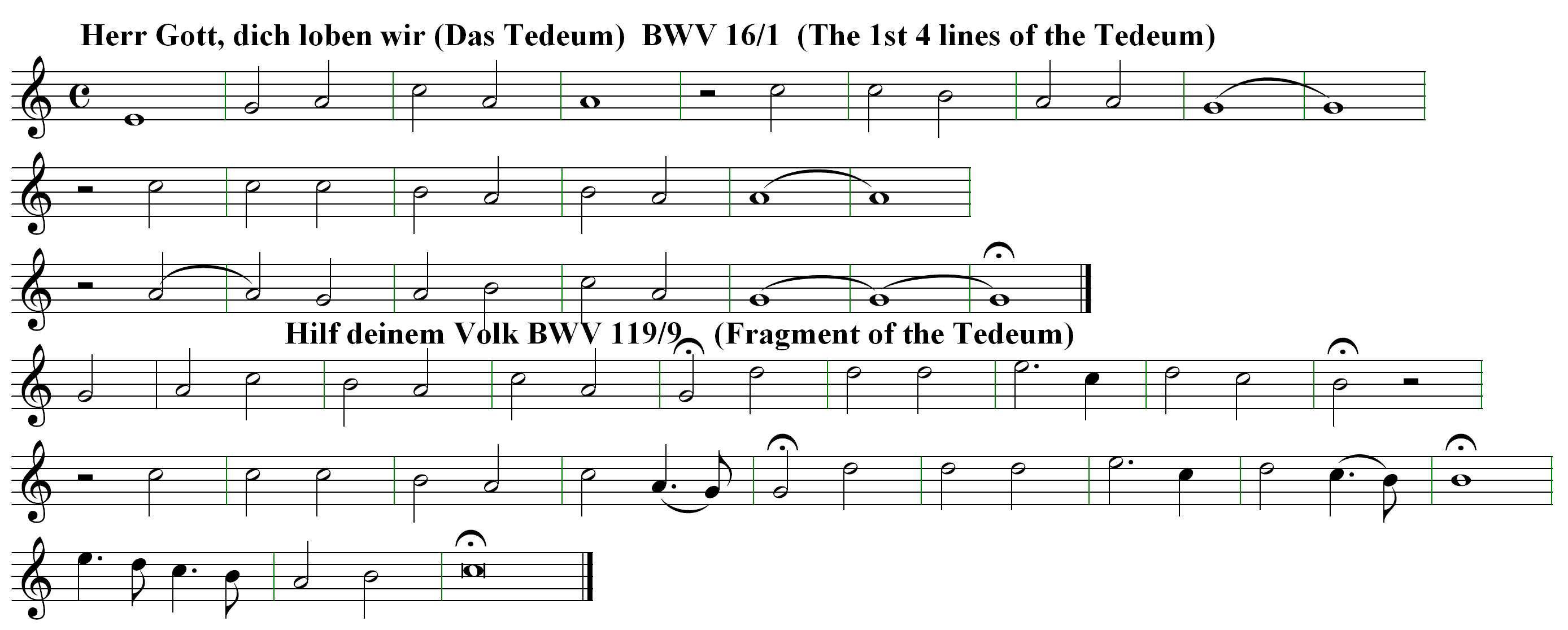
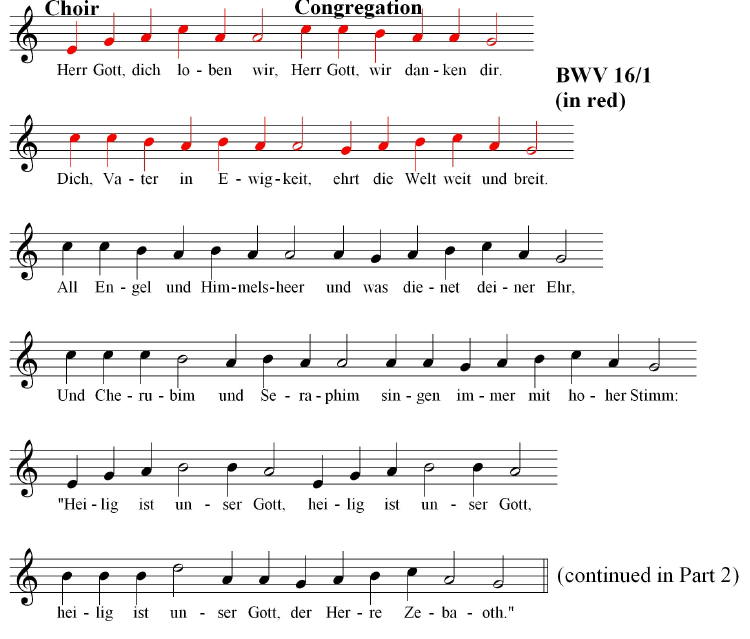
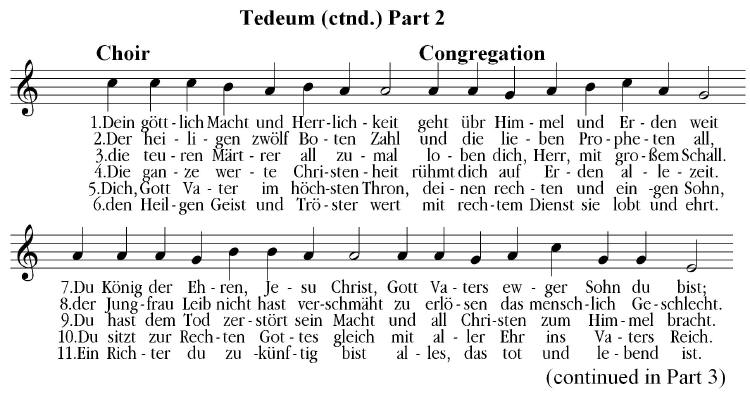
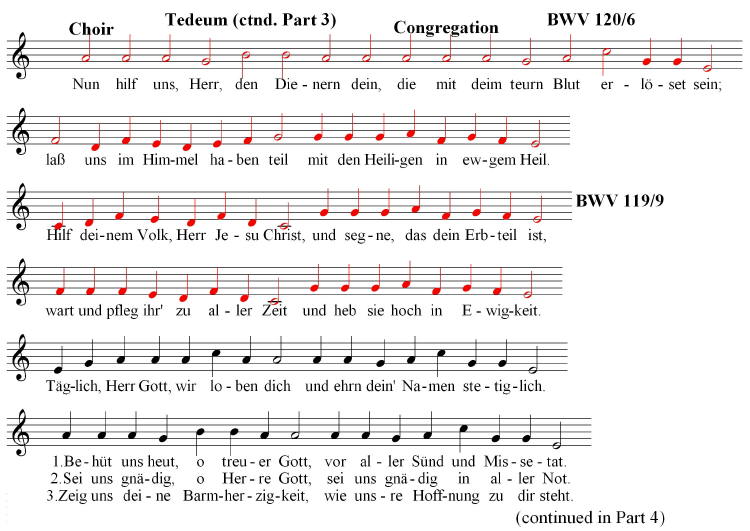
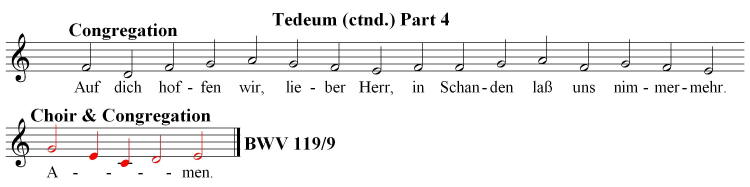
The last surviving first printing and appearance of Luther’s Das Deutsche Tedeum was destroyed in a fire during the 19th century. The current EKG, as indicated above, still includes the antiphonal chant. It can be viewed along with indications as to which parts Bach set to music. |
|
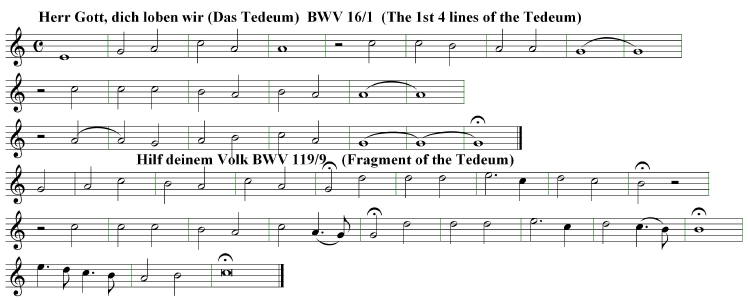
Das Tedeum Part 1 (and BWV 16/1): |
|
|
|
Das Tedeum Part 2: |
|
|
|
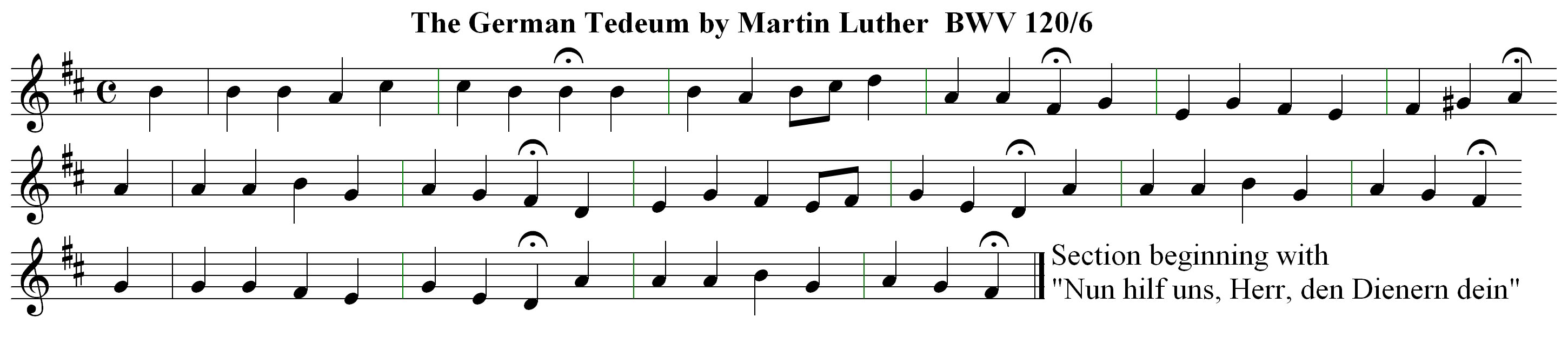
Das Tedeum Part 3 BWV 120/6 and BWV 119/9: |
|
|
|
Das Tedeum Part 4 BWV 119/9: |
|
|
| |
|
Text: EKG: 137 Herr Gott, dich loben wir [The German Tedeum] |
|
The EKG surmises that the Latin text which Martin Luther used as a basis for his German rendition might have originated with Niketas von Remesiana (?) (Niceta of Remesiana) who lived from circa 366 to circa 420 AD. |
| |
|
Use of the Chorale Melody by : |
|
Text: EKG: 137 Herr Gott, dich loben wir [The German Tedeum]
[there are no verses since it is treated as one long chant] |
|
Ver |
Work |
Mvt. |
Year |
Br |
RE |
KE |
Di |
BC |
Score |
Music Examples |
|
- |
BWV 16 |
Mvt. 1 |
1726 |
- |
- |
- |
- |
A57:1 |
- |
Mvt. 1 (Leusink) [ram] |
|
- |
BWV 119 |
Mvt. 9 |
1723 |
- |
134 |
- |
- |
B3:9 |
PDF |
Mvt. 9 (MG) [midi] | Mvt. 9 (Leusink) [ram] |
|
- |
BWV 120 |
Mvt. 6 |
1729 |
- |
135 |
- |
- |
B6:6 |
PDF |
Mvt. 6 (MG) [midi] | Mvt. 6 (Leusink) [ram] |
|
- |
BWV 190 |
Mvt. 1 |
1724 |
- |
- |
- |
- |
A21:1 |
- |
|
|
* |
BWV 190 |
Mvt. 2 |
1724 |
- |
- |
- |
- |
A21:2 |
- |
|
|
* |
BWV 190a |
Mvt. 2 |
1730 |
- |
- |
- |
- |
B27:2 |
- |
|
|
* BWV 190/2 = BWV 190a/2 |
|
|
|
|
|
|
|
|
|
|
|
|
|
|
| |
|
Untexted: |
|
Ver |
Work |
Mvt. |
Year |
Br |
RE |
KE |
Di |
BC |
Score |
Music Examples |
|
*** |
BWV 328 |
- |
? |
205 |
133 |
205 |
- |
F38:1 |
PDF |
Chorale (MG) [midi] |
|
*** |
BWV 725 |
- |
1700-17 |
- |
- |
- |
- |
K99 |
- |
|
|
** In the ‘Orgelbüchlein’ Bach had allotted space only for a short chorale prelude based upon Herr Gott, dich loben wir, one which he never did get around to composing.
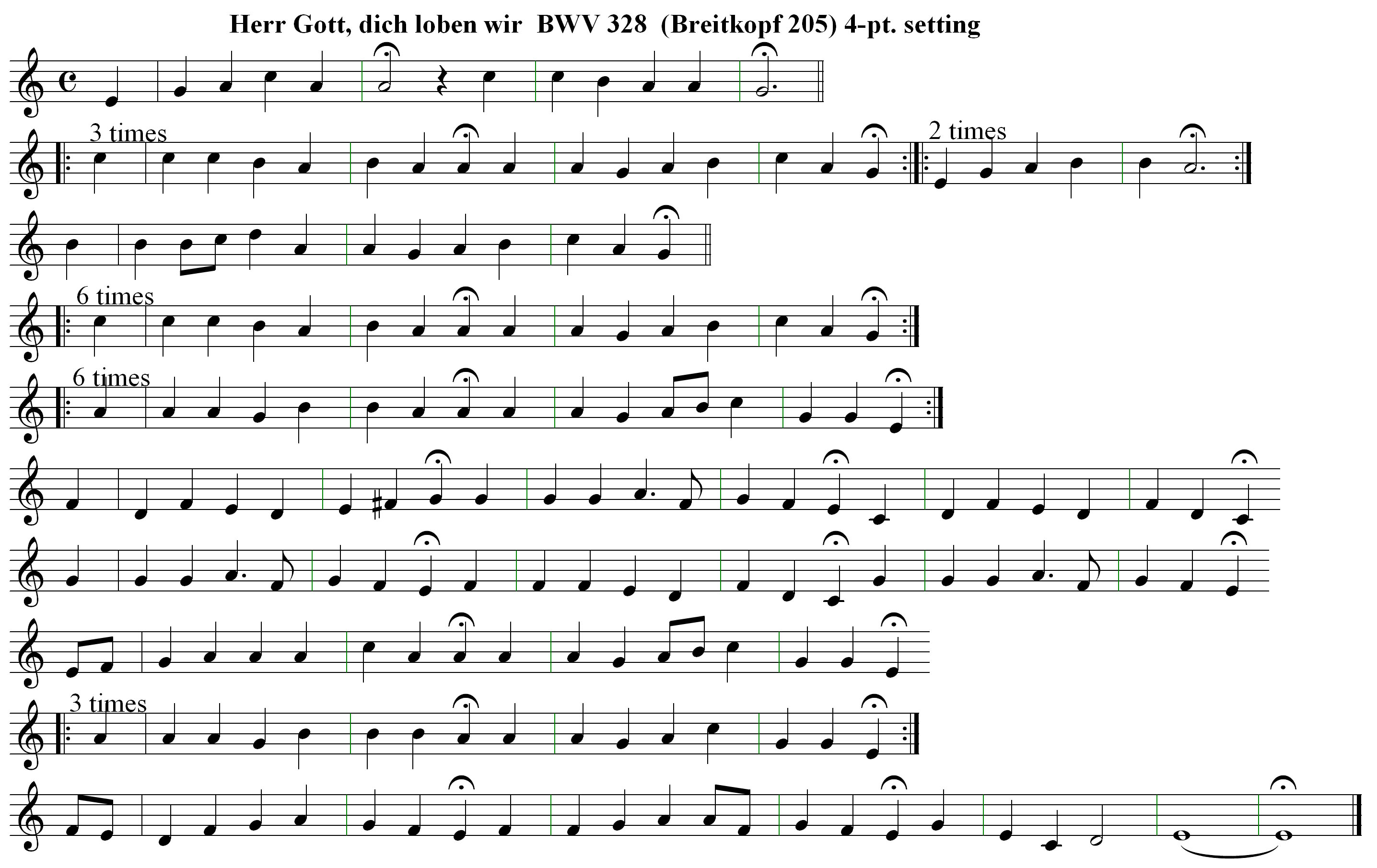
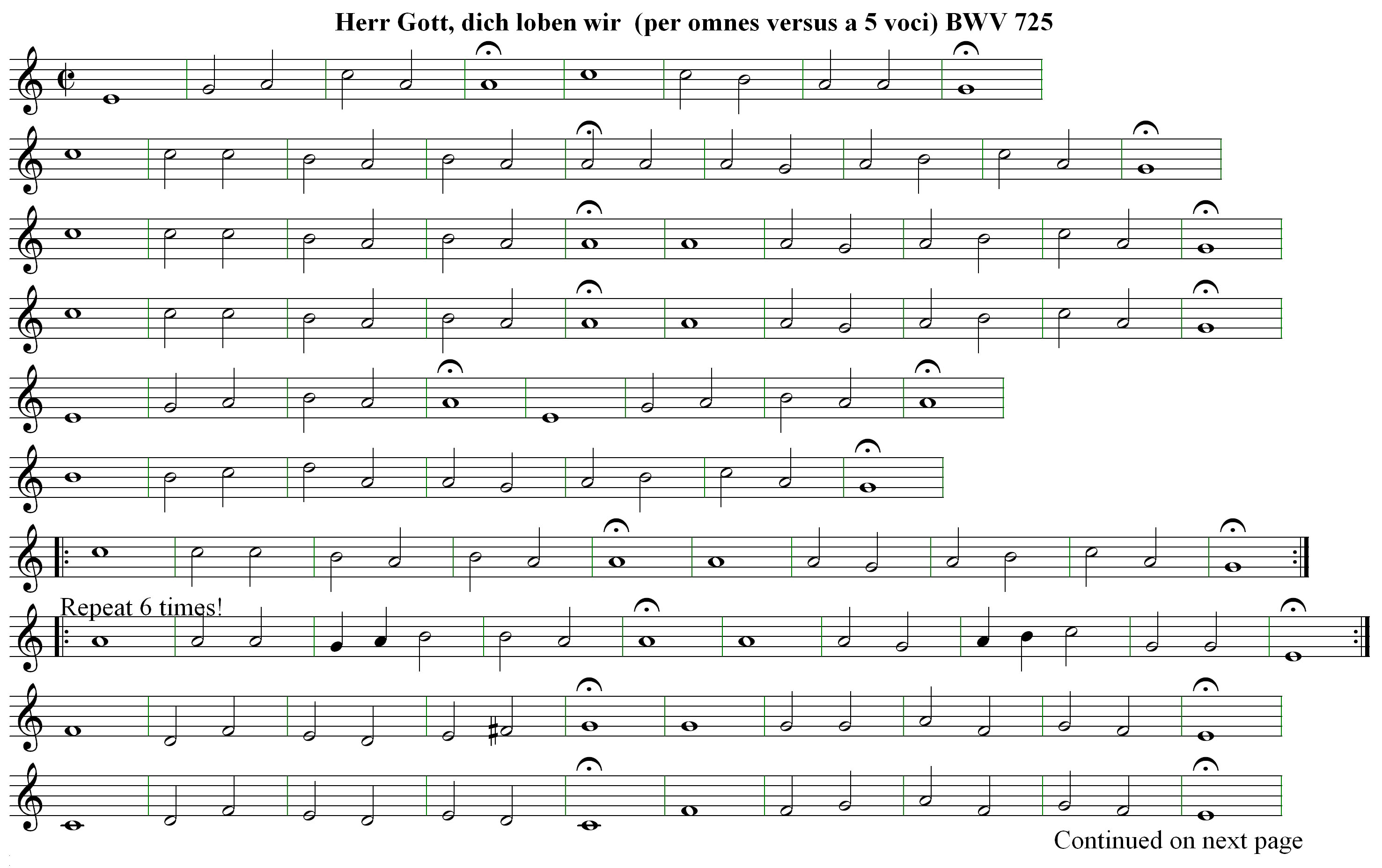
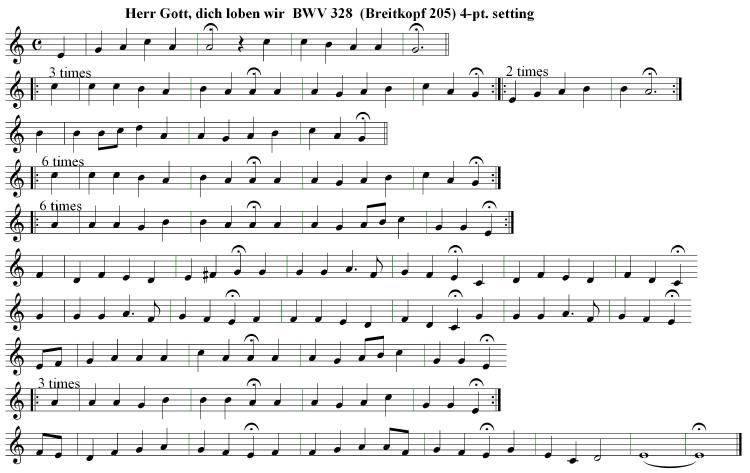
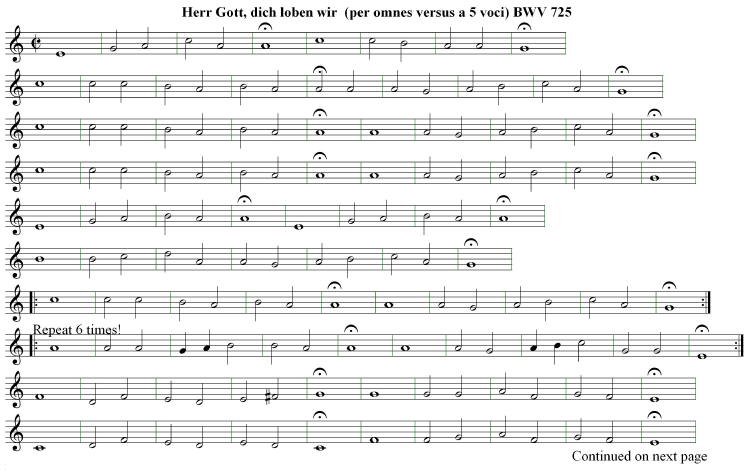
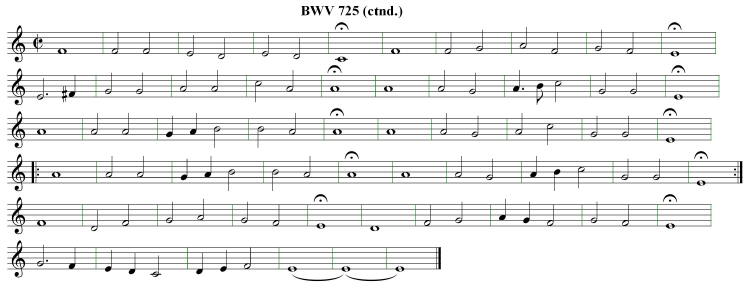
*** BWV 328 is a 4-pt setting probably for voices from a cantata or other work which can no longer be found while BWV 725 is a 5-pt. setting for organ. Peter Williams [“The Organ Music of J. S. Bach” Cambridge University Press, 2003, p. 467] summarizes as follows: BWV 328 often agrees with BWV 725 when it does not re-harmonize for a new verse; mm 188-212 have a different melody. |
|
|
|
|
|
|
| |
|
Use of the Chorale Melody by other composers: |
|
Leonhard [Leonhart] Schroeter [Schröter] (c1532-c1601):
Te Deum laudamus (deutsch) componiret durch Leonhartum Schoetern, Octo auf zween Chor, Anno Domini, 1571
Der schöne Lobgesang Te Deum laudamus durch D. Martin Luther verdeutscht, for 8 voices (Magdeburg, 1576)
Canticum sanctorum Ambrosii et Augustini Te Deum laudamus, for 8 voices, incomplete (Magdeburg, 1584) |
|
Jacobus Syring (died 1606):
Te Deum laudamus Teutsch (Ülzen, 1583) |
|
Bartholomäus Gesius [Gesaius] (1555-62? - 1613):
Herr Gott dich loben wir for 5 voices (1598) |
|
Sethus Calvisius (1556-1615):
Herr Gott, dich loben wir (Te Deum laudamus)
4-pt. setting for 2 choirs |
|
Melchior Vulpius (c1560-1615):
Herr Gott, dich loben wir a 4-pt. setting for 2 choirs from Kirchen Geseng vnd Geistliche Lieder D. Martini Lutheri vnd anderer frommen Christen (1604) |
|
Hieronymus Praetorius (1560-1629):
A motet for 16 voices Herr Gott dich loben wir (The German Te Deum) (1612)
[From the Grove Music Online, Oxford University Press, 2005, acc. 9/15/05, Frederick Gable describes the important contribution of this Praetorius (not Michael!) to the Lutheran church music tradition: |
|
>>Hieronymus Praetorius
(born Hamburg, Aug 10, 1560; died Hamburg, Jan 27, 1629). Composer, organist, copyist and music editor, son of Jacob Praetorius. After receiving his first organ instruction from his father, he studied at Hamburg with Hinrich thor Molen during 1573 and at Cologne with Albinus Walran from 1574 to 1576. His first position was as organist at Erfurt from 1580 to 1582, when he returned to Hamburg as assistant organist to his father at the Jacobikirche (with the chapel of St Gertrud); on his father’s death in 1586 he became first organist, and he held this post until his death. He took part in the Gröningen organ examination of 1596, which Hans Leo Hassler and Michael Praetorius also attended; this was probably his only personal contact with other composers of polychoral works. Three of his four sons were musicians too….the third son, Michael, published a five-part wedding motet at Hamburg in 1619 and died at Antwerp possibly in 1624.
All but five of Praetorius’s masses, motets and vocal Magnificat settings were published between 1616 and 1625 in Hamburg as a five-volume collected edition. Some of the volumes had been published in earlier editions and a number of motets from the first two volumes appeared in the printed collections of Bodenschatz, Phalèse and Schadaeus. All of Praetorius’s masses are parody masses, four based on his own motets and the other two on motets by Jacob Meiland and Stefano Felis. His 102 motets set mostly psalm and antiphon texts, but he also composed several wedding motets to non-liturgical Latin texts which were both published separately and in the collected edition of the most progressive and important works.<<
|
|
To find out more about this important musical figure, see: Hieronymus Praetorius - Short Biography |
|
Johann Hermann Schein (1586-1630):
Das Tedeum (1618) in 4 Chor und 2 Capellen ausgeteilet (“divided into 4 choirs of instruments and 2 vocal choirs”)
Herr Gott, dich loben wir, SATB [bc] (1627) |
|
Jacob Praetorius (ii) (1586-1651):
Herr Gott dich loben wir, Chorale Prelude for Organ (1636) |
|
Samuel Scheidt (1587-1654):
Herr Gott, dich loben wir, a 12 (having 12 parts);
Te Deum laudamus, polychoral |
|
Johann Andreas Herbst [Autumnus] (1588-1666):
Herr Gott dich loben wir for 8 voices |
|
David Schedlich [Schädlich] (1607-1687):
Herr Gott dich loben wir for 23 voices, performed in 1649; lost |
|
Franz Tunder (1614-1667):
Herr Gott, dich loben wir, Chorale Fantasia for Organ |
|
Johann Erasmus Kindermann (1616-1655):
Cantata Herr Gott, dich loben wir for 6 voices and instruments |
|
Peter Morhard [Mohrhardt, Mohrhart] (died in Lüneburg, 1685):
German composer and organist. He is first heard of in 1662, when he became organist of the Michaeliskirche, Lüneburg
An organ arrangement: Herr Gott, dich loben wir [with prelude] |
|
Andreas Kneller (1649-1724):
Preambulatory Tedeum Versettes for Organ on Herr Gott dich loben wir |
|
Johann Kuhnau (1660-1722):
A Deutsches Tedeum on the occasion of the 200th Anniversary of the Reformation in 1717. Kuhnau's authorship still not firmly proven. |
|
Georg Philipp Telemann (1681-1767):
Alleluja, Herr Gott, dich loben wir, sacred cantata for chorus, 2 oboes, 2 trumpets, timpani, strings & continuo, TWV 1:63 (1731)
Herr Gott, dich loben wir, wedding cantata for chorus, flute, oboe, bassoon, 3 trumpets, timpani, strings & continuo, TWV 11:15a (1732)
Herr Gott, dich loben wir (III), sacred cantata for chorus, f, bassoon, 2 violins, viola & continuo, TWV 1:745 |
|
Johann Ludwig Krebs (1713-1780):
Herr Gott, dich loben alle wir, Chorale for organ |
|
Johann Lorenz Albrecht (1732-1773):
A sacred song Herr Gott, dich loben wir (Berlin, 1768) |
|
Friedrich Schwindl [Schwindel] (1737-1786):
Herr Gott dich loben wir (TeDeum), SSATB, orchestra, organ, later arranged by others for SATB, orchestra, and even a Latin text version for SATB, orchestra |
|
Friedrich Wilhelm Rust (1739-1796):
Herr Gott dich loben wir a cantata for solo voices, chorus, and orchestra |
|
Johann Philipp Schönfeld (1742-1790):
A cantata Herr Gott, dich loben wir for S, B, chorus, orchestra |
|
Justin Heinrich Knecht (1752-1817):
Herr Gott, dich loben wir a vocal composition before 1799 |
|
Felix Mendelssohn-Bartholdy (1809-1847):
Herr Gott, dich loben wir (TeDeum), solo voices, double chorus, 4 trombones, strings, organ completed 16 July 1843, performed in Berlin, 6 Aug 1843
In the Grove Music Online, quoted from above, R. Larry Todd states: |
|
>> Mendelssohn was instructed to direct each year orchestral soirées and two oratorios, and to supervise the church music for high holy days. But decisions about the nature and role of music in the Prussian service were deferred. Soon afterwards Mendelssohn received a commission to prepare a new setting of the Te Deum (Herr Gott, dich loben wir), an onerous task he completed in two days, for a performance in Berlin Cathedral on 6 August marking the millennium of the founding of the German Reich.<<
|
|
Friedrich Wilhelm Franke (1862-1932):
Das deutsche Tedeum for mixed choir, baritone solo and orchestra |
|
Hans Friedrich Micheelsen (1902-1973):
Deutsches Tedeum for 5 voices |
|
Kurt Fiebig (1908-1988):
Deutsches Tedeum |
| |
|
Arrangements/Transcriptins of Bach's use of the Chorale Melody: |
|
Peter Baekgaard:
Transcription for organ of Chorale (Mvt. 1) from Cantata BWV 16. See:
PDF |
| |
|
Sources: NBA, vols. III/2.1 & 2.2 in particular [Bärenreiter, 1954 to present] and the BWV ("Bach Werke Verzeichnis") [Breitkopf & Härtel, 1998]
The PDF files of the Chorales were contributed by Margaret Greentree J.S. Bach Chorales
Software: Capella 2004 Software, version 5.1.
Prepared by Thomas Braatz & Aryeh Oron (September 2005) |