|
|
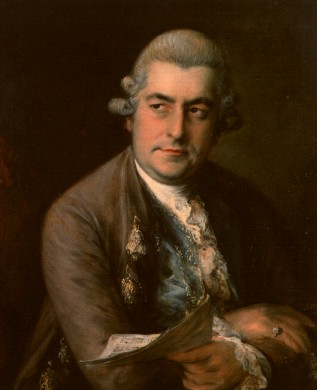
Johann Christian Bach [50] (Composer, Bach's Pupil ) |
|
Born: September 5, 1735 - Leipzig, Germany
Died: January 1, 1782 - London, England |
|
Johann Christian Bach [50] was a composer of the Classical era, the eleventh and youngest son of J.S. Bach [24]. He is sometimes referred to as 'the London Bach' or 'the English Bach', due to his time spent living there. He is noted for influencing the concerto style of Mozart. |
|
Life |
|
Johann Christian Bach [50] was born to J.S. Bach [24] and Anna Magdalena Bach in Leipzig, Germany. His distinguished father was already 50 at the time of his birth, which would perhaps contribute to the sharp differences between his music and that of his father. He was also J.S. Bach’s copyist in the years 1746-1750. Even so, his father first instructed him in music until he died when Johann Christian was 15, after which he worked in Berlin with his second oldest brother Carl Philipp Emanuel Bach [46], considered at the time to be the most musically gifted of Bach's sons.
Johann Christian Bach lived in Italy for many years starting in 1756, first studying with Padre Martini in Bologna and later with Giovanni Battista Sammartini. He became an organist at a cathedral in Milan in 1760. He also embarked on an operatic career, with operas staged in Turin and Naples. During his time in Italy he converted from Lutheranism to Catholicism. He met soprano Cecilia Grassi in 1766 and married her shortly thereafter. She was about eight years older than Johann Christian and, perhaps because of this, they never had children.
Johann Christian Bach was then invited to compose for the King's Theatre in London, where he settled in 1762; his operatic career was patchy, but he was soon appointed as music master for Queen Charlotte and was successful as a teacher. He also promoted and played in a prominent concert series with his compatriot and friend Carl Friedrich Abel, a notable player of the viola da gamba. Together they brought the newest and best European music to Londoners' notice. He befriended the boy W.A. Mozart on his London visit, 1764-1765. Many of his works were published, including songs written for Vauxhall Pleasure Gardens. In 1772 and 1774 he visited Mannheim for performances of his operas Temistocle and Lucio Silla; In 1779 he wrote Amadis de Gaule for the Paris Opיra. But the success of these works, like that of his London operas, was limited. His popularity faded in the late 1770's, and after financial troubles his health declined; he died in London at the beginning of 1782, and was soon forgotten. |
|
Music |
|
Johann Christian Bach composed cantatas, chamber music, keyboard and orchestral works, operas and symphonies. His music blends sound German technique with Italian fluency and grace; hence its appeal to, and influence upon, the young Mozart. His symphonies follow the Italian three-movement pattern: the light, Italian manner of his earlier ones gave way to richer-textured and more fully developed writing by the mid-1760's. The peak of his output comes in the six symphonies of his Op. 18, three for double orchestra and exploiting contrasts of space and timbre. His interest in orchestral colour gave rise to several symphonies concertantes, for various soloists and orchestra, suitable material for his London concerts. At these he also played his piano concertos, attractive for their well-developed solo-tutti relationship though still modest in scale. Of his chamber music, the Op. 11 quintets (flute, oboe, strings and continuo) are particularly appealing for their charming conversational style and their use of colour. He also composed keyboard sonatas, with and without violin accompaniment, in a style accessible to his pupils and players of modest ability. His music is often leisurely in manner, and this must have militated against the operas success as dramatic music. He also composed a quantity of Latin sacred music during his time in Italy. Though sometimes regarded as a decadently hedonistic composer by comparison with his brother Carl Philipp Emanuel Bach, Johann Christian stands firmly as the chief master of the galant, who produced music elegant and apt to its social purpose, infusing it with vigour and refined sensibility. |
|
Posthumous evaluation |
|
Although Bach's fame declined in the decades following his death, his music still showed up on concert programmes in London with some regularity, often coupled with works by Haydn. In the 19th century, scholarly work on the life and music of Johann Christian's father began, but this often led to the exaltation of J.S. Bach 's music at the expense of that of his sons; Philipp Spitta claimed towards the end of his J.S. Bach biography that "it is especially in Bach's sons that we may mark the decay of that power which had culminated [in Sebastian] after several centuries of growth" (Spitta, Vol. 3, p. 278), and J.S. Bach's first biographer, Johann Nikolaus Forkel, said specifically of Christian that "The original spirit of Bach is . . . not to be found in any of his works" (New Bach Reader, p. 458). It was not until the 20th century that scholars and the musical world began to realize that Bach's sons could legitimately compose in a different style than their father without their musical idioms being inferior or debased, and composers like Johann Christian began to receive renewed appreciation.
Johann Christian Bach is of some historical interest as the first composer who preferred the piano to older keyboard instruments such as the harpsichord. Johann Christian’s early music shows the influence of his older brother Carl Philipp Emanuel Bach, while his middle period in Italy shows the influence of Sammartini. |
|
Contrasting styles of J.S. Bach and J.C. Bach |
|
Johann Christian Bach's father died when Johann Christian was only fifteen, perhaps one reason why it is difficult to find points of similarity between the music of J.S. Bach and that of Johann Christian. By contrast, the piano sonatas of Carl Philipp Emanuel Bach, Johann Christian's much older brother, tend to invoke certain elements of the father at times, especially as regards the use of counterpoint. (Carl Philipp Emanuel Bach was 36 by the time J.S. Bach died.)
Johann Christian's music departs completely from the styles of the elder Bachs in being highly melodic. He composed in the galant style incorporating balanced phrases, emphasis on melody and accompaniment, without too much contrapuntal complexity. The galant movement was against the intricate lines of Baroque music, and instead placed importance on fluid melodies in periodic phrases. It preceded the classical style, which fused the galant aesthetics with a renewed interest in counterpoint. |
|
J.C. Bach and the symphony |
|
The symphonies in the Work List for J.C. Bach in the New Grove Bach Family listed ninety-one works. A little more than half of these, 48 works, are considered authentic, while the remaining 43 are doubtful.
By comparison, the composer sometimes called "the Father of the Symphony," Joseph Haydn, wrote slightly over 100 symphonies. Most of these are not fully comparable to Johann Christian Bach's symphonies, because many of Johann Christian's works in this category are cloto the Italian sinfonia than to the late classical symphony in its most fully developed state as found in the later works in this category by Haydn and Mozart.
Using comparative duration as a rough means of comparison, consider that a standard recording of one of Bach's finest symphonies, Op. 6 no. 6 in g minor, has a total time of 13 minutes and 7 seconds (as performed by Hanover Band directed by Anthony Halstead), while Haydn's "Surprise" Symphony in a typical recording (by Ádám Fischer conducting the Austro-Hungarian Haydn Orchestra) lasts 23 minutes and 43 seconds.
It is clear that the listener of J.C. Bach's symphonies should come to these works with different expectations from the ones he or she brings to those of Haydn or Mozart. Concert halls today are frequently filled with the music of Haydn, and comparatively rarely with that of J.C. Bach, which probably has less to do with their relative quality (since the music of the latter is clearly accomplished and worthy of being heard) than with their relative historical positions regarding the classical symphony. But J.C. Bach's music is more and more being recognized for its high quality and significance. The Halstead recording mentioned above is part of a complete survey of this composer's orchestral works on 22 CD's for the record label CPO, and the complete works of J.C. Bach have now been published in The Collected Works of Johann Christian Bach. |
|
Works |
|
Orchestral music:
Over 40 symphonies and overtures, including 6 each in Op. 3 (1765), Op. 6 (1770), Op. 8 (c1775), Op. 18 (c1782), 3 in Op. 9 (1773)
12 symphonies concertantes
25 keyboard concertos, including 6 each in Op. 1 (1763), Op. 7 (1770), Op. 13 (1777)
2 oboe concertos
2 bassoon concertos
Chamber and wind music:
Keyboard sextet
2 keyboard quintets
Keyboard quartet
35 accompanied keyboard sonatas
6 quintets Op. 11 flute, ob, vn, va, bc (1774)
Quartets, strings, flute and strings, 2 flutes and strings
Flute quartets
6 strings trios Op. 2 (1763)
Over 20 trio sonatas, duets
Wind sinfonias, wind quintets, marches
Keyboard music:
6 sonatas Op. 5 (1766)
6 sonatas Op. 12 (1774)
Other sonatas arrangements, duets
Dramatic music:
Orione (1763)
Temistocle (1772)
Lucio Silla (1774)
La clemenza di Scipione (1778)
Amadis de Gaule (1779)
6 others
Contributions to other composers works
Gioas, roi di Guida, oratorio (1770)
Sacred vocal music:
About 30 works, incl. Dies irae, c (1757)
Secular vocal music:
6 cantatas and serenatas
19 chamber duets
Vauxhall songs
Arias, songs, folksong settings, transcriptions |
 |
|
Source: Wikipedia Website (from the Encyclopædia Britannica Eleventh Edition); WQXR Website; The New Grove Bach Family (by Christoph Wolff, MacMillan London, 1983)
Contributed by Aryeh Oron (January 2008); Thomas Braatz (January 2011) |
|
Bach Family : Sorted by Name | Sorted by Number | Family Tree | Family History | Discussions: Part 1 | Part 2 | Part 3 |
|
Bach's Pupils : List of Bach's Pupils | Actual and Potential Non-Thomaner Singers and Players who participated in Bach’s Figural Music in Leipzig | Bach’s Pupils - Discussions: Part 1 | Part 2 |
|
Works previously attributed to J.S. Bach |
|
Movement in F major, BWV Anh 131 [AMN II/32] (Anh III 183)
Aria Andro dall' colle prato/unspecified for Soprano solo, 2 flutes, strings & bc, BWV Anh 158 |
|
Links to other Sites |
|
Johann Christian Bach (Wikipedia)
Classical Net - Basic Repertoire List - J.C. Bach
Johann Christian Bach Biography (Naxos)
Johann Christian Bacn (Karadar)
Bach, Johann Christian: Biography (Sojurn)
HOASM: Johann Christian Bach |
Johann Christian Bach, Biographie, Discographie (Goldberg)
Johann Christian Bach (Britannica Online Encyclopedia)
Biography of Johann Christian Bach (Classical Composers Database)
Johann Christian Bach (Find A Grave Memorial)
Bach, Johann Christian (1735 - 1782), Germany/England (Estrella)
Bach, Johann Christian (WQXR) |
|
Bibliography |
|
Ernest Warburton : "Johann Christian Bach," in Christoph Wolff et al., The New Grove Bach Family. NY: Norton, 1983, pp. 315ff
Philipp Spitta: Johann Sebastian Bach, trans. Clara Bell & J. A. Fuller-Maitland, NY: Dover, 1951 (reprint of 1889 ed.)
Christoph Wolff, ed.: The New Bach Reader, NY: Norton, 1998 |
|
|