|
|
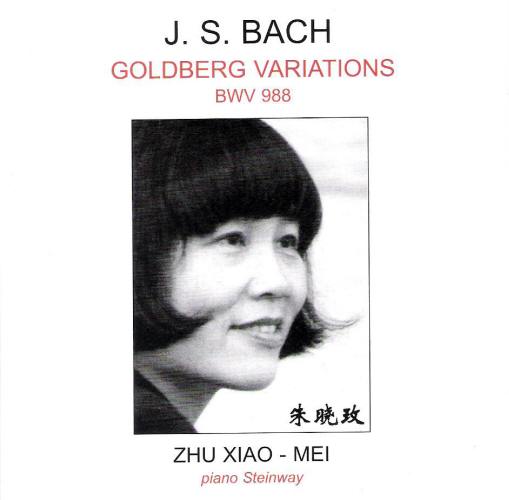
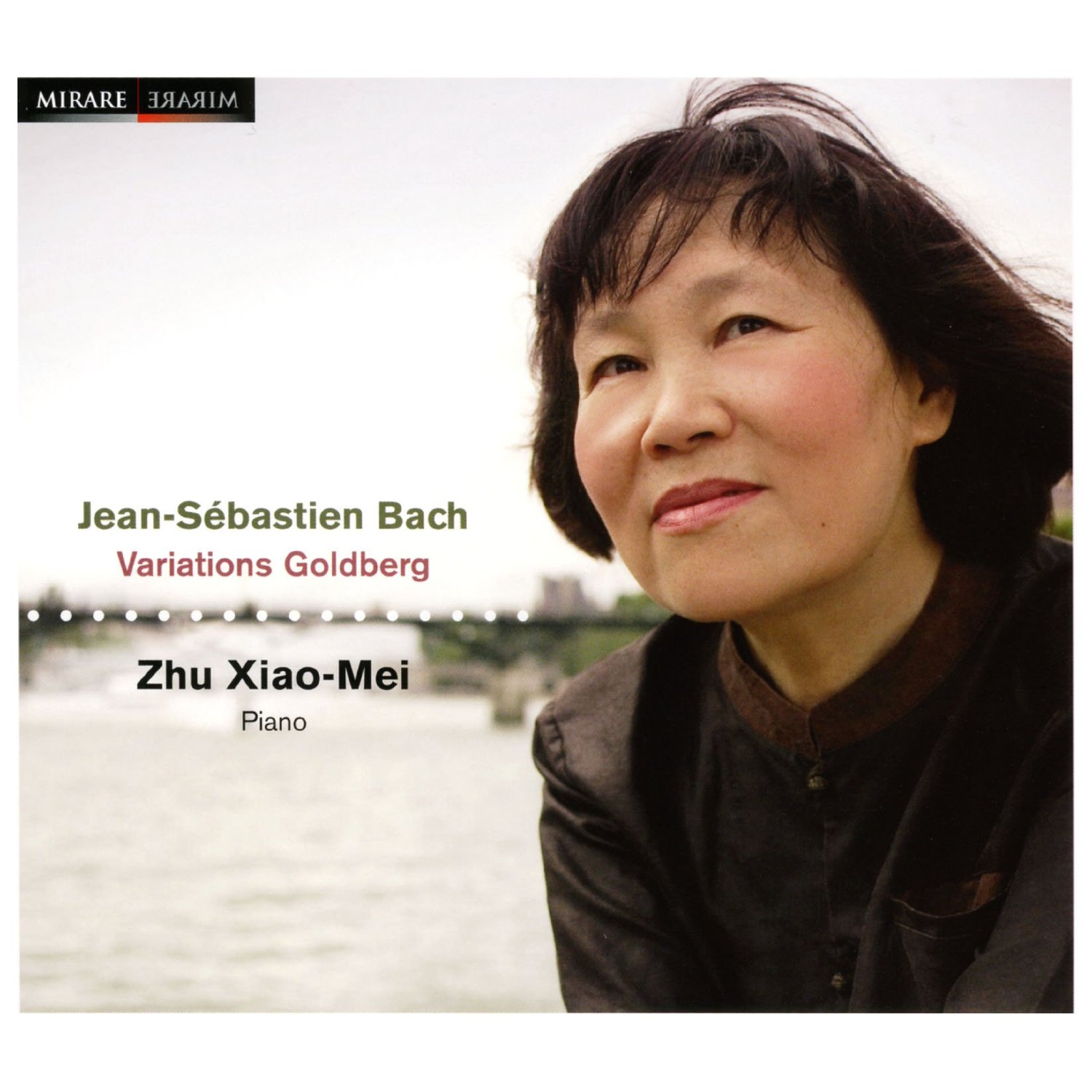
Goldberg Variations BWV 988
Zhu Xiao-Mei (Piano)
Zhu plays the Goldbergs |
|
Bradley Lehman wrote (July 16, 2001; updated September 2002):
ZHU Xiao-Mei plays the Goldberg Variations on a Steinway: Mandala (Harmonia Mundi dist) 4950 from 1999. 61'20". Budget- to midprice. A steal, and in my opinion Ms Zhu's performance has vaulted to share the summit with Gould '59 among the recordings on piano that I've heard. Wow!
Why do I hear this as so great?
She has a complete grasp of the music, knowing where everything belongs, and a willingness to play it straightforwardly instead of overemphasizing anything. She trusts us to "get it." She plays phrases, not notes. She varies her touch all over the place to bring out things subtly. She lets the music get her hyped up sometimes, with great passion, and lets it bring a cooler serenity as well. Note: I didn't say she brings a passionate delivery to the music; she gets it from the music. It's a huge and vital difference.
As Ralph Waldo Emerson noted, "A foolish consistency is the hobgoblin of small minds." Zhu allows the music to be subtly inconsistent in her repeats and during sections, intuitively altering her delivery from moment to moment as she feels it, letting the music grow. It's organic, the furthest thing from intellectual control (as Tureck, Gould, and some others play). Zhu recognizes that richness in Bach comes from letting things be irrational enough within a controlled structure.
The result is that we hear the music making its own effect, not the effort of a performer trying to show us something, or a performer trying to be a Personality. The performance is satisfying while it's happening, and even more satisfying in retrospect. In how many more ways can I say that the performance is organic?
Zhu's touch at the piano is so natural; that's another reason why I like her sound so much. She plays the piano for what it is, not trying to simulate some other instrument. She doesn't try to create odd tone colors for sections as players of the Russian school do; she just lets the music flow with a fairly consistent touch. She doesn't use artificial-sounding articulations, either, she just plays! Within that basic consistency she has a large range of dynamics and intensity. As I mentioned above, she uses that range with what sounds like intuitive reaction rather than a pre-planned intellectual road map.
In overall feeling (and in character/tempos of individual sections) Zhu's performance sounds modeled on Gould '59 (Salzburg)...perhaps that's why I like it so much. She also does what he does in var 29, playing octaves in the bass, but even more enthusiastically as a grand climax before the quodlibet. Otherwise she sticks very closely to the text.
The sound and production are fine; I caught only a few moments where rough digital edits break the continuity (most notably in var 29).
Zhu takes the first repeats but not the second repeats. The exceptions are var 16 where she takes none, and 30 (quodlibet) where she takes both. These exceptions interestingly break up the AAB pattern when it has got almost too predictable. Internally, the repeated first sections are anything but predictable: she brings out different things without changing any of the notes. It's as if she has an endless supply of different interpretations available in her mind, and in each moment she chooses one that fits with the larger flow of emotions. Sometimes she lets the emotion extend over several variations; at other times she changes it quickly from phrase to phrase. Again, that unpredictability is welcome and it seems in no way arbitrary. It springs from the musical content, and from how the performance up to that point has been going. (Once again I'm finding another way to say it's natural and organic!)
Listening to her reminds me of how it feels inside to play the Goldbergs straight through in concert (on harpsichord, several times in the mid-1980s)...it's a journey, an experience, being swept along by the rich characters of the music. This CD seems to contain a Real performance, not a patched-together anthology of nice moments. That's what I look for in a "great" recording: a sense of something happening with freshness and directness. The overall effect is of how wonderful Bach's music is, not how wonderful the player is.
Here's a quote from the program notes: "The Art of Zhu Xiao Mei, made up of contemplative concentration and insatiable vigour, tells us, at the highest level of mastery, about the emotion of a life. The interpretation of the Goldbergs that she gives us today--dense, serene, but exultant--leads us to the heart of her light, on the paths of a just woman." (Alain Meunier)
Well said. |
|
Some comparisons |
|
Some comparisons...other CDs I have of the Goldbergs on piano are: all four of Gould's, Barenboim (Erato), Tureck at Wm F Buckley's house (Albany-Troy), Perahia (Sony), and Martins (Concord Concerto).
I used to have Lifschitz' set but I sold it: his artificial touch and "listen to me play piano" delivery and his repeats in the upper octave all put me off. I don't like it when pianists in Bach adopt an affected touch for a passage to simulate what they think harpsichord registration does (terraced tone, and no inflection within phrases). We harpsichordists are a lot more expressive than such pianists evidently think we are...it's a different instrument with its own techniques.
I heard the first Schiff recording years ago and enjoyed it, but (if memory serves) his way of delivering phrases sounds a bit affected. I do like the way he makes things sound improvisatory. I haven't heard his remake. Zhu is more direct: we're listening to the music rather than to an artist trying to say something profound about the music. Art conceals art.
Barenboim has decent continuity but is overall dull: too much concentration on the notes instead of the phrases, and he seems emotionally cautious. Too objective. Zhu is much more eand involved, and her performance sounds more "live" in spirit even though Barenboim's really is live in concert.
Martins' performance is a circus. A thrill every minute. Fun, but it's not at the service of the music. It's "listen to me do something clever with the music!" and too aggressive, like the Eroica Trio's way with things. Zhu makes the music sound natural, every idea springing from within the music instead of pasted on as Martins does.
Perahia's performance is pretty but bland, a middle-of-the-road approach to offend no one. That, plus Perahia's well-respected Big Name, are probably why it sells so well. My feeling about this Goldberg performance is summed up in my review of his English Suites at: Amazon.com....
Tureck is very interesting but I'm ultimately not moved. It's too much an intellectual dissection, all head, not enough heart. Her articulations are artificial, too, and she sometimes reminds me of the stiffness in Gould '81. She's of the belief that a player should improvise many new notes on repeats, to be clever and "expressive," while I'd rather hear it done by emphasis and touch (Zhu's way) rather than by so many new notes. [I've also heard her newest remake (DG) and her earlier harpsichord recording (Columbia LPs)...same story. I like her Buckley performance better than the DG. The DG performance would benefit from a simpler flow; it gets caught up in too much structural detail.]
Gould '81 is a loss for me, too much Glenn Gould Being Glenn Gould, and playing Gould's Ideas About Bach rather than playing Bach. Lots of interesting ideas and some moving moments, but too much artificial nonsense in his touch and his forced tempo relationships. [September 2002: the sound quality is much improved in the new "State of Wonder" reissue, remastered from the analog backup tapes, and it makes this performance easier to listen to. It reaffirms my confidence that Gould in his late years did still care about beautiful sound. Years of listening to the all-digital standard issue, with its garish tone, have made me more uncharitable toward this performance than I perhaps should be.]
Gould '54 is good for a live performance, but not as focused as he did himself later, plus the sound is lousy. Ultimately dull against his own standard.
Gould '55 is great, playing the piano honestly and the music brilliantly, with depth of emotion and a joyous sparkle. But Gould '59 live in Salzburg is the best of all. It has the strengths of '55 but also a better connection across the whole performance...more unity and an overwhelming cumulative effect, where '55 is a series of sometimes disconnected vignettes. Zhu is somewhere in that league of Gould '59 and '55: great. And I'm enjoying listening to her more than all the others above.
Additionally on LP I have the two Gould Columbia recordings plus Rosen, Johannesen (1977), and Peter Serkin's solo debut (1965). It's been a while since I listened to any of them except the Goulds, so I have nothing to say about them here.
There's my mostly intuitive reaction to the Zhu CD. It's the state of mind she puts me in. I'm now listening to it for the fifth time in the past 24 hours (July 2001). This is a great CD.
Addendum: I also have Zhu's recordings of the Bach Partitas and 17 Scarlatti sonatas; they are similarly very good. |
| |
|
Feedback to the Review |
|
Donald Satz wrote (July 17, 2001):
[To Bradley Lehman] Although I don't have the glowing opinion of Zhu's GV that Brad has, I do love her Variations 15, 17, & 18. Gould '55' better than '81'?; I don't see it, as I feel that Gould '55' is more one-dimensional and so concerned with speed and momentum that many other aspects are neglected. |
| |
|
A closer comparison of Perahia and Zhu |
|
Bradley Lehman wrote (October 2002):
Perahia's playing is indeed gorgeous, pleasing, lyrical. Everything is well thought-out and delivered impeccably. He is obviously one of the best living pianists, no question. He is intelligent about detail and about the big picture. Everything is balanced beautifully. And his booklet notes confirm that he is concerned with structure, as is also evident in the playing. This is an outstanding CD, compared against anything or standing on its own.
So, what's wrong with that? Nothing, really. But I believe an approach with too much rationality (like Perahia's!) is for me a dead end. A lovely one, to be sure, but lacking. Its sheer perfection is astonishing, yes. And that is simultaneously its [very minor!] downfall. The way I hear it, the familiar features of the music are the background, we know what's coming next (having heard this piece on piano hundreds of times before, in various performances), no surprises; and Perahia's phenomenal level of preparation is the foreground. It sounds to me like an end in itself, that preparation. He lays all the notes and phrases out there perfectly, like a platonic ideal. Everything is right where we expect it, like reading the score. The foreground is how wonderful Perahia is, in service of this wonderful music, engaging it with an astounding level of thoroughness.
And then we come to Zhu. The difference, for me, is subtle but crucial. Her preparation is no less thorough, her pianistic gifts no less complete. She doesn't do anything zany or eccentric either. Her tone is just as gorgeous. She, like Perahia, draws attention selflessly to the music rather than to the performer's own personality. And, incredibly, she goes beyond Perahia's perfection. (That probably doesn't seem possible, until you've heard both performances side by side.) The perfect preparation is not the end in itself, it's merely the background. The foreground is spontaneously flowing music, as if she's making it up on the spot, even after one has heard the work hundreds of times and this particular performance dozens of times. In her hands, the music always surprises and delights, and can't be fully predicted even on repeated listening. It's an amazing balance. The "right" thing (in my opinion) is in the foreground here. It's play. It's as if she could have gone any any number of directions at any given moment, according to her feelings; the flow is terrific, with every moment influenced by all that have gone before. The moods surge and relax, and just when we thought we had things figured out, she shows us something different (and equally natural). We're not at the mercy of anyone's feelings, Zhu's or our own, but she projects the sense that music is about more than intellect and structure. The music sings with a life of its own, breathing and moving under its own power.
Perahia is wonderful, yes, but he is "second best" to this: he doesn't sound spontaneous enough. I notice new things about the music every time I listen to Zhu; I've listened to Perahia fewer times and he doesn't show me anything I didn't already know. Music is about more than careful preparation. I already knew that the Goldberg Variations are an amazing structure, and I already knew that Perahia is a consummate pianist. It's not especially interesting to hear that again; I already know it's there.
And, incidentally, I'd say Zhu sounds more lyrical than Perahia, if that is even possible. She's "lyrical" in the sense of making the music sound as if it had words: and words cause a singer to inflect the notes in ways an instrumentalist doesn't. Words imply a meaning of something extra-musical. I don't know what words Zhu is imagining (and I don't know much Chinese, in any case!), if any, but her surges and relaxations of emotion sound like they're geared to some level of meaning that isn't on the printed page. That's lyrical, for me. Perahia is content with beautiful tone and perfectly balanced instrumental phrases. It's a less rich landscape, gorgeous but more limited.
(If it matters: I'm coming to this from about 25 years of hearing this piece played on piano in variousrecordings, plus from the "inside" of performing it myself in concert, on harpsichord. If I want to "hear" a platonic piano performance of it, I don't even need to put on Perahia's CD at all, I can just look at the score and imagine everything from start to finish. All the facts are in there, all details and structures perfectly balanced. That's nice, but when I listen to a CD I want more out of life than a mental platonic performance; I want to hear things I didn't already know. That's what I find in Zhu, and don't find in Perahia. As wonderful as Perahia is, he doesn't very often point my attention toward things I hadn't already noticed years ago. At this point, 25 years into knowing piano versions of this piece, I find Zhu and the live 1959 Salzburg Gould the two that continue to delight and move me most. Perahia is better than most or all of the others; he suffers only by comparison here! Among CDs of Goldbergs-on-piano, Perahia's is justifiably a mountaintop achievement, worthy of all praise. I'm suggesting that there are higher mountains yet!)
Let me try to say things in a different way. Let's take a mental holiday.
You have 75 minutes to relax, and you're in a city. You sprawl comfortably on a sofa, the world is rock-solid, things are quiet enough, and the Goldberg Variations begin. For the next 75 minutes the music goes along beautifully, everything in place, all perfectly prepared. The experience is lovely while it's happening, and your memory of it afterward is also positive. All very, very nice. In the stillness of this contemplation you've had a nice listen through the Goldberg Variations. That's Perahia's performance.
Now start again. This time you're not in the city. You're in a smallish boat in the middle of a placid and beautiful lake. You sprawl comfortably, things are quiet enough, and the Goldberg Variations begin. The music goes along beautifully, all perfectly prepared, all is lovely both during the experience and afterward. But you've noticed a LOT more all the way along. The music has been just as relaxing and perfect as in Perahia's performance, but your attention has been more directly engaged in the process. Why should this be? Well, your boat (and therefore also your body) have been bobbing gently in response to all the inevitable, irrational, unpredictable motions of water. You yourself have been in constant motion, under natural forces. And your perspective to the music has therefore been shifting every minute or every few seconds, showing you a slightly different view on the Goldberg Variations than you would expect on solid dry land. And the work reveals itself with more dimensions than you knew were in there; it's not merely perfect. It has some beautiful irrationality of its own, the moments flow into one another just like the rise and fall of your boat, always in motion. The listener moves. Your world has been just as calm, in its own way, as the comfy sofa world on land, but you're feeling more effects of natural forces beyond anyone's control. And your listening is richer for it. That's Zhu's performance. It's amazing.
Listening to Perahia, time is perceived as a constant. Listening to Zhu, time is perceived as a liquid. Listening to Perahia, if your mind wanders, things will go along in that steady and will be exactly where you left them when you get back; you return at your own initiative. Listening to Zhu, if your mind wanders briefly, time itself soon shakes you gently back to awareness. (This has nothing to do with tempo fluctuations in the performances, but rather with the way Zhu bends the listener's perception of time! Hard to explain. Weird stuff.)
Here's another perspective on the Zhu performance (as I hear it):
Secret O' Life
(James Taylor)
The secret of life is enjoying the passage of time
Any fool can do it
There ain't nothing to it
Nobody knows how we got to
The top of the hill
But since we're on our way down
We might as well enjoy the ride
The secret of love is in opening up your heart
It's okay to feel afraid
But don't let that stand in your way
'Cause anyone knows that love is the only road
And since we're only here for a while
Might as well show some style
Give us a smile
Isn't it a lovely ride
Sliding down
Gliding down
Try not to try too hard
It's just a lovely ride
Now the thing about time is that time
Isn't really real
It's just your point of view
How does it feel for you
Einstein said he could never understand it all
Planets spinning through space
The smile upon your face
Welcome to the human race
Some kind of lovely ride
I'll be sliding down
I'll be gliding down
Try not to try too hard
It's just a lovely ride
Isn't it a lovely ride
Sliding down
Gliding down
Try not to try too hard
It's just a lovely ride
Now the secret of life is enjoying the passage of time |
| |
|
|