|
Chorale Melodies used in Bach's Vocal Works
O großer Gott von Macht |
|
Melody & Text | Use of the CM by Bach | Use of the CM by other composers | Footnotes |
| |
|
Melody & Text: Zahn: 5101a | EKG: |
|
Author: Balthasar Schnurr, Leipzig 1632 [1] |
|
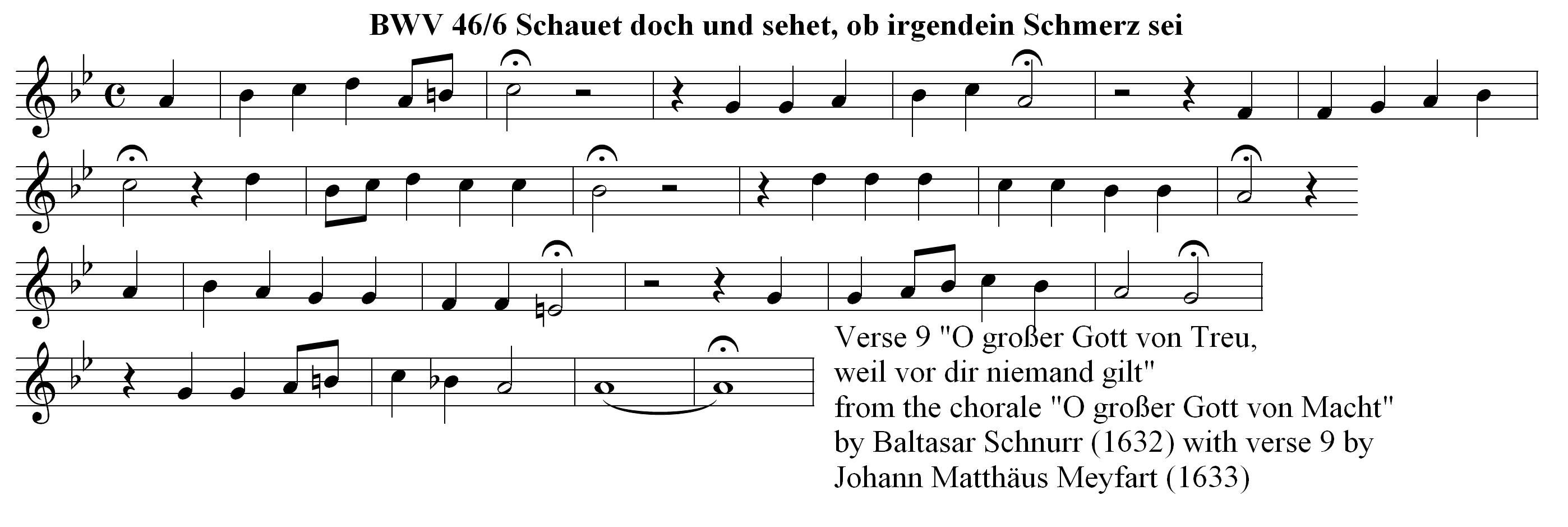
Both the NBA KB I/19 (Robert L. Marshall) and the BWV Verzeichnis refer only to the text: 9th verse of the Meyfart text, as they put it – implying that the entire chorale text was by Meyfart. No mention is made of the source of the melody other than the Zahn number listed above.
The Colmarisches Gesangbuch (online) lists this chorale text as #289 and explains “This ‘Lied” [to be understood as 'text only' here] was no longer available or used in later hymnals, but it does occur among the chorales used by J. S. Bach. [2] The comments to the Colmar Hymnal go on to state: This 'song-text' is by Balthasar Schnurr (1572-1644) with the exception of the 9th verse [most likely the final verse of Meyfart’s chorale text] which is not by Meyfart at all, but rather by Jeremias Weber (1600-1643) who provided this verse as his own extension of the Meyfart chorale text. [This means that the very verse which Bach included in his 4-pt. setting of this chorale in BWV 46/6, the only time Bach ever used this melody, the text which is assumed by the Marshall, Dürr and the editors of the BWV Verzeichnis {Dürr, Kobayashi, Beißwenger} is not at all by Meyfart, but rather Jeremias Weber.] Continuing with the Colmar hymnal commentary: The title of this chorale text/melody combination (1633) is “Ein andächtiges Buß-Lied, Aus der Vorbitt Abrahams für die Sodomiter, Gen 18” [“A devout song of penance derived from Abraham’s intercession on behalf of the Sodomites (Genesis 18.”] This chorale text has included/adopted, as the title indicates, the biblical passage from Genesis 18:22-33 where Abraham, in a sense, haggles with God in order to save Sodom and Gomorrha from imminent destruction.”
Z. Philipp Ambrose (online) indicates:
The verse which Bach uses in BWV 46/6 is based upon 1 Lamentations 1: 12 and was supplied by Johann Matthäus Meyfart in 1633 as a supplemental verse to Balthasar Schnurr’s “Ein andächtiges Buß-Lied, Aus der Vorbitt Abrahams für die Sodomiter, Gen 18.” [So now it appears that Schnurr may have supplied the music as well as the text for the first 8 verses of “O großer Gott von Macht,” but Meyfart supplied the text for the only verse (9) that Bach had ever set to music.] Ambrose lists as his source a collection “Fischer-Tümpel, III, #321. The initial date and place of publication is Leipzig, 1632 and it appears under Schnurr’s name (he either financed it himself and/or was himself the publisher. Note: Today there are still ‘Schnurrs’ living in Germany and even specifically in Leipzig! Was one Schnurr a publisher, the other a pastor with an obvious talent for writing poetry/verse? With whom did the melody originate: was it Schnurr or did he, simply ‘borrow’ a melody (today no longer recognized) from elsewhere as was the common custom of his day? What does Zahn 5101a have to say about this and why haven’t the Bach experts sorted all this out before? |
| |
|
Use of the Chorale Melody by Bach: |
|
Text : O großer Gott von Macht | Zahn: 5101a
Author: Johann Matthäus Meyfart (1633) |
|
Ver |
Work |
Mvt. |
Year |
Br |
RE |
KE |
Di |
BC |
Score |
Music Examples |
|
9* |
BWV 46 |
Mvt. 6 |
1723 |
81 |
- |
82 |
- |
A117:6
F158 |
PDF | PDF(s) |
Mvt. 6 (CCARH) [midi] | Mvt. 6 (MG) [midi] | Mvt. 6 short (MG) [midi] | Mvt. 6 (Leusink) [ram] |
|
*There is a listing of O großer Gott von Macht as ‘Deest’ by Grove Music Online. We have chosen to disregard this as it remains questionable until it has been accepted by having a BWV number assigned to it. In any case, we don’t even know what form this is in: a 4 pt. setting, a chorale prelude or partita, etc.?] |
|
|
| |
|
Use of the Chorale Melody by other composers: |
|
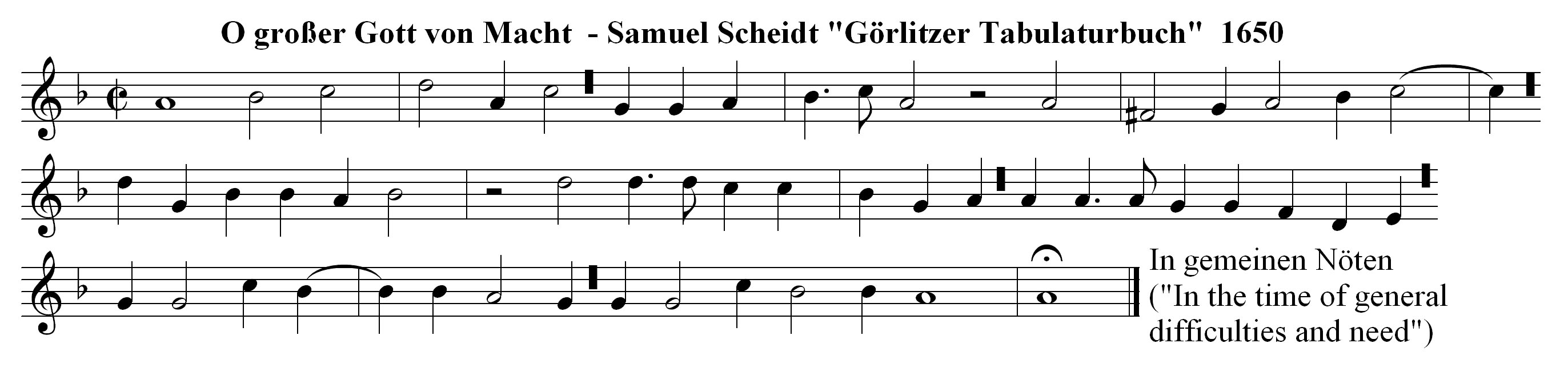
Samuel Scheidt (1587-1654):
SSWV 532, a 4-pt. setting of O großer Gott von Macht from his Tabulatur-Buch hundert geistlicher Lieder und Psalmen (Görlitz, 1650)”. |
|
|
|
Georg Philipp Telemann (1681-1767):
Cantata O großer Gott von Macht (Neumeister libretto), TWV 1: 1196 (1719) |
| |
|
Footnotes: |
|
[1] Information about Balthasar Schnurr’s abilities as a composer of chorale melodies can not be confirmed independently – both the MGG1 and Grove Music Online make no reference anywhere to this name. An online Google search did substantiate the existence of a father and son by the same name. The son, Balthasar Schnurr, jr., was a pastor in Hengstfeld and was forced by the events of the 30-Years War to flee to Crailsheim and Burleswagen in 1642 (according to the source below he died in 1644.) Probably the same pastor is referred to in another independent report as the pastor, Balthasar Schnurr who received a laurel crown as recognition for his efforts as a poet in Hengstfeld in 1626/1627. No mention is made of any musical abilities.]
[2] Marc Hug, the author of this comment and has kindly supplied the explanation that this statement refers specifically to those Alsatian hymnals which appeared in print after the Colmar hymnal (1781-1807). |
| |
|
Sources: NBA, vols. III/2.1 & 2.2 in particular [Bärenreiter, 1954 to present] and the BWV ("Bach Werke Verzeichnis") [Breitkopf & Härtel, 1998]
The PDF files of the Chorales were contributed by Margaret Greentree J.S. Bach Chorales
Software: Capella 2004 Software, version 5.1.
Prepared by Thomas Braatz & Aryeh Oron (August 2005, January 2006, February 2009) |