|
Chorale Melodies used in Bach's Vocal Works
O Gott, du frommer Gott |
|
Overview | Melody 1 | Melody 2 | Melody 3 | Melody 4 | Use of the CM by other composers | Arrangements/Transcriptions |
| |
|
Overview: |
|
|
|
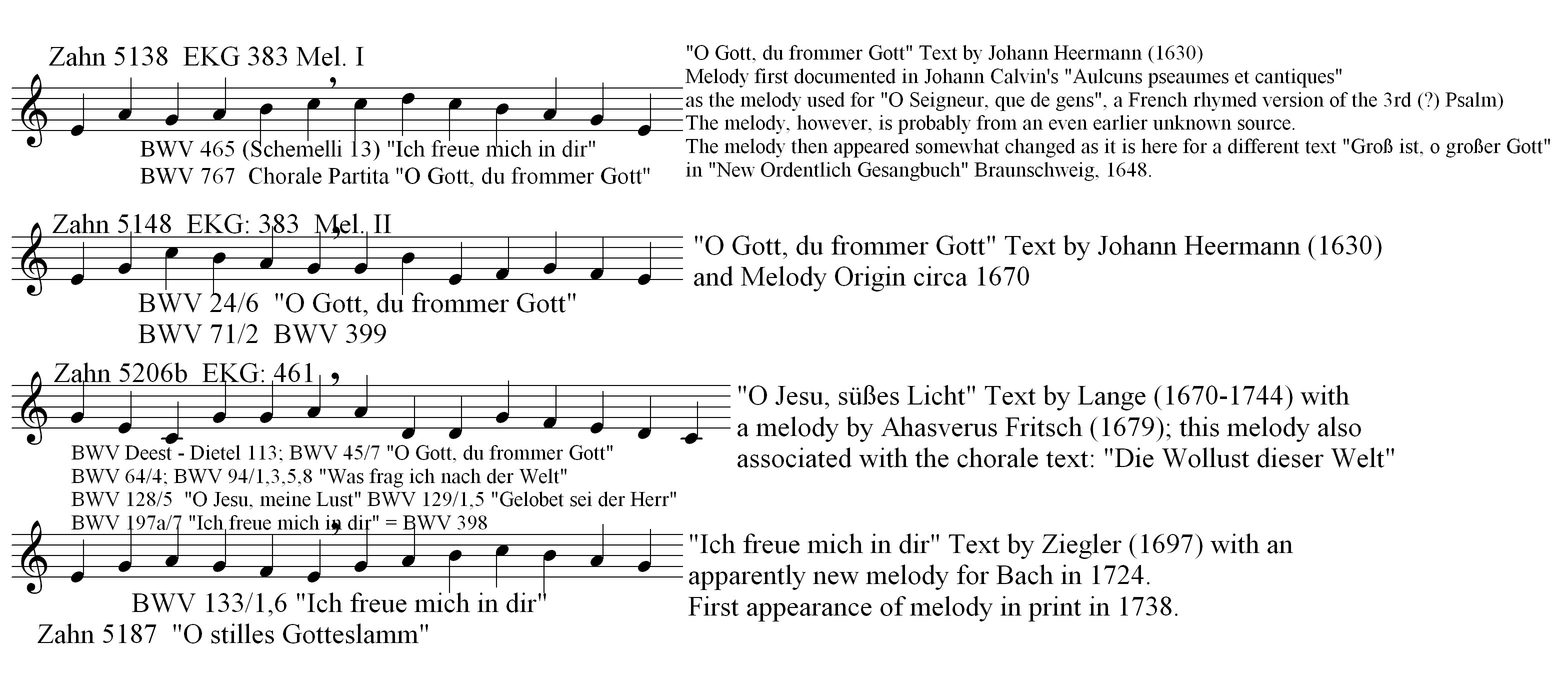
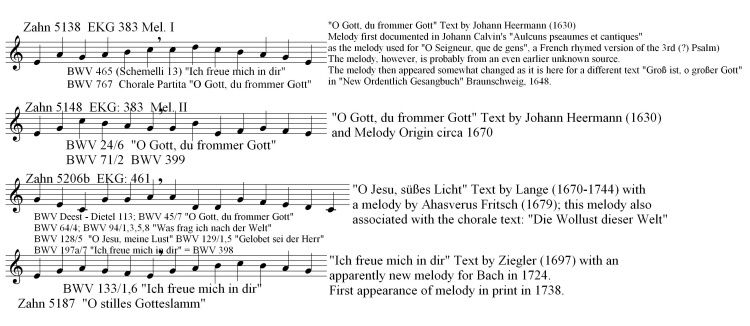
The preceding diagram is a succinct survey of all the important characteristics that help to distinguish the various melody variants that are linked together by use of the chorale text O Gott, du frommer Gott by Johann Heermann (1630). Bach used these variant melodies to set the same chorale text, but also other chorale texts as well. Only the last variant (Zahn 5187) was not set directly to music using Heermann’s chorale text; however, it is nevertheless linked to this entire group by another text Ich freue mich in dir by Kaspar Ziegler (1697), a situation where a relatively new melody was used which has nothing in common with the other three melodies except that Bach used the same chorale text with two out of the three melodies for “O Gott, du frommer Gott” listed above it. |
| |
|
Observation: |
|
Reflecting a fairly common situation found in 16th, 17th, and 18th century hymnals, Bach would not only use alternate melodies for the same chorale text, but also alternate texts for the same chorale melody. This can become very confusing, since even in Bach’s time, there is a strong tendency to refer to any specific chorale text and melody as clearly linked unit as if the union between text and music is a firm and everlasting one since the time of its conception. To be sure, Bach himself sometimes suggested alternate titles for chorale compositions as in his “Orgelbüchlein”, but, more often than not, these alternate chorale texts that were used with a specific melody are not even mentioned. This seems to reflect the general situation that prevailed as underlying melodies, sometimes even those originally connected with a given chorale text would be supplanted by another melody, this often being dependent upon popularity of the text-melody combination as it existed in various cities and principalities throughout Germany. Another development which may have begun even before Bach’s time and certainly became quite prominent after his death is the reduction of chorale melodies to a minimum so that eventually a congregation could sing hundreds of different chorale texts to a small stock of melodies of not more than two dozen melodies that were used over and over again. Bach seems to have been working hard to counter this incipient trend by employing many different melodies which his congregations would have heard his choirs sing and which they later might emulate in congregational singing.
Alfred Dürr, in his book “Johann Sebastian Bach: Die Kantaten” Bärenreiter, 1995 (last revised edition) p. 157, discusses Bach’s marginal notation in 1724 of an apparently new chorale melody for Ich freue mich in dir, a text which he otherwise set to other variants of the “O Gott, du frommer Gott” melody. Dürr speculates that this melody (Zahn 5187) “was apparently new to Bach and, accordingly, probably not customary in Leipzig.” |
| |
|
Procedure: |
|
Each chorale melody will be treated separately (See: Melody 1, Melody 2, Melody 3, Melody 4), although the textual connections between all of the ones in this group are quite strong. At the very end, after all 4 melodies have been presented, a list of other composers using these melodies is presented. There is, however, a strong caveat attached to this list as it does not presume to make any distinctions between all the possible chorale melody variants that any specific composer might have used. |
| |
|
Melody 1: Zahn: 5138 | EKG: 383 |
|
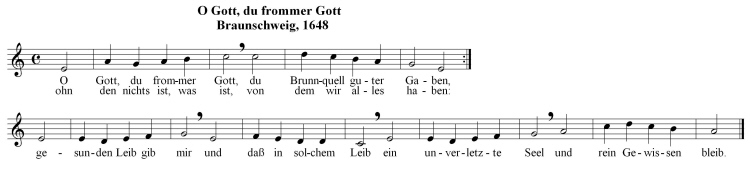
This melody is first documented in Johann Calvin’s “Aulcuns Pseaumes et Cantiques mys en chant” (1539) as the melody used for “O Seigneur, que de gens”, a French, rhymed version of the 3rd(?) Psalm. However, this melody is very likely from a yet earlier, unknown source. Later, this melody appeared in a somewhat changed form as it appears here and used with a different chorale text “Groß ist, o großer Gott” in “New Ordentlich Gesangbuch” Braunschweig, 1648: |
|
|
|
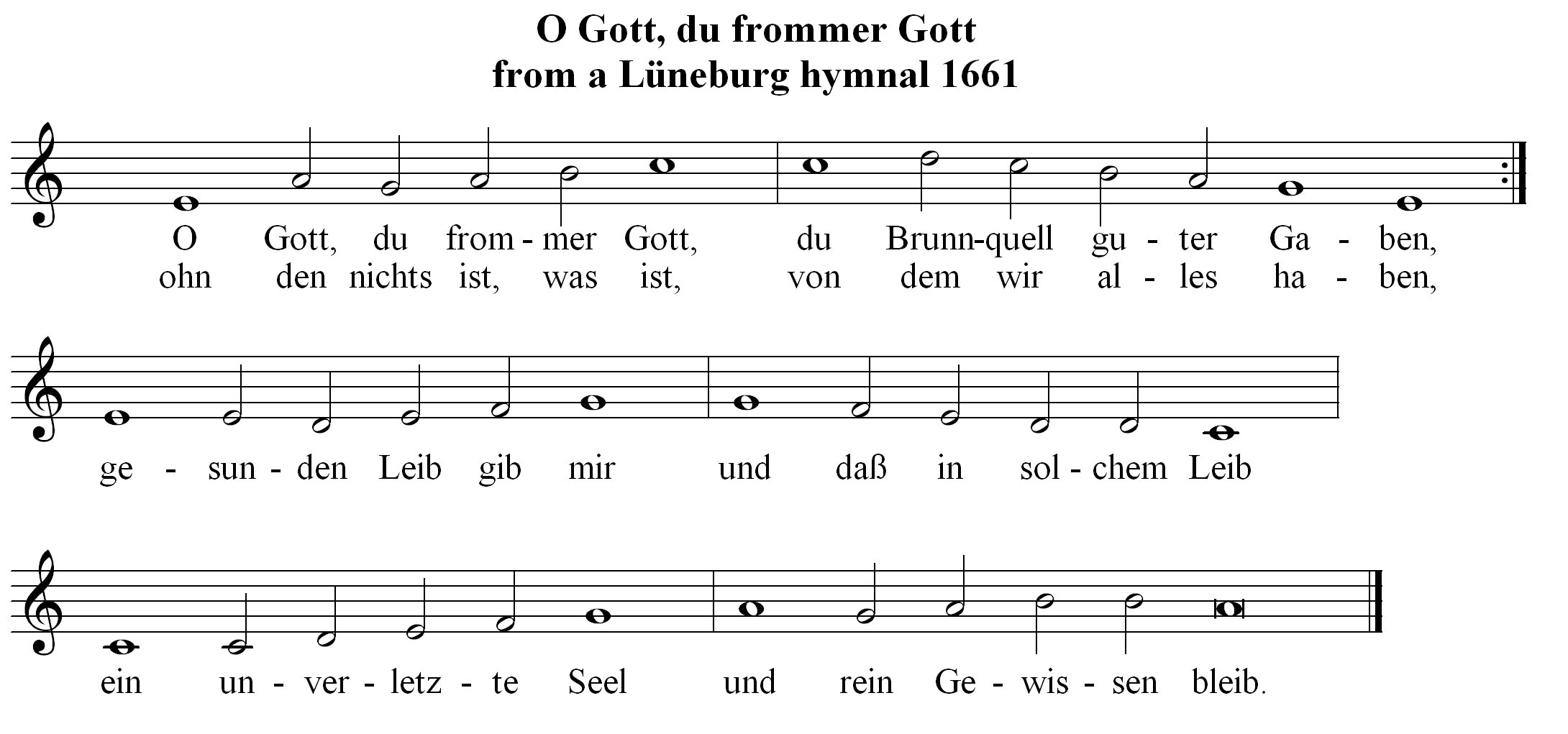
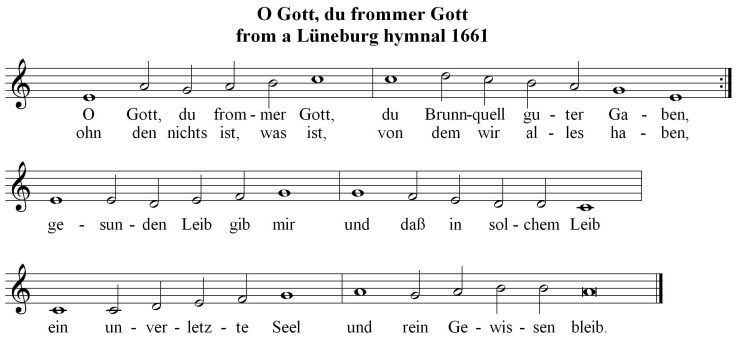
Here is the shape of the melody as recorded in a Lüneburg hymnals from 1661: |
|
|
|
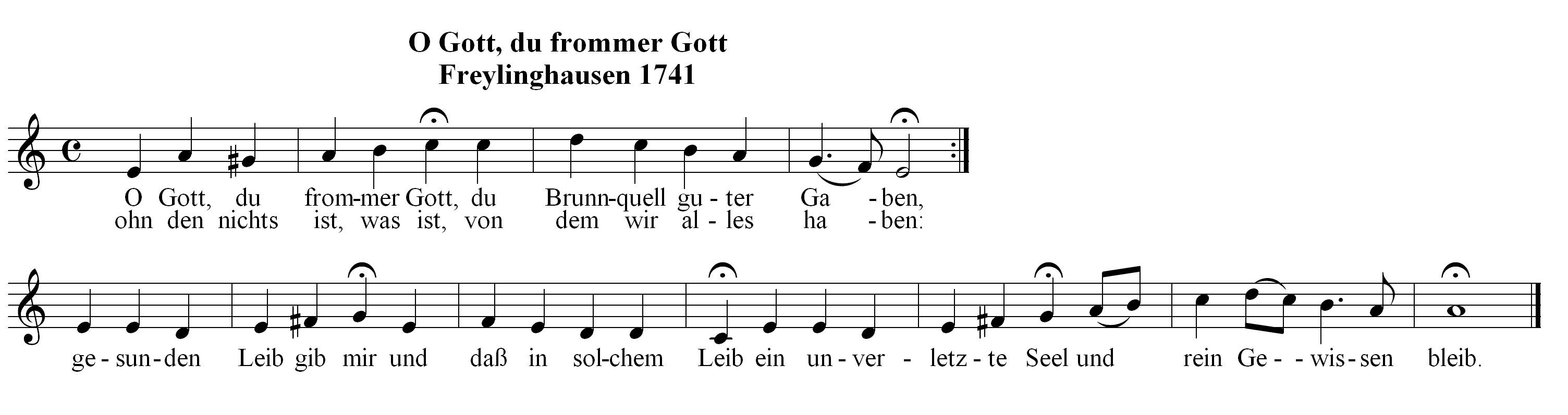
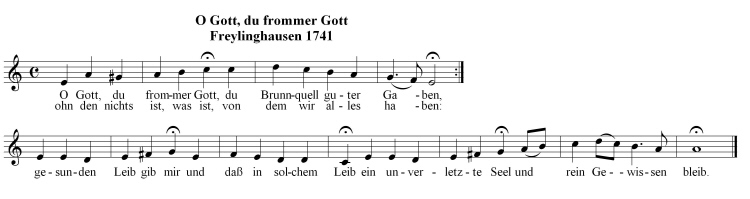
A much later documentation is found in the Freylinghausen 1741 hymnal: |
|
|
| |
|
Use of the Chorale Melody by Bach: |
|
Text : Ich freue mich in dir EKG:
Author: Kaspar Ziegler (1697)
|
|
Ver |
Work |
Mvt. |
Year |
Br |
RE |
KE |
Di |
BC |
Score |
Music Examples |
|
All |
BWV 465 |
- |
b 1736 |
- |
- |
- |
|
F231 |
- |
|
|
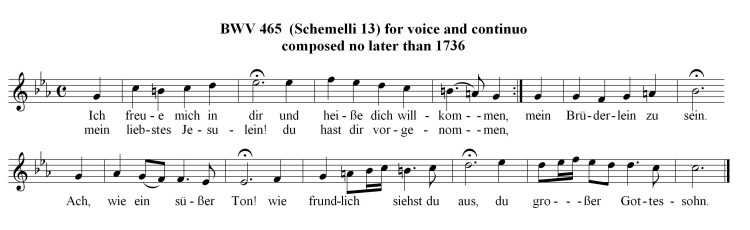
BWV 465: Ich freue mich in dir
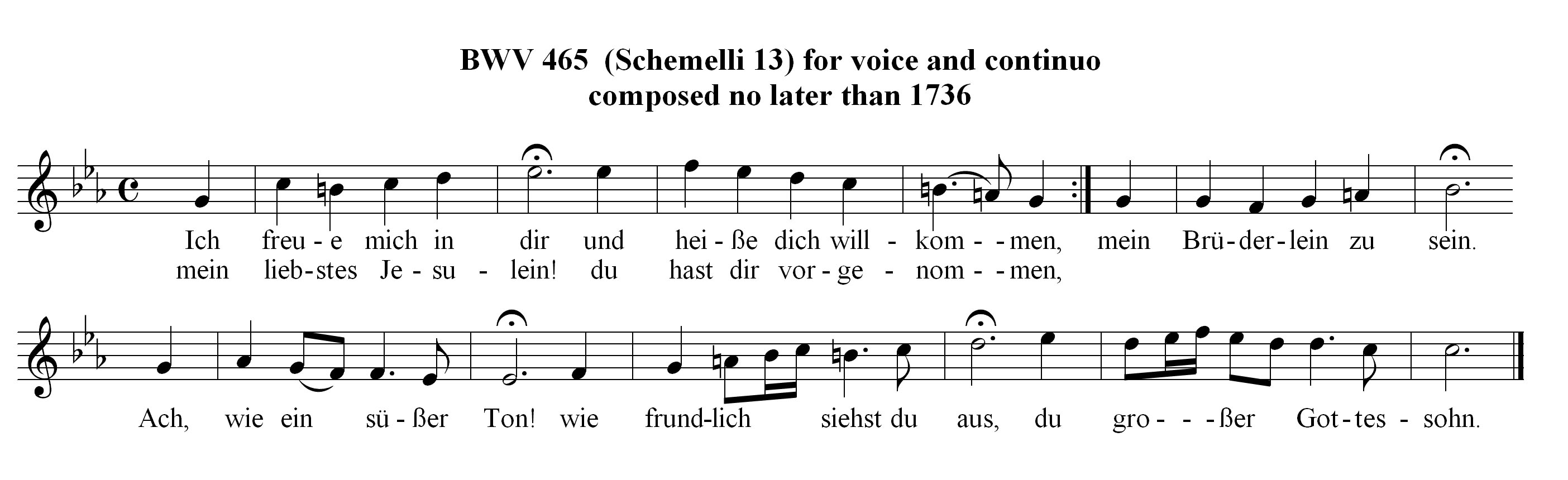
The BWV Verzeichnis has BWV 465 listed with the references: (Mel. 13, Nr. 194) The NBA lists it as Nr. 13 but the section containing all Bach's possible melodies states "aus Schemellis Gesangbuch" [extracted from Schemelli's 'songbook'] Thus it becomes clear that Schemelli's songbook probably included hundreds of 'songs' and Nr. 194 refers to its location in that book, while the NBA has selected only those songs which can be attributed to Bach and numbered them accordingly. |
|
|
| |
|
Untexted: |
|
Ver |
Work |
Mvt. |
Year |
Br |
RE |
KE |
Di |
BC |
Score |
Music Examples |
|
- |
BWV 767 |
- |
1702-07 |
|
|
|
|
K95 |
- |
|
|
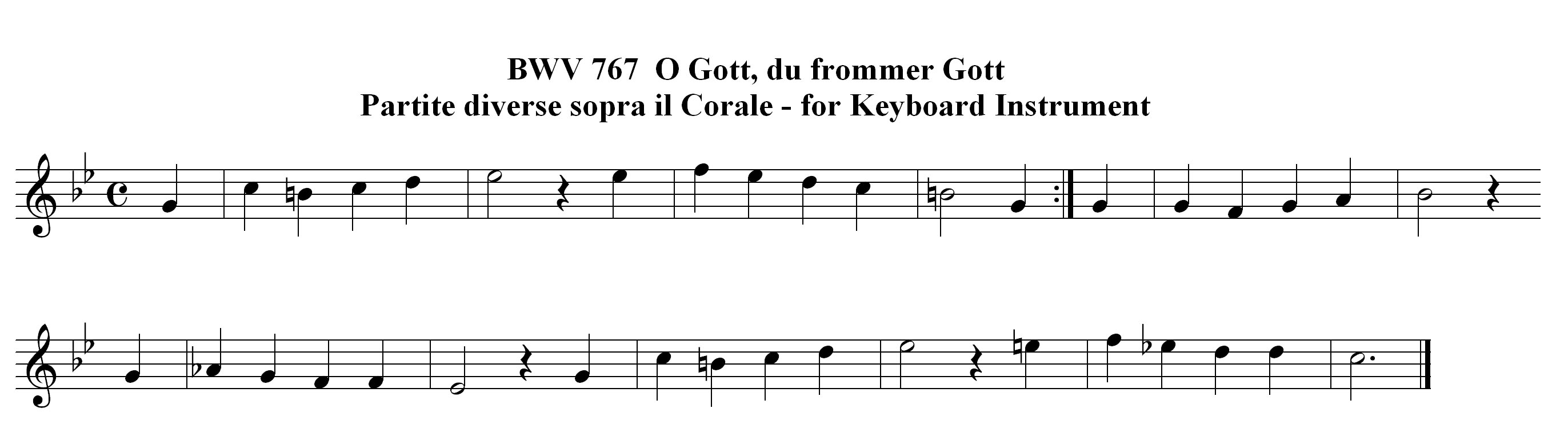
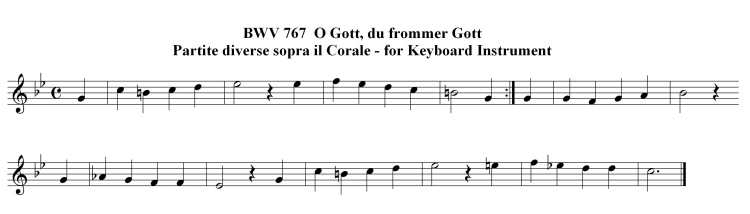
BWV 767 Title: Partite diverse sopra: O Gott, du frommer Gott |
|
|
| |
|
Melody 2: Zahn: 5148 | EKG: 383 |
|
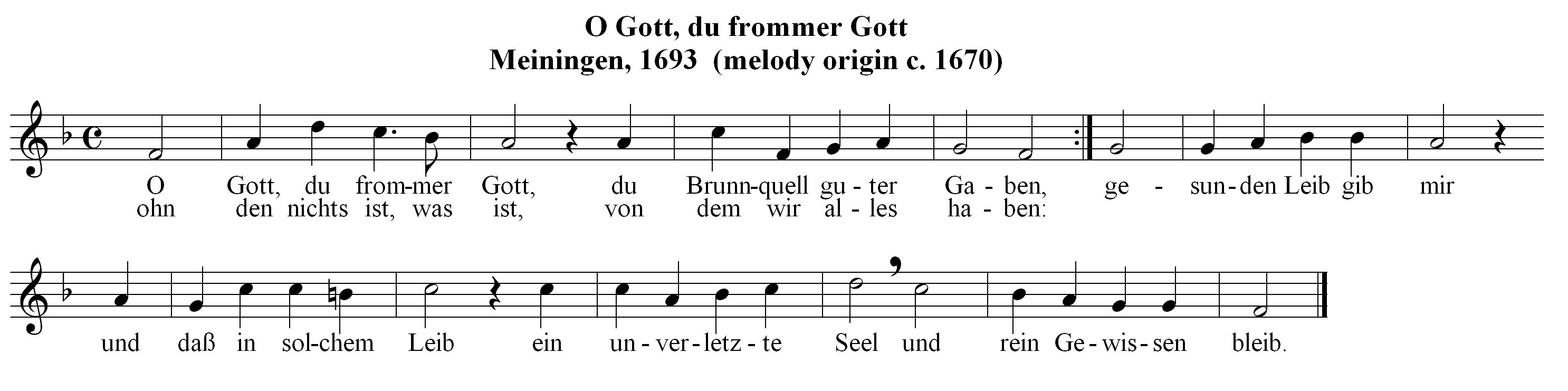
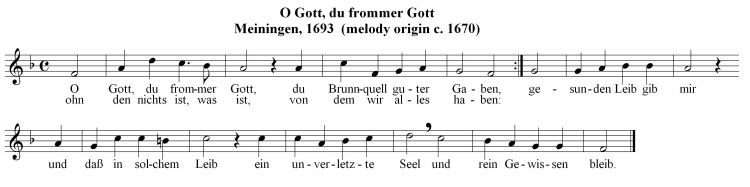
This melody’s origin can only be traced back to circa 1670. No other information regarding its composer or its first time connection with the Johann Heermann (1630) is available. Here is how this melody appeared in a hymnal from Meiningen in 1693: |
|
|
| |
|
Use of the Chorale Melody by Bach: |
|
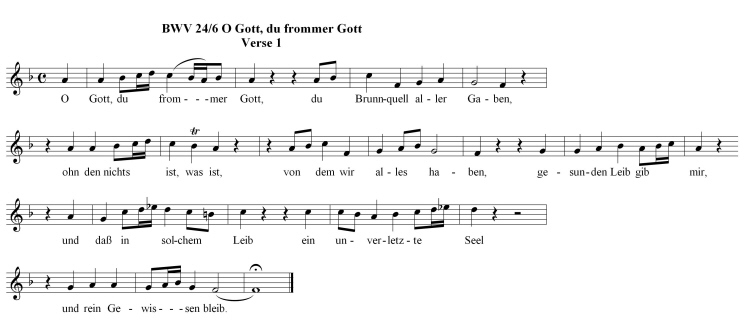
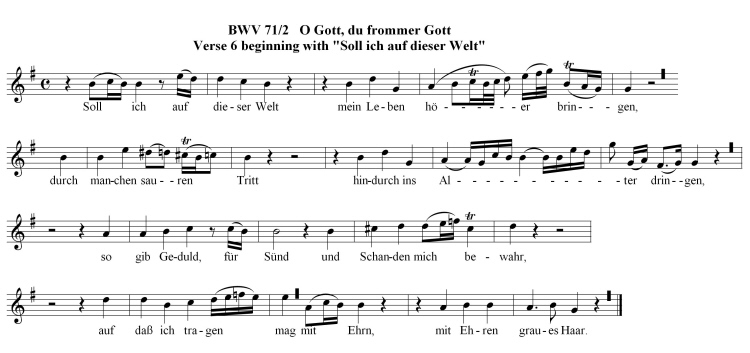
Text : O Gott, du frommer Gott
Author: Johann Heermann (1630) |
|
Ver |
Work |
Mvt. |
Year |
Br |
RE |
KE |
Di |
BC |
Score |
Music Examples |
|
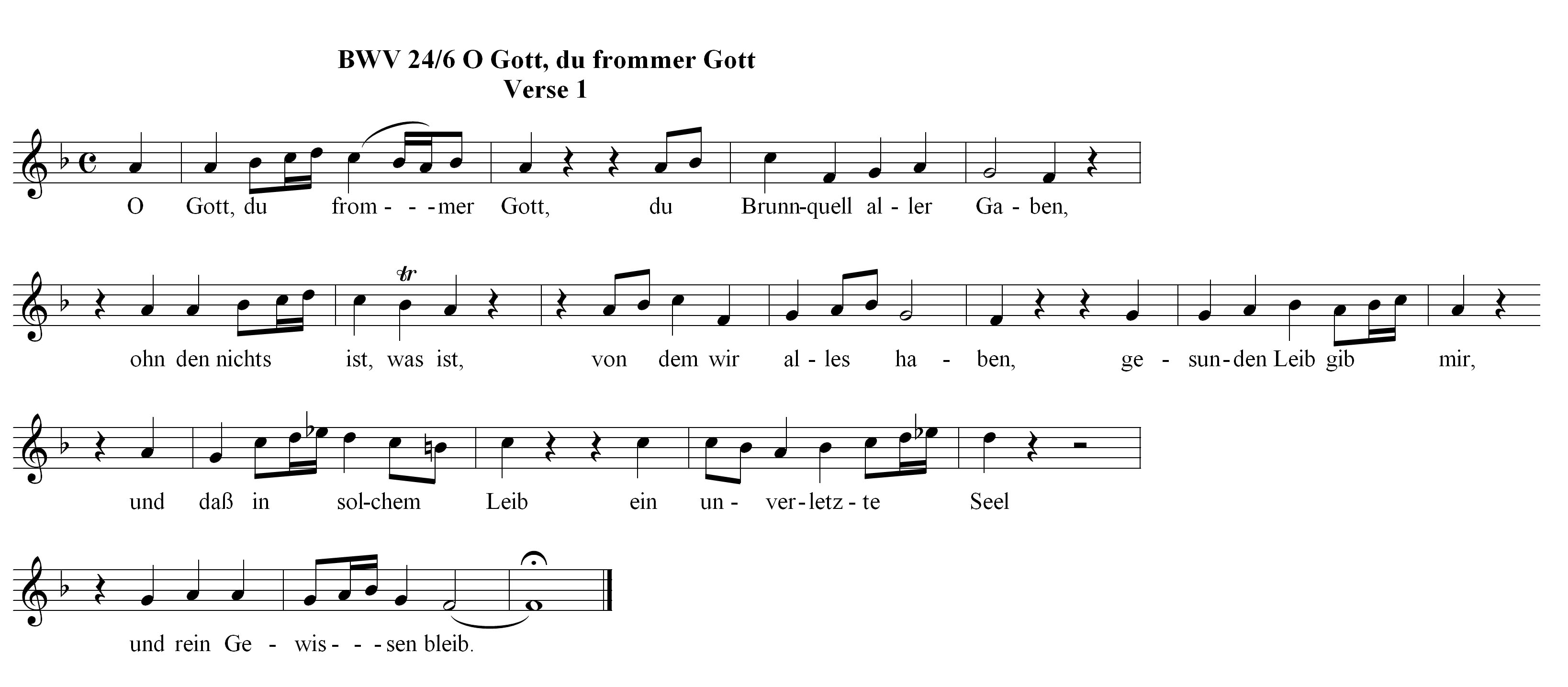
1 |
BWV 24 |
Mvt. 6 |
1723 |
336 |
- |
337 |
|
A102:6 |
PDF | PDF s |
Mvt. 6 (MG) | Mvt. 6 (MG) short [midi] Mvt. 1 (Leusink) [ram] |
|
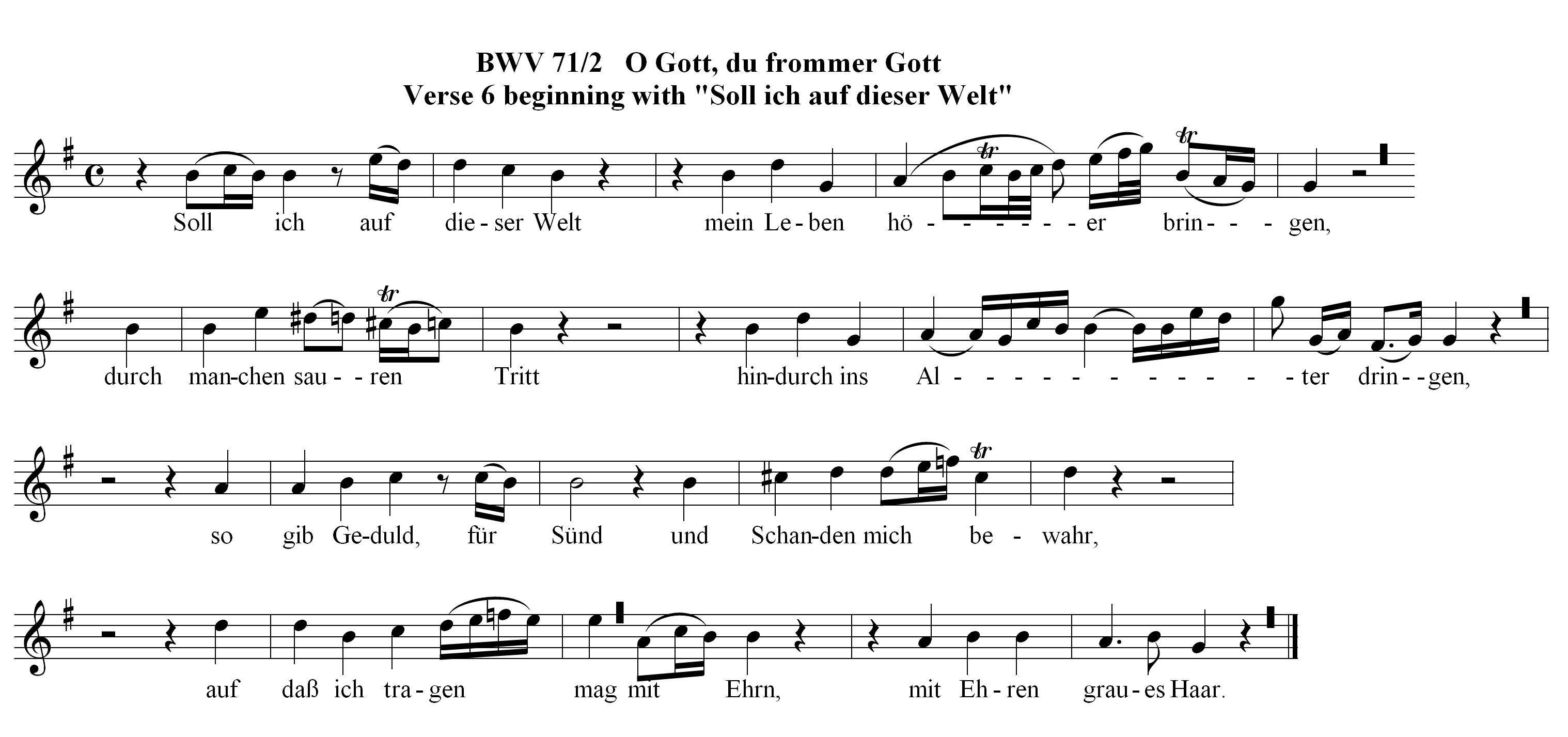
6 |
BWV 71 |
Mvt. 2 |
1708 |
- |
- |
- |
- |
B1:2 |
- |
Mvt. 2 (Leusink) [ram] |
|
|
|
|
| |
|
Untexted: |
|
Ver |
Work |
Mvt. |
Year |
Br |
RE |
KE |
Di |
BC |
Score |
Music Examples |
|
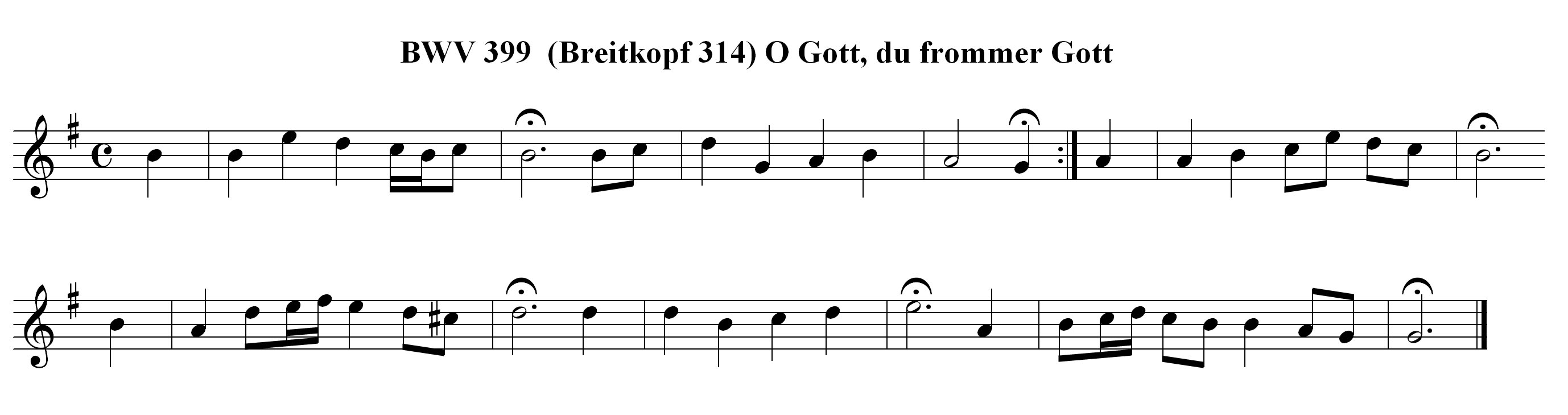
- |
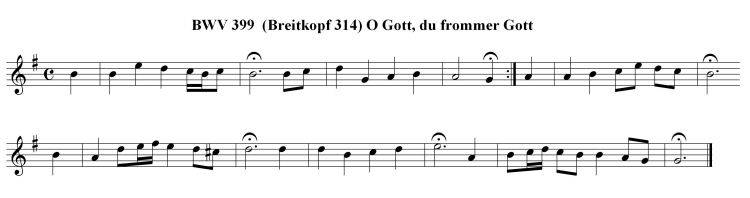
BWV 399 |
- |
? |
314 |
282 |
315 |
|
F157.1 |
PDF |
Chorale (MG) [midi] |
|
|
| |
|
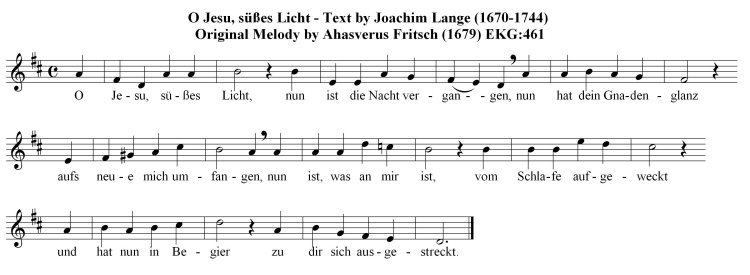
Melody 3: Zahn: 5206b | EKG: 461 |
|
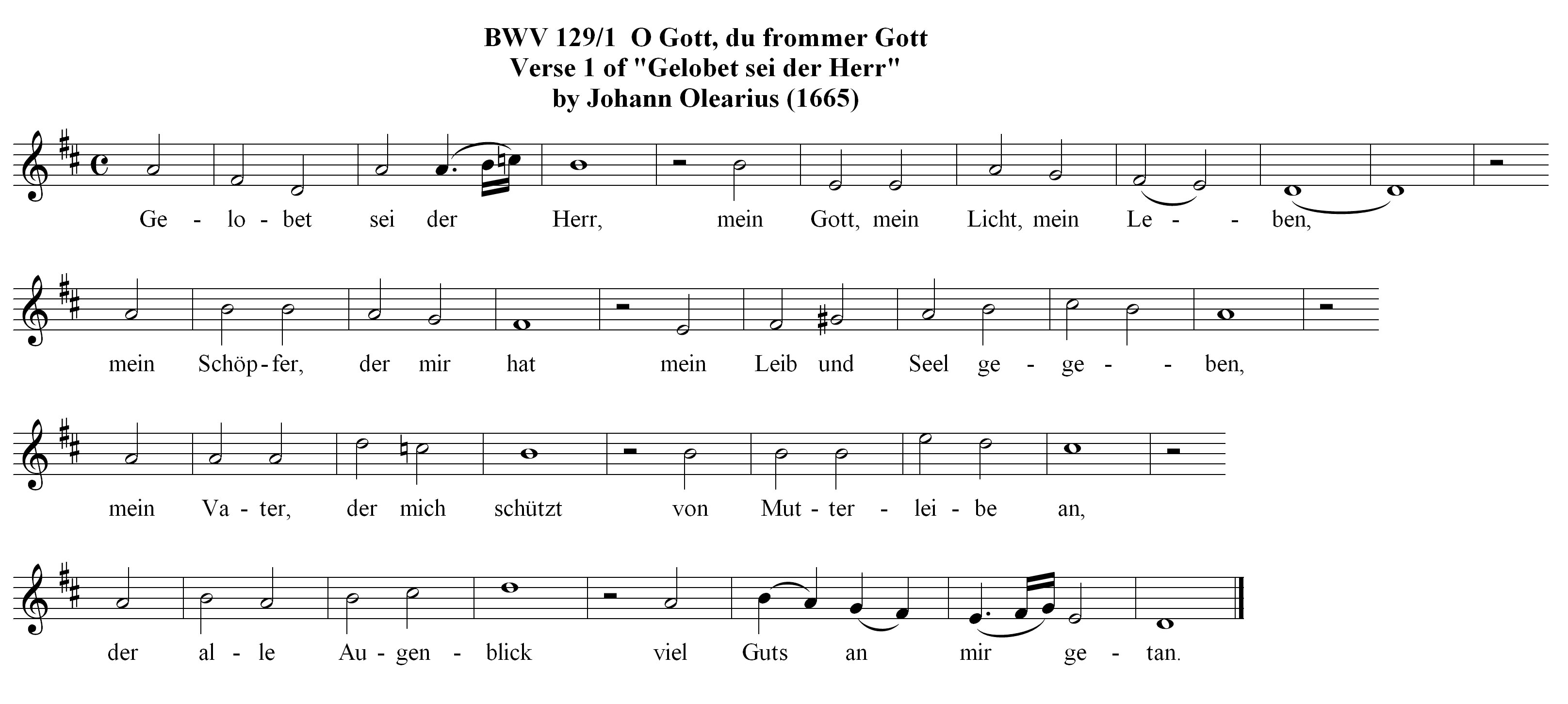
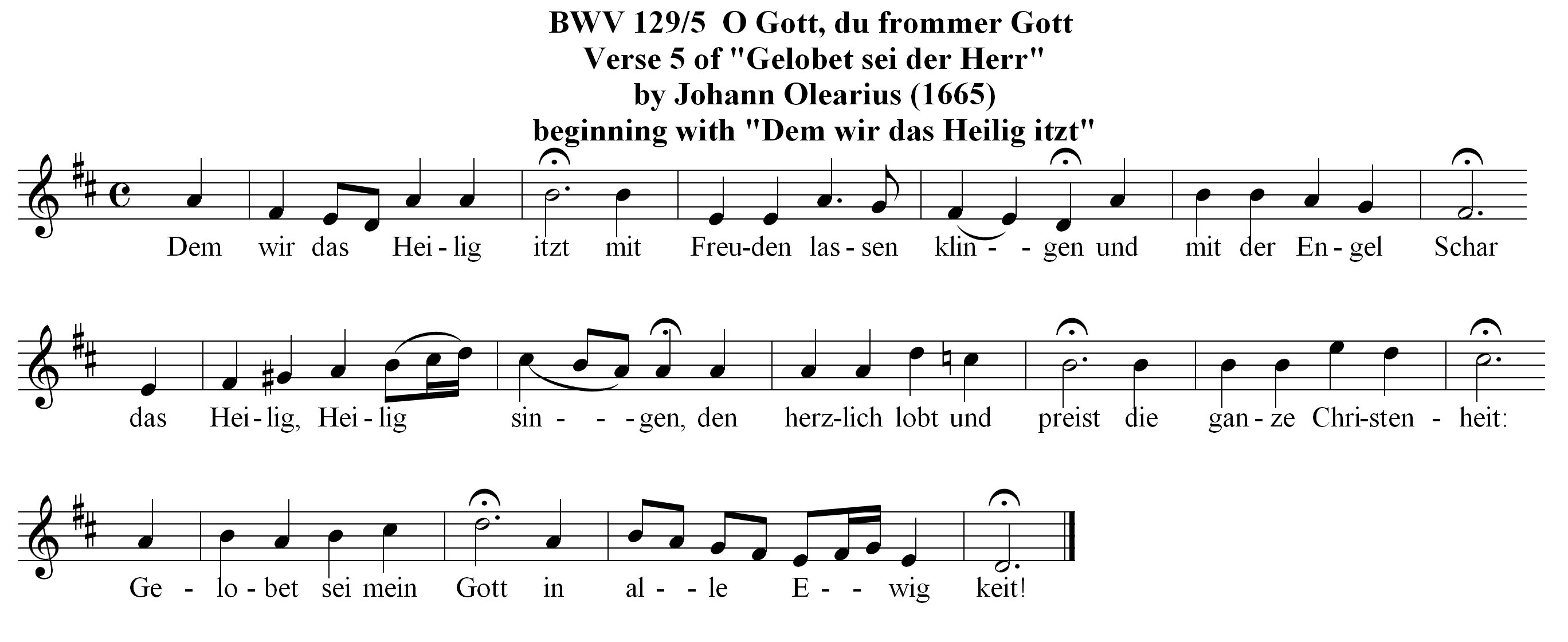
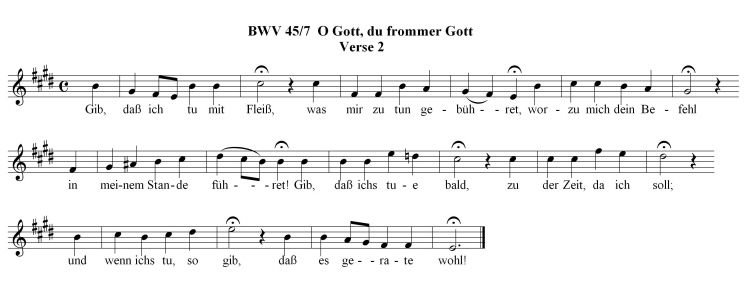
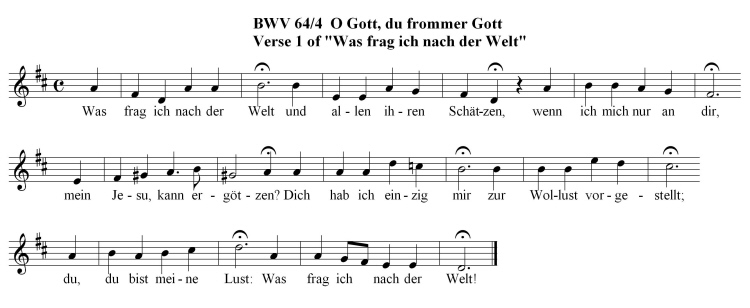
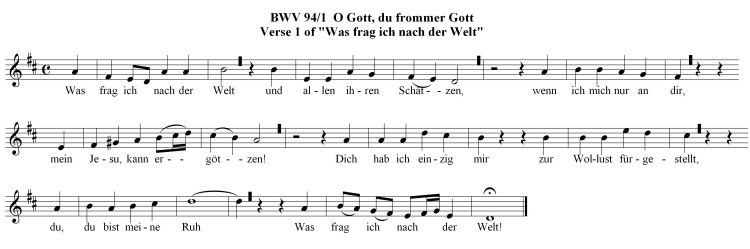
The composer of this melody, the one which Bach most frequently utilized for his settings of Johann Heermann’s (1630) chorale text, but also for many other texts as well, is identified as Ahasverus Fritsch with a date of composition set as 1679. The chorale texts associated with this melody are numerous:
1. “Die Wollust dieser Welt” not used by Bach, but possibly the original use of the melody (Text author unknown)
2. “O Jesu, süßes Licht” Text by Joachim Lange (1670-1744) not used by Bach, but still in use today in the EKG
3. O Gott, du frommer Gott Text by Johann Heermann (1630)
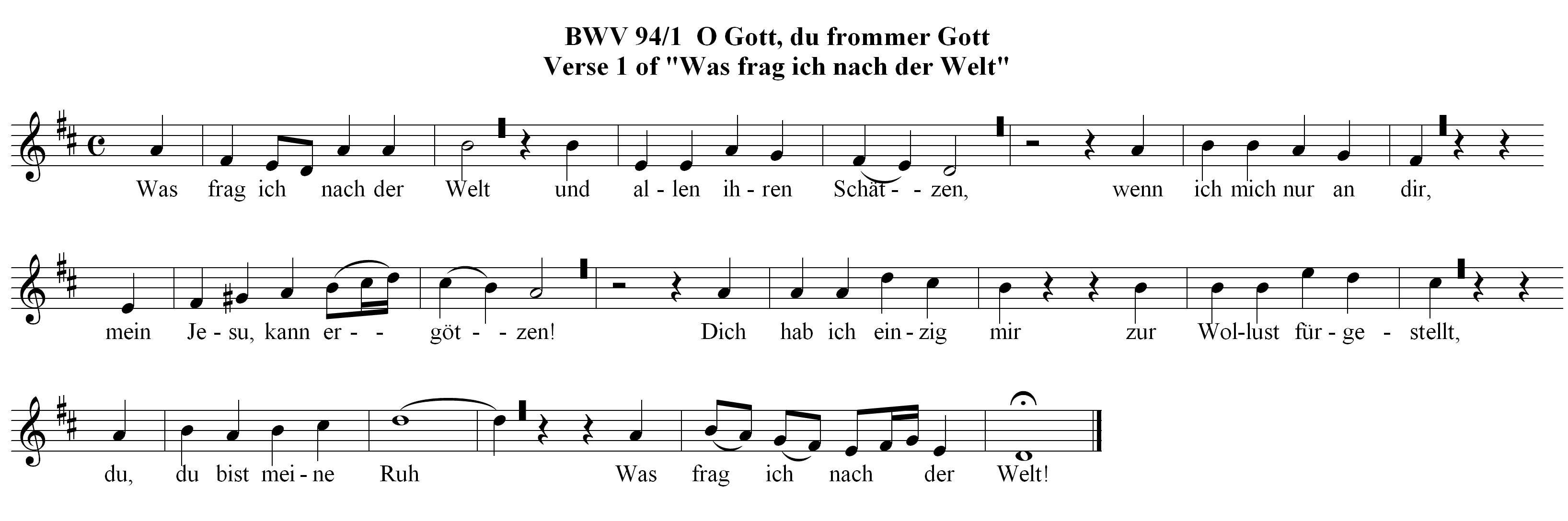
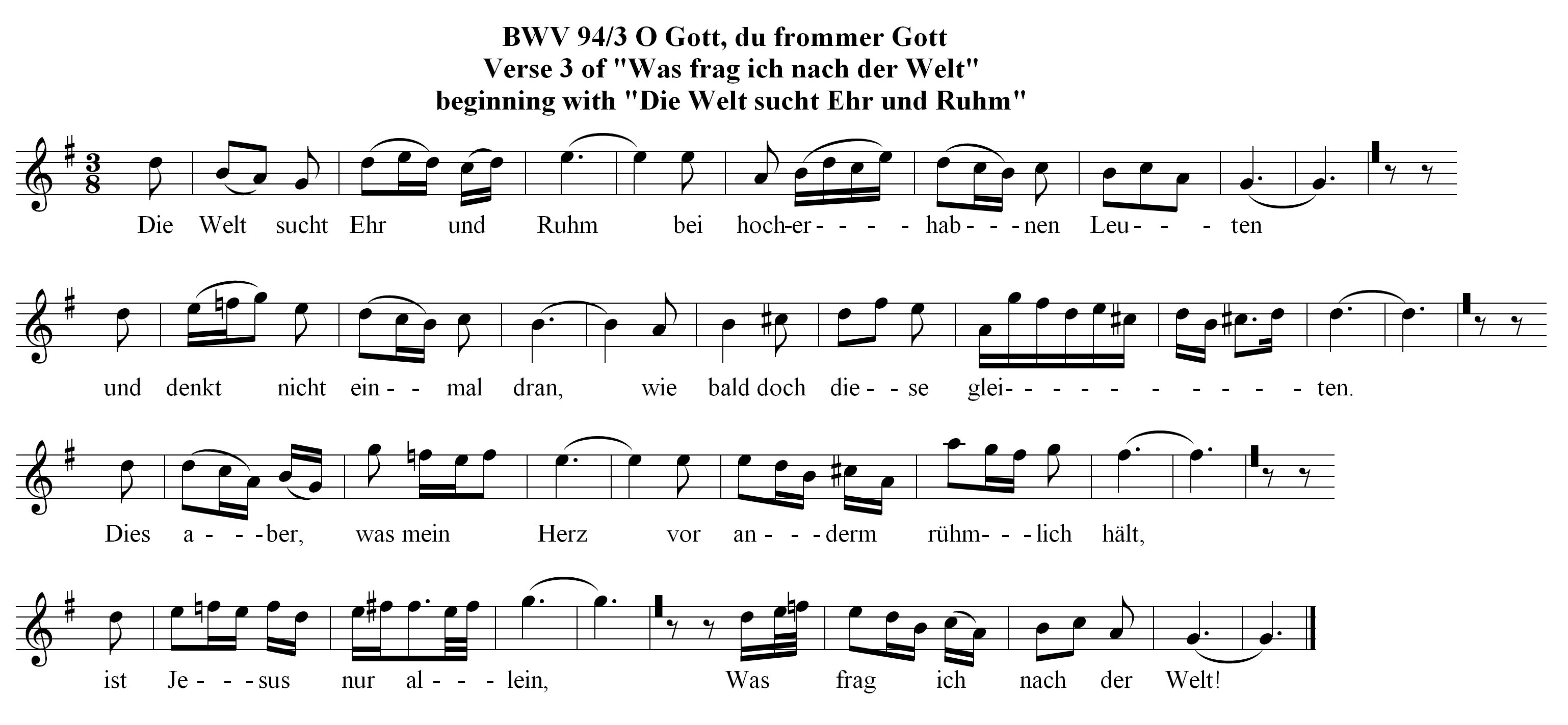
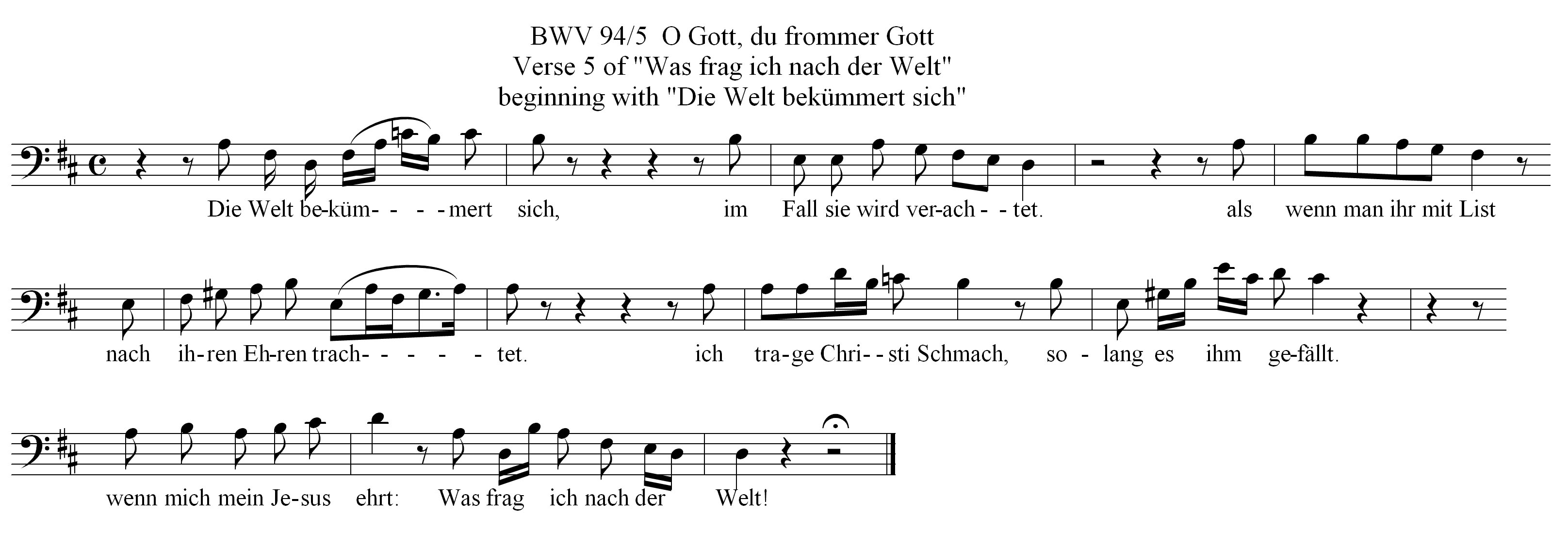
4. Was frag ich nach der Welt Text by Balthasar Kindermann (1664)
5. Gelobet sei der Herr, mein Gott Text by Johann Olearius (1665)
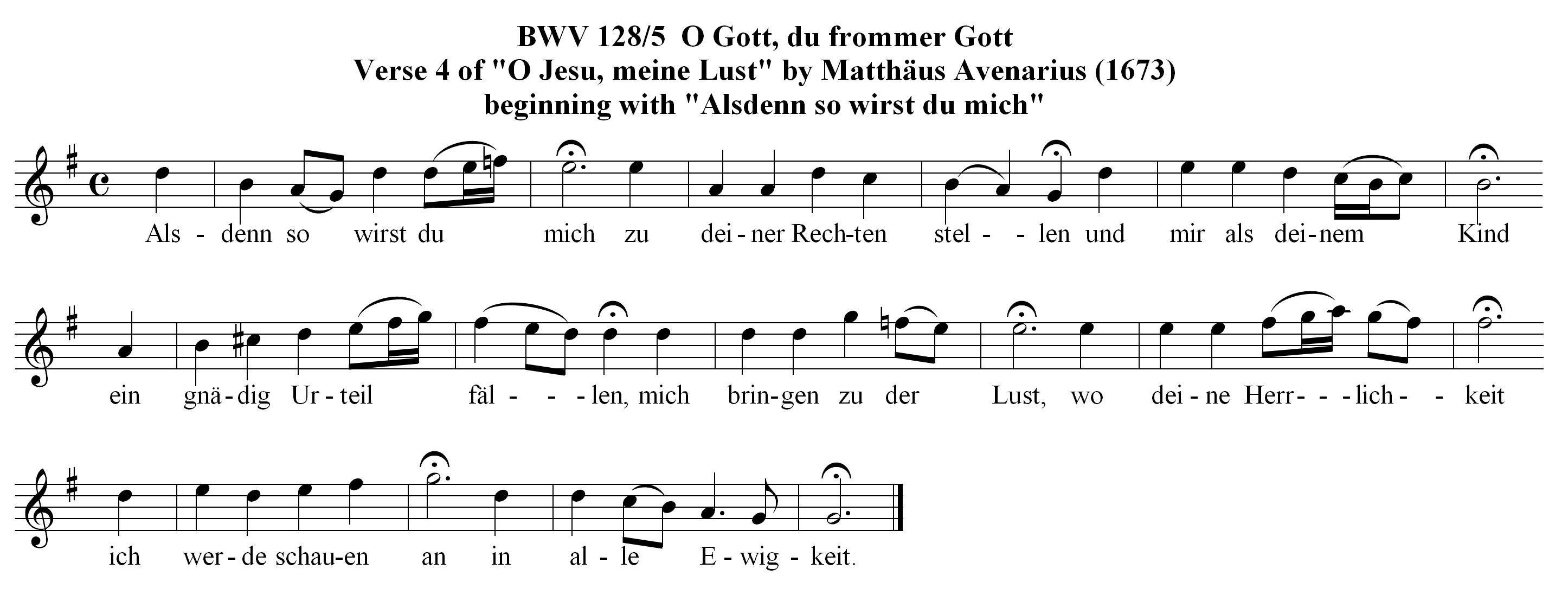
6. O Jesu, meine Lust Text by Matthäus Avenarius (1673)
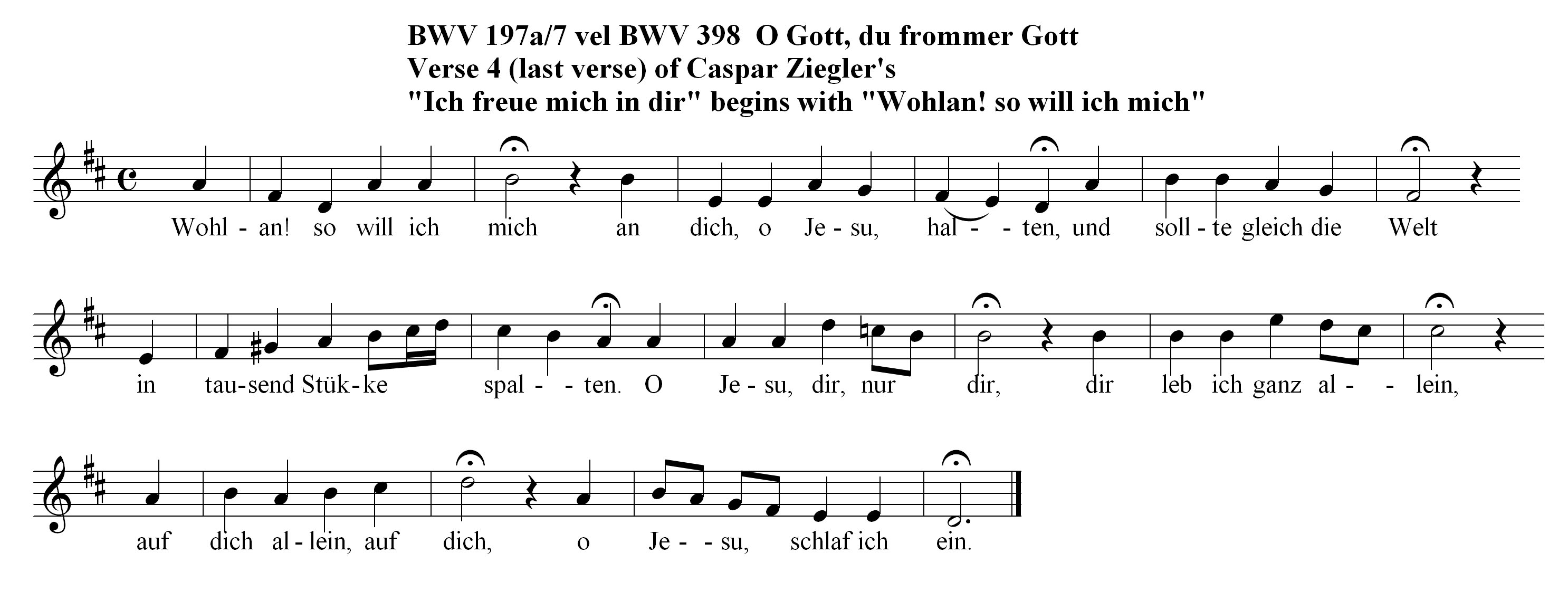
7. Ich freue mich in dir Text by Kaspar Ziegler (1697)
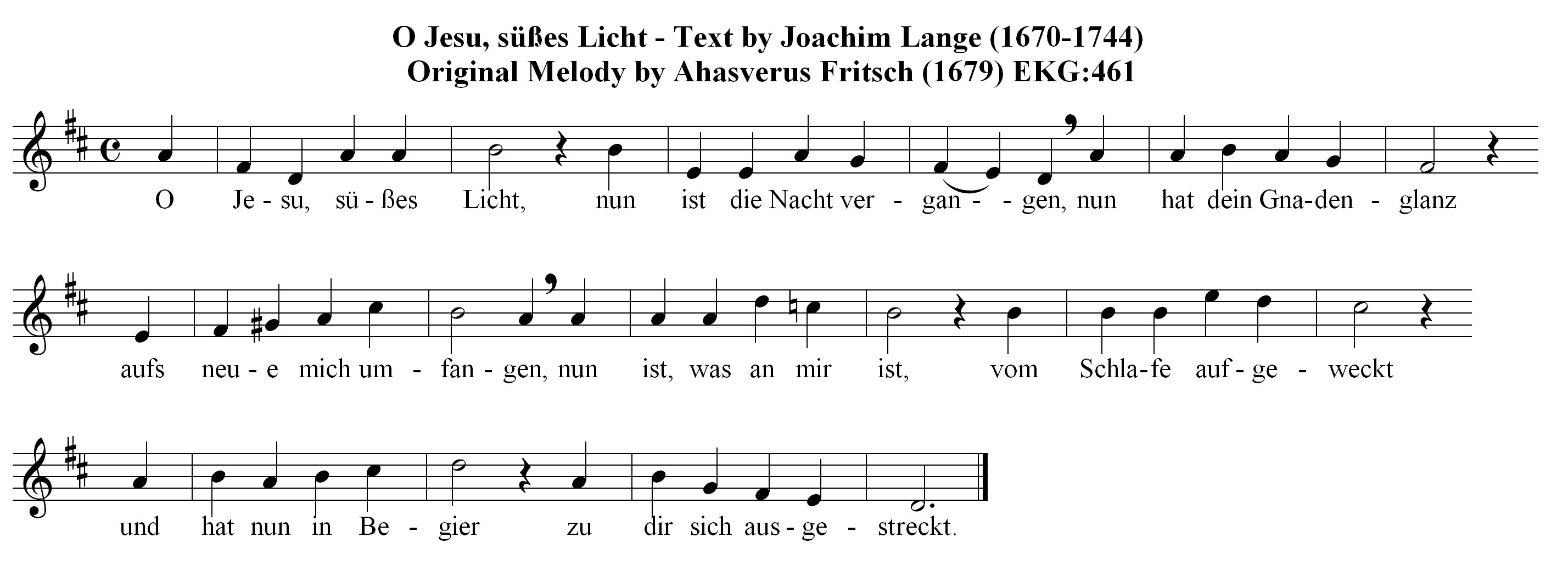
Here is the original melody by Ahasverus Fritsch (1679) as it appears in the present-day Evangelical-Lutheran hymnal printed in Germany. The text by Lange appears to have been added later. |
|
|
| |
|
Use of the Chorale Melody by Bach: |
|
Text 3/1 : O Gott, du frommer Gott
Author: Johann Heermann (1630) |
|
Ver |
Work |
Mvt. |
Year |
Br |
RE |
KE |
Di |
BC |
Score |
Music Examples |
|
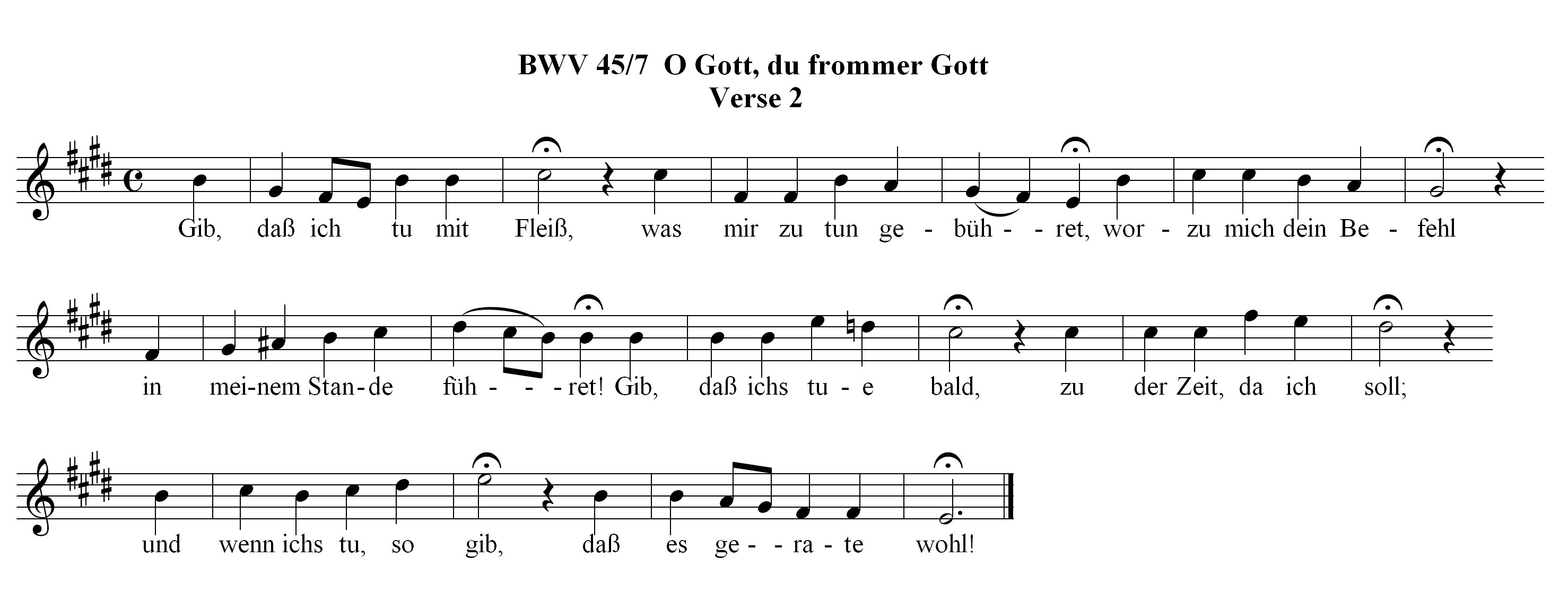
2 |
BWV 45 |
Mvt. 7 |
1726 |
84 |
278 |
85 |
|
A113:7 |
PDF |
Mvt. 7 (CCARH) [midi] | Mvt. 7 (MG) [midi] | Mvt. 7 (Leusink) [ram] |
|
|
| |
|
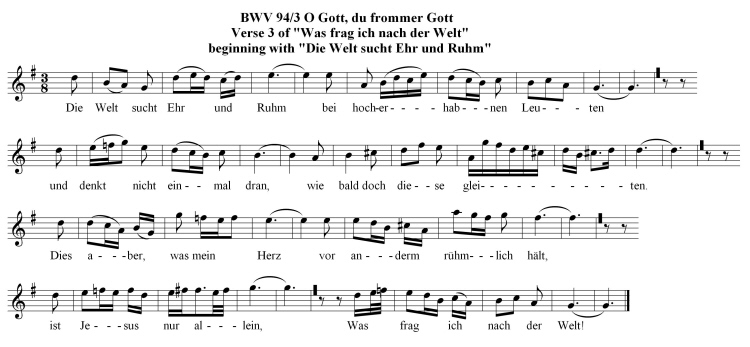
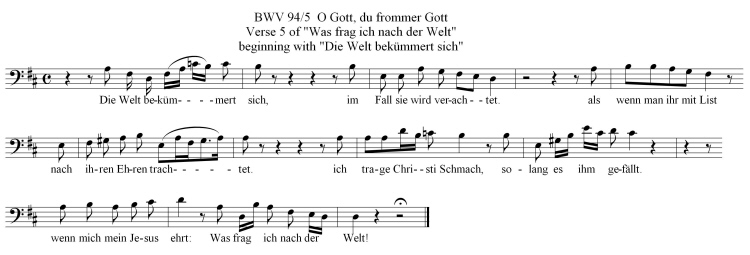
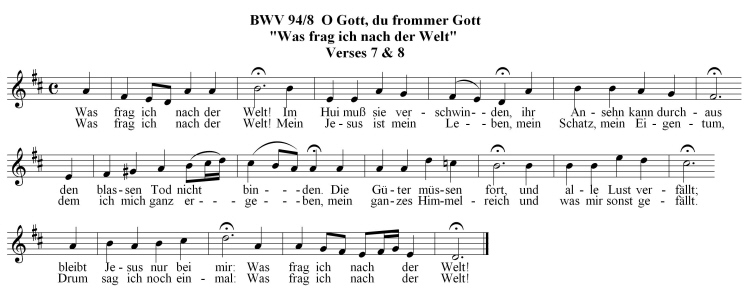
Text 3/2 : Was frag ich nach der Welt
Author: Balthasar Kindermann (1644) |
|
Ver |
Work |
Mvt. |
Year |
Br |
RE |
KE |
Di |
BC |
Score |
Music Examples |
|
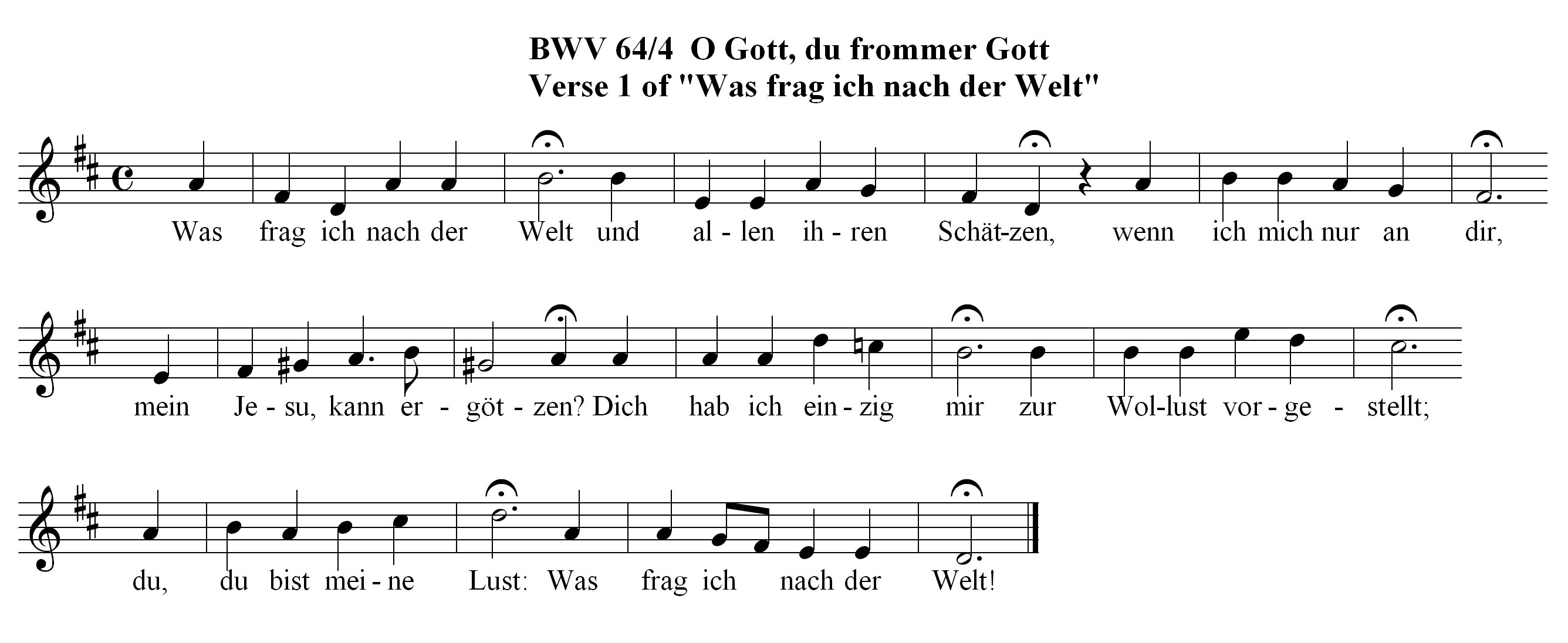
1 |
BWV 64 |
Mvt. 4 |
1723 |
255 |
280 |
255 |
14 |
A14:4 |
PDF |
Mvt. 4 (MG) [midi] | Mvt. 4 (Leusink) [ram] |
|
1 |
BWV 94 |
Mvt. 1 |
1724 |
- |
- |
- |
- |
A115:1 |
- |
Mvt. 1 (Leusink) [ram] |
|
3 |
BWV 94 |
Mvt. 3 |
1724 |
- |
- |
- |
- |
A115:3 |
- |
Mvt. 3 (Leusink) [ram] |
|
5 |
BWV 94 |
Mvt. 5 |
1724 |
- |
- |
- |
- |
A115:5 |
- |
Mvt. 5 (Leusink) [ram] |
|
7,8 |
BWV 94 |
Mvt. 8 |
1724 |
290 |
281 |
291 |
72 |
A115:8 |
PDF |
Mvt. 8 (MG) [midi] | Mvt. 8 (Leusink) [ram] |
|
|
|
|
|
|
|
|
|
|
| |
|
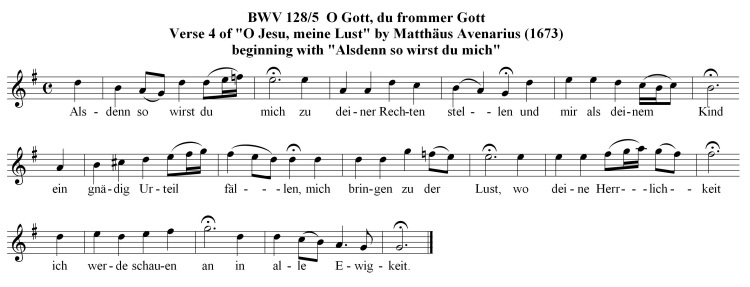
Text 3/3: O Jesu, meine Lust
Author: Matthäus Avenarius (1673) |
|
Ver |
Work |
Mvt. |
Year |
Br |
RE |
KE |
Di |
BC |
Score |
Music Examples |
|
4 |
BWV 128 |
Mvt. 5 |
1725 |
- |
279 |
- |
|
A76:5 |
PDF |
Mvt. 5 (YFM) [midi] | Mvt. 5 (MG) [midi] | Mvt. 5 (Leusink) [ram] |
|
|
| |
|
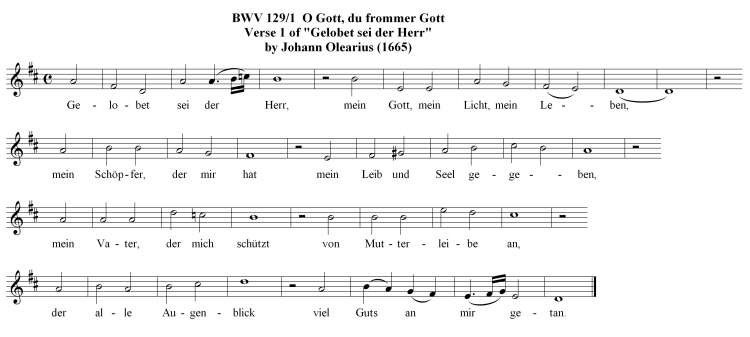
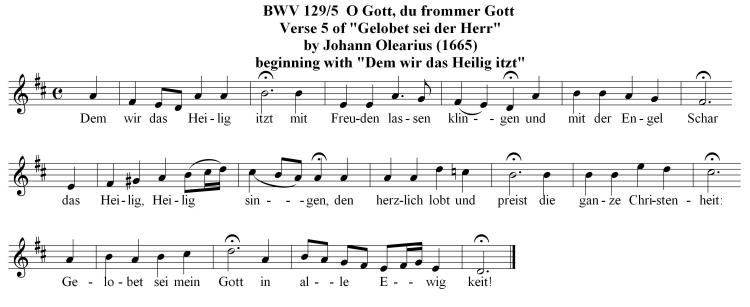
Text 3/4: Gelobet sei der Herr, mein Gott
Author: Johann Olearius (1665) |
|
Ver |
Work |
Mvt. |
Year |
Br |
RE |
KE |
Di |
BC |
Score |
Music Examples |
|
1 |
BWV 129 |
Mvt. 1 |
1725 |
- |
- |
- |
- |
A93:1 |
- |
Mvt. 1 (Leusink) [ram] |
|
5 |
BWV 129 |
Mvt. 5 |
1725 |
- |
- |
- |
114 |
A93:5 |
- |
Mvt. 5 (MG) [midi] | Mvt. 5 (HSEM) [mp3] | Mvt. 5 (Leusink) [ram] |
|
|
|
|
| |
|
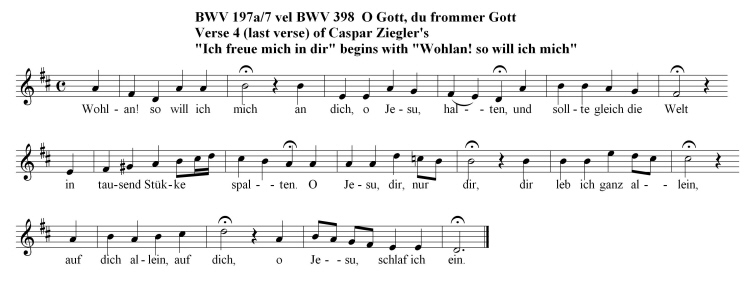
Text 3/5: Ich freue mich in dir
Author: Kaspar Ziegler (1697) |
|
Ver |
Work |
Mvt. |
Year |
Br |
RE |
KE |
Di |
BC |
Score |
Music Examples |
|
4 |
BWV 197a |
Mvt. 7 |
1728 |
- |
- |
- |
|
A11:7 |
PDF |
- |
|
|
| |
|
Untexted: |
|
Ver |
Work |
Mvt. |
Year |
Br |
RE |
KE |
Di |
BC |
Score |
Music Examples |
|
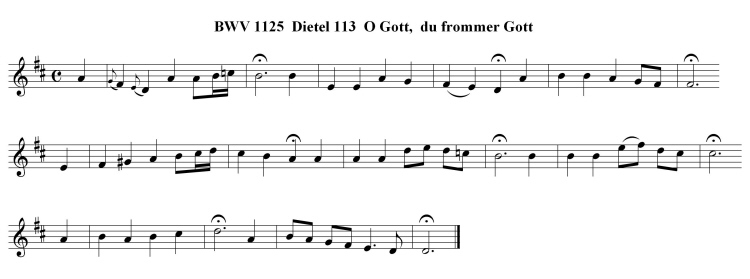
- |
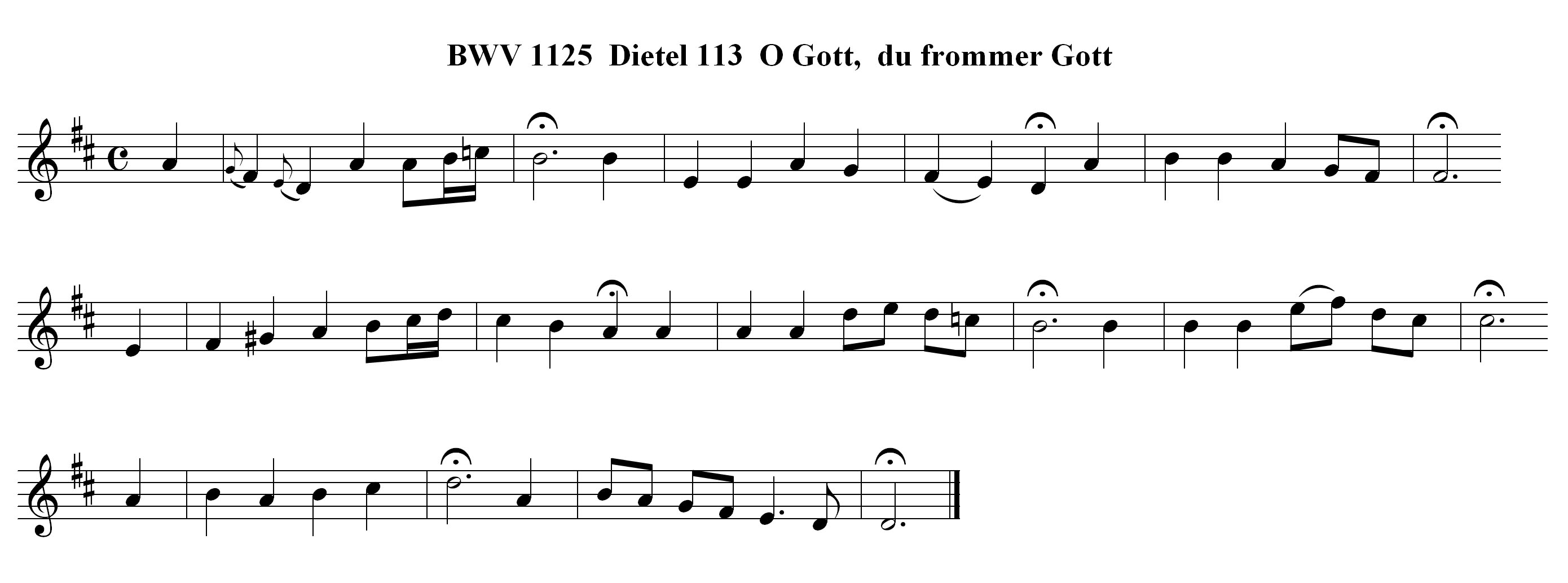
BWV 1125 |
- |
? |
- |
- |
- |
113 |
|
- |
|
|
- |
BWV 398 |
- |
1728 |
311 |
277 |
312 |
|
F45.2b |
PDF |
Chorale (MG) [midi] |
|
BWV 1125: O Gott, du frommer Gott probably from a lost cantata.
BWV 398 = BWV 197a/7 |
|
|
| |
|
Melody 4: Zahn: 5187 |
|
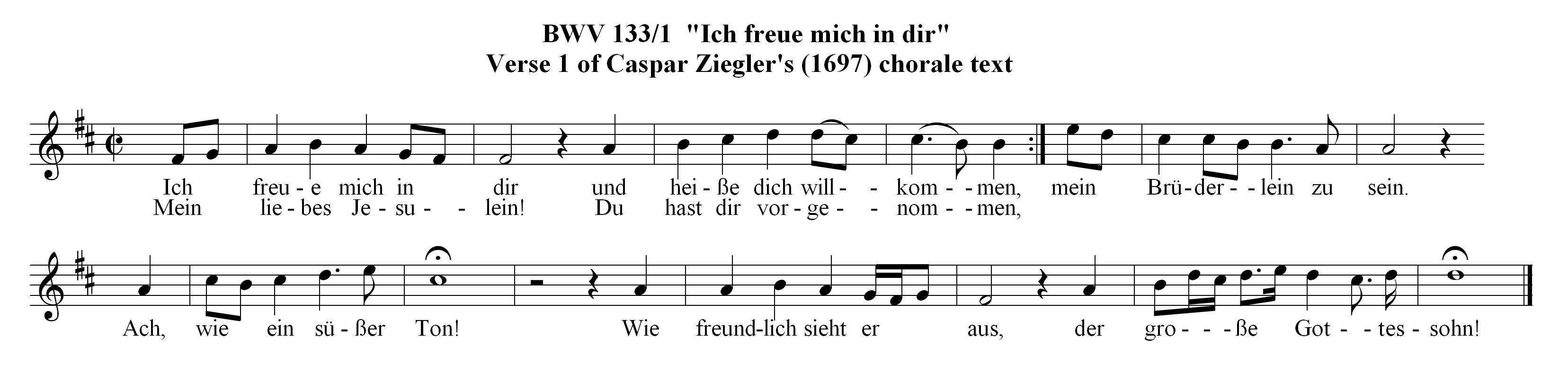
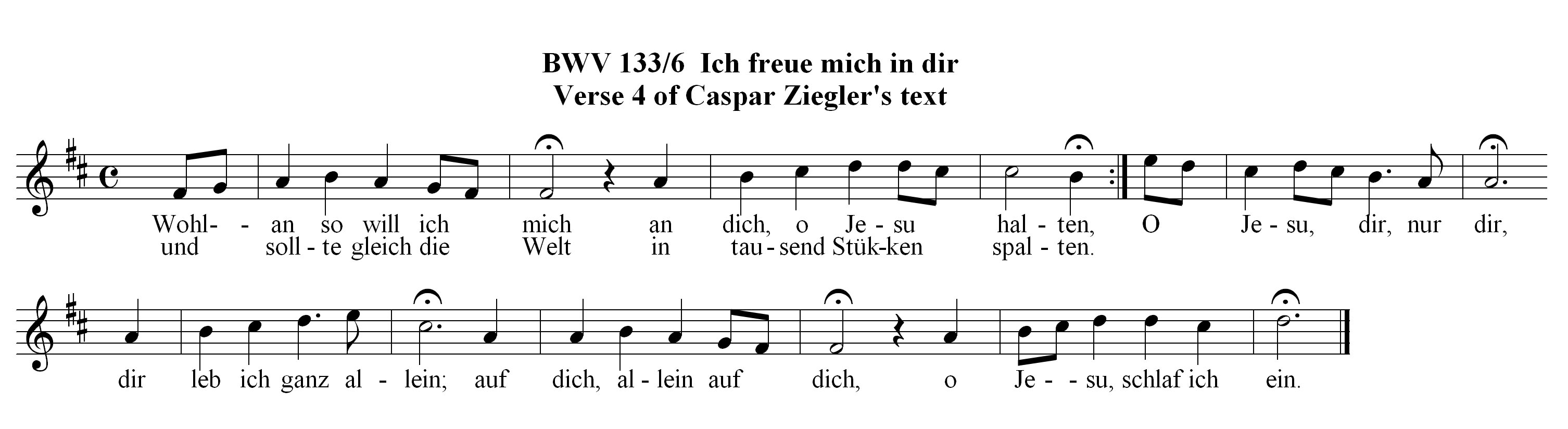
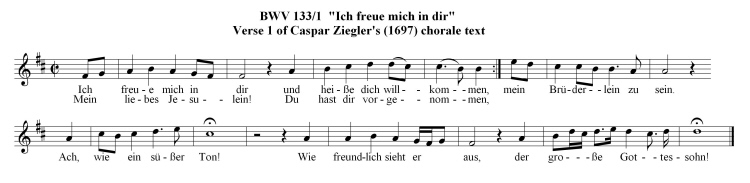
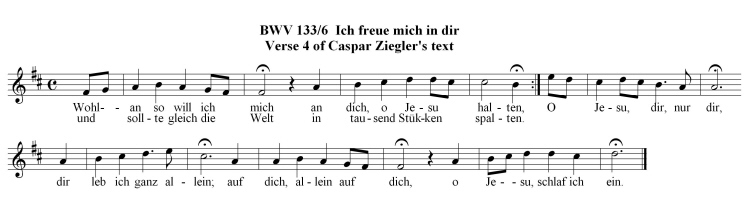
Neither the composer nor date of composition is known. The first appearance of this melody in print is in 1738. The circumstances surrounding Bach’s notation of the melody in the blank space left on the score of the “Sanctus” (1724) later incorporated into the B-minor Mass (BWV 232), may be evidence of its rather recent origin with Bach not being familiar with the melody before this time. |
| |
|
Use of the Chorale Melody by Bach: |
|
Text : Ich freue mich in dir
Author: Kaspar Ziegler (1697) |
|
Ver |
Work |
Mvt. |
Year |
Br |
RE |
KE |
Di |
BC |
Score |
Music Examples |
|
1 |
BWV 133 |
Mvt. 1 |
1724 |
- |
- |
- |
- |
A16:1 |
- |
Mvt. 1 (Leusink) [ram] |
|
4 |
BWV 133 |
Mvt. 6 |
1724 |
61 |
181 |
60 |
56 |
A16:6 |
PDF |
Mvt. 6 (MG) [midi] | Mvt. 6 (Leusink) [ram] |
|
|
|
|
| |
|
Use of the Chorale Melodies by other composers: |
|
Additional composers using the same 4 chorale melodies with the titles given above. They are organized by title and as chronologically as possible. |
|
O Gott, du frommer Gott |
|
Georg Friedrich Kauffmann (1679-1735):
O Gott, du frommer Gott, Chorale Prelude for Organ |
|
Johann Ludwig Krebs (1713-1780):
O Gott, du frommer Gott, 2 Chorale Preludes for Organ, one with an obbligato instrument |
|
Carl Philipp Emanuel Bach (1714-1788):
O Gott du frommer Gott, Chorale setting for Organ (or Keyboard), H. 336/1 |
|
Gottfried August Homilius (1714-1785):
O Gott, du frommer Gott, Cantata |
|
Johann Friedrich Doles (1715-1797):
O Gott, du frommer Gott, Cantata |
|
Johannes Brahms (1833-1897):
O Gott, du frommer Gott, Chorale Prelude for Organ, Op. posth. 122/7 (1896) |
|
Dame Ethel (Mary) Smyth (1858-1944):
O Gott du frommer Gott, for organ |
|
Max Reger (1873-1916):
O Gott, du frommer Gott, Chorale Prelude for Organ, Op. 67/31 (1902)
O Gott, du frommer Gott, Chorale Prelude for Organ, Op. 135a/20 (1914) |
|
Kurt Fiebig (1908-1988):
O Gott, du frommer Gott, Choralkantaten for Chor, Soli, Instr. u. Org. (1935-1945) |
| |
|
Gelobet sei der Herr |
|
Heinrich Schütz (1585-1672):
Gelobet sei der Herr for 5, 10, 11, 20 voices (Weimar) |
|
Johann Rosenmüller (1615-1684):
Gelobet sei der Herr for 4 or more voices + instruments |
|
Johann Krieger (1652-1735):
Gelobet sei der Herr, Cantata (1689) |
|
>>Besonders nennenswert ist die Tripel- Fuge in »Gelobet sei der Herr« (NA in DTB VI/1); eine . Kopie dieses Werkes ist von Händels Lehrer Zachow geschrieben, was vermuten läßt, daß das Werk (1689 in Weißenfels aufgef.) auch Händel bekannt war.<<
[“Particularly noteworthy is the triple fugue in “Gelobet sei der Herr”. Zachow, Handel’s teacher, personally made a manuscript copy of this work which was performed in Weißenfels in 1689. It is likely that Handel was also acquainted with this work.”]
[Harold E Samuel in an article from the MGG1, Bärenreiter, 1986; English translation by Thomas Braatz]
|
| |
|
Arrangements/Transcriptions of Bach's use of the Chorale Melodies: |
|
Walter Rummel (1887-1953)::
Piano transcription of O Gott, du frommer Gott! from Cantata BWV 94 |
|
See list of Piano Transcriptions of BWV 24/6, BWV 94/1, BWV 129, 5 by various composers/arrangers at:
Piano Transcriptions of Bach's Works - Index by BWV Number Part 1: Cantatas |
|
See list of Piano Transcriptions of BWV 767 by various composers/arrangers at:
Piano Transcriptions of Bach's Works - Index by BWV Number Part 4: Chorale Preludes for Organ |
| |
|
Sources: NBA, vols. III/2.1 & 2.2 in particular [Bärenreiter, 1954 to present] and the BWV ("Bach Werke Verzeichnis") [Breitkopf & Härtel, 1998]
The PDF files of the Chorales were contributed by Margaret Greentree J.S. Bach Chorales
Software: Capella 2004 Software, version 5.1.
Prepared by Thomas Braatz & Aryeh Oron (December 2005) |