|
Chorale Melodies used in Bach's Vocal Works
Herr Gott, dich loben alle wir [1]
|
|
Melody & Text | Use of the CM by Bach | Use of the CM by other composers | Footnotes |
| |
|
Melody & Text: Zahn: 460 [2] | EKG: 115 |
|
Text: |
|
The author of this CT is Paul Eber (1511-1569) and the first appearance of this CT is from 1554. It is Eber’s paraphrase/translation of Philipp Melanchton’s (1497-1560) Latin verse “Dicimus grates tibi” which first appeared in 1539.
Eber is also the poet responsible for other important CTs of which the following are still in the German Evangelical Lutheran Hymnal (all of which relate to melodies which have settings by Bach):
Helft mir Gotts Güte preisen
Wenn wir in höchsten Nöten sein
Herr Jesu Christ, wahr’ Mensch und Gott |
| |
|
Melody: |
|
This chorale melody probably dates back to a 15th-century secular chanson. As a contrafact it made its first appearance in print in the Geneva Psalter of 1551
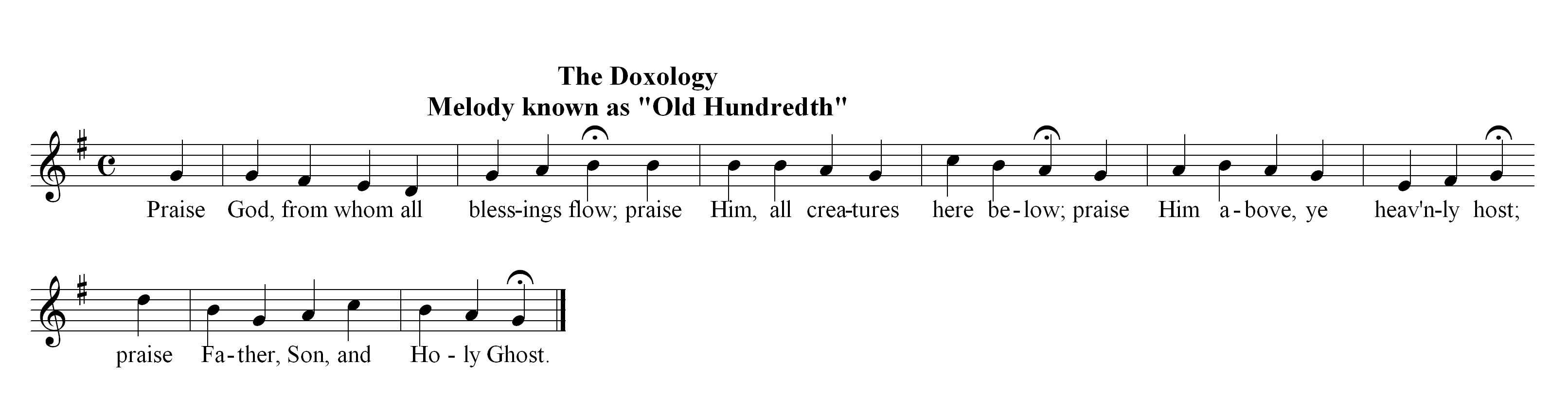
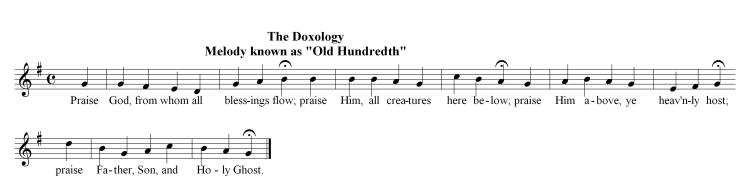
It is widely known in many English-speaking Christian churches as the one used for the „Doxology“ [„Doxology“: an invocation in praise of God that is often spoken or sung during Christian worship.], “Praise God, from whom all blessings flow” . In this form the melody is often referred to as the “Old 100th”: |
|
|
|
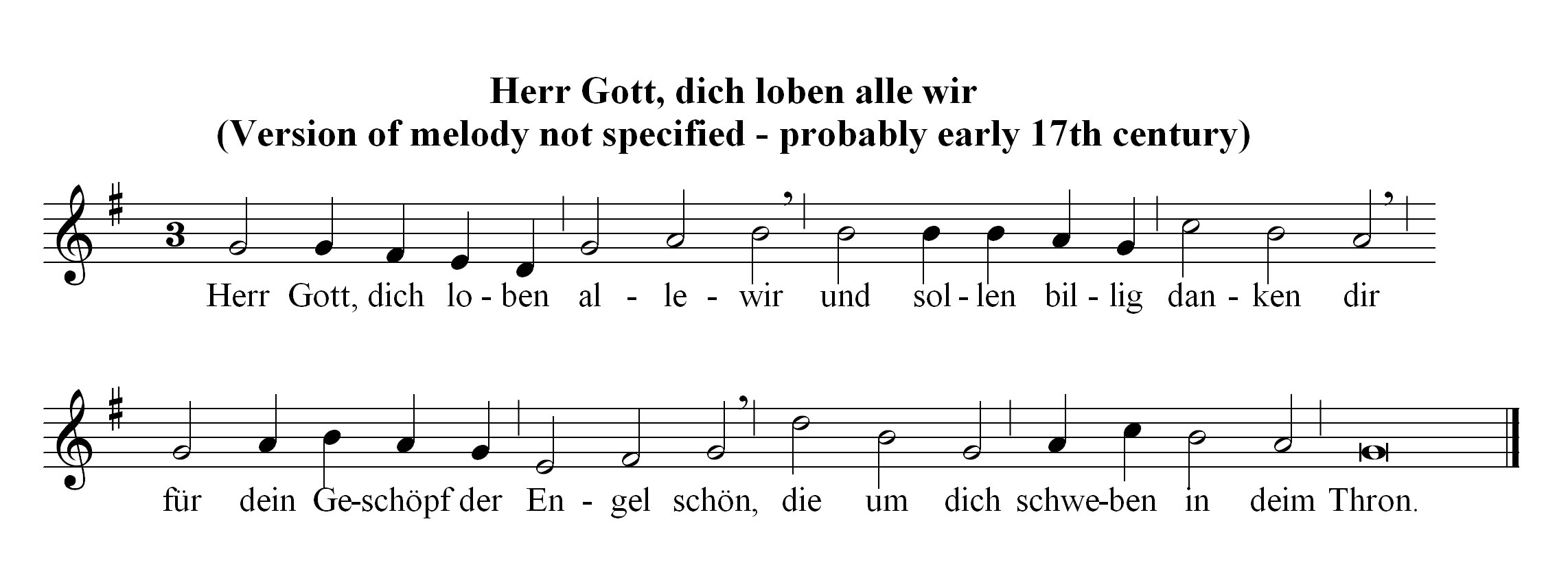
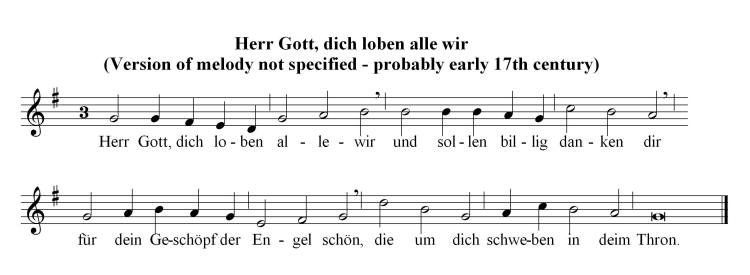
Both the German “Herr Gott, dich loben alle wir”, (here in an early 17th-century version: |
|
|
|
and the English “Praise God, from whom all blessings flow” find their original melody source in the Genevan Psalter, (1551) attributed to Louis Bourgeois, who may, according to recent research, have based this melody on a secular French chanson.
This chanson source has not yet been uncovered; however, there are some scholars
who believe this melody to be an original composition by Bourgeois. In any case, Bourgeois seems to have played an important part in including it as the melody for French Psalm 134 (this connection is also documented in the later Genevan Psalter from 1562) in the Genevan Psalter of 1551 which is the first instance of the sacred use of this melody. |
|
Further interesting background can be found in this excerpt from an article on the Genevan Psalter of 1551 and the role Louis Bourgeois played in composing, rewriting, adapting (contrafact), and revising many of the chorale melodies used in this edition of the Genevan Psalter: |
|
>>The Protestant reformers, eager to provide appropriate music for their devotions, drew on both popular and courtly secular music as well as older sacred music, altering texts as needed. The Genevan Psalter borrows heavily from popular chanson melodies, while many Lutheran chorales derive their music from traditional sacred melodies and secular songs (e.g. Isaac's Innsbruck becomes O Welt ich muss dich lassen).
Pseaumes octantetrois de David, mis en rime Francoise, a savoir, quaranteneuf par Clement Marot … et trentequatre par Theodore de Besze, de Vezelay en Bourgongne (Geneva, 1551) is the first Calvinist psalter in which the work of poet and musician is acknowledged. Marot, who had died by that time, and Théodore de Bèze, the theologian who continued the work of versifying the psalms, are both mentioned in the title. The musician responsible for the melodies was Loys Bourgeois, who had been active as a music teacher in Geneva since 1545. Bourgeois explained his work in a preface, claiming that he wrote new music for the 34 Bèze psalms, rewrote 12 and revised 24 of the old melodies, and left only 15 untouched. Writers have often credited Loys Bourgeois for work on other Genevan psalters, but his role, though substantial, was confined to this publication; the new melodies for the 1543 edition were probably composed by Guillaume Franc. Bourgeois left Geneva in 1552.<<
Authors: Howard Slenk and Janr. Luth in Grove Music Online, © Oxford University Press, 2006, acc. 5/15/06
|
|
In the German chorale tradition, this melody has also been associated with the following chorale texts:
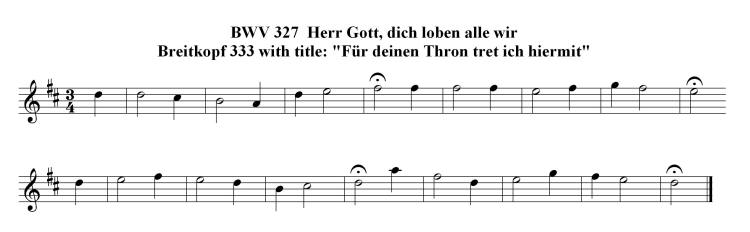
1. Für deinen Thron tret ich (see BWV 327 below)
Texts not set by Bach:
2. Nun mach uns heilig, Herre Gott
3. Das walt Gott Vater und Gott Sohn
4. Ihr Knecht des Herren allzu gleich (suggested as the name of this melody by the BWV Verzeichnis) |
|
Dick Wursten added (November 22, 2011):
Herr Gott, dich loben alle wir = melody of ps. 134 in the Geneva Psalter.
Composer of this melody = Louis (or Loys) Bourgeois.
First appeared in Geneva, Psaumes Octantetrois de David (83 Psalms of David) 1551.
[curious and complicating aspect: This tune is used in the ENGLISH Psalter for Psalm 100, and thus is known until today as ‘The Old Hundredth” http://en.wikipedia.org/wiki/Old_100th |
| |
|
Use of the Chorale Melody by Bach: |
|
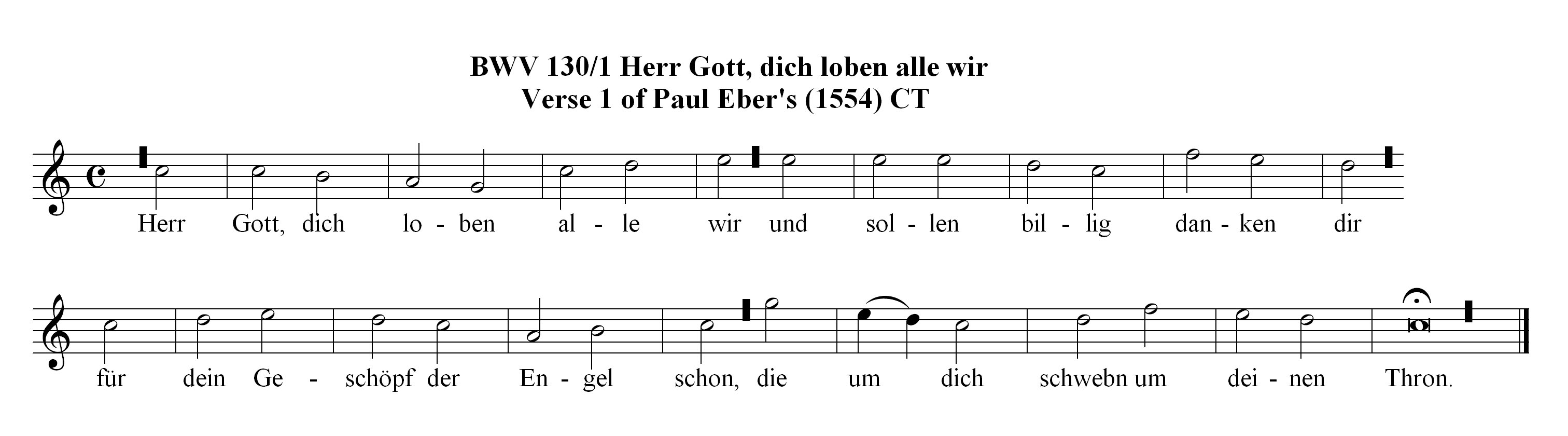
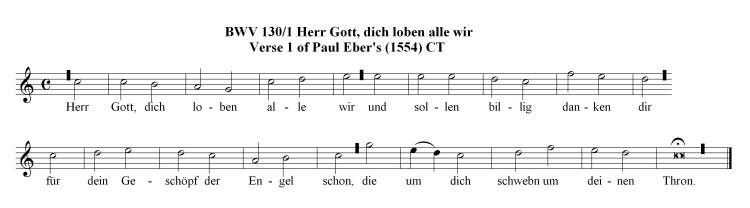
Text: Herr Gott, dich loben alle wir | EKG: 115
Author: Paul Eber (1554) |
|
Ver |
Work |
Mvt. |
Year |
Br |
RE |
KE |
Di |
BC |
Score |
Music Examples |
|
1 |
BWV 130 |
Mvt. 1 |
1724 |
- |
- |
- |
- |
A179:1 |
- |
Mvt. 1 (Leusink) |
|
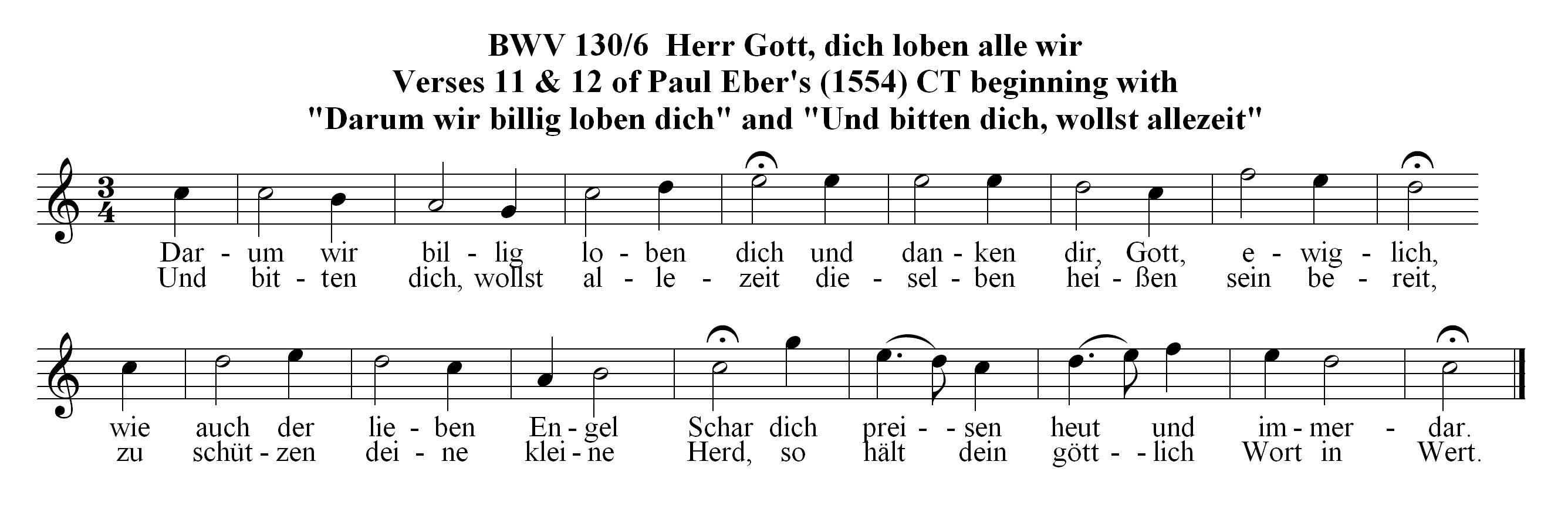
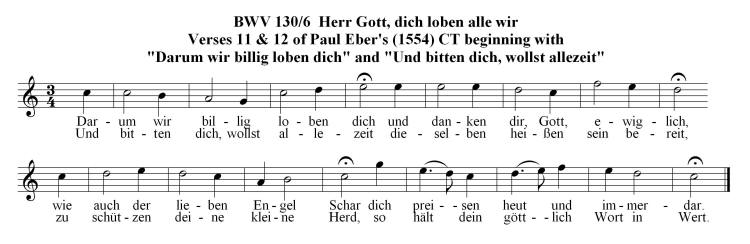
11, 12 |
BWV 130 |
Mvt. 6 |
1724 |
Anh 8 |
131 |
- |
85 |
A179:6 |
PDF |
Mvt. 1 (MG) [midi] | Mvt. 6 (Leusink) [ram] |
|
BWV 130/6: Dietel 85 (w/o instrumental parts) Breitkopf Anhang
8. |
|
|
|
|
| |
|
Untexted: |
|
Ver |
Work |
Mvt. |
Year |
Br |
RE |
KE |
Di |
BC |
Score |
Music Examples |
|
- |
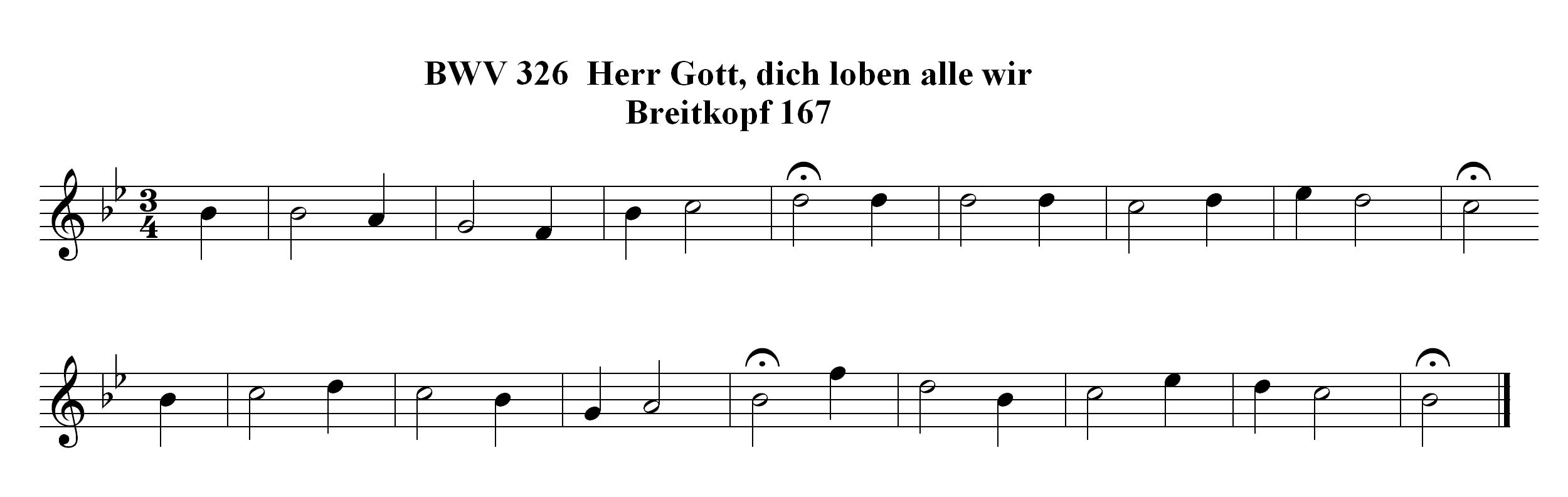
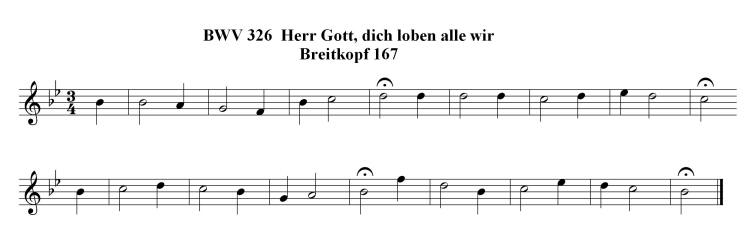
BWV 326 |
- |
? |
167 |
129 |
164 |
- |
F105:1 |
PDF |
Chorale (MG) [midi] |
|
- |
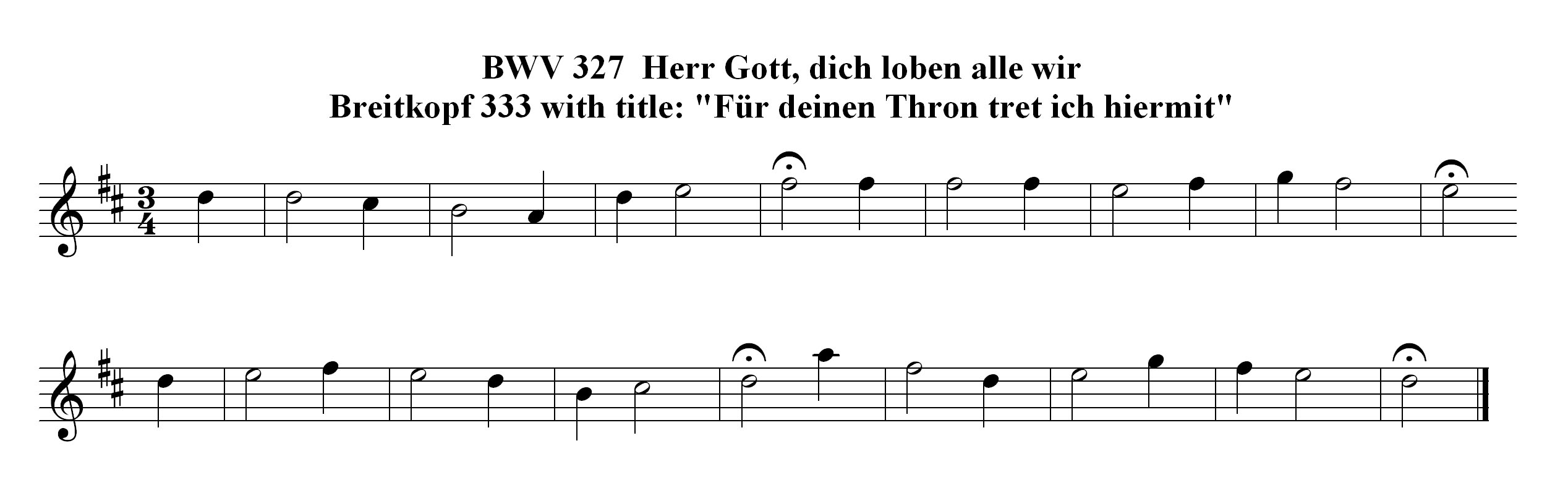
BWV 327 |
- |
? |
333 |
132 |
334 |
- |
F105:2 |
PDF |
Chorale (MG) [midi] |
|
BWV 327: Listed in Breitkopf with a variant title as Für deinen Thron tret ich. |
|
|
|
|
| |
|
Use of the Chorale Melody by other composers: |
|
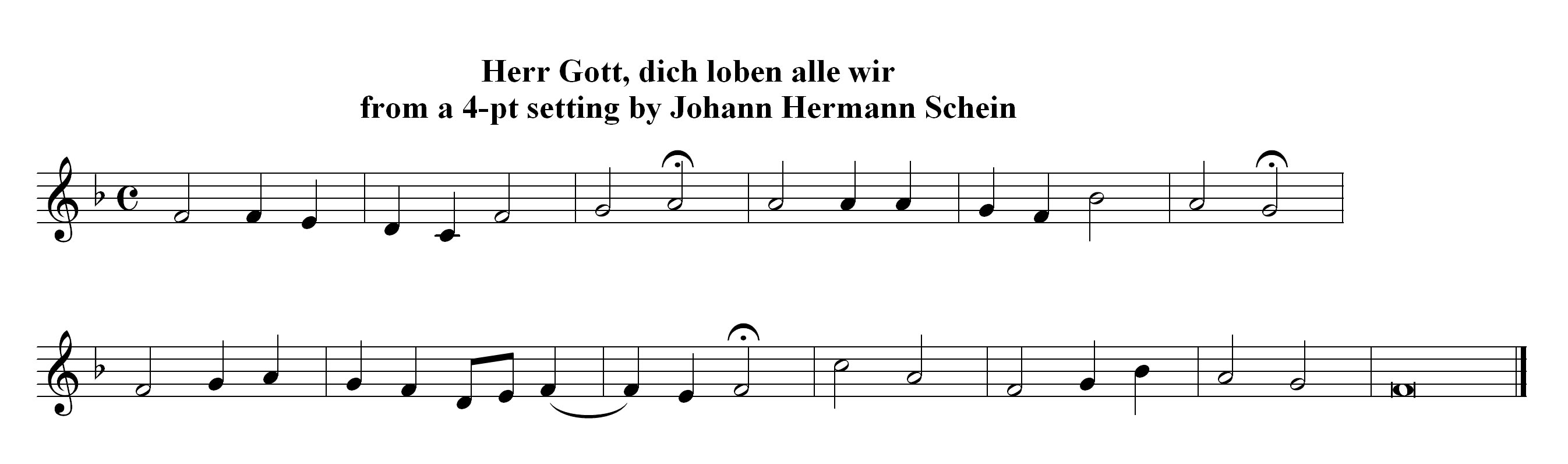
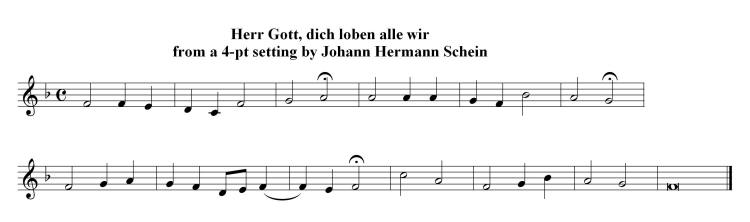
Johann Hermann Schein (1586-1630):
Herr Gott, dich loben alle wir, SATB [bc] (1627); A ii/1, 76
Herr Gott, dich loben alle wir, SS, bc (1618); A iv, 139, P v, 113 |
|
|
|
Samuel Scheidt (1587-1654):
Herr Gott, dich loben alle wir (chorale), STB, bc, SSWV 321; S xi, 90 (Halle, 1635)
Herr Gott dich loben alle, SSWV 467; S i, 12 (Görlitz, 1650) |
|

|
|
Johann Pachelbel (1653-1706):
Herr Gott, dich loben alle wir, Chorale Prelude for Organ |
|
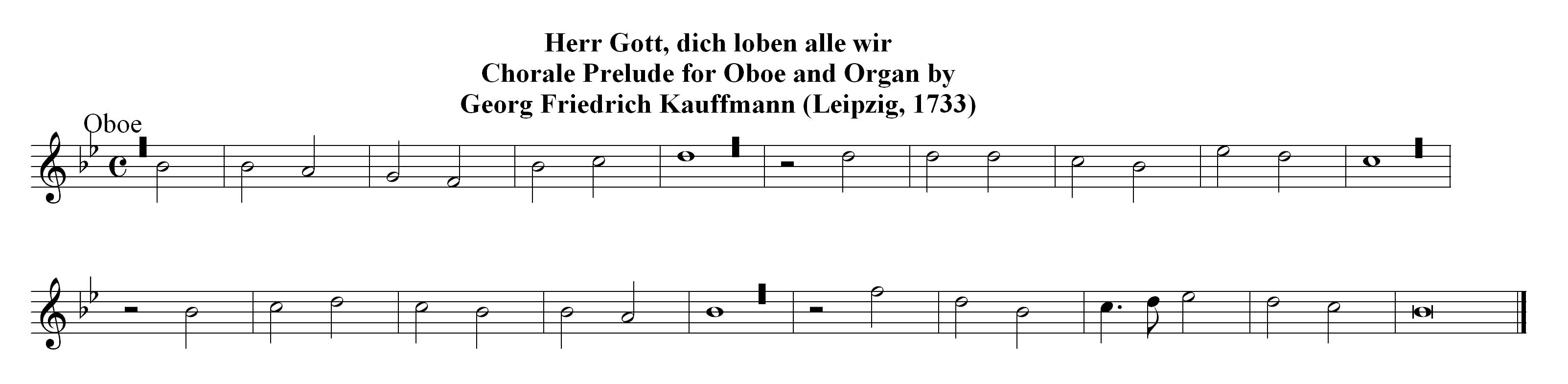
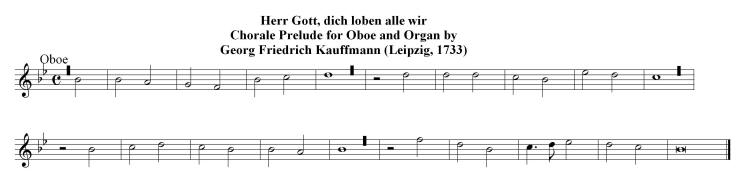
Georg Friedrich Kauffmann (1679-1735):
Herr Gott, dich loben alle wir, Chorale Prelude for Oboe and Organ (Leipzig, 1733) |
|
|
|
Johann Ludwig Krebs (1713-1780):
Herr Gott, dich loben alle wir, Chorale Prelude for Organ |
|
Günter Raphael (1903-1960):
Herr Gott, dich loben alle wir, op.84, A, Bar, chorus, ob, va, vc, org (1959) |
| |
|
Footnotes |
|
[1] Not to be confused with the Te Deum laudamus = Herr Gott, dich loben wir [The German Tedeum] (different melody) nor with Nun lob, mein Seel, den Herren which has the same melodic incipit but differs thereafter.
[2] The BWV Verzeichnis gives Zahn 368 with the melody title Ihr Knecht des Herren allzugleich
Another source gives Zahn 6002 Preis, Lob und Dank sei Gott dem Herren Geneva Psalter, 1551, but Zahn 460 is also related to the Geneva Psalter, 1551. |
| |
|
Sources: NBA, vols. III/2.1 & 2.2 in particular [Bärenreiter, 1954 to present] and the BWV ("Bach Werke Verzeichnis") [Breitkopf & Härtel, 1998]
The PDF files of the Chorales were contributed by Margaret Greentree J.S. Bach Chorales
Software: Capella 2004 Software, version 5.1.
Prepared by Thomas Braatz & Aryeh Oron (May
2006 - November 2011) |