|
Chorale Melodies used in Bach's Vocal Works
Ach wie flüchtig, ach wie nichtig [1]
|
|
Melody & Text | Use of the CM by Bach | Use of the CM by other composers | Footnotes |
| |
|
Melody & Text: Zahn: 1887b | EKG: 327 |
|
Text: Ach wie flüchtig, ach wie nichtig |
|
The text is by Michael Franck (1609-1667). See below for the first printing of his chorale text in 1652. |
| |
|
Melody: |
|
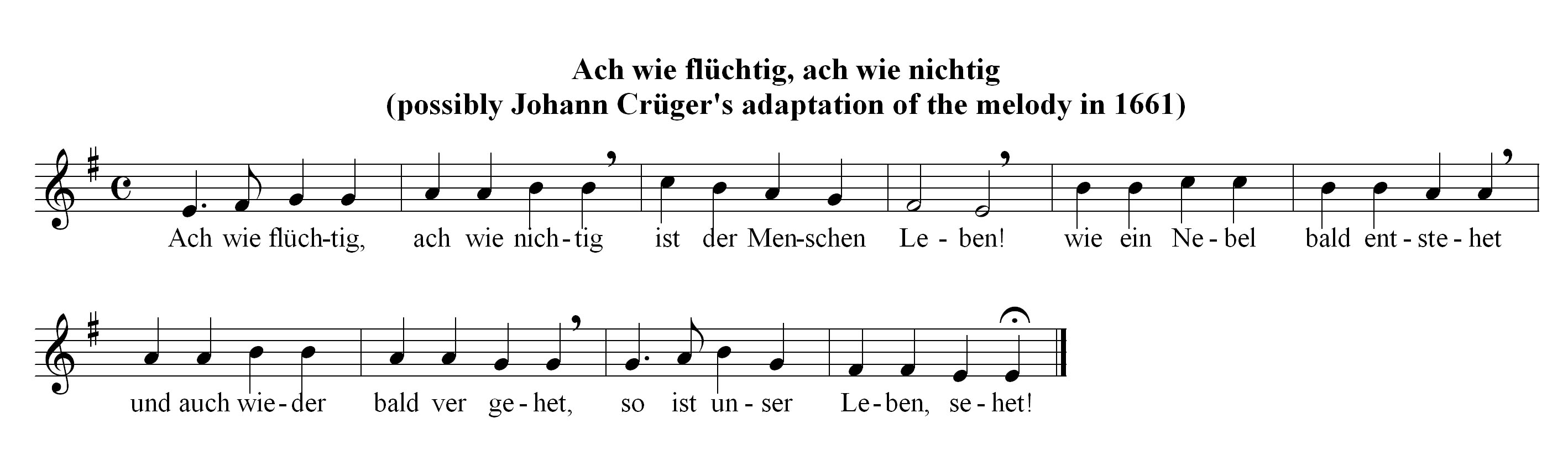
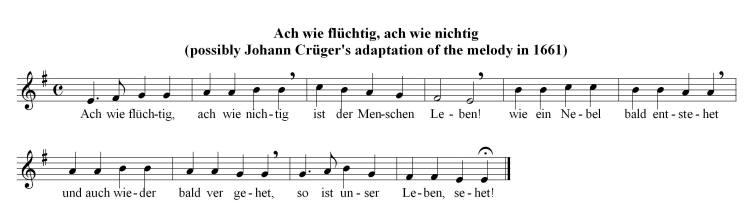
Michael Franck’s chorale text with his melody made its first appearance in print in „Die Eitelkeit, Falschheit und Unbeständigkeit der Welt“ („Vanity, Falsehood and Transitoriness of the World“), Coburg, 1652 (This is Zahn 1887a). Johann Crüger later modified it somewhat for his collection entitled: „Praxis pietatis melica“ (10th edition), Berlin, 1661.
Possibly Crüger’s original melody appeared thus: |
|
|
| |
|
Hymnal versions Bach may have known: |
|
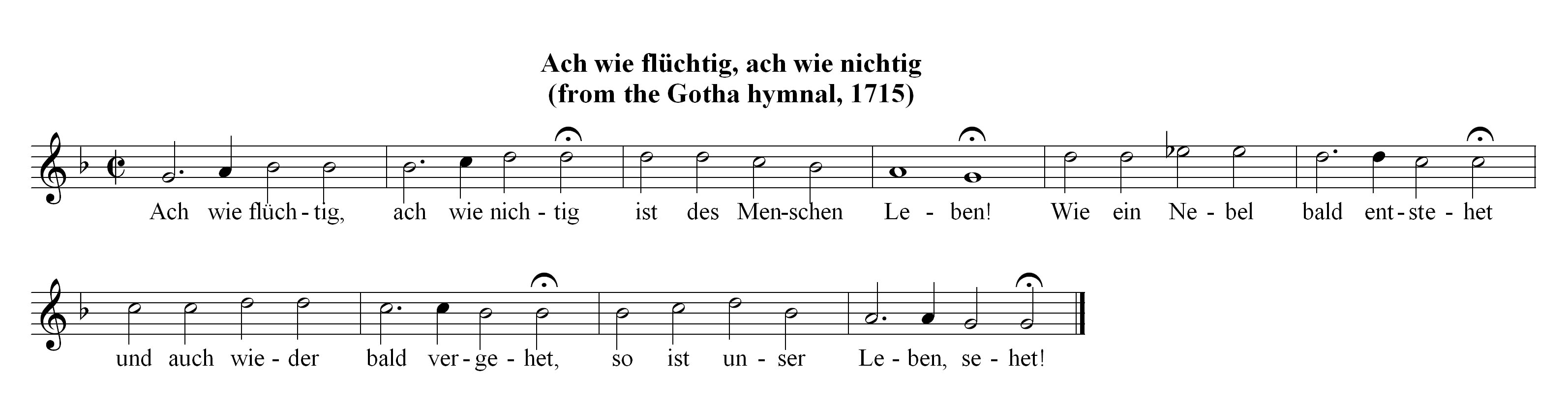
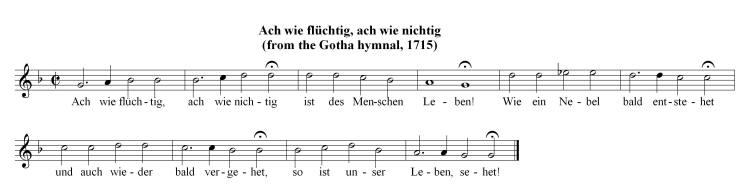
Bach may well have been acquainted with the melody as given in the Gotha hymnal of 1715: |
|
|
| |
|
Use of the Chorale Melody by Bach: |
|
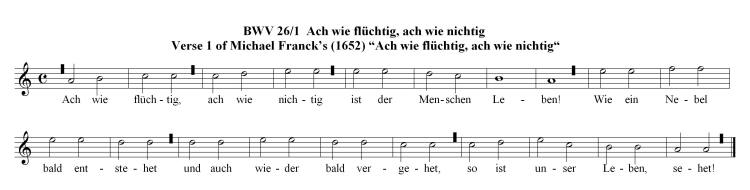
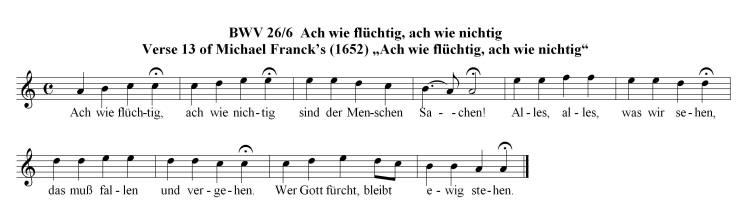
Text: Ach wie flüchtig, ach wie nichtig | EKG: 327
Author: Michael Franck (1652) |
|
Ver |
Work |
Mvt. |
Year |
Br |
RE |
KE |
Di |
BC |
Score |
Music Examples |
|
1 |
BWV 26 |
Mvt. 1 |
1724 |
- |
- |
- |
- |
A162:1 |
- |
Mvt. 1 (Leusink) [ram] |
|
13 |
BWV 26 |
Mvt. 6 |
1724 |
48 |
11 |
48 |
- |
A162:6 |
PDF |
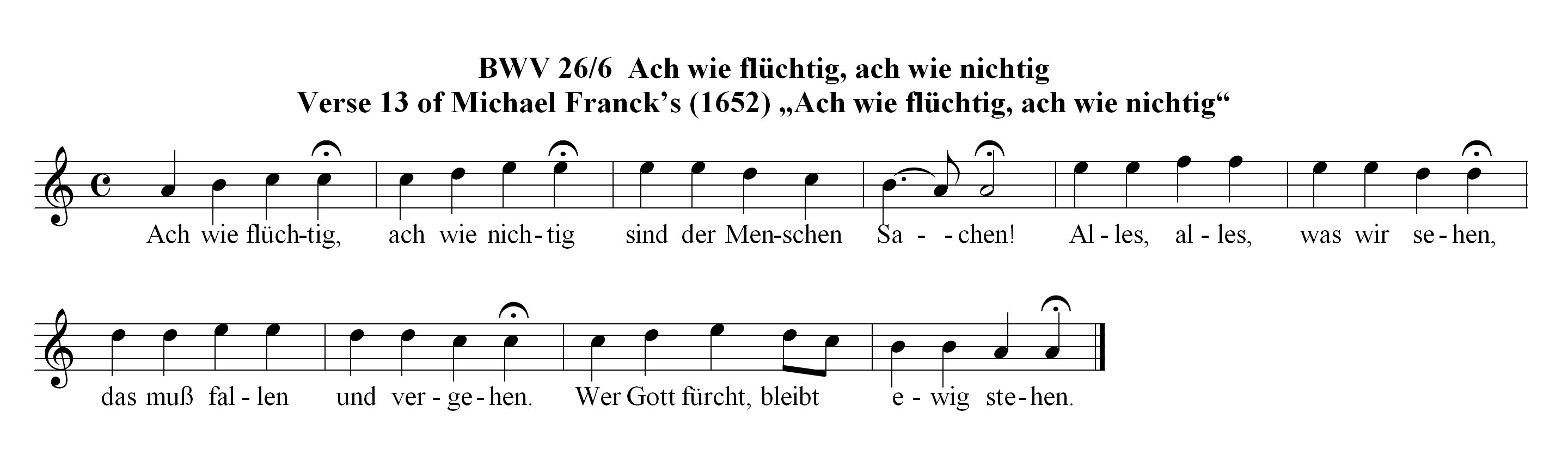
Mvt. 6 (MG) [midi] | Mvt. 6 (Leusink) [ram] |
|
|
|
|
| |
|
Untexted: |
|
Ver |
Work |
Mvt. |
Year |
Br |
RE |
KE |
Di |
BC |
Score |
Music Examples |
|
- |
BWV 644 |
- |
1713/15 |
- |
- |
- |
- |
K73 |
- |
|
|
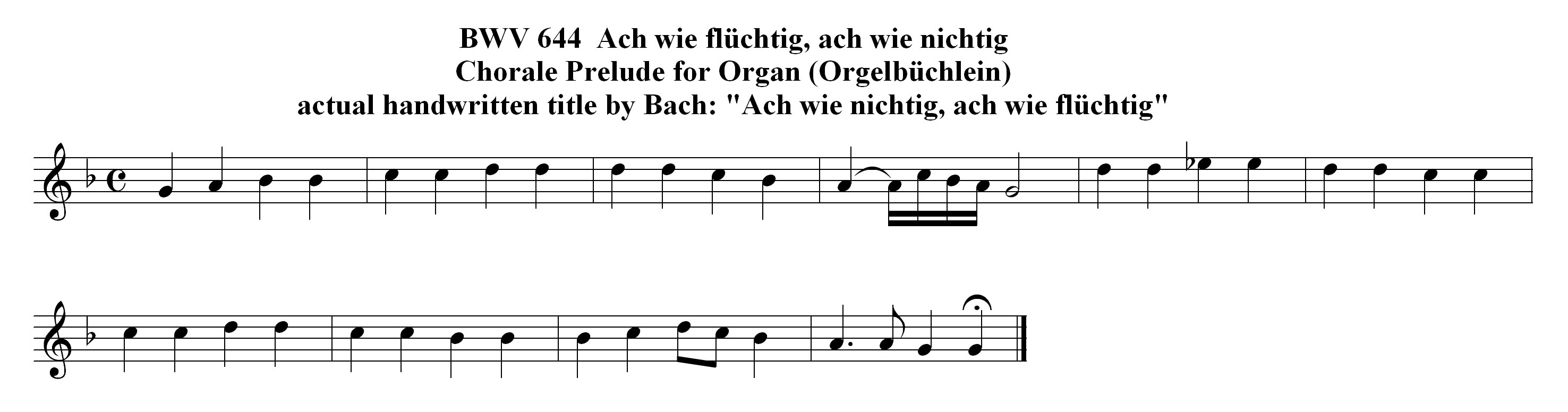
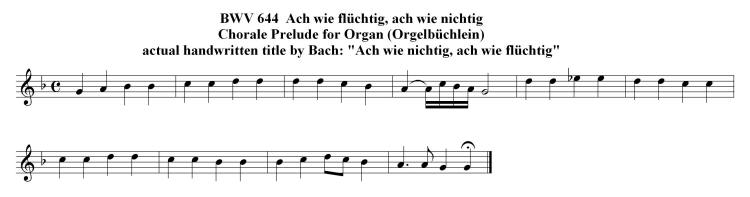
BWV 644: Chorale Prelude for Organ (Orgelbüchlein
No. 45) |
|
|
| |
|
Use of the Chorale Melody by other composers: |
|
Dietrich Buxtehude (c1637-1707):
Lost work ? |
|
Die beiden »extraordinairen Abendmusiken« von 1705 waren ebenfalls Auftragsarbeiten für politische Gelegenheiten (Tod Kaiser Leopolds I., Krönung Josephs I.); sie sind nicht in der Reihe der ordentlichen Abendmusiken aufgeführt, die Textbücher nicht im üblichen Quartformat, sondern in prunkvollem Folio gedruckt worden. Das Textbuch zu „Castrum doloris“ beschreibt die reich mit allegorischen Schaustellungen ausgeschmückte Kirche, den kaiserlichen Leichnam auf dem Paradebett, die Engel, Wappen, Kronen, Kandelaber, die schwarz verhangenen Musik-Chöre, das sordinierte Instrumenten-Spiel (ein Lamento in der Form einer »Ciaconnetta« mit Glockenspiel; der Vergleich mit Bachs »Kurfürstinode«, BWV 198, liegt nahe), das Allegorienpersonal des »Actus« und seine Arien; die Feier wurde mit dem Choral »Ach, wie nichtig«, vorgetragen »von allen Orgeln und Chören, darin die ganze christlich Gemeine und Versammlung mit einstimmet, ganz kläglich beschlossen«.
Friedrich Blume reports in his article on Dietrich Buxtehude in the MGG1 (Bärenreiter, 1986), that all of the printed texts for Buxtehude’s famous “Abendmusiken” have been lost, but because those “Abendmusiken” for extraordinary occasions (in this instance, the death of King Leopold I) have been preserved due to their larger paper format (folio instead of quarto size), we are able to obtain a description of the splendor which attended such occasions: the church decorated with special allegorical displays, the royal bier in a prominent position, angels, heraldry, crowns, candelabras, the musical performance balconies draped in black, the instruments playing with mutes a Lament in the form of a “Ciaconetta” with bells (Glockenspiel) – a comparison with Bach’s own performance of his ode on the death of an electress, BWV 198, comes to mind, all the allegorically designated performers presenting this “Actus” with its arias, and to close the celebration appropriately, all the organs, choirs and congregation joined in singing the chorale: “Ach, wie nichtig” in a heart-rending manner. |
|
Georg Philipp Telemann (1681-1767):
Ach wie nichtig, ach wie flüchtig (C.F. Weichmann), 2 fl, 2 ob, 3 tpt, timp, str, bc (fragment), TWV 4:2 (1732)
Ach wie nichtig, ach wie flüchtig (H. Sillem), fl, ob, 3 tpt, timp, str, bc, TWV 4:6 (1733)
Ach wie nichtig, ach wie flüchtig (I), Sacred Cantata for chorus, 2 flutes (or 2 oboes), strings & continuo, TWV 1:37 (1757)
Ach wie nichtig, ach wie flüchtig (II), Sacred Cantata for chorus, 3 flutes, violin, viola da gamba & continuo, TWV 1:38 |
|
Georg Böhm (1661-1733):
Chorale Partite and variations on Ach wie nichtig, ach wie flüchtig, clavier |
|
Carl Karow (1790-1863):
Ach wie flüchtig, ach wie nichtig, Choral for Organ |
|
Philipp Mohler (1908-1932):
Unaccompanied chorale: Ach, wie flüchtig, ach, wie nichtig (J.M. Franck), op.15, male voices (1936) |
|
Hugo Distler (1908-1942):
Vorspiel & Satz: Ach wie flüchtig, ach wie nichtig, for organ |
|
Anton Heiller (1923-1979):
Motet for Choir: Ach wie nichtig, ach wie flüchtig, unaccomanied. (1949) |
|
Ernst Pepping (1901-1981):
Partita no.1: Ach wie flüchtig for Organ (1953) |
|
Helmut Eder (1916-2005):
Chorale Variations: Ach wie flüchtig, ach wie nichtig, for organ (1968) |
|
Max Georg Baumann (1917-1999):
Intonation for organ: Ach wie flüchtig, Op. 86/1a (1973) |
|
Dagmar Koptein (b 1957):
Choral Fantasy: Ach, wie flüchtig, for Organ (1994?) |
| |
|
Footnotes |
|
[1] Sometimes given in other contexts as „Ach wie nichtig , ach wie flüchtig”, but this interchange is due to the original chorale text which alternates the sequence at the beginning of each verse with the final verse 13 returning once again to that of verse 1. The situation with this switching is, however, even more involved when one notes that Georg Böhm, Dietrich Buxtehude, J.S. Bach (only for BWV 644), and Georg Philipp Telemann, have the title of this chorale melody begin with “Ach wie nichtig” instead of “Ach wie flüchtig”. |
| |
|
Sources: NBA, vols. III/2.1 & 2.2 in particular [Bärenreiter, 1954 to present] and the BWV ("Bach Werke Verzeichnis") [Breitkopf & Härtel, 1998]
The PDF files of the Chorales were contributed by Margaret Greentree J.S. Bach Chorales
Software: Capella 2004 Software, version 5.1.
Prepared by Thomas Braatz & Aryeh Oron (May 2006) |