|
|
General Topics:
Main Page
| About the Bach Cantatas Website
| Cantatas & Other Vocal Works
| Scores & Composition, Parodies, Reconstructions, Transcriptions
| Texts, Translations, Languages
| Instruments, Voices, Choirs
| Performance Practice
| Radio, Concerts, Festivals, Recordings
| Life of Bach, Bach & Other Composers
| Mailing Lists, Members, Contributors
| Various Topics
|
|
OVPP (One-Voice-Per-Part)
Discussions - Part 21 |
|
Continue from Part 20 |
|
Koopman Masses and Magnificat and OVPP |
|
John Pike wrote (June 4, 2008):
While on holiday I read a number of e mails about OVPP. It reminded me of something I read in BBC Music Magazine this month. Koopman was awarded recording of the month for his recording of the Lutheran Masses, Magnificat, Gloria in Excelsis Deo BWV 191 and Sanctus BWV 232. The review includes the comment: "Koopman has always vehemently and publicly rejected the arguments for one-to-a-part chorus". In an interview with him on the opposite page, Koopman states "Some people still claim we should use soloists and no choir for Bach, perhaps simply because it's much cheaper to travel with four soloists and no professional choir than to travel with both! But we know that Bach was paid at one point to educate just over 100 music students, so if he had used only ten of these then he had a bigger orchestra and choir than I use (Koopman uses 16 singers on this recording). The Bach Arkhiv (sic) in Leipzig has also recently discovered some music used in the 1730s by Bach's choir, in which the boys had written in the names of their colleagues, from which we can tell Bach was using up to five sopranos".
My reaction to this: Ton Koopman is a very renowned and excellent performer of Bach, but his suggestion that his peers use OVPP to save money is risible. This attitude really throws into doubt his reliability as a witness as to the recent discovery by the Bach Archiv. Does anyone have any further information about this discovery? What EXACTLY does this music from the 1730s show and does it really support Koopman's claim? Does it show that in a particular performance Bach used "up to 5 sopranos" or does it merely indicate that Bach selected his sopranos from a roster of up to 5? Does it even really indicate that? These are crucial distinctions.
One of the comments in the recent e mail thread was about a quotation relating to the boys coming up to the stands and someone commented that this showed that the boys were sharing music and that therefore Bach was not using OVPP. These two statements are non sequiter. There are a number of explanations other than sharing the same part. They could have been reading their own line from a score with all the choir lines. I don't know if there is any evidence that the boys ever did this in any music by Bach or any other composer, eg in a motet, but it is a THEORETICAL possibility. Another possibility is that the boys only shared a stand, and placed their separate parts on the same stand.
I have read Rifkin's original essay and his book "Bach's Choral Ideal" as well as Andrew Parrott's book. They all present a substantial body of evidence for OVPP, and the idea of selecting singers from a roster, just as a football manager will select his team for a particular game from a roster of players signed with the club, makes very good artistic and administrative sense. However, I am not yet persuaded beyond all doubt that Bach's choral ideal was OVPP. I strongly suspect that he used it for much, if not all, of his choral music after those first few cantatas in Leipzig, but I am not sure whether this was an artistic choice or a situation imposed on him by having students being ill so much of the time. I do also strongly suspect that OVPP was a conscious artisitic preference for certain cantatas of a particularly intimate nature. My doubts are because of the Entwurff and how one translates it and views it. What was his purpose in writing (to increase resources available to him?) and what was his real reason for wanting more singers: was it to cover illness only (so that at the least an 8 part motet could be sung), to highlight lack of resources and singers of the requisite standard or would he really have preferred to have had more singers on each part for certain pieces. Neither the OVPP group nor the non-OVPP group have so far convinced me that the case is proven, although I am currently far more sympathetic to the OVPP cause, and is just sounds so good in practice, to my ears at least.
In Medical research, we have to be very careful that the statements we make are really supported by the evidence and this does not always happen, even with the world's mot eminent researchers. I strongly suspect that Koopman and some others are using "evidence" to suit their own preferences, without really asking carefully enough whether the "evidence" really does demonstrate their claims. It seems to me that Parrott and Rifkin are using evidence more reliably, testing their hypotheses more thoroughly and are really questioning what the significance of particular pieces of evidence is. |
|
Douglas Cowling wrote (June 4, 2008):
John Pike wrote:
< There are a number of explanations other than sharing the same part. They could have been reading their own line from a score with all the choir lines. I don't know if there is any evidence that the boys ever did this in any music by Bach or any other composer, eg in a motet, but it is a THEORETICAL possibility. Another possibility is that the boys only shared a stand, and placed their separate parts on the same stand. >
I'm glad to see that there is at least one other member who wants to respect historical methodoloy and the documentary evidence of the OVPP hypothesis but who has an instinctive gut feeling that it can't be the way Bach performed his works. In some cases -- Cantatas BWV 4 and BWV 106 -- I have been a convert to OVPP. In others, I still think the Sanctus of the B Minor Mass (BWV 232) sounds ridiculous performed OVPP. Suprisingly, I found the "Et Resurrexit" worked very well.
I'm afraid that this ambivalence is here to stay. Barrring a massive discovery of documentary evidence, we're all going to have embrace mutliple approaches to the music.
As to performing scores, singers didn't begin to sing from full choral scores until cheap printing made them affordable in the late 19th century. There were choirs still singing from individual parts in the 20th century.
On a related note, publlishers abandoned the old C clefs for the soprano, alto and tenor voices about this time, substituting modern G clefs. The Bach Ausgabe adopted modern clefs, unlilke the old BW Gesellschaft which retained the original clefs.
Some Lutheran choirs must have held to the old notation. I was surprised to discover a second copy of the Bach motets in choral scoring but in the old C clefs. That was published in the 20's. |
|
Ed Myskowski wrote (June 4, 2008):
Bach & OVPP
>Some Lutheran choirs must have held to the old notation. I was surprised to discover a second copy of the Bach motets in choral scoring but in the old C clefs. That was published in the 20's.<
1820s? $20 per copy? |
|
Ed Myskowski wrote (June 4, 2008):
>Ton Koopman is a very reknowned and excellent performer of Bach, but his suggestion that his peers use OVPP to save money is risible.<
Here in USA, we might simply say BS.
>This attitude really throws into doubt his reliability as a witness as to the recent discovery by the Bach Archiv. Does anyone have any further information about this discovery? What EXACTLY does this music from the 1730s show and does it really support Koopman's claim? Does it show that in a particular performance Bach used "up to 5 sopranos" or does it merely indicate that Bach selected his sopranos from a roster of up to 5? Does it even really indicate that? These are crucial distinctions.<
That is a bit much to repeat, but that is the crux of the post, no?
>I am not yet persuaded beyond all doubt that Bach's choral ideal was OVPP. I strongly suspect that he used it for much, if not all, of his choral music after those first few cantatas in Leipzig, but I am not sure whether this was an artistic choice or a situation imposed on him by having students being ill so much of the time. I do also strongly suspect that OVPP was a conscious artisitic preference for certain cantatas of a particularly intimate nature. My doubts are because of the Entwurff and how one translates it and views it.<
Persuaded beyond all doubt? Not likely to be enough evidence for that.
Bachs choral ideal? The discussion, and evidence is simply about what he did, not what he woudld might have liked to do. That is the problem! Everyone knows Bach, his dreams, blah, blah ,blah. I could have saved a few keystrokes and written <ETC!> I can use the exercise.
>In Medical research, we have to be very careful that the statements we make are really supported by the evidence and this does not always happen, even with the world's most eminent researchers. I strongly suspect that Koopman and some others are using "evidence" to suit their own preferences, without really asking carefully enough whether the "evidence" really does demonstrate their claims.<
Lordy, Lordy. I hope the Doctors are doing a better job than the Musicians! Sometimes I wonder. |
|
Ed Myskowski wrote (June 4, 2008):
>not what he woudld might have liked to do.<
Try as I might, I cannot find a way to pass that off as an intentional pun, or construction. I expect you understood.
>Lordy, Lordy. I hope the Doctors are doing a better job than the Musicians! Sometimes I wonder.<
Not directed toward any particular Doctor, especially one who might be examining me. Specifically, not to any BCML correspondent. I expect that was understood, as well, but it never hurts to be certain. |
|
James Atkins Pritchard wrote (June 4, 2008):
Douglas Cowling wrote:
< I'm afraid that this ambivalence is here to stay. Barring a massive discovery of documentary evidence, we're all going to have embrace multiple approaches to the music. >
Perhaps this is all to the good... |
|
John Pike wrote (June 4, 2008):
Ed wrote: "Bachs choral ideal? The discussion, and evidence is simply about what he did, not what he woudld might have liked to do. That is the problem! Everyone knows Bach, his dreams, blah, blah ,blah. I could have saved a few keystrokes and written <ETC!> I can use the exercise."
The phrase "Bach's Choral ideal" was deliberately chosen. That is the title of Rifkin's book. His argument is not just that Bach used OVPP out of compulsion, but that was his IDEAL as well. |
|
Ed Myskowski wrote (June 4, 2008):
John Pike wrote:
>The phrase "Bach's Choral ideal" was deliberately chosen. That is the title of Rifkin's book. His argument is not just that Bach used OVPP out of compulsion, but that was his IDEAL as well.<
Thanks for the clarification, my apologies for overlooking the point. |
|
J. Laurson wrote (June 4, 2008):
John Pike wrote:
>One of the comments in the recent e mail thread was about a quotation relating to the boys coming up to the stands and someone commented that this showed that the boys were sharing music and that therefore Bach was not using OVPP. These two statements are non sequiter. There are a number of explanations other than sharing the same part. They could have been reading their own line from a score with all the choir lines. I don't know if there is any evidence that the boys ever did this in any music by Bach or any other composer, eg in a motet, but it is a THEORETICAL possibility. Another possibility is that the boys only shared a stand, and placed their separate parts on the same stand. ------ <
Of the many intriguing and good arguments that lead tendentially toward OVPP and VeryFewVPP (VFVPP), the "choristers didn't share music" one has got to be the weakest.
While it may not be provable beyond all doubt that they did, it is by far the more reasonable assumption than to strain in somehow proving (or even just claiming) that they didn't. Sure one music stand COULD have held two parts -- but that's a stretch.
To this day, all German boys choirs I am familiar with (I sang in the eldest of them all [from 975 A.D. on] for several years) generally share parts... 2/1 and 3/2. (I distinctively remember getting a painful reprimand, though, when I was too lazy to use my part (one, just for me, as I was in the second row) and instead looked over my two front-mates' shoulders into theirs'.)
Not that this leads us anywhere, because the whole (somewhat tiresome) OVPP-or-not debate is based on variously convincing and well researched conjecture.
No matter how many times one reads Koopman or Rifkin, one will - depending on intuition masquerading as science (or sometimes not masquerading at all) - consider the former an ideologue or the latter a sophist. |
|
John Pike wrote (June 5, 2008):
[To James Atkins Pritchard] I agree with what is written above. Indeed, I seem to remember seeing some other evidence, both written and pictorial, that choristers did share parts, at least some of the time (although current tradition in Germany is not necessarily a good indication of Bach's practice). What such evidence cannot prove, of course, is that they always shared parts, for every piece, by every composer, all of the time. As I said before, based on evidence from both Rifkin/Parrott on the one hand, and from their opponents on the other, I suspect that sometimes they did share parts/sang MVPP and sometimes they didn't, either because too many boys were ill or because the conductor or composer (eg Bach) took an artistic decision to only use OVPP. I also strongly suspect that, on other occasions, the conductor/composer made an artistic decision to use MVPP, when resources allowed. Doug's comments about cantatas BWV 4 and BWV 106 on the one hand, and parts of the B minor mass (BWV 232) on the other hand, seem to me to make eminently good sense. I gather that Gardiner has used OVPP in parts of the MBM (BWV 232) and full choir in other parts. Since we will never know what Bach did (if indeed he ever performed it) this seems to me to be a very sensible artistic decision, creating maximum expressive effect. Given Gardiner's rather harsh pronouncements about Rifkin in the past, it is also a rather interesting and ironic decision. Whatever one thinks about OVPP, I think folk should at least acknowledge the genius of Rifkin in starting this work and sticking with it despite the onslaught from peers (who, like Koopman and Gardiner, really should know better).
As others have commented, I don't think there is enough evidence at present (nor is there ever likely to be) to make categorical statements about how many voices per part should be used in any particular piece. To a certain extent, I don't think it really matters anyway; there are enough recordings out there now to suit all tastes and many, both OVPP and MVPP, are very beautiful. One of the things I like so much about this list is the ability of members (Neil especially comes to mind) to recognise the strengths (as well as weaknesses) of recordings by conductors for whom they would not automatically have an affinity. In any case, Bach's music is so rich, of such beauty and so "flexible" and resilient, that it seems to withstand virtually any treatment, whether it be OVPP, mass choirs, the swingle singers, a Simon and Garfunkel song, Jacques Loussier, a TV advert, or any of the other myriad uses that have been made of it. |
|
Kim Patrick Clow wrote (June 5, 2008):
John Pike wrote:
< I agree with what is written below. Indeed, I seem to remember seeing some other evidence, both written and pictorial, that choristers did share parts, at least some of the time (although current tradition in Germany is not necessarily a good indication of Bach's practice). >
In the Parrott book, there is only a picture of boys sharing a part outside a church, but I don't believe there isn't any suriving illustration that shows them inside a church sharing a part?
>Given Gardiner's rather harsh pronouncements about Rifkin in the past, it is also a rather interesting and ironic decision. <
Yes, given Gardiner's snotty comments and jabs at Harnoncourt as well, plus his reputation for being a bit of a less than diplomatic person with his performers.
>Whatever one thinks about OVPP, I think folk should at least >acknowledge the genius of Rifkin in starting this work and sticking >with it despite the onslaught from peers (who, like Koopman and Gardiner, really should know better). <
Yes, Koopman and Wolff have their own moments of smugness as well. The funny thing is how above this level of tone Joshua Rfkin has been, in any rebuttals or articles, he's polite and cordial. Wolff is certainly no friend for open scholarship, since he pretty much controls access to who can see the Sing-Academy manuscripts in Berlin now.
|
|
Douglas Cowling wrote (June 5, 2008):
Kim Patrick Clow wrote:
< In the Parrott book, there is only a picture of boys sharing a part outside a church, but I don't believe there isn't any suriving illustration that shows them inside a church sharing a part? >
Looking at pictorial representations of musicians is a fascinating sidebar because you always have to ask if the artist is providiing photographic evidence or an artistic representation.
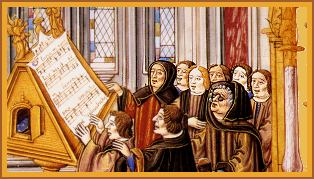
In the 15th century Ockeghem miniature we see a group of singers performing from a large choir size book. Particularly interesting are the hands on the shoulders of the person in front -- we see this in many illustration right up to the 18th century. I like the older singer in the back who has to wear spectacke
http://peterbird.name/choral/Ockeghem_and_his_singers.jpg
Although small printed part-books came into fashion in the late 16th century, it appears that choir format music remained in service. This Canaletto drawing shows Venetian singers in 1766 performing from one very large book.
http://www.abcgallery.com/C/canaletto/canaletto48.html
Given the centuries-old library at St. Thomas, it would be interesting to know if there were any choir-size books in use (I doubt it because of the change in notatiion)
As early as the Ockeghem miniature, Della Robbia's choir loft in Florence has friezes of choirboys sharing a printed part-book. Again note the hands on the shoulders. The series of friezes is so idealized and classicised that I doubt much evidence can be drawn.
Closer to home and the multiple choirs of the SMP, this frontispiece of the works of Praetorius shows three choirs in separated galleries. In each gallery, a "conductor" with a part-book leans over the railing so that the three ensembles can be kept in sync. Bach must have delegated someone similarly to keep the ripieno choir in the other gallery in sync.
http://www.thecipher.com/braccio_MichaelPraetoriusMusarumSioniarum_1607_FULL.jpg |
|
Douglas Cowling wrote (June 5, 2008):
John Pike wrote:
< Whatever one thinks about OVPP, I think folk should at least acknowledge the genius of Rifkin in starting this work and sticking with it despite the onslaught from peers (who, like Koopman and Gardiner, really should know better). >
Has anyone asked Rifkin if he plans to rerecord an OVPP performance of his wonderful Bach/Beatles cantata spoof, "The Cantata for the Third Sunday after Shea Stadium"? |
|
Uri Golomb wrote (June 5, 2008):
Doug Couwling asked:
< Has anyone asked Rifkin if he plans to rerecord an OVPP performance of his wonderful Bach/Beatles cantata spoof, "The Cantata for the Third Sunday after Shea Stadium"? >
Well, I've met him a few times -- an interview is coming out soon in Goldberg -- and raised the issue. Apparently, he's been performing it from time to time OVPP -- he says it works very well that way, even though he wrote it for choral forces. Alas, no plans yet to release a new recording -- though it might happen.
The entire Baroque Beatles Album is idiomatically written that it would indeed sound better on period instruments; so I do hope he does the whole thing (including a few additional numbers that were prepared for an abandoned sequel) again. |
| |
|
OVPP Controversy Article |
|
Aryeh Oron wrote (December 2, 2010):
Thomas Braatz has completed an article on the OVPP theory, presented for you on the BCW to read and respond.
In May, 2010, the Early Music journal published two scholarly position papers on the much-debated OVPP theory first proposed by Joshua Rifkin almost 30 years ago. My article will first attempt to present a short history of the choir sizes used for performing Bach's concerted vocal music after his death in 1750 until the present day when serious Bach performances are faced with a relatively new dilemma: One Voice Per Part or 3 to 4 to a part. There is no doubt that the consequences of choosing one method over the other will produce different results and affect listeners differently. Some might refer to the B-Minor Mass performed OVPP as 'Bach's B-Minor Madrigal', while others are convinced empirically the OVPP is the only true way to listen to Bach. In the Early Music journal, Andreas Glöckner presents the evidence that he believes supports the idea that Bach used 3 or perhaps 4 Thomaner per part in performing Bach's cantatas, etc. Andrew Parrott responds and attempts to clarify why the same key sources referred to by Glöckner actually favor the OVPP theory. In my article the reader might find out why this theory still provokes heated discussions (and will continue to do so in the future).
Article: http://www.bach-cantatas.com/Articles/OVPPControversy.pdf
Linked from: http://www.bach-cantatas.com/Articles/index.htm |
|
Ed Myskowski wrote (December 2, 2010):
Aryeh Oron wrote:
< Thomas Braatz has completed an article on the OVPP theory, presented for you on the BCW to read and respond. >
<Ed Myskowski wrote (May 30, 2008):
As to questions of whether OVPP is theory, and how widely accepted, I will defer to the musicians. My personal opinion is that Sigiswald Kuijken makes a concise, eloquent, and non-confrontational statement of his gradual acceptance of the performance practice, with convincing sound to match. Very persuasive to my ears and mind.> (end quote)
Sorry that I am unable to quickly recover the source of the Kuijken paraphrase. I was certain that it is the general introductory booklet to the ongoing cantata series on Accent label, but that does not appear to be the case. I am confident that it is accurate. Exact reference soon come. The point is, Parrott and Rifkin are not alone, out of phase with the great establishment of Bach scholars.
Note that Tom Braatz states that part of his his motivation for writing the article is to ensure that the OVPP theory does not contaminate the transmission of Bachs intent, musical and spiritual. For our current work under discussion, BWV 43 for Ascension Day, there are no (zero!) OVPP performances available. Not much threat there. The modern, HIP, performances (Gardiner, Herreweghe, Koopman, Suzuki) all use the multiple (3-4) voice choirs now approved by Tom. The earlier Harnoncourt HIP recording uses an even larger boys choir. These performers have all received Toms disdain in the past. I believe he now states that serious, modern performances with 3-4 voices per are the accepted scholarly standard, as long as they are not OVPP, and that he is in agreement with that standard. |
|
Ed Myskowski wrote (December 3, 2010):
Ed Myskowski wrote:
<Ed Myskowski wrote (May 30, 2008):
As to questions of whether OVPP is theory, and how widely accepted, I will defer to the >musicians. My personal opinion is that Sigiswald Kuijken makes a concise, eloquent, and >non-confrontational statement of his gradual acceptance of the performance practice, with >convincing sound to match. Very persuasive to my ears and mind.> (end quote)
< Sorry that I am unable to quickly recover the source of the Kuijken paraphrase. [...] I am confident that it is accurate. Exact reference soon come. >
The paraphrase is indeed accurate, from the booklet notes (pp 8-9) to the Kuijken CD on Deutsche Harmonia Mundi/BMG, BWV 9, BWV 94, BWV 187. I had not noticed before, but this is a 2001 release of 1999 recordings based on live performance. It appears to be the prototype or first inspiration for the ongoing series on Accent. Highly recommended. Vol. 10 includes the Ascension Oratorio, BWV 11, which we will discuss next week. I will be available to help avoid any spiritual or musical straying from Bachs intended path, induced by the OVPP performance.
A few more words, directly from Kuijken:
<Even if there are historical arguments [OVPP theory] that on one level are utterly compelling, we shall always be left with the question of taste (good or less good -- everyone has the right to evince even the worst possible taste).> (end quote) |
|
Kim Patrick Clow wrote (December 3, 2010):
Aryeh Oron wrote:
< Thomas Braatz has completed an article on the OVPP theory, presented for you on the BCW to read and respond.
Article: http://www.bach-cantatas.com/Articles/OVPPControversy.pdf
Linked from: http://www.bach-cantatas.com/Articles/index.htm >
Parrott's reply is called whiny, and accusatory, but I certainly did not read it that way. Maybe Parrott's patience has worn thin after going through all of these points so many times, neither side seems to want to consider the merit of the opposing viewpoint; maybe it's a case of "your mileage may vary." But if we're talking about whiny and accusatory, I've seen Ton Koopman and Christoph Wolf in action, with their snarky comments and back-patting each other with jabs at Joshua Rifkin's expense. It was pretty unprofessional. and such a turn off for me, since I had nothing but great respect for the both of them. But Wolf and Koopman aren't alone on that count- J.E. Gardiner snarked at great length about N. Harononcourt's attempts to recreate Bach's original performing forces by using boys choirs. That after he just whined about how in Germany as a teenager, he had been subjected to historically uninformed Wagnerian sized choirs and orchestras. JEG has also said some rather unkind comments about Rifkin as well, calling him "inflexible." In my opinion, Joshua Rifkin has been completely polite, well mannered, and professional in any paper, interview (televised or printed), and has NEVER been remotely snarky like Wolf, Gardiner, and Koopman. I find that somewhat compelling.
Many thanks for Herr Braatz's paper, it's a fantastic addition to the website and its beautifully illustrated and typeset !! |
|
Ed Myskowski wrote (December 4, 2010):
Kim Patrick Clow wrote:
< Many thanks for Herr Braatz's paper, it's a fantastic addition to the website and its beautifully illustrated and typeset !! >
Fantastic may be the precise word.
I agree that the illustrations are impressive, but I do wonder about the caption at the heading, to the effect "Thomaner [12-15, or so] heading to church". It looks to me as if they are walking in the other direction, heading back to school. Perhaps after a rehearsal? |
|
Kim Patrick Clow wrote (December 4, 2010):
Ed Myskowski wrote:
< Fantastic may be the precise word. >
Glad you agree!
< I agree that the illustrations are impressive, but I do wonder about the caption at the heading, to the effect "Thomaner [12-15, or so] heading to church". It looks to me as if they are walking in the other direction, heading back to school. Perhaps after a rehearsal? >
In the close-up, it's pretty obvious they're moving from left to right in the engraving. |
|
Douglas Cowling wrote (December 4, 2010):
Ed Myskowski wrote:
< It looks to me as if they are walking in the other direction, heading back to school. Perhaps after a rehearsal? >
I would be curious to know if any rehearsals were allowed in the church proper. Many choir schools still have rehearsal rooms with seating and choir stalls in the same layout as the church choir loft. The Gorey-esque figures in the engraving could be one of the ensembles always coming and going to sing the two daily services in St. Thomas' or St. Nicholas' |
|
Ed Myskowski wrote (December 4, 2010):
Kim Patrick Clow wrote:
< In the close-up, it's pretty obvious they're moving from left to right in the engraving. >
I will give it another look, not convenient at the moment. From a first look, I thought their headgear looked like they were moving from right to left. Perhaps hoods? Definitely a group of 12 to 15 (a few shadowy figures in the back), at any rate, whoever they may be.
One of the questions I have always had, in this shadowy discussion: If the boys could sing two or three to a part copy, why did the violinists always seem to have their individual copies, in the remaining parts? |
|
Ed Myskowski wrote (December 4, 2010):
Douglas Cowling wrote:
< The Gorey-esque figures in the engraving could be one of the ensembles always coming and going to sing the two daily services in St. Thomas' or St. Nicholas' >
Neat! |
|
Kim Patrick Clow wrote (December 4, 2010):
Ed Myskowski wrote:
< One of the questions I have always had, in this shadowy discussion: If the boys could sing two or three to a part copy, why did the violinists always seem to have their individual copies, in the remaining parts? >
I don't know honestly. I've assumed at times the performances could easily have two players per part (e.g. violinists). Most of the time they were standing, so it wouldn't be too hard to squeeze in together to see the music.
A friend of mine also puts a big grain of salt on any engravings as being taken literall;, we don't now how much of the artwork is really a realistic representation of the historical fact, and how much is embellishment, |
|
Douglas Cowling wrote (December 4, 2010):
Kim Patrick Clow wrote:
< I've assumed at times the performances could easily have two players per part (e.g. violinists). >
Modern orchestras still divide violins, violas and cellos into "desks" each with two players. Even though all players are given their own score for individual practice, at the formal rehearsal and performance, it is the score of the senior player which is on the desk/music stand and it is the job of the junior player to turn the pages. |
|
Ed Myskowski wrote (December 4, 2010):
Kim Patrick Clow wrote:
<< I've assumed at times the performances could easily have two players per part (e.g. violinists). >>
Douglas Cowling wrote:
< Modern orchestras still divide violins, violas and cellos into "desks" each with two players. Even though all players are given their own score for individual practice, at the formal rehearsal and performance, it is the score of the senior player which is on the desk/music stand and it is the job of the junior player to turn the pages. >
Ah, the nature of humans (and everyone else) to establish a pecking order!
I did not necessarily mean to go off in this direction, but it does seem relevant to the OVPP scholarly discussion (controversial to some).
(1) One of the arguments for multiple voices per part (MVPP) continues to be that two or three Thomaner could read from a single hand-written part. I will aside the for the moment the proposition that they could sight read that effort.
(2) Reconstructions of obbligato violin lines (or obligato if you prefer to go way back to the Latin original and bypass the intermediate Italian misconstruction) are based on the idea that individual parts for two first violins were written, one of which is sometimes lost.
From the surviving Bach cantata performing parts, if the string players have individual parts, what logic allows two or three singers to perform from a single part?
This seems a convenient opportunity to point out that obbligato (music, Italian) means obligatory (American English: you have to do it). Humorous (?) example, the obligatory peas on a motel dinner plate. |
|
Sys-Ex John wrote (December 4, 2010):
Kim Patrick Clow wrote:
<< I've assumed at times the performances could easily have two players per part (e.g. violinists). >>
Douglas Cowling wrote:
< Modern orchestras still divide violins, violas and cellos into "desks" each with two players. Even though all players are given their own score for individual practice, at the formal rehearsal and performance, it is the score of the senior player which is on the desk/music stand and it is the job of the junior player to turn the pages. >
My apologies for interjecting, but don't we all conveniently forget that they didn't have have electric lighting then? Try reading a score by candle light and sharing it between two or three people. Modern string payers, and indeed wind players too, either have a light over the stand or are lit by strong overhead lamps.
A candle overhead is of no practical use, it has to go below the score, with the burning wick positioned just below the stave being read. One holding the score the other the candle? Did music stands of the era have candle holders? Unlikely I think because, as the candle burns down it needs repositioning. It also needs moving down as one reads down the score, otherwise it gets in the way.
Anyone who has been carol singing on a dark night, with just lanterns, will understand the problem all too well. Admittedly they would, for daytime services, have had some natural light. And these were handwritten scores, much more difficult IMHO to read that our modern printed scores. I personally hold the view that more than two sharing is most unlikely. But it is that, just an opinion. I'm no scholar, just a singer/chorister with a little practical experience.
An aside, maybe that's why the choirs had a loft which might have been positioned higher to catch more daylight? Just a thought!
Just my 2d. |
|
Anne (Nessie) Russell wrote (December 4, 2010):
Sys-Ex John wrote:
>My apologies for interjecting, but don't we all conveniently forget that they didn't have have electric lighting then? Try reading a score by candle light and sharing it between two or three people. Modern string payers, and indeed wind players too, either have a light over the stand or are lit by strong overhead lamps. <
Excellent point. Whenever 21st century people try to reconstruct what Bach did they usually forget these things. We in this century can not know for certain how music sounded in Bach's time. |
|
Douglas Cowling wrote (December 4, 2010):
Music Desks & Candles
Sys-Ex John wrote:
< Did music stands of the era have candle holders? >
There are plenty examples of 18th century style music desks with two candle sconces on left and right sides (on organ desks as well). Baroque musicians stood at the desks to play or sing so the possibility of two players per part is reasonable (three singers, as as been suggested on this list, is less likely) All of Bach's services were in the morning or early afternoon when the natural light was strong.
Jacob Norden: Old Musical instruments - Old music stand
Mallett: A Regency Duet Music Stand
Not really part of our discussion, but the orchestra pit of the opera house in Cesky Rumlov in Bohemia, retains its 18th century music desks: two free-standing stands with candle scones and the long two-sided desk for the orchestra. Although the latter has electric lights now, the original candle sconces are fitted all along the desk.
http://www.castle.ckrumlov.cz/docs/en/zamek_oinf_nadace.xml |
| |
|
Article: Mattheson on OVPP/OPPP |
|
Aryeh Oron wrote (September 15, 2012):
Thomas Braatz has contributed a new article for the Articles section of the BCW.
Thomas Braatz wrote:
I have discovered an important statement from Bach’s time relating to the size of choirs and instrumental groups involved in performing figural music in large churches. This could be considered an extension to the problem posed by another statement by Niedt/Mattheson on the registration of church organs used in performing the continuo (organo) parts to Bach’s cantatas, passions, oratorios, etc. What appeared to be unresolved is the question: How did the choral sections of these church compositions sound when, as theorized by Joshua Rifkin, they were performed by Bach along with a large church organ in Leipzig with only a single vocalist per vocal part and a reduced number of instrumentalists also usually only one per part with the exception of some string instruments? The answer to this question is given quite clearly by Mattheson who deplores the staffing of church music groups (choirs and instrumentalists) as it existed in Hamburg. In his response to a reference that claims that you only need 8 people to create ‘a worthy/impressive harmony’ in a large church, Mattheson states that the absolute minimum number of musicians needed for performing figural music in a large church would be 24.
The source and translation for this statement is given in the form of a PDF. It includes the Mattheson original text from Johann Mattheson’s Der Musicalische Patriot (Hamburg, 1728) and a selection from his Veritophili (Hamburg, 1717). The latter serves as an introduction to the dire situation for church musicians in Hamburg before Telemann arrived there. All of this has been explained to me as the result of the miserly attitude of the Pfeffersäcke [‘pepper sacks’ = the rich merchants in grain, spice, etc.] who controlled the purse strings of the Hamburg city/state government. The PDF is divided into sections:
1. A Fraktur representation of the original from Der Musicalische Patriot.
2. The transliteration into Roman type for those who might find it easier to read than the original.
3. The English translation
4. A Fraktur representation of the original from Veritophili.
5. Its transliteration.
6. Its translation into English.
The link to the PDF is: http://www.bach-cantatas.com/Articles/MatthesonChoirSize.pdf
Linked from: http://www.bach-cantatas.com/Articles/index.htm
and from the Home Page of the BCW http://www.bach-cantatas.com/ [Articles box]: |
|
Charles Francis wrote (September 15, 2012):
The article from Thomas Braatz is very interesting from several perspectives.
Two practices are explicitly described: i) a music director who does not perform ii) one that actively contributes by singing or playing an instrument.
The 4'000 singers scenario has actually been realised back in 1888 and the audio survives: http://www.youtube.com/watch?v=-qDwz3JdD1c
The recording quality is poor, but it does show that the tempo for this piece has increased by around a factor of three in 125 years. We may speculate as to whether more singers would tend to sing more slowly, of course, although I doubt that choir size would be the determining factor.
The four vocalists, two violinists, organist and director mentioned in the Mattheson text, give eight musicians in total. An additional two trumpets, timpani, string bass, two oboes and two bassoons, provide a further eight. So sixteen of 24 musicians are accounted for, which leaves eight further vocalists - i.e., a total of twelve vocalists. So in the case of a double motet there would be six vocalists available for each choir.
Note, that twenty four musicians would be sufficient to perform the Matthew Passion OVPP.
That the 17 Hamburg churches had only have five to six vocalists between them suggests that the de facto performance practice was OVPP. |
|
Douglas Cowling wrote (December 18, 2010):
Aryeh Oron wrote:
< Thomas Braatz: How did the choral sections of these church compositions sound when, as theorized by Joshua Rifkin, they were performed by Bach along with a large church organ in Leipzig with only a single vocalist per vocal part and a reduced number of instrumentalists also usually only one per part with the exception of some string instruments? The answer to this question is given quite clearly by Mattheson who deplores the staffing of church music groups (choirs and instrumentalists) as it existed in Hamburg. In his response to a reference that claims that you only need 8 people to create Oa worthy/impressive harmony¹ in a large church, Mattheson states that the absolute minimum number of musicians needed for performing figural music in a large church would be 24. >
We might want a more nuanced interpretation of this document. The situations in Hamburg and Leipzig are very different. In Hamburg, there is one body of 5-6 singers which rotates between 17 churches.
In Leipzig, Bach has four churches each with their own choir and prefect-conductor-organist. The company of instrumentalists is linked with Choir I and performs mornings in St. Thomas and afternoons in St. Nicholas. Concerted music is heard in those two churches every Sunday and festivals on a strict schedule. There is no expectation of concerted music in the other two churches. Bach has much larger forces at his command, and they are marshalled on a predictable roster, the essence of "well-regulated" church music.
The document suggests that the whole body of 24 performers is the optimum number but they do not play all the time: winds and brass are available but they don't play every Sunday.
There are two odd passages in the document.
First, the count of seven players makes no provision for a cello or bass. The use of cello and two violins as a standard ensemble goes back to Monteverdi and Praetorius who are both quite insistent on securing the bass line. Matheson's omission is curious. Is he suggesting that the bass is played only on the organ?
The other difficult passage is the sentence which talks about the addition of eight persons to to the vocalists. At first reading, it appears that the extra performers are singers, but the reference is clearly to the wind and string players. Can someone parse the original? |
|
Douglas Cowling wrote (December 18, 2010):
Matheson & Orchestra Size
The Matheson article that Thomas Braatz uploaded raises many questions, including the fact that Matheson doesn't include a cello or violone in the "default" seven players.
Pondering this question, it might be that Matheson assumed that the bass line was played on the pedal at 8¹ and 16¹ as a norm. That speaks to a very different bass sound than that in modern performances. |
|
Aryeh Oron wrote (September 20, 2012):
Article: Added explanatory introduction to the Mattheson article
Thomas Braatz has added an introduction to the Mattheson article on choir size.
Thomas Braatz wrote:
Mattheson’s statement regarding the minimum size of a choral/instrumental group performing figural music in a large church has raised some questions which I have attempted to answer in the introduction I have supplied to my article. At the same time I have provided some important background information about Mattheson which might explain why his statements are important to our understanding of performance practices in Germany during the first half of the 18th century.
See: http://bach-cantatas.com/Articles/MatthesonChoirSize.pdf
Linked from: http://bach-cantatas.com/Articles/index.htm
and from the Home Page: http://www.bach-cantatas.com/ [Articles box] |
|
Kim Patrick Clow wrote (September 20, 2012):
[To Thomas Braatz] Great article.
I just wanted to add some interesting sidebars.
It's mentioned that in 1707, J.C. Schieferdecker married Buxtehude's daughter, to become organist at St. Mary's in Lübeck (photo of the interior here: http://i.imgur.com/34Xq2.jpg ). That year, the Swedish army was stomping through Germany, causing several events to occur - Count Erdmann von Promnitz fled his court, disbanding his orchestra, including Telemann. Leipzig was under the Swedish gun, and many fled the impending siege, including Christoph Graupner, who fled to Hamburg, and discovered immediately on his arrival that the
harpsichord position at the Hamburg opera was open because Schieferdecker had left. Graupner was hired on the spot and lived with Mattheson.
Graupner wrote later that was desperate to leave Hamburg after a few years, suggesting that like any young man, he had enjoyed too many earthly pleasures there. But some have speculated it really Mattheson's mother (who lived in the same house) that drove Graupner crazy, seeking a way out of his predicament ;) |
|
William L. Hoffman wrote (September 20, 2012):
[To Kim Patrick Clow] There's more to the story:
The golden age of the Hamburg Opera under Reinhard Keiser included his nurturing select German composers-performers such as Mattheson, Graupner, and the young George Frideric Handel, who in 1703 came for a summer visit from Halle and stayed with Mattheson. In August, they took a carriage ride to Luebeck, where Mattheson auditioned for Buxtehude's job, as apparently did Handel. On the short trip, says Mattheson, they improvised double fugues and met a pigeon seller. Neither pursued the position, while Keiser emplyed Handel as a "back-desk violinist" at the Hamburg Opera.
Sebastian Bach, who was engaged briefly at Weimar as a seviolinist about 1703, also auditioned in December 1704 at Leubeck and declined Buxtehude's position. On December 5, 1704, Mattheson's third opera, "Cleopatra," was premiered at the Hamburg opera, with Handel at the harpsichord, accompanying. Tenor Matthesson sang Antonius' suicide aria a half-hour before the end and went to the orchestra but was prevented by Handel from accompanying the rest of the opera. Afterward, they had a sword duel at the exit of the opera in the open market place. Says Mattheson: "Things might have passed off very unfortunately for both of us, had God's guidance not graciously ordained that my sword blade -- thrusting against the broad, metal coat-button of my opponent -- should be shattered. No harm came of the affair...." Handel, quite a keyboard virtuoso, left for Italy the next year, succeeded by Herr Schieferdecker. |
|
Kim Patrick Clow wrote (September 20, 2012):
[To William L. Hoffman] Here is a wonderful Chaconne by Herr Schieferdecker: http://youtu.be/Mi77IHsYelA |
|
Ed Myskowski wrote (September 21, 2012):
William L. Hoffman wrote:
< On December 5, 1704, Mattheson's third opera, "Cleopatra," was premiered at the Hamburg opera, with Handel at the harpsichord, accompanying. Tenor Matthesson sang Antonius' suicide aria a half-hour before the end and went to the orchestra but was prevented by Handel from accompanying the rest of the opera. Afterward, they had a sword duel at the exit of the opera in the open market place. Says Mattheson: "Things might have passed off very unfortunately for both of us, had God's guidance not graciously ordained that my sword blade -- thrusting against the broad, metal coat-button of my opponent -- should be shattered. >
A cute anecdote, but I always wonder whether such *miracle* escapes are not embroidered with a bit of fancy, not to say fantasy. |
|
Kim Patrick Clow wrote (September 21, 2012):
Ed Myskowski wrote:
< A cute anecdote, but I always wonder whether such *miracle* escapes are not embroidered with a bit of fancy, not to say fantasy. >
Ironic this topic came up. I had a discussion with a friend earlier this week, who said a lot of the stories about Mozart's abilities, along with biographical bits were drummed up, and "there was no proof they were true." I'm sure scholars have to determine which accounts are more accurate than others (particularly when they conflict with each other). But there's nothing in Mattheson's account that doesn't seem out of character for either one of the participants: Handel was known for having a temper and being rather "resolute" when he believed his personal prerogatives were being infringed upon. Bach was known for his temper, getting into a fight, and being jailed once by an employer. Duels in Germany with swords were common during the same period:
"The German dueling tradition originates in the Late Middle Ages, within the German school of fencing. In the 15th century, duels were fought between members of the nobility wearing full plate armor. During the late 16th and the 17th century, this tradition is gradually replaced with the modern fencing with the rapier following the Dardi school, while at the same time the practice of dueling spread to the bourgeois classes, especially among students." |
|
Ed Myskowski wrote (September 21, 2012):
Kim Patrick Clow wrote:
< But there's nothing in Mattheson's account that doesn't seem out of character for either one of the participants: Handel was known for having a temper and being rather "resolute" when he believed his personal prerogatives were being infringed upon. Bach was known for his temper, getting into a fight, and being jailed once by an employer. Duels in Germany with swords were common during the same period: >
It is not the duel, but rather Mathesons escape, with Handels sword blade shattered on a coat button, which I continue to find fanciful. I suspect that a more mundane (and perhaps inept!) standoff is a more likely explanation of both adversaries surviving unscathed. |
|
Kim Patrick Clow wrote (September 21, 2012):
Ed Myskowski wrote:
< It is not the duel, but rather Mathesons escape, with Handels sword blade shattered on a coat button, which I continue to find fanciful. I suspect that a more mundane (and perhaps inept!) standoff is a more likely explanation of both adversaries surviving unscathed. >
I think the entire account is very plausible and believable.
Here's an image of a 18th century waist coat. http://www.pyramidcollection.com/images/P8474B.jpg
There's plenty of buttons for a sword to hit on. Steel was pretty brittle during this period and for a decorative waist sword, I'd imagine it would have been nearly non-functional as a weapon. There are accounts of sword duels where the blade snapped very easily, leaving the unlucky very vulnerable.
Here's a modern fencing sword, snapping just by being tapped on the floor: http://www.youtube.com/watch?v=w26poFtyNck |
|
Douglas Cowling wrote (December 22, 2010):
Cleopatra
Ed Myskowski wrote:
< On December 5, 1704, Mattheson's third opera, "Cleopatra," was premiered at the Hamburg opera, with Handel at the harpsichord, accompanying >
A lovely clip of Canadian soprano Isabel Bayrakdarian with Tafelmusik singing Cleopatra's aria "Mein Leben ist hin" from Matheson's 'Cleopatra'. http://www.youtube.com/watch?v=Vh_iew8lIA8&feature=plcp
And spectacular coloratura in "Tra le procelle assorto from Graun's "Cesare e Cleoptra" -- double cadenza!
http://www.youtube.com/watch?v=tlmgoLZku7E&feature=relmfu |
|
Douglas Cowling wrote (December 22, 2010):
Correction:
Here is "Tra le procelle assorto" from Carl Heinrich Graun's "Cesare e Cleopatra." http://www.youtube.com/watch?v=QUmNGNH7Kzg&feature=relmfu
You can really get a sense of why people jumped up and applauded wildly DURING arias. |
|
Aryeh Oron wrote (September 23, 2012):
Article: Expansion of Niedt/Mattheson Article
Thomas Braatz has expanded his Niedt/Mattheson article.
Thomas Braatz wrote:
Recently I posted an article featuring a Niedt/Mattheson quotation that described the proper use and registration of a church organ that participated in performing the basso continuo accompaniment in figural music.
Since I have come upon further supporting evidence which corroborates this quotation, I have expanded the article to include this as an appendix at the end of the initial version of this article. In the selected excerpt from his Das Neu-Eröffnete Orchestre (Hamburg, 1713), Mattheson strongly objects against the use of house pipe organs, also known as positivs, chair, or chest organs, in performing figural music in churches. The past few decades have seen an increased use of such organs as part of the basso continuo group in numerous performances and recordings of Bach’s cantatas, oratorios, etc. This performance practice does not conform with the documentary evidence provided by very important sources from the firstthree decades of the 18th century in Germany.
The best source of information on this topic is, of course, J.S. Bach. Fortunately, he left us with a clear indication refuting the use of chest organs and the like in the performance of his figural music. He undoubtedly supports the use of a 16’ organ stop in such situations where a church organ is present.
Article: http://bach-cantatas.com/Articles/NiedtPedals.pdf
Linked from: http://bach-cantatas.com/Articles/index.htm
and from the Home Page: http://www.bach-cantatas.com/ [Articles box] |
| |
|
Continue on Part 22 |
|
Choir Form: Part 1 | Part 2 | Part 3 | Part 4 | Part 5 | Part 6 | Part 7 | Part 8 | Part 9
One-Voice-Per-Part (OVPP): Part 1 | Part 2 | Part 3 | Part 4 | Part 5 | Part 6 | Part 7 | Part 8 | Part 9 | Part 10 | Part 11 | Part 12 | Part 13 | Part 14 | Part 15 | Part 16 | Part 17 | Part 18 | Part 19 | Part 20 | Part 21 | Part 22
Articles: Bach’s Choir and Orchestra [T. Koopman] | Evidence for the Size of Bach’s Primary Choir [T. Braatz]
Books on OVPP: The Essential Bach Choir [A. Parrott] | Bach's Choral Ideal [J. Rifkin]: Part 1 | Part 2 | Part 3 |
|
General Topics:
Main Page
| About the Bach Cantatas Website
| Cantatas & Other Vocal Works
| Scores & Composition, Parodies, Reconstructions, Transcriptions
| Texts, Translations, Languages
| Instruments, Voices, Choirs
| Performance Practice
| Radio, Concerts, Festivals, Recordings
| Life of Bach, Bach & Other Composers
| Mailing Lists, Members, Contributors
| Various Topics
|
|
|