|
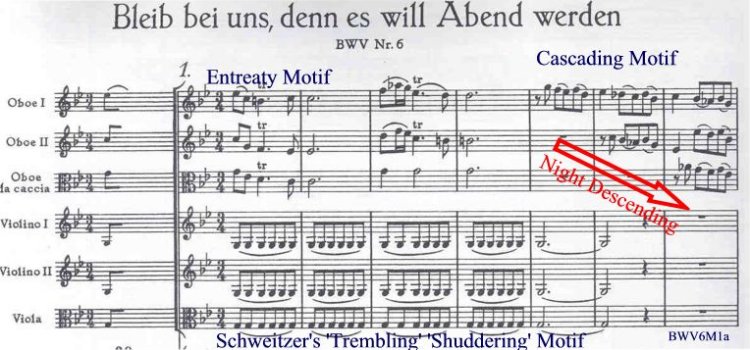
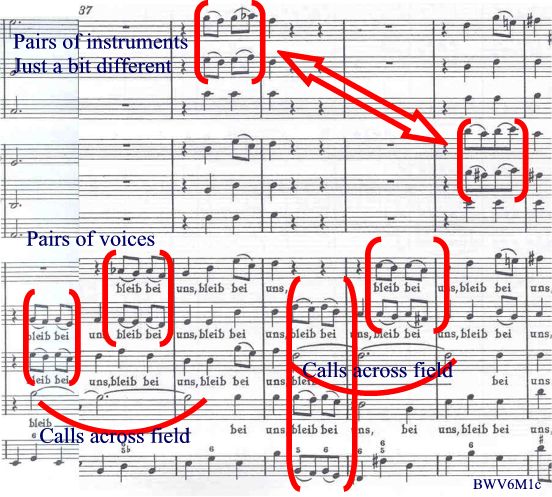
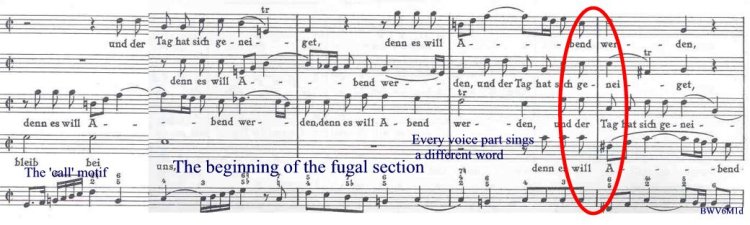
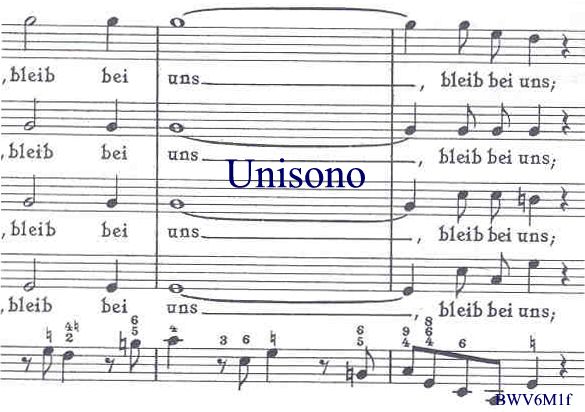
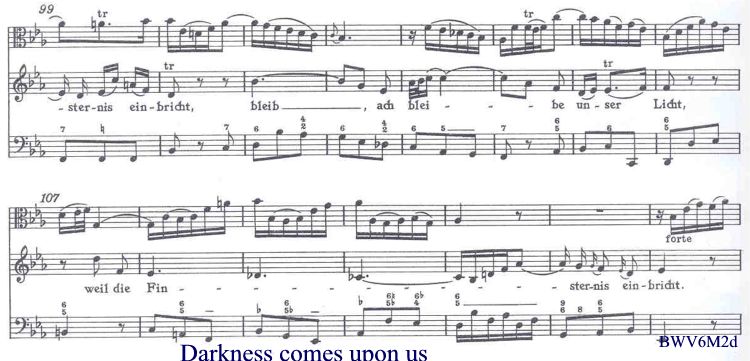
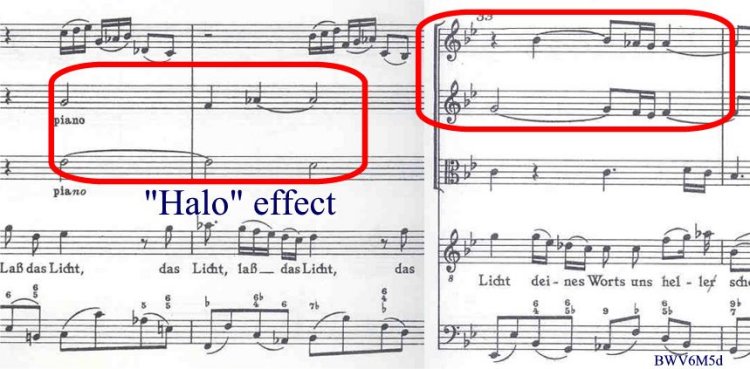
This week I thought I would try a different approach to understanding and appreciating BWV 6. Consulting various texts that I have, it is possible to document how differently scholars viewed this cantata over the past 129 years. One of the giants of Bach scholarship is Philipp Spitta who began publishing his monumental volumes in 1873. He identifies the tripartite structure - slow, the faster fugal section, slow - as being new in Bach's design of an initial cantata movement. He senses the movement from a relatively quiet feeling the disciples had in their natural surroundings in the evening to the middle section of much greater excitement, perhaps even agitation on their part. He says that Bach is describing a tranquility that is normally observable in nature, but here there is an uncanny fear that is also present as night falls. Spitta sees the long notes held out by different voices in the fugal section as resembling calls coming across a field at twilight and in the first and the third repeated section, he sees long, deep shadows falling across the landscape. In the alto aria mvt. 2, at the point where the alto sings, "Bleib, ach bleibe unser Licht, weil die Finsternis einbricht!" the otherwise noble longing expressed in the first part of the aria is transformed into an almost heartbreaking feeling at the approach of darkness with a frightful, eerie quality.
[Just a personal note at this point -- as a young man, I never did enjoy what I considered in my scientific frame of mind to be 'flights of fancy' or an overactive imagination in the description of Bach's works. Now things have been turned around, as I recognize that listeners are able to perceive similar things without taking recourse to reading in advance everything that has been written about any given cantata. I would even suggest that you, as a listener, should first listen to one recording of a cantata without reading about the various interpretations, so as to be able to enhance your ability to discover many things on your own without help from other sources. Then read Aryeh's presentation to find confirmation of some things that you did already notice and others that are new to you. Then listen to another recording, etc. After a while you will come to the conclusion that you do have the ability to sense correctly what is important or different in a Bach cantata. And if it is any comfort for anyone just beginning to listen and understand Bach's cantatas, consider that fact that the experts, the "big guns" in Bach scholarship can be completely wrong in their assessments. Read on!]
The soprano chorale, mvt. 3, that Bach considered special enough to include in the Schübler Chorales for organ, BWV 649, is the very mvt. that Spitta describes as lacking depth. For him there are too many quirky jumps, arpeggios and runs. He even goes so far as to lump this mvt. with the tenor aria that follows the recitative. In essence Spitta says, from the standpoint of compositional quality, "keep the first two mvts., the rest you can throw away." So much for Spitta, who had great flashes of insight, but with so much material to cover, fell short in time and energy to cover everything with equal greatness. Who knows? Perhaps he had only heard this cantata once in his life, and somehow the greatness of Bach came through in the first two movements despite the poor performance he may have heard. Why else would we always be hungry for 'just another new recording' of a Bach cantata?
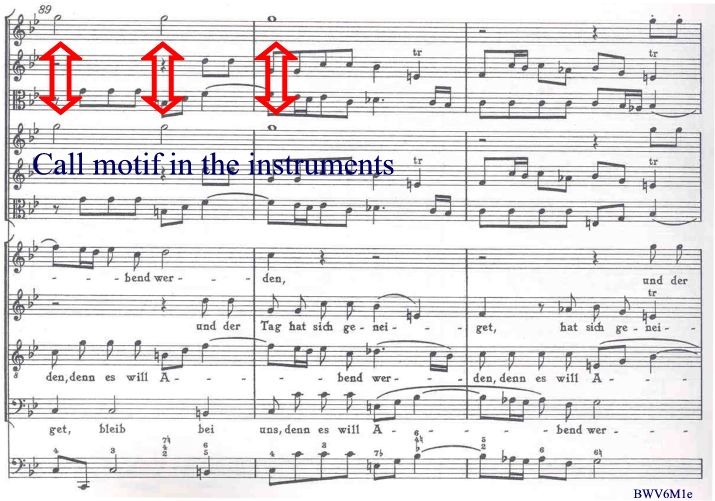
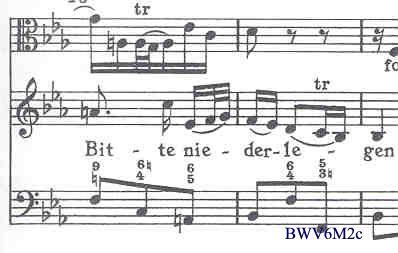
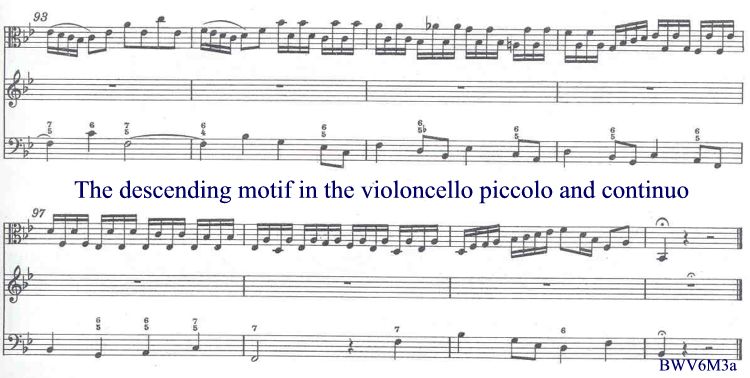
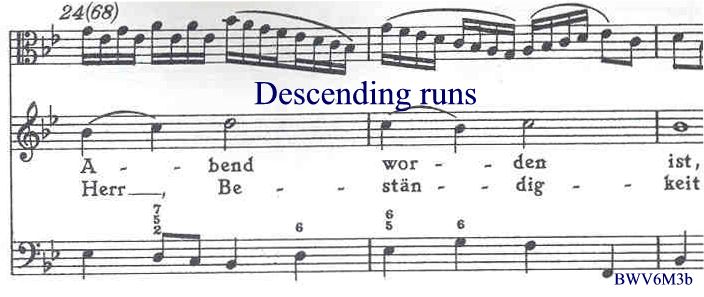
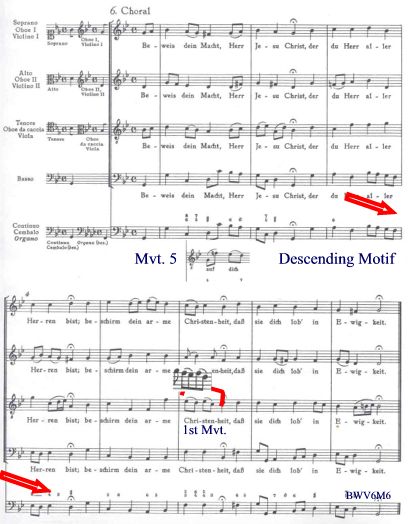
In his discussion of this cantata, Albert Schweitzer (1905) begins with, "The solo movements of BWV 6 are somewhat lengthy." Not a very auspicious beginning, but we know that Schweitzer characterized Bach as the supreme painter in music, whereas Beethoven and Wagner were for Schweitzer the great poets of music. So he calls the opening mvt. "a masterpiece of poetry in music." He points to the descending nature of the music for the words, "denn es will Abend werden" = "for evening is nigh," and states that 'the voices descend, as if the gloom of night were weighing upon them.' Schweitzer is the only one who sees/hears in the accompaniment a repeated note sequence, 'an anxious quivering.' The middle fugal section he characterizes as having even more urgency and expressiveness of entreaty and pain. He picks up on Spitta's apt description of the long, drawn-out notes in the fugue as resembling 'cries resounding from the gloomy fields, and then sudden stillness, after which a return to prayer with ' a caressing triple rhythm.' When the cadence changes to a major key, it is 'as if the Lord had intimated the granting of the prayer.'
Woldamar Voigt in his "Die Kirchenkantaten J. S. Bachs" 1918 attempts to provide a guide for anyone who wants to understand the sacred cantatas of J.S.Bach, but also gives advice on how to present the cantatas in a performance. In mvt. 1 he hears the deep-sounding bells (are these the same as the 'anxious quivering' that Schweitzer discovered?) in the somber evening ambience. Bach's scoring for three oboes (one being the oboe da caccia) he would expand by adding two flutes to the 1st oboe part, a clarinet to the 2nd oboe part and a clarinet and a bassoon to the 3rd oboe (da caccias were probably not even available at that time). Mvt. 2 (alto aria) he says, is beautiful, and since Bach does not use a complete da capo here, 'you have the freedom to shorten likewise the other arias elsewhere.' For the soprano chorale mvt. 3, Voigt suggests using a viola to replace the violoncello piccolo along with a quiet organ accompaniment. Better yet, he says, skip the soprano part and play that part on the organ using one or two gamba stops, and arrange the continuo to be played by the string orchestra. Because the text of the tenor aria mvt. 4 is so bland or insipid, it had an effect upon the composition of the music, making the second part of this aria become halting or too hesitant, so that it can not move forward properly. "You may be forced to keep this tenor aria, because it simply would not do, to have the final chorale follow right after the soprano chorale." So much for Woldemar's advice to a new generation of budding organists/choir directors at the beginning of the 20th century!
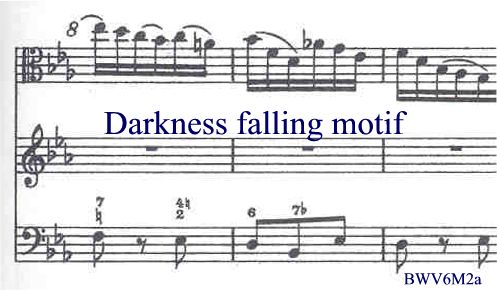
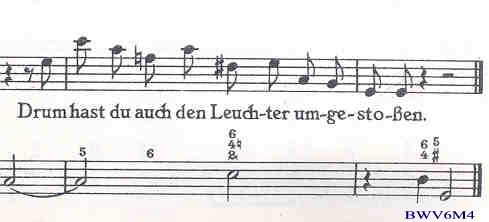
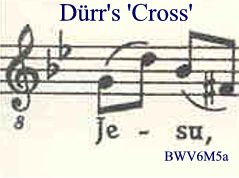
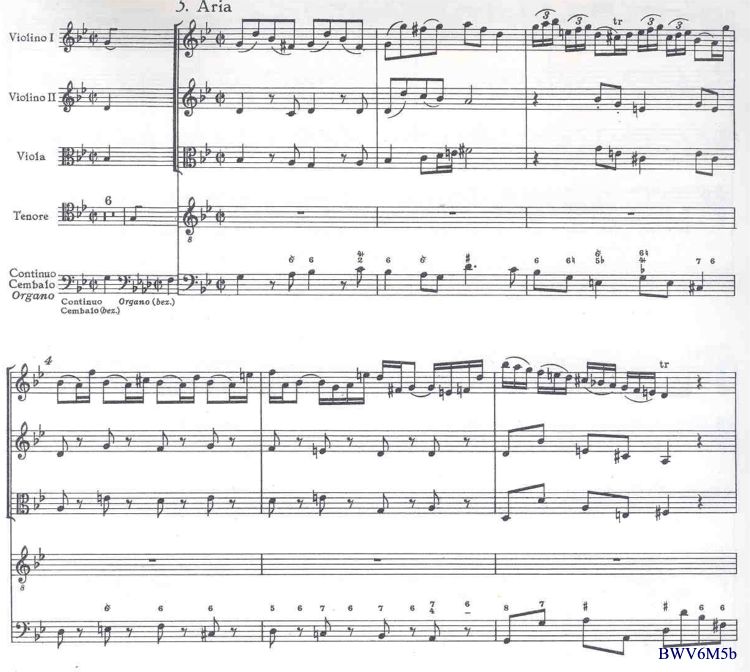
Alfred Dürr (Johann Sebastian Bach: Die Kantaten) 1971, who also wrote the liner notes for this cantata in the Teldec series, laments the dry text by a theologian, who at least had the insight to include a passing reference to NT Rev 2,5 in mvt. 4, where the bass sings in the recitative, "Drum hast du auch den Leuchter umgestoßen"="Therefore hast Thou knocked over the candlestick." Structurally, says Dürr, the cantata is bipartite, but he does not think the cantata was performed in parts (before and after the sermon). In addition to mentioning the impressive greatness that Bach exhibits in mvt. 1, Dürr points out the three groups that frequently enter with the theme at different times: 1) the oboe choir 2) the string orchestra 3) the choir. It is as if they were gesturing to each other as they express their feelings. The faster fugal section begins with only voices and continuo until all voices have entered, then the full orchestra joins in the fugue. This is somewhat like having the solo voices followed by the ripieno choir. In mvt. 2 Dürr sees again a moving gesture, this time upwards with the words, "Hochgelobter Gottessohn"="Highly praised Son of God." With the word "Finsternis" ="Darkness" there is a sinking downward in whole-tone steps. Bach has chosen the darker alto voice, paired with the oboe da caccia, to illustrate this darkne. Regarding mvt. 3 (soprano chorale) he points to the virtuosic, rhythmical figures that abound and surround the chorale. The main motif in the tenor aria mvt. 5 which first appears in the strings and then in the voice, he says, "are without a doubt a symbol for a cross" [I have difficulty seeing this, but I will include his example, and perhaps you can find the cross.]
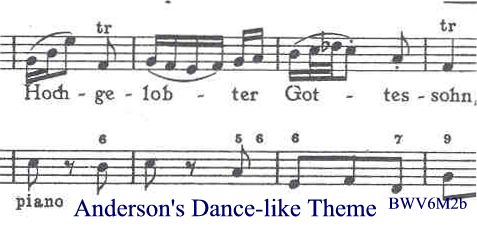
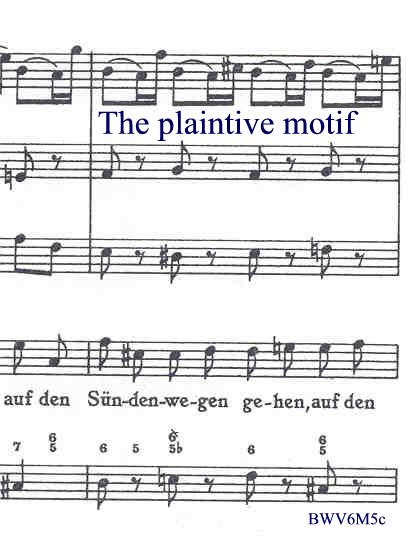
Nicholas Anderson (Oxford Composer Companions: J.S.Bach) 1999, counters Spitta by saying that Bach is using an earlier, preferred structural scheme in this cantata: Biblical text - aria - chorale - recitative - aria - chorale. The NBA I/10 KB does not accept Anderson's contention that the existence of the usual organ part along with an extra harpsichord part proves that they were used simultaneously and that this was "an accepted practice, if not a habitual one" in Bach's time. According to Anderson, mvt. 1 is 'affective word painting,' 'the falling theme evokes evening,' and the repetition of the words, "Bleib bei uns" has an 'imploring urgency.' He connects, as Aryeh has already pointed out, the falling theme with the "Ruht wohl", the penultimate section of SJP BWV 245. The 2nd mvt. has a dance-like theme and contains a plea for Christ's continuing presence. Anderson describes this aria as 'expressive melodic writing, but somberly colored, depicting the encroaching darkness.' Of mvt. 5 (tenor aria) he states that it has a full string accompaniment and that the 'resolute melodic contour in the upper string parts reflects the underlying optimism of the text.' |