|
|
Cantata BWV 89
Was soll ich aus dir machen, Ephraim?
Commentary |
|
Malcom Boyd | Alfred Dürr | Albert Schweitzer | W. Gillies Whittaker |
| |
|
Thomas Braatz wrote (November 20, 2005):
Here are two commentaries:
The "Oxford Composer Companions: J. S. Bach" [Oxford University Press, 1999] has the following commentary, probably by Malcom Boyd:
>>"Was soll ich aus dir machen, Ephraim" ('How shall I give thee up, Ephraim?'). Cantata for the 22nd Sunday after Trinity, BWV 89, first performed at Leipzig on 24 October 1723. The Gospel appointed for the day, Matthew 18: 23-35, deals with forgiveness, exhorting Christians to show the same mercy towards others that God shows towards them, and this in general is the theme of the cantata. But the anonymous librettist has chosen an Old Testament passage, Hosea 11: 8, to stand at the head of his text: 'How shall I give thee up, Ephraim? how shall I deliver thee, Israel? how shall I make thee as Admah? how shall I set thee as Zeboim? mine heart is turned within me, my repentings are kindled together.' Although it is Jehovah, not Christ, who is speaking, Bach set this sombre passage, as he so often did the "vox Christi," as a bass solo in a manner which lies somewhere between arioso and aria. Following the arioso tradition, each clause of the text is set to new material, while the accompaniment of two oboes, horn, strings, and continuo (the cantata's full instrumental complement) is tightly constructed, with recurring motifs and a formal ritornello at the beginning and end.
Two recitative-aria pairs follow, the first for alto, the second for soprano. Both recitatives are accompanied only by continuo, and so too is the alto aria 'Ein unbarmherziges Gerichte'. This is remarkable above all for its unusual structure. Basically ternary (A-B-A′), in so far as the two opening lines of text are repeated at the end, the first (A) section ends in the dominant (A minor), leading us to expect eventually a modified da capo; but the middle (B) section closes in the distant key of C minor, practically ensuring a thorough reorganization of the final (A′) section so as to regain the tonic key (D minor). The term 'free da capo', often somewhat indiscriminately applied to Bach's arias of this basic type, is here for once appropriate. The soprano aria 'Gerechter Gott, ach rechnest du?', in a more straightforward ritornello form and with oboe obbligato, sounds a note of optimism, and the cantata ends with a four-part setting of the seventh strophe of Johann Heermann's hymn "Wo soll ich fliehen hin" (1630) in cantional style, with colla parte instrument support.<<
Here is a translation of commentary by Alfred Dürr, an eminent Bach scholar, who has published, among other things, a book on the cantatas: "Johann Sebastian Bach: Die Kantaten" [Bärenreiter, 1971 - 1995 (last revised edition)]:
>>The text of this cantata uses as a point of departure the Gospel reading for the 22. Sunday after Trinity in which is revealed the contrast between human guilt and heavenly grace bestowed by God. The cantata opens with a related biblical quotation from Hosea 11:8 [NLT]: "Oh, how can I give you up, Israel? How can I let you go? How can I destroy you like Admah and Zeboiim? My heart is torn within me, and my compassion overflows." The following four mvts., a pair of recitatives and arias, treat the unforgivable sinfulness of human beings, who, themselves are not ready to forgive (mvts. 2 and 3) and the heavenly love revealed in Jesus' sacrificial death (mvt. 4 and 5.) The text of the final chorale by Johann Heermann (1630) summarizes this contrast between human deficiency and heavenly grace.
The unknown librettist/poet weaves a series of biblical allusions into the fabric of the text. For instance, mvt. 3 is, for the most part, a paraphrase of Jacob 2:13: "An unmerciful judgment will come over those who have not been merciful." In mvt. 4, Jesus' phrase "des Gesetzes Ende" is from Romans 10:4 [Luther 1545 unrevised] "Denn Christus ist des Gesetzes Ende; wer an den glaubet, der ist gerecht" [NLT] "For Christ has accomplished the whole purpose of the law. All who believe in him are made right with God." There are numerous allusions to the Gospel reading such as in mvt. 2 "und drückt den Nächsten um die Schuld" ["he pressed his neighbor/fellow human being to pay back the debt."]
Bach composed this cantata during his first Leipzig yearly cycle for October 24, 1723. In addition to the usual 2 oboes, strings and continuo, the orchestration also calls for a horn just as he did in BWV 162 and BWV 109. In mvt. 1, Bach decided at the last minute again, while the parts were still being copied out, to add an insignificant horn part used only to fill in the harmonies and to have used it to support the singing of the chorale melody in mvt. 6. Apparently Bach, during those weeks, had a brass player available for performing in the cantatas, a brass player to whom he wanted to give an opportunity to play although Bach only dared to entrust him with easy parts.
The introductory mvt. is one of those bass solos, based on a biblical quotation, which, according to its formal structure stands somewhere between an arioso and an aria. One of the characteristic forms of solo vocal mvts. which were developed by Bach during his 1st year in Leipzig is a bass solo based upon a 'Dictum' (a direct quotation of Jesus, or in the Old Testament words spoken by God.) The preference for the bass voice in such 'Dictums' or better 'Dicta,' comes from a liturgical tradition according to which the readings from the Passion were distributed among several singers. There the words of Christ were always sung by a bass while the evangelist was sung by a tenor and the remaining parts by an alto. Because of this tradition, the bass assumed the role of Christ, "vox Christi," in other church music as well. "Dicta" sung by soloists already appear in Bach's Weimar cantatas, but they are composed in the form of a recitative: BWV 18/2, BWV 182/3, BWV 172/2, BWV 61/4 and for alto: BWV 12/3. But now, in Leipzig, Bach begins to prefer another form which is, according to formal structure, somewhere between an aria and an arioso. Most often Bach dispenses with a title for such a mvt. or on certain occasions will use a title like "Basso Solo", but only rarely will you find the designation "Arioso" or even "Aria" for such a mvt. The earliest mvt. of this sort that has come down to us is BWV 22/1, Bach's audition cantata, where it is sandwiched between an introductory tenor recitative and a following choral mvt. Only after the large chorale cantatas of the first weeks of Bach's tenure beginning with the 22nd Sunday after Trinity does this type of mvt. become more frequent, sometimes with full orchestra accompaniment (BWV 89/1), BWV 166/1, BWV 86/1,), sometimes as a continuo aria (BWV 153/3, BWV 154/5, BWV 81/4.) Somewhat related to this type of aria, but having a more unique structure are the mvts. in BWV 83/2 and BWV 67/6. In the following yearly cycles there are also similar mvts.
By looking at Bach's copyists' indications for 'tacet' mvts. where the designation 'Aria' appears, it is not at all clear whether Bach authorized this descriptive heading or not. The ritornello, characterized by individual themes seems to point toward a connection with the 'aria' form. Thisis also apparent in the use of 'Choreinbau,' which in this instance, as also in other arias of this type, might better be described as 'Vokaleinbau' since a single voice appears as an overlay on top of the repetition of the instrumental
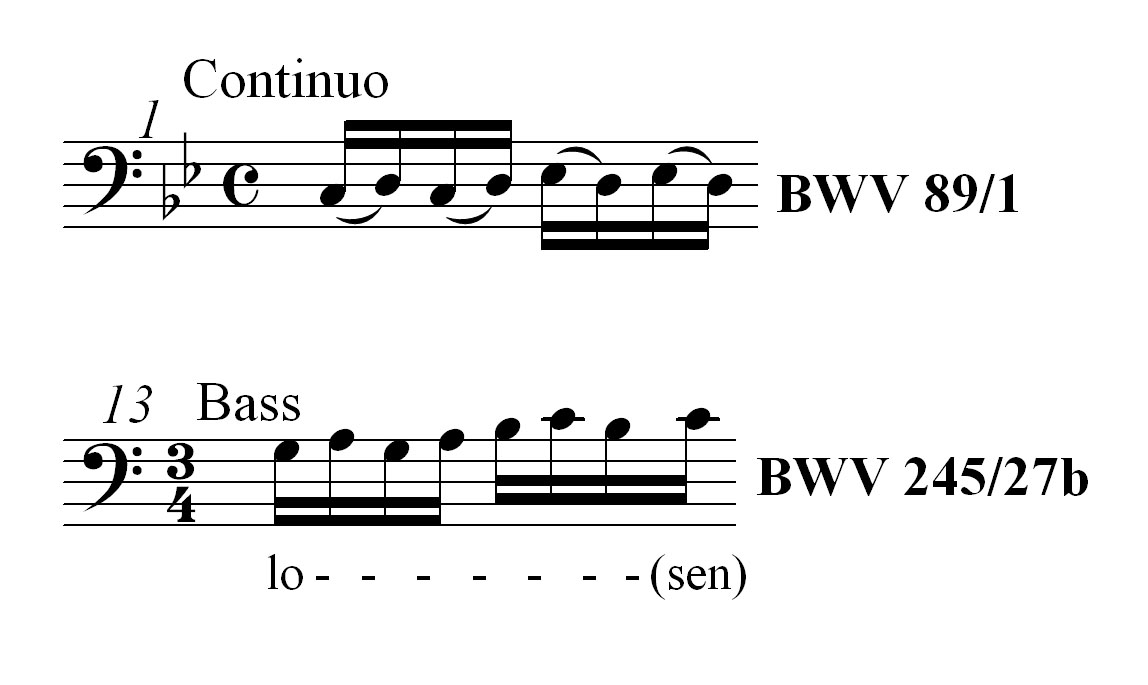
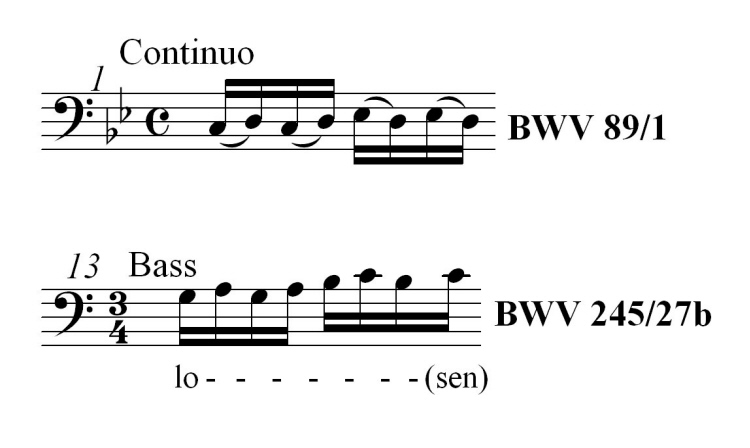
ritornello. This is not a unique feature of Bach's compositional style, but rarely does any other composer use it so frequently and persistently. Formally, however, this 1st mvt. is closer to an 'arioso' since the sections of the biblical text are presented one after the other without any 'da capo.' The only closure occurs with the repetition of the orchestral ritornello. There is a motif within the ritornello that takes on greater importance as the mvt. develops. Possibly it was intended to present a musical depiction of indecisiveness which the text attempts to portray. There is a similarity here in the continuo at the beginning of the mvt. with the turba chorus "Lasset uns den nicht zerteilen" on the word 'losen' in the SJP BWV 245/27b. |
|
|
|
The remaining mvts. have a remarkably weak orchestration: what follows are 3 'continuo' mvts. (mvts. 2-4) after which there is an aria using an obbligato oboe and only in the simple final chorale are all the instruments used again.
In the middle of the 3 mvts. with continuo and surrounded by recitatives, there is an alto aria "Ein unbarmherziges Gerichte" (mvt. 3) which has an expressive theme at first presented by the continuo ritornello and then picked up by the alto voice. The middle section of the aria has some lively, passionate coloraturas. The conclusion of the aria has a freely modified 'da capo.' The first of the two recitatives surrounding the aria is a plain, secco recitative while the second begins with a secco section but leads into a concluding 'arioso.' This final 'arioso' is where a textual change is emphasized as it leads from the threat of being judged to consolation which is the subject of mvt. 5.
The 2nd aria (mvt. 5) begins in similar fashion to the 1st aria: the melody played by the oboe in the ritornello is then taken over by the voice in a simpler form more suitable for singing; yet, the song-like simplicity of this relaxed, almost dance-like mvt. provides a complete contrast to the artistic expressivity of the first.
A simple 4-pt. chorale concludes this cantata.<< |
|
Thomas Braatz wrote (November 24, 2005):
Here are some commentaries:
Albert Schweitzer, translated by Earnest Newman from the German 1911 edition, Breitkopf & Härtel, and published by Dover, New York, in 1966, Vol. 2, p. 117 and p 257-8
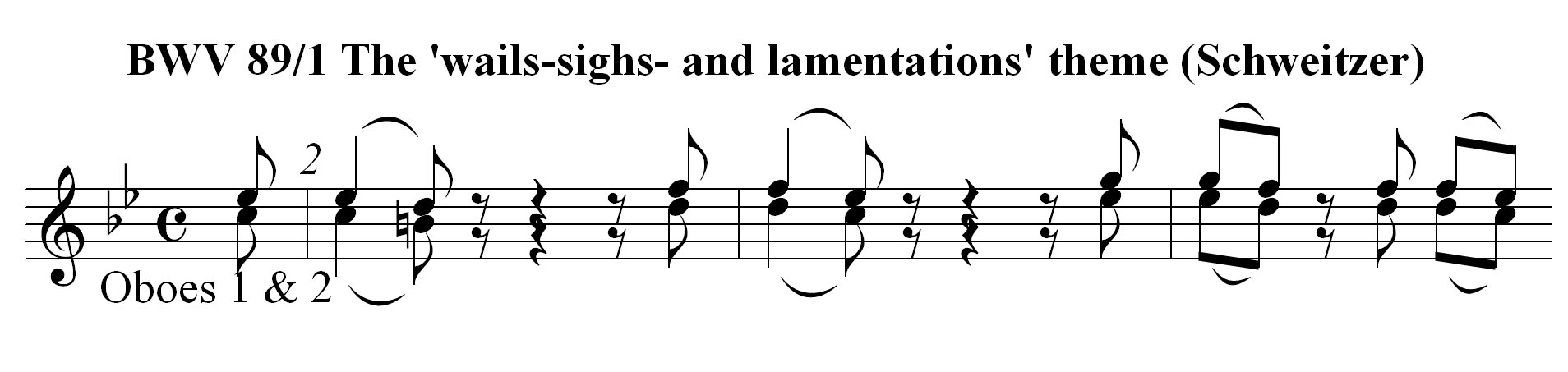
>>One of the most perfect specimens of Bach’s mood-painting is to be seen in the accompaniment to the first aria of the cantata “Was soll ich aus dir machen, Ephraim?” BWV 89….This text [Hosea 9:8] is reproduced by means of three themes The first, in the bass, symbolizes the wrath of God [God’s anger – p. 117] – |
|

|
|
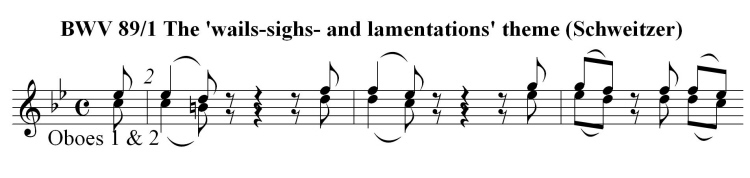
The oboes give out wails and sighs [sighs and lamentation – p. 117] – |
|
|
|
The sorrowful question is put by the violins – |
|

|
|
As these motives intertwine and interpenetrate each other without coming to any conclusion, so God’s heart is distracted by contradictory thoughts upon Israel.
That the theme in the violins is meant to suggest the sorrowful question is proved by the first chorus of the cantata “Ich elender Mensch, wer wird mich erlösen von dem Leibe dieses Todes? (BWV 48), where the orchestral accompaniment is constructed upon a theme that is almost identical with that of “Was soll ich aus dir machen, Ephraim?”<< |
|

|
| |
|
W. Gillies Whittaker “The Cantatas of Johann Sebastian Bach” vol. 1, pp. 388-392, Oxford University Press, 1959.
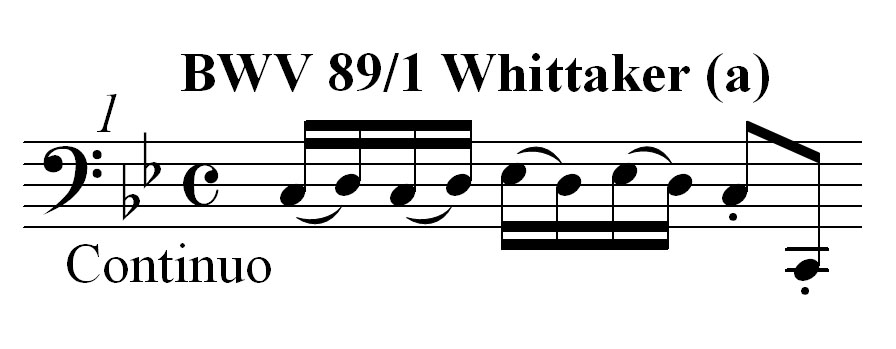
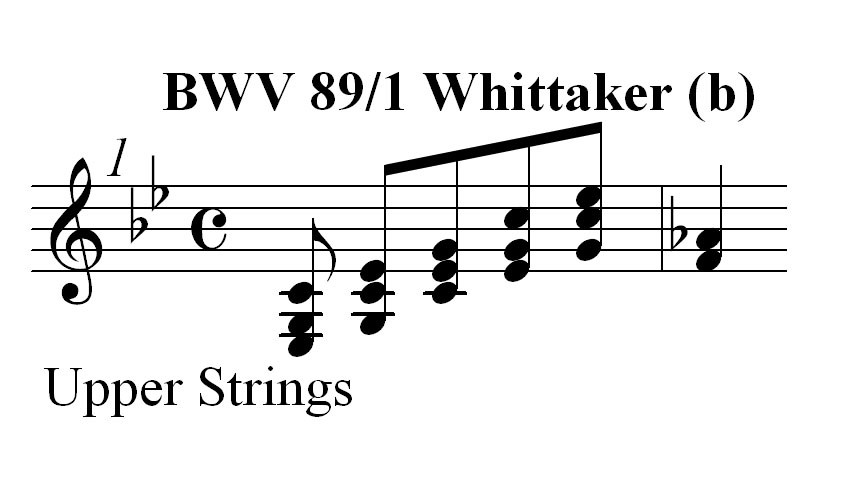
>>The only cantata in this group which includes a soprano is a remarkable one. It belongs possibly to the years round about 1730, [correct date is October 24, 1723] for the Twenty-Second Sunday after Trinity, and is based upon the same theme as the solitary cantata for tenor solo, discussed supra, the parable of the unmerciful servant, from the Gospel, St. Matthew 18: 23-35. In BWV 55 it is the sinner, placing himself in the position of the hard-hearted servant, who speaks; in BWV 89 the personal element does not come until mvt. 4; mvts. 1, 2, and 3 are addressed to him. A splendid verse from Hosea (11:8) opens, ‘Was soll ich aus dir machen, Ephraim? Soll ich dich schützen, Israel?’ (‘What shall I of thee make, Ephraim? Shall I thee protect, Israel?’), an inviting text for musical setting. But the unknown librettist overlooked one point. The unmerciful servant was ‘delivered to the tormentors, till he should pay all that was due’, whereas in Hosea, in spite of the fierce anger of the Lord against Ephraim, the verse concludes ‘My repentings are kindled together’ and the next begins ‘I will not execute the fierceness of mine anger, I will not return to destroy Ephraim; for I am God, and not man.’ Thus mvt. 1 does not tally with mvts. 2 and 3, as will be seen later. However, the text from Hosea results in a remarkable bass aria, unique in Bach's writings, and one is content to overlook the irregularity of the libretto for the sake of the music. In bars 1 and 2 four distinct motives are announced, a grim muttering in the bassi, the anger of God: |
|
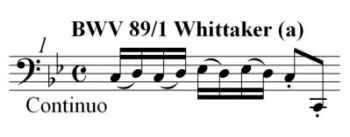
|
|
a rising and falling questioning idea in the strings: |
|
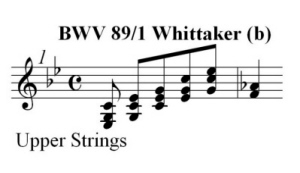
|
|
a sighing phrase for the two oboes: |
|
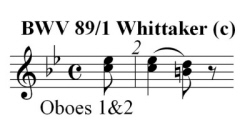
|
|
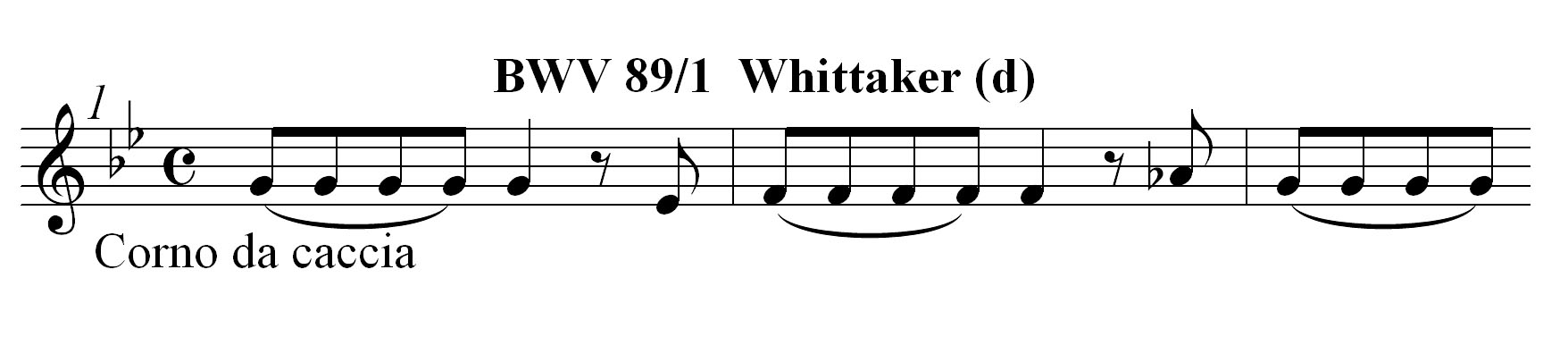
while the corno relentlessly intones a repeated-note figure—(d): |
|
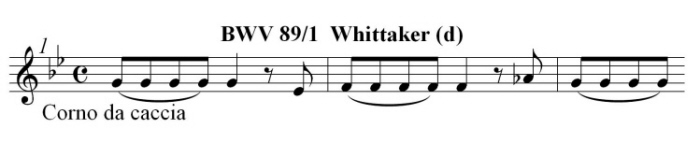
|
|
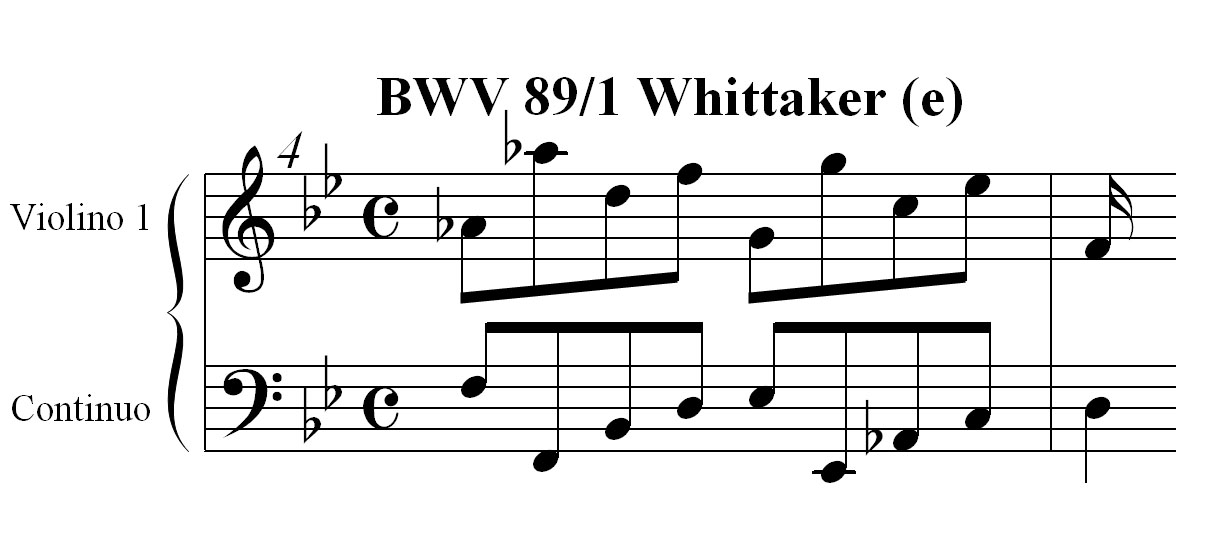
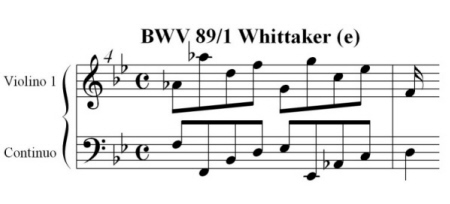
A forbidding, dark-clouded atmosphere is thus thrown at once on the canvas. In bar 4 (c) is quickened into quavers and a powerful leaping figure appears in violin 1: |
|
|
|
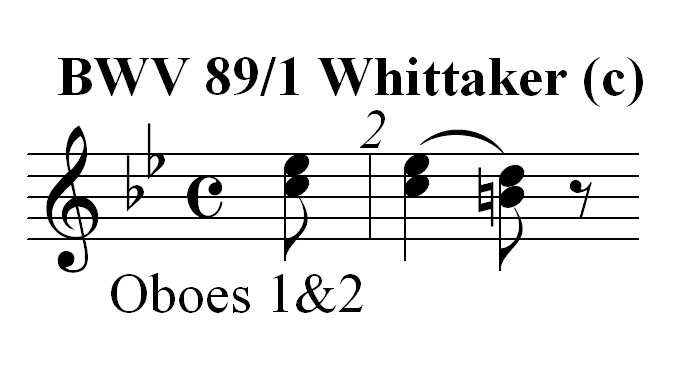
At the end of the bar an ominous melody in thirds begins in the oboes: |
|

|
|
which continues with (a). When the thirds begin (a) is heard in the violins and then (c) in the bassi. The texture of the aria is rich, eight-part counterpoint being frequent. The vocal line is superbly declamatory and descriptive. The voice sings, ‘Was soll ich aus dir machen’ four times, using a derivative of (b) and ending each set of two with ‘Ephraim’, the second with a pause. (a), (c), (d), and (e) are heard in the orchestra. Six and a half bars of the introduction now come in the instruments, in Eb instead of C minor, and the soloist sings the second clause, with first a holding note and then a vigorous run, partly based on (b), to ‘schützen’, and concludes with a pause on ‘Israel’. Another impressive pause is at the end of ‘Soll ich nicht billig ein Adama aus dir machen, and dich wie Zeboim zurichten?’
(‘Shall I not cheaply an Admah of thee make, and thee as Zeboim punish?’); the fate which befell the two wicked cities and the sternness of the ‘zurichten’ are grimly depicted by runs. (a), (b) in part and complete, (c), (e), and (f) come in the orchestra, (b) for the first time in the continuo After these terrible warnings, forbidding in their pauses, the Judge reveals His leaning towards forgiveness—‘Aber mein Herz ist anders Sinnes’ (‘But my heart is of other mind’)—and as the singer delivers the words seven times, omitting the conjunction in the later repetitions, the vocal melody is less angry. There is a long trill on ‘Sinnes’ [this trill does not exist in the NBA edition] and runs on ‘Sinnes’ and ‘anders’, and (a) is found in the vocal line. The horn is silent until the Dal Segno; all the motives associated with the other instruments are there; beginning with bar 3 of this section the whole of the introduction is introduced, different in key and in scoring. Dovetailing with the end of the section the introduction is inserted again identical in key, but with many alterations—not only is the horn absent but (f) is in sixths instead of in thirds, the lower notes of oboe II producing an even more sinister effect. The vocal line—‘meine Barmherzigkeit ist zu brünstig’ (the magnificent Biblical clause, ‘My repentings are kindled together’ sufferslamentably in a literal translation, ‘my compassion is too ardent’)—is new, except that (a) appears in it and becomes more and more florid. All the orchestra save the continuo ceases, to allow a wonderful coloratura on ‘brünstig’ and an impassioned close. As in Wagner, the vocal line of this extraordinary aria moves in free independent melody, though borrowing occasionally from the symphonic orchestral texture. A dramatic bass can find a superb opportunity here.
Mvt. 2, an alto recitativo secco, speaks of judgment and vengeance, and culminates in a fine succession of chromatic chords in the penultimate bar: ‘Yea, verily should God a word of judgement speak and His name-mocking on His enemies avenge. Uncountable is the reckoning of thy sins, and had God even equal patience, rejects then thy hostile mind the offered goodness, and oppresses the neighbor for his debt; and therefore must vengeance itself kindle.’ An aria for the same voice and accompaniment begins: ‘Ein unbarmherziges Gerichte wird über dich gewiß ergehn’ (‘An unpitying judgment will on thee surely fall’). In ‘Die Rache fängt bei denen an, die nicht Barmherzigkeit gethan’ (‘The vengeance begins with those, who not compassion (have) done’—see James 2:13), ‘Die Rache’ is set to fierce and fiery trills; ‘und machet sie wie Sodom ganz zu nichte’ (‘and brings them as Sodom wholly to nought'), is vehemently dramatic, with a run on ‘Sodom’ which matches those on ‘Admah’ and ‘Zeboim’ in Mvt. 1. The continuo line is constructed completely out of the 'judgment' theme (a), and scales tearing upward and downward: |
|

|
|
The inevitability of divine judgement is indicated by canons at a beat distance on (a); (b) storms with fine effect during ‘die Rache’ and ‘Sodom’. This aria almost negates musical beauty; its gloom, relentlessness, and intensity sacrifice art to Old Testament realism. There is no denying its truthfulness and its appositeness to the grim first part of the cantata, but one wonders if Bach did not go a step too far in his passionate denunciation of the sinning creditor.
A soprano recitativo secco now brings us back to a more human state of mind; evil things are cast out of the heart, the culprit shudders at the realization of the consequences of a sinful life, and at the close, when Jesus is approached in faith, an Adagio wandering passage gradually sinks down in contrition: ‘Well then! my heart puts anger, quarrel, and discord away; it is ready the neighbor to pardon. But, how affrights me my sinful life, that I before God in guilt am! Yet Jesu's blood makes this account good, if I to Him, as the law’s end, myself faithfully turn.’ (See Romans 10:4.)
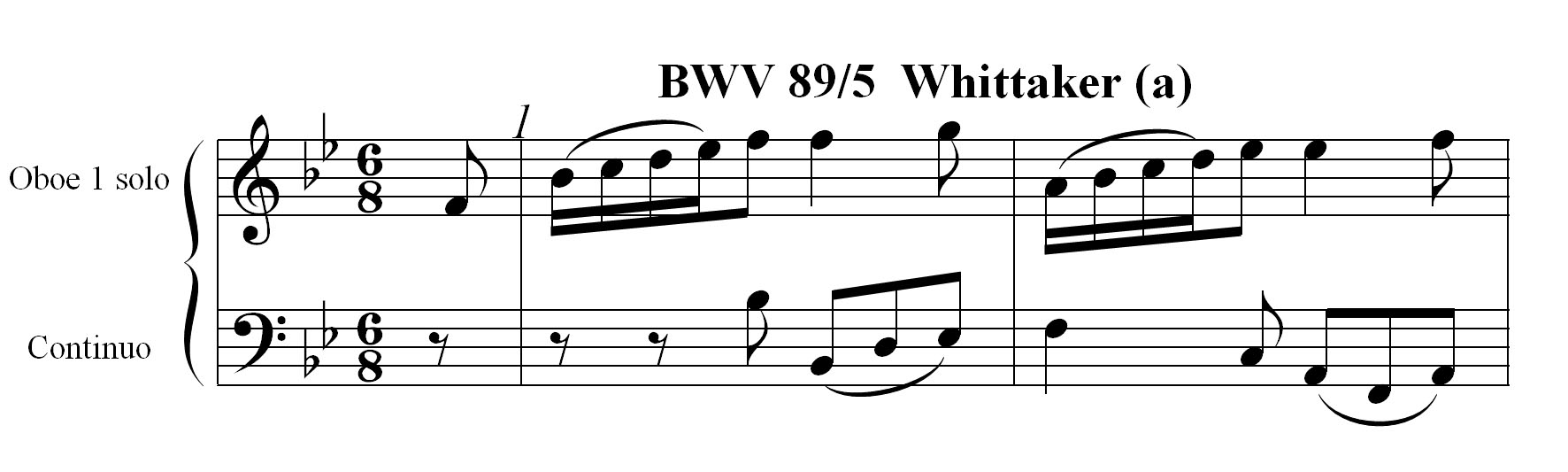
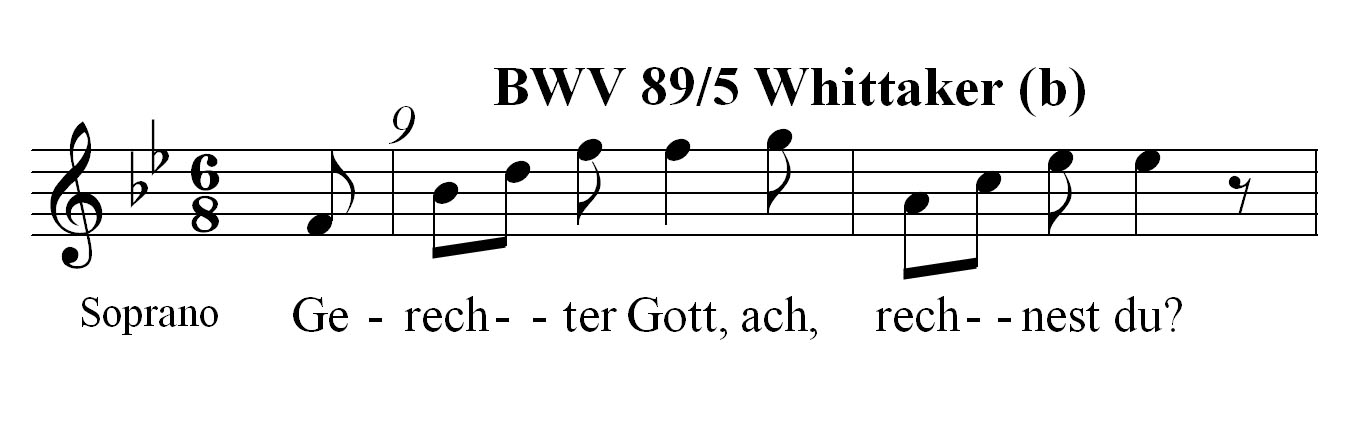
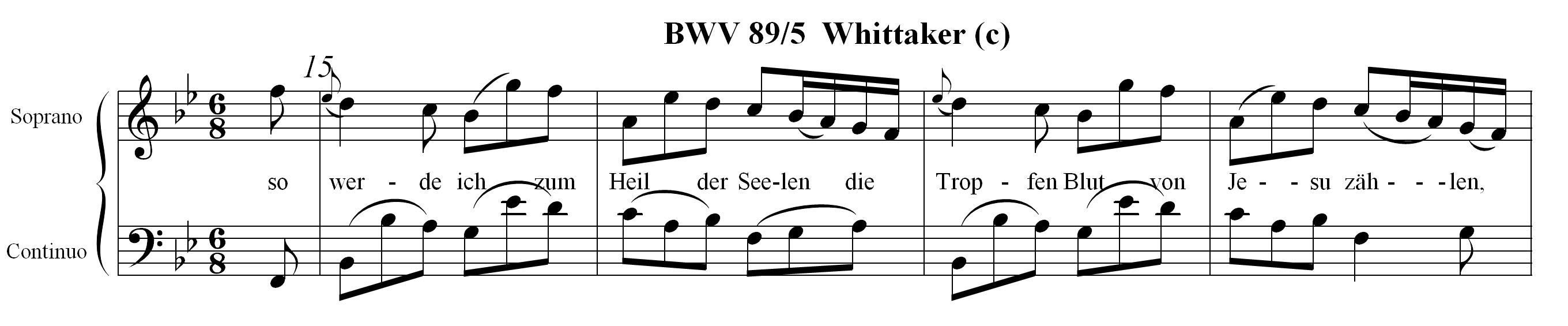
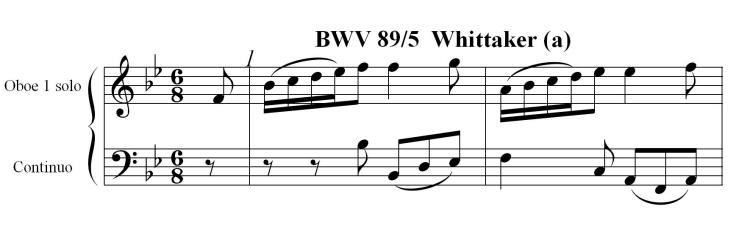
The succeeding soprano aria, with oboe obbligato, is confident in the results of the mercy of Christ. The oboe opens with a lovely melody of upward ripples and joyful leaps: |
|
|
|
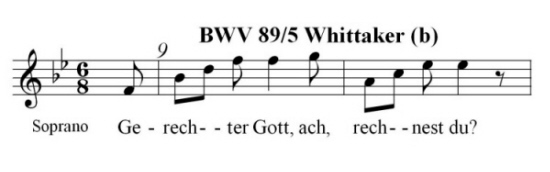
the vocal melody outlines the first oboe phrases without filling in intermediate details: |
|
|
|
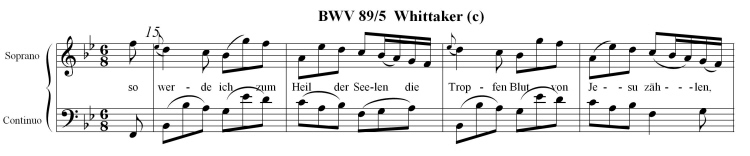
After the Scarlattian statement of (a) oboe and voice give out (a) and (b) in canon (if it can be called technically a canon when the two melodies are not exactly the same!) and the singer continues with an expansion of the answering oboe clause: |
|
|
|
A version of (a) now appears in the continuo. After an interlude in which (a) is followed by a free inversion of (c), the soloist pleads, ‘Ach! rechne mir die Summe zu!‘ (‘Ah, count to me the total up!’), using a new version of (b), while the run of (a) comes in oboe and continuo. (a) in the oboe leads to: ‘Ja, weil sie Niemand kann ergründen, bedeckt sie meine Schuld und Sünden’ (‘Yea, because it nobody can fathom, covers it my guilt and sins’). The vocal melody is new, the upward flight of (a) is heard in oboe and continuo, the falling of the cleansing drops of blood is indicated by downward scales in bassi and voice. (a) and (b), the latter altered, form an interlude, and the text from ‘Ach’ is repeated, but the singer begins with a version of (b) and a long bassi descent is answered by a corresponding vocal ascent at the close—the impetuous joy at the knowledge that the blood of Christ will redeem from all misdeeds.
Bach departs from his common practice in the beautifully harmonized closing chorale by adding both oboes to the soprano line. The old folk-tune, ‘Venus du und dein Kind’ (‘Venus, thou and thy child’), surely was transfigured spiritually when it was transformed into the chorale melody, ‘Auf meinen lieben Gott’, which is associated with J. Heermann's Lenten hymn, ‘Wo soll ich fliehen hin’, of which stanza 7 is used: ‘To me lacks indeed very much, Yet, what I wish to have Is all for me to the good, Acquired with Thy blood, Wherewith I overcome Death, devil, hell, and sin.’ During the last line the bassi remember their descent in the aria and sink to the lowest depths.<< |
| |
|
|