|
Chorale Melodies used in Bach's Vocal Works
Schmücke dich, o liebe Seele |
|
Melody & Text | Use of the CM by Bach | Use of the CM by other composers | Arrangements/Transcriptions |
| |
|
Melody & Text: Zahn: 6923 | EKG: 157 |
|
Text: Schmücke dich, o liebe Seele |
|
By Johann Franck (1618-1677) (1649) |
| |
|
Melody: |
|
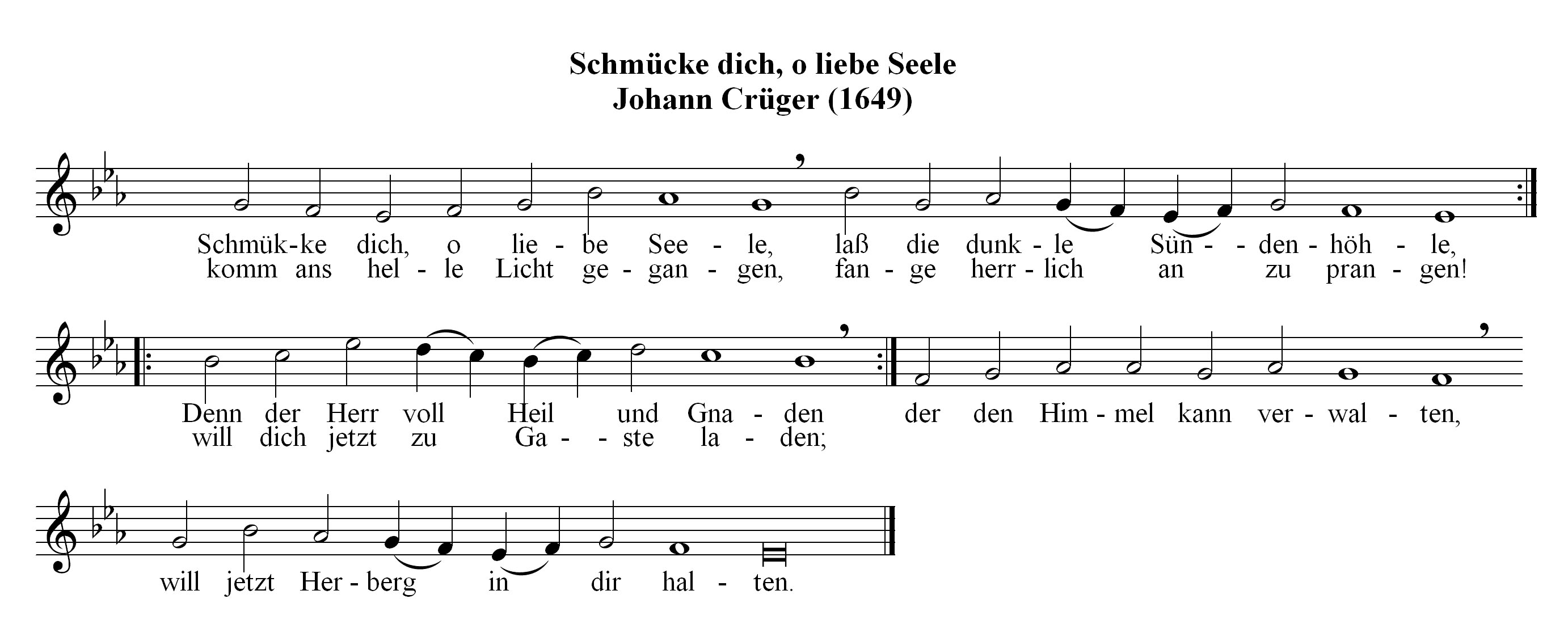
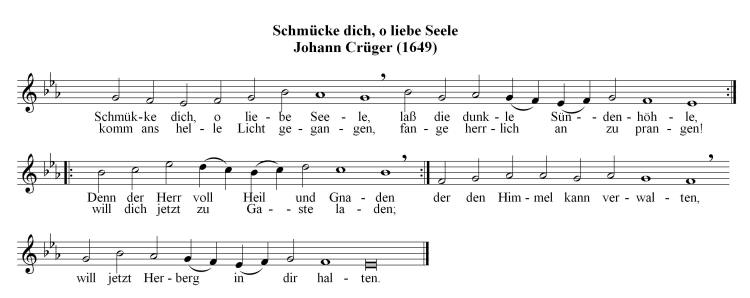
By Johann Crüger in Geistliche Kirchen-Melodien (Berlin 1649). |
|
>> The most important mid-17th-century chorale composer was Johannes Crüger, Kantor at the Nikolaikirche in Berlin (where from 1657 Paul Gerhardt was deacon) and the principal musical collaborator of both Gerhardt and Johann Heermann; his 70 original melodies include those for Gerhardt’s Wie soll ich dich empfangen (EKG 10) and Fröhlich soll mein Herze springen (EKG 27), for Heermann’s Herzliebster Jesu (EKG 60), and for Schmücke dich, o liebe Seele (EKG 157) and Jesu, meine Freude both by Johann Franck. They are all distinguished by their fusion of simplicity suited to the congregation with expressive declamation and rhythmic flexibility, the latter being due largely to the incorporation of Calvinist models. As a hymnbook editor Crüger introduced the private devotional hymn (Erbauungslied) that prevailed in the second half of the 17th century; in his first collection, Newes vollkömliches Gesangbuch (1640), which bore the explicit designation ‘for home or church use’, the standard core of Reformation de tempore chorales appeared together with the new Trostlieder of Heermann and others. For the first time chorales were presented as melody and figured bass (instead of four-part harmonizations), a format obviously appropriate for home devotions at the keyboard and for church congregations with organ accompaniment. Organ accompaniment had been introduced in about 1600 but had become widespread only as many church choirs were dissolved in the wake of the Thirty Years War. Crüger modified the traditional Reformation melodies by adding large numbers of leading-note accidentals, which helped to erase the last vestiges of the church mode system in favour of major–minor tonality. The second edition, which appeared as Praxis pietatis melica, contained a larger number of contemporary chorales including 15 by Gerhardt. (Later editions reflected changing tastes, and with the 44th, the Praxis pietatis melica became the most reprinted hymnbook in Protestant history.)<<
Authors: Robert L. Marshall/Robin A. Leaver in Grove Music Online, ©Oxford University Press 2006, acc. 5/22/06
|
| |
|
Hymnal versions Bach may have known: |
|
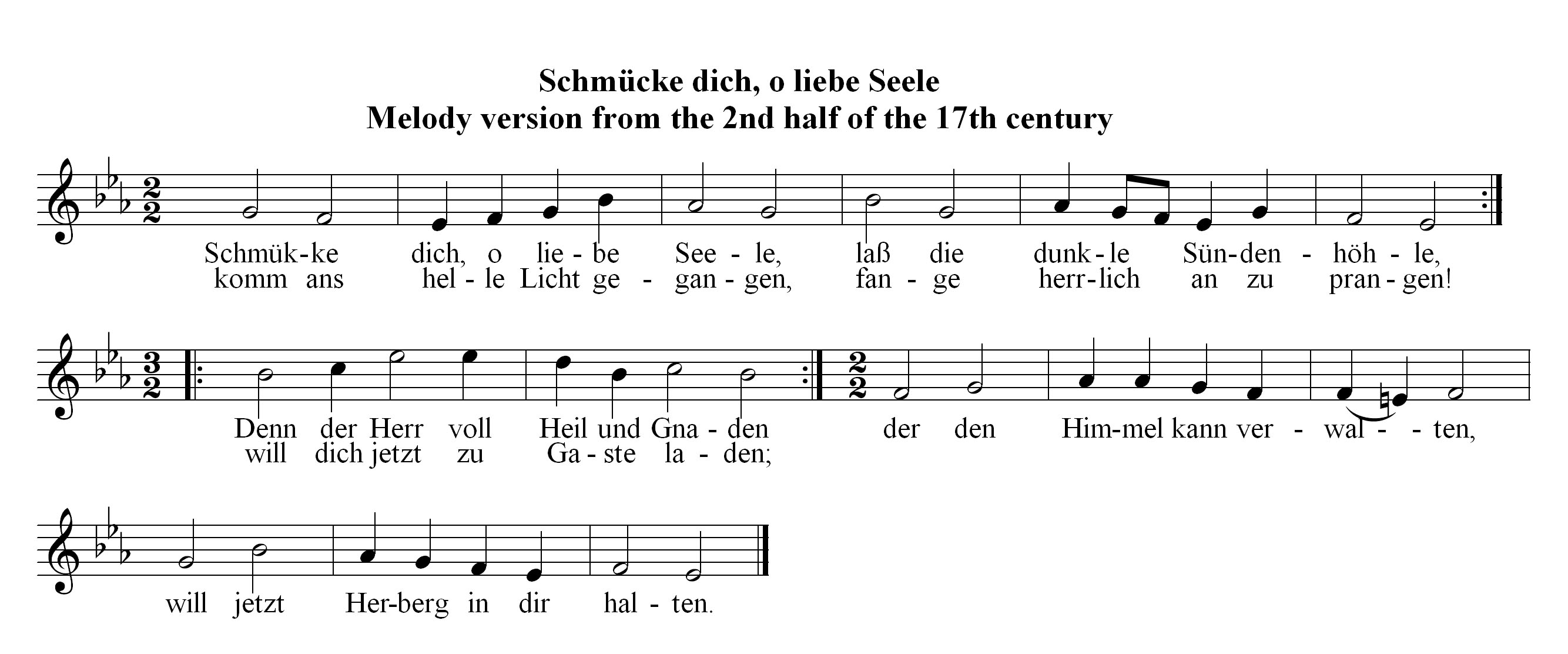
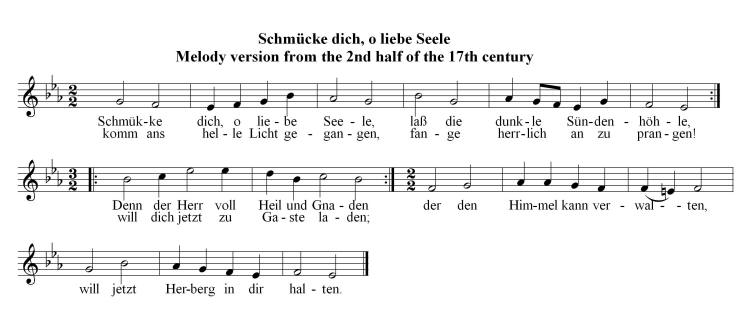
Hymnal versions of the melody from the 2nd half of the 17th century:
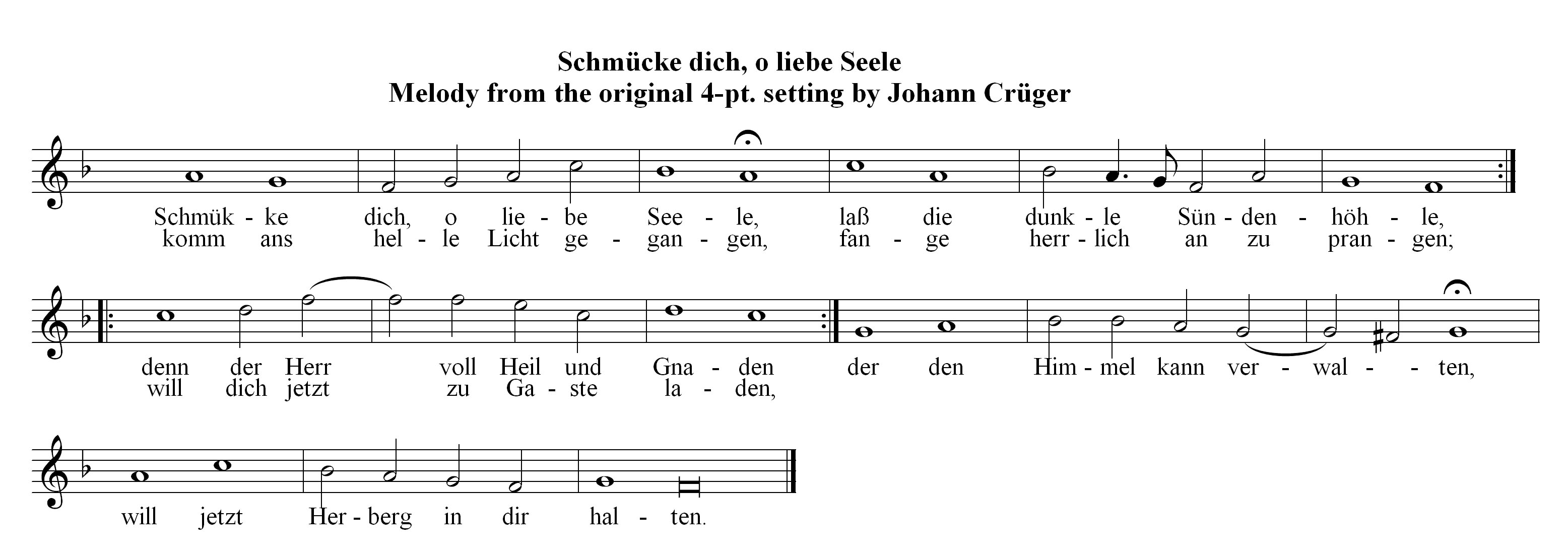
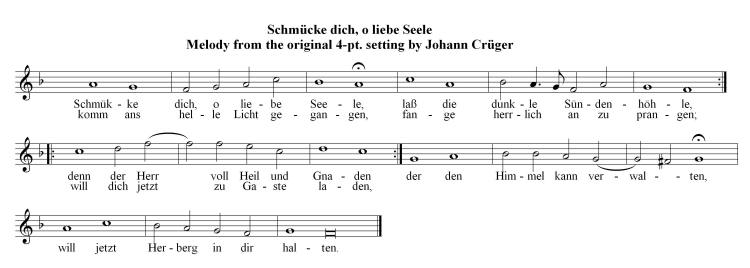
Two sources with varying results claim to show the original shape of Crüger’s melody as it first appeared in 1749: |
|
|
|
|
|
Another hymnal from the 2nd half of the 17th century has the melody given thus: |
|
|
| |
|
Use of the Chorale Melody by Bach: |
|
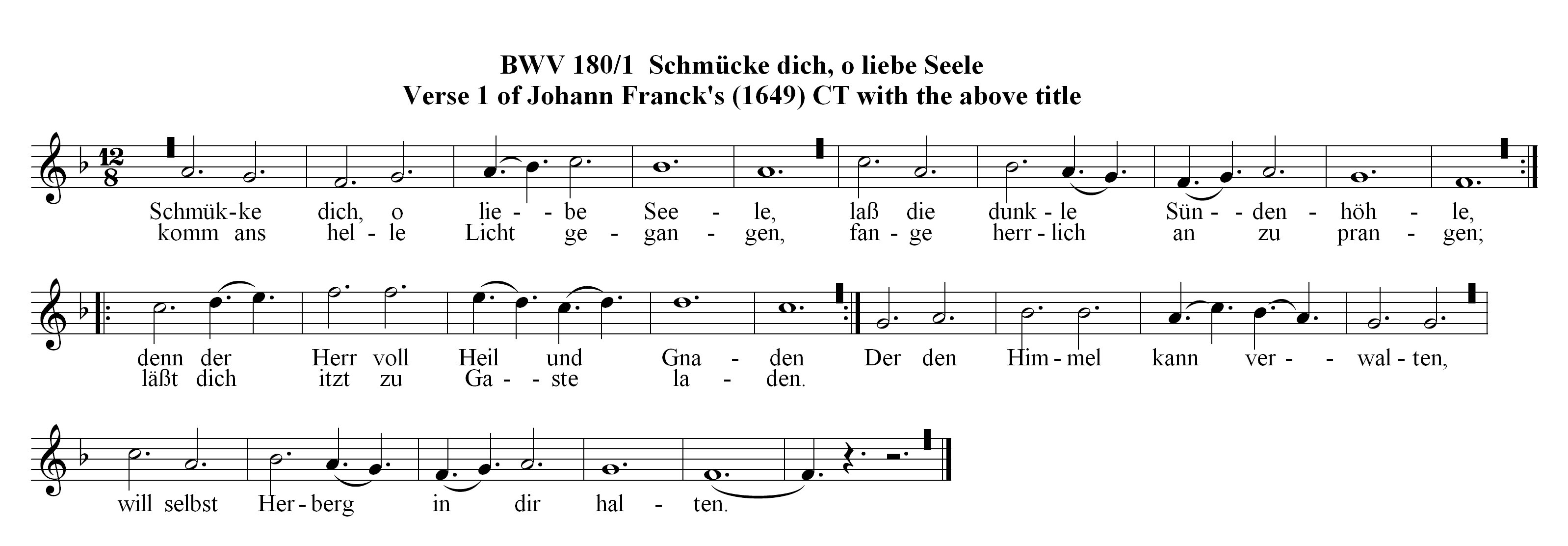
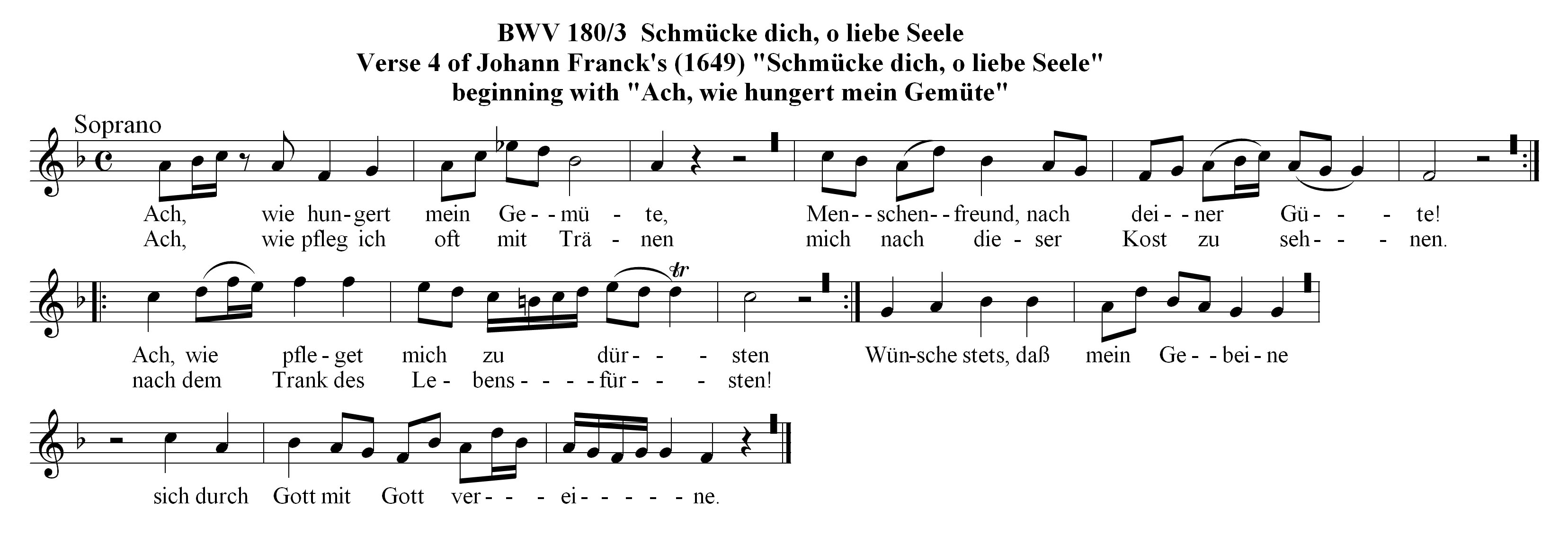
Text: Schmücke dich, o liebe Seele | EKG: 157
Author: Johann Franck (1649) |
|
Ver |
Work |
Mvt. |
Year |
Br |
RE |
KE |
Di |
BC |
Score |
Music Examples |
|
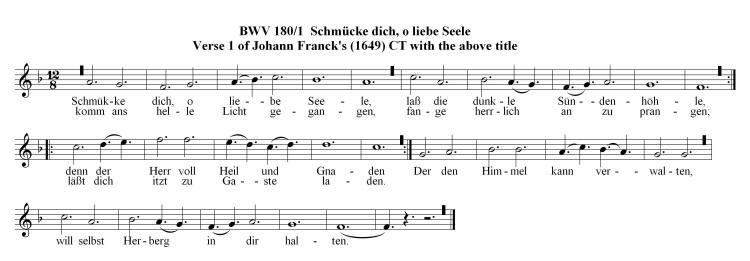
1 |
BWV 180 |
Mvt. 1 |
1724 |
- |
- |
- |
- |
A149:1 |
- |
Mvt. 1 (Leusink) [ram] |
|
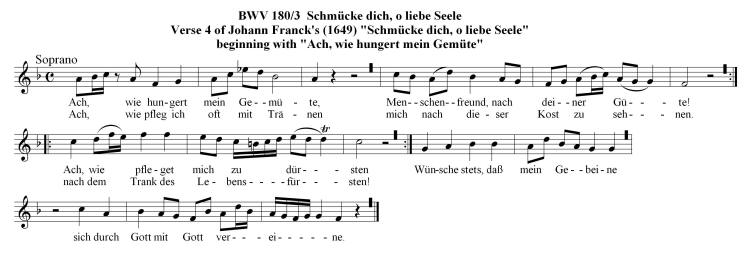
4 |
BWV 180 |
Mvt. 3 |
1724 |
- |
- |
- |
- |
A149:3 |
- |
Mvt. 3 (Leusink) [ram] |
|
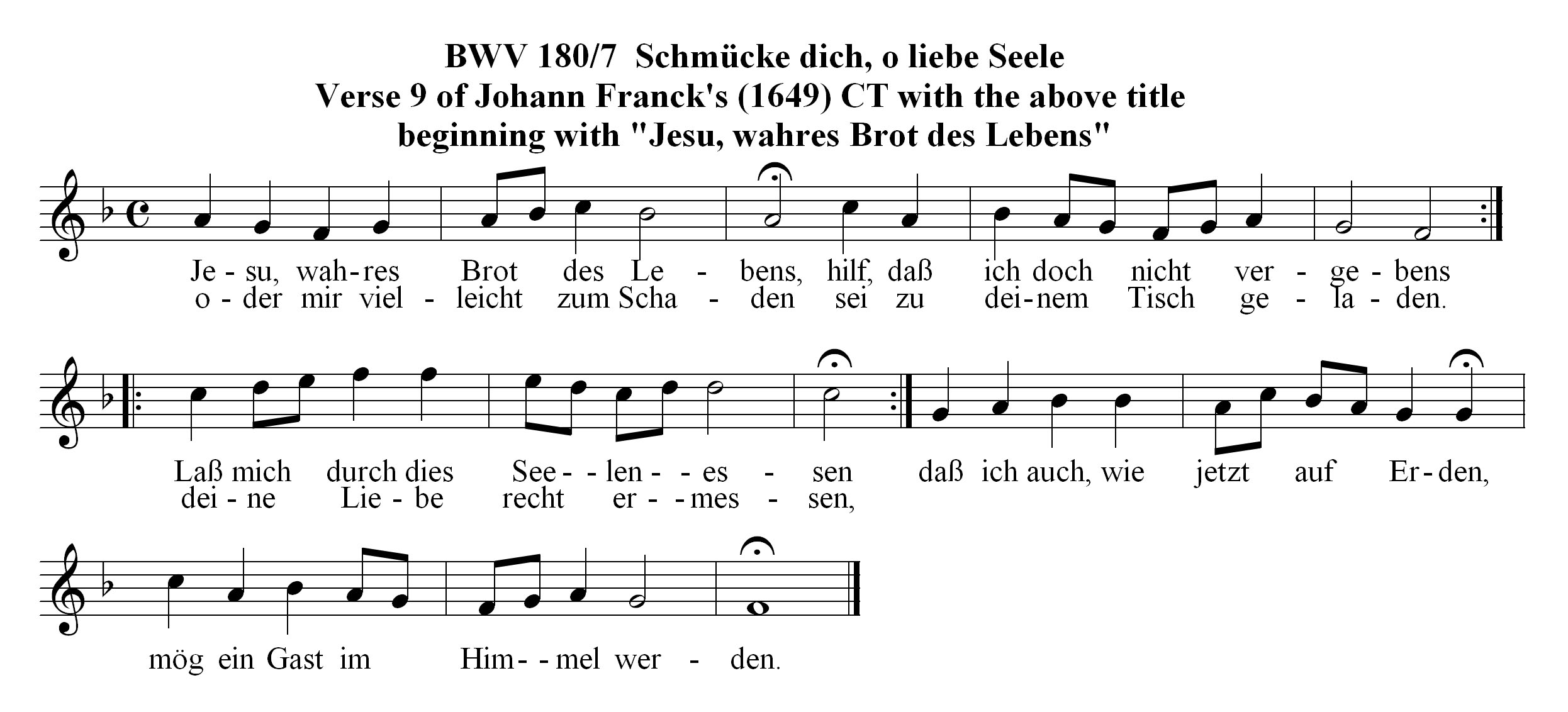
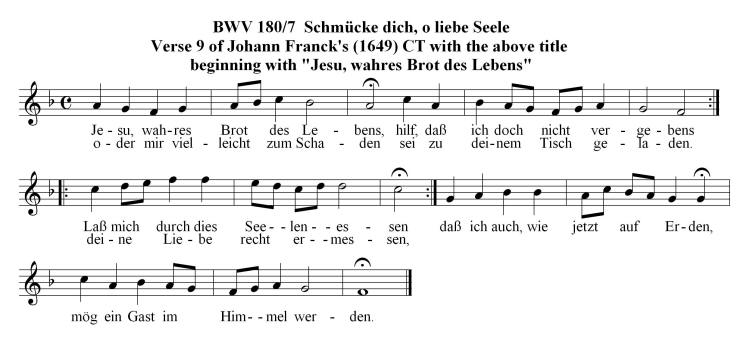
9 |
BWV 180 |
Mvt. 7 |
1724 |
22 |
204 |
22 |
25 |
F171:1
A149:7 |
PDF
PDFv |
Mvt. 7 (MG) [midi] | Mvt. 7 ver (MG) [midi] | Mvt. 7 (Leusink) [ram] |
|
BWV 180/6: Breitkopf 22 (in Eb) and Dietel 25 |
|
|
|
|
|
|
| |
|
Untexted: |
|
Ver |
Work |
Mvt. |
Year |
Br |
RE |
KE |
Di |
BC |
Score |
Music Examples |
|
- |
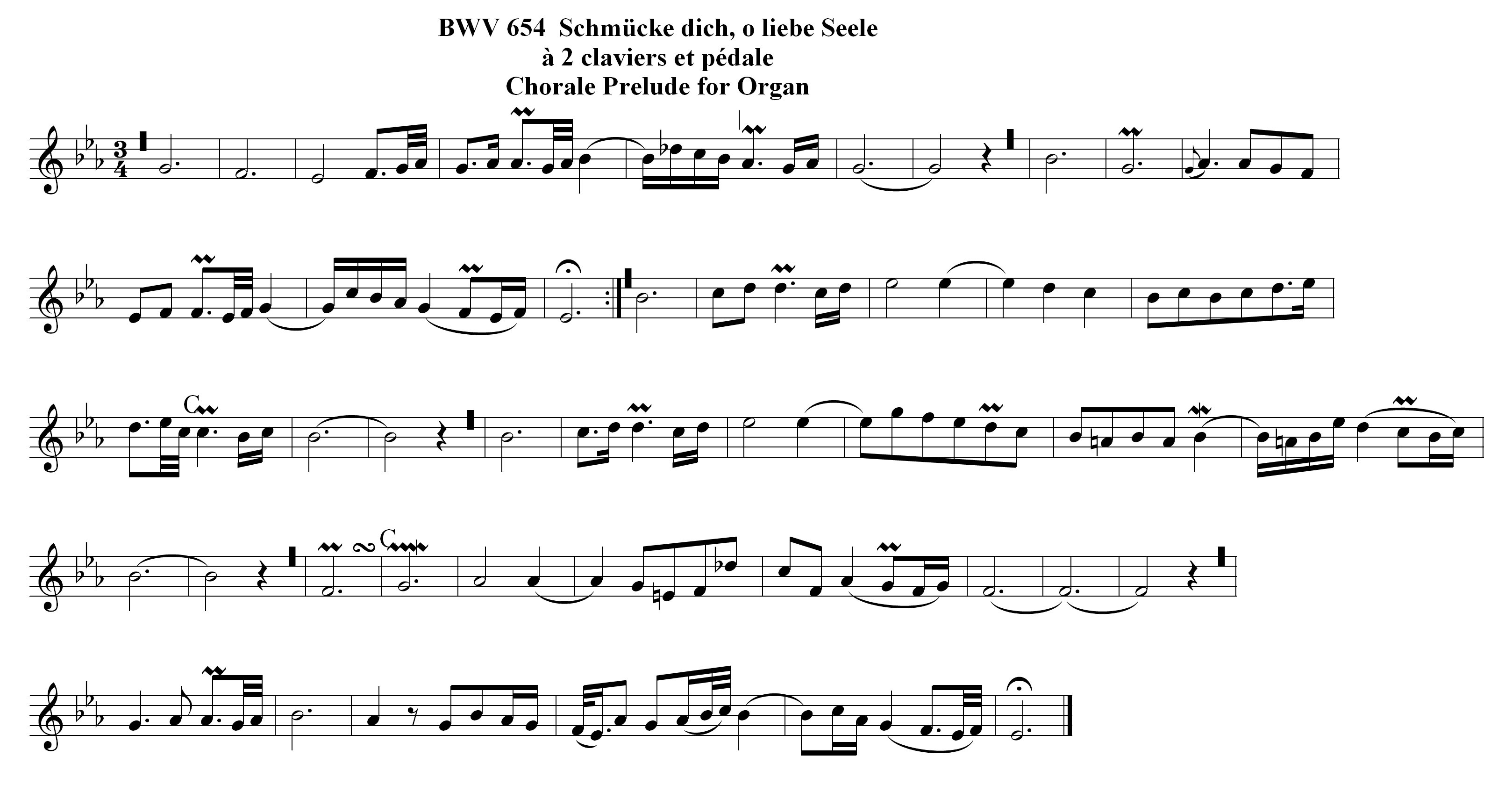
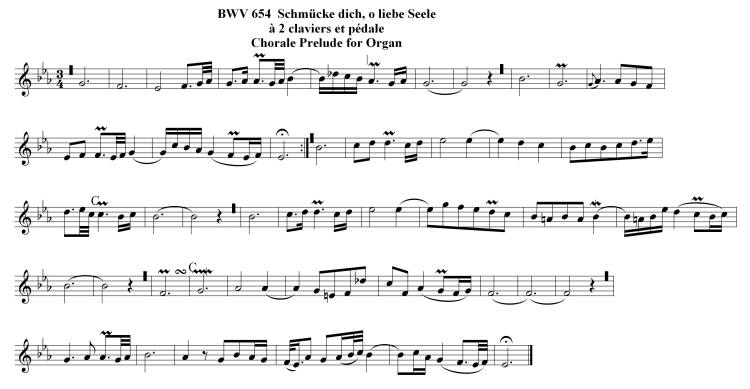
BWV 654 |
- |
Weimar |
- |
- |
- |
- |
K77 |
- |
Chorale Prelude (MG) [midi] |
|
BWV 654(a): Chorale Prelude for Organ (Achtzehn Choräle No. 4), Weimar (BWV 654a) with revisions (BWV 654) in Leipzig, 1739/1742; 1746/1747; 1750.
BWV 759: (composer Gottfried August Homilius, this is not included in the NBA) |
|
|
| |
|
Use of the Chorale Melody by other composers: |
|
Johann Jacob Bach (1655-1718):
Schmücke dich, o liebe Seele, for four voices and instruments (listed in Schweinfurt inventory of 1689) |
|
Georg Philipp Telemann (1681-1767):
Sacred Cantata: Schmücke dich, o liebe Seele (I) (libretto by Erdmann Neumeister), for 4 voices, strings, bc, 1:1253 (1721)
Sacred Cantata: Schmücke dich, o liebe Seele (I), for 4 voices, oboe, strings, bc, 1:1254
Schmucke dich, o liebe Seele, 2 Chorale Preludes for Organ in E flat major, TWV 31:9-10 (1735) |
|
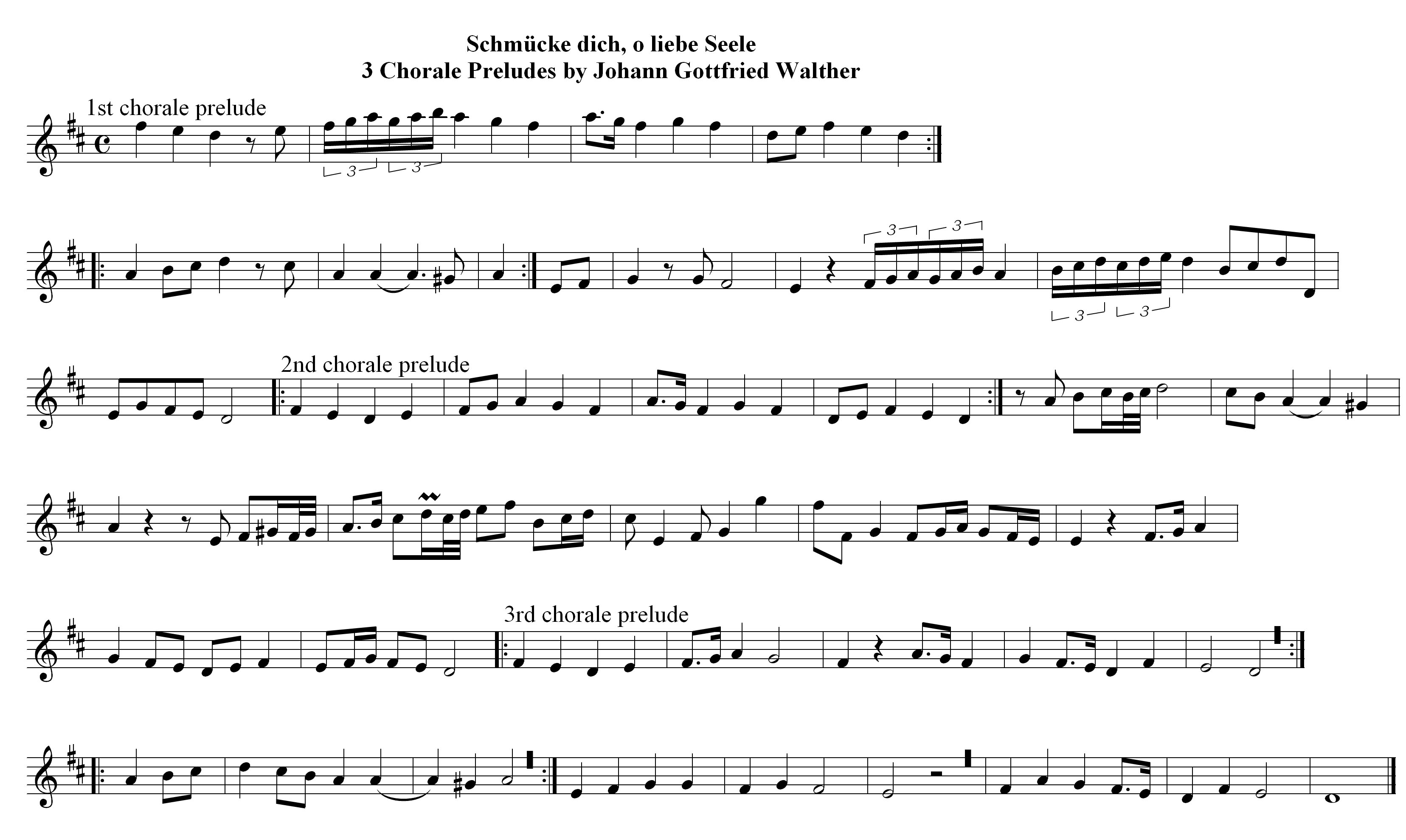
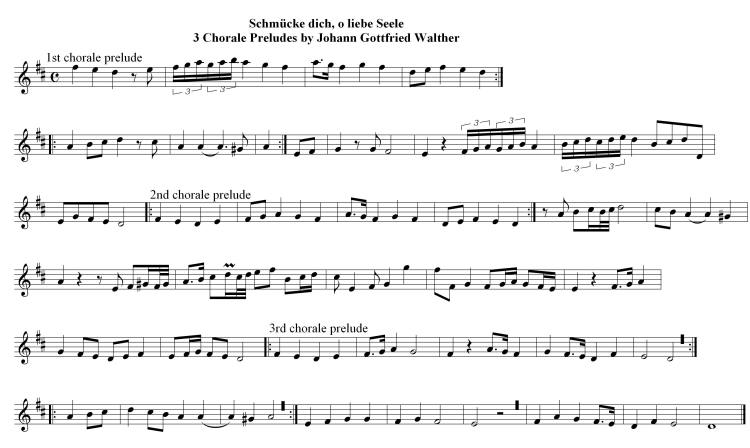
Johann Gottfried Walther (1684-1748):
Schmücke dich, o liebe Seele, Chorale Prelude (or Partita) for Organ, LV 52 |
|
|
|
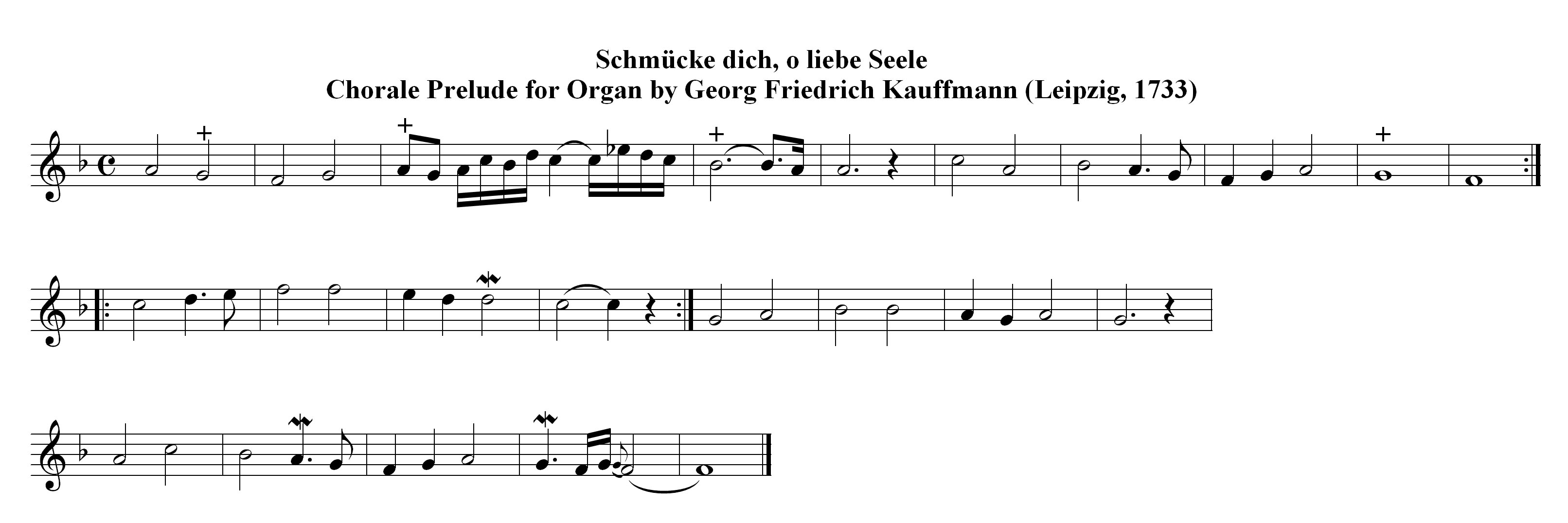
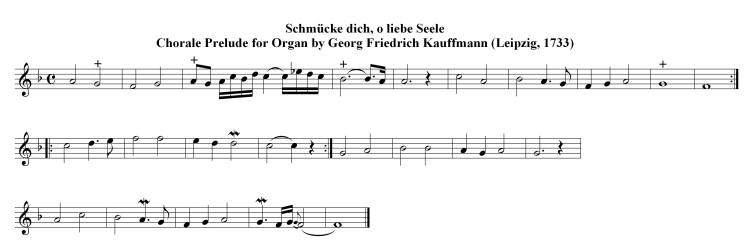
Georg Friedrich Kauffmann (1679-1735):
Schmücke dich, o liebe Seele, Chorale Prelude for Organ (1733) |
|
|
|
Johann Caspar Vogler (1696-1763):
Schmücke dich, o liebe Seele, Chorale Prelude for Organ |
|
Gottfried August Homilius (1714-1785):
Schmücke dich, o liebe Seele, Chorale Prelude for Organ (previously attributed to JS. Bach as BWV 769)
Schmücke dich, o liebe Seele, Chorale Prelude for Organ (previously attributed to JS. Bach as BWV Anh 74)
Schmücke Dich, O Liebe Seel, for organ & oboe |
|
Johannes Brahms (1833-1897):
Schmücke dich, o liebe Seele, Chorale Prelude for Organ Op. 122 No. 5 (1896) |
|
Ulrich Hildebrandt (1870-1940):
Schmücke dich, o liebe Seele, Choral for Organ |
|
Max Reger (1873-1916):
Schmücke dich, o liebe Seele, Chorale Prelude for Organ, Op. 67/36 (1902) |
|
Peter Hurford (b 1930):
Schmücke dich, o liebe Seele, Chorale Prelude for Organ |
|
Guy Bovet (b 1942):
Schmücke dich, o liebe Seele, for Partita sopra for organ, in Deuxième livre d’orgue (1958-1961)
Schmücke dich, o liebe Seele, for organ, in Quatrième livre d’orgue (1964-1970)
Schmücke dich, o liebe Seele, for organ, in Nouvelles pièces d’orgue (1993) |
| |
|
Arrangements/Transcriptions of Bach's use of the Chorale Melody: |
|
Arnold Schoenberg (1874-1951):
Orchestral arrangement of BWV 654 Schmücke dich, o liebe Seele (1922) |
| |
|
Sources: NBA, vols. III/2.1 & 2.2 in particular [Bärenreiter, 1954 to present] and the BWV ("Bach Werke Verzeichnis") [Breitkopf & Härtel, 1998]
The PDF files of the Chorales contributed by Margaret Greentree J.S. Bach Chorales
Software: Capella 2004 Software, version 5.1.
Prepared by Thomas Braatz & Aryeh Oron (May 2006) |