|
Chorale Melodies used in Bach's Vocal Works
Liebster Gott, wenn werd ich sterben
[1]
|
|
Melody & Text | Use of the CM by Bach | Use of the CM by other composers | Footnotes |
| |
|
Melody & Text: Zahn: 6634 | EKG: [is not in the hymnal] |
|
Text: |
|
This CT, consisting of a total of 5 verses is by Caspar Neumann. The earliest, documented appearance of it is around 1690. It does not appear in the comprehensive Vopelius hymnal of 1682. |
| |
|
Melody: |
|
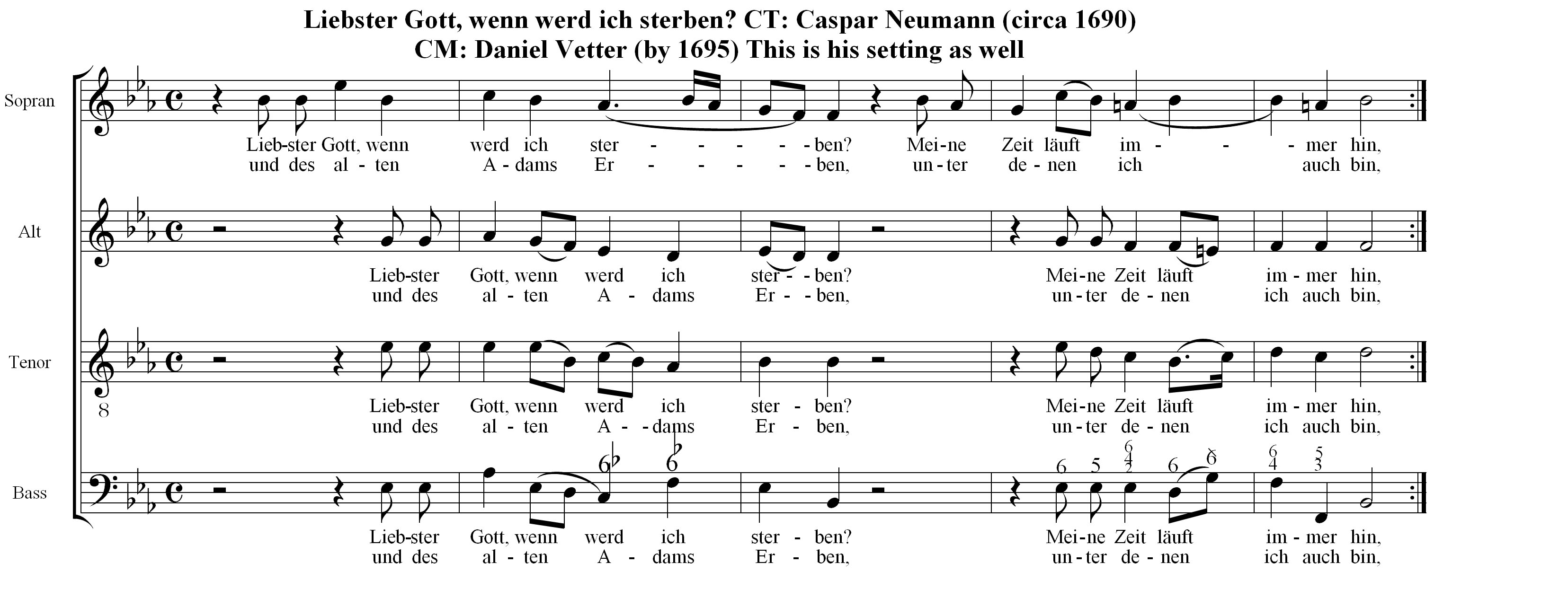
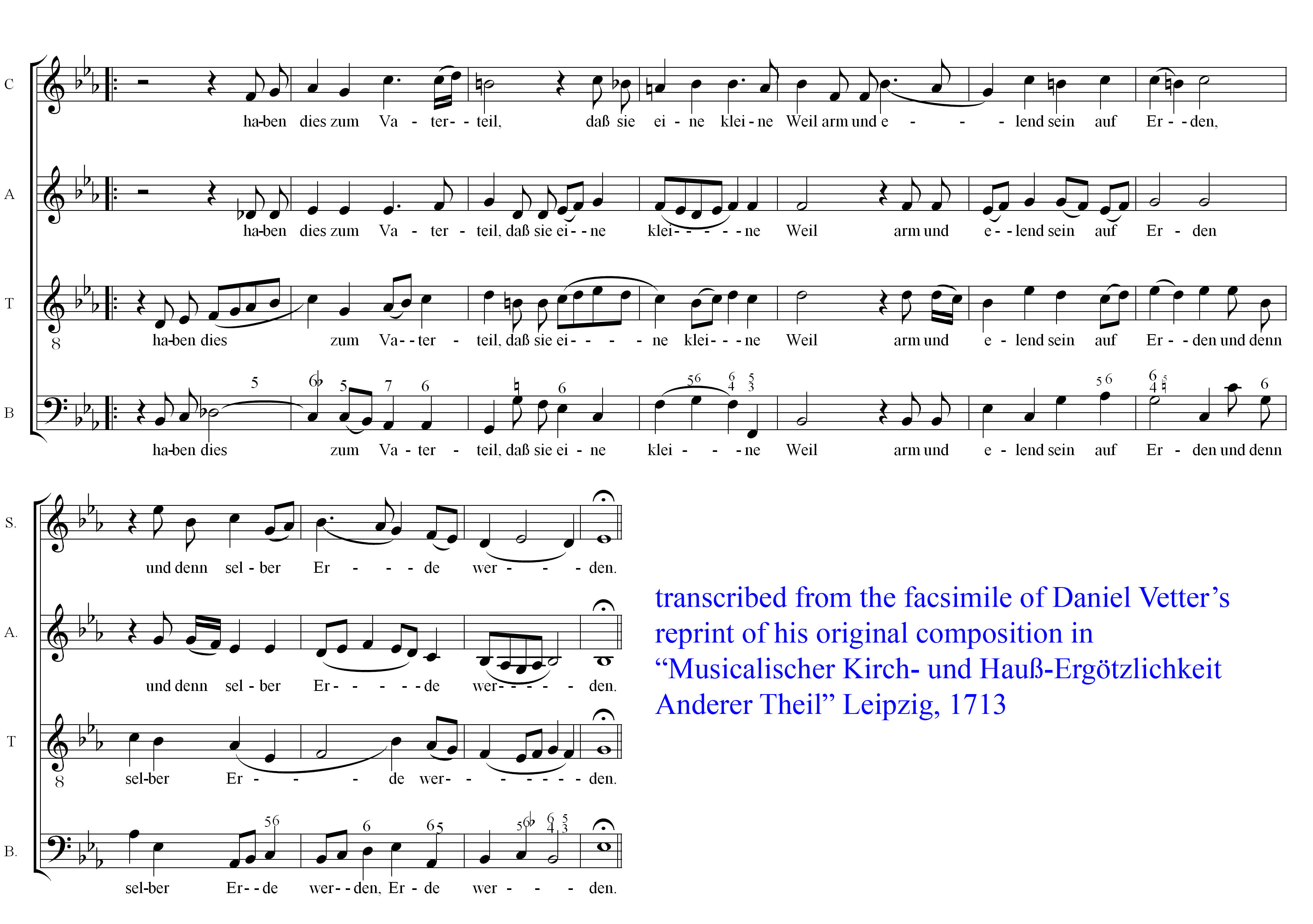
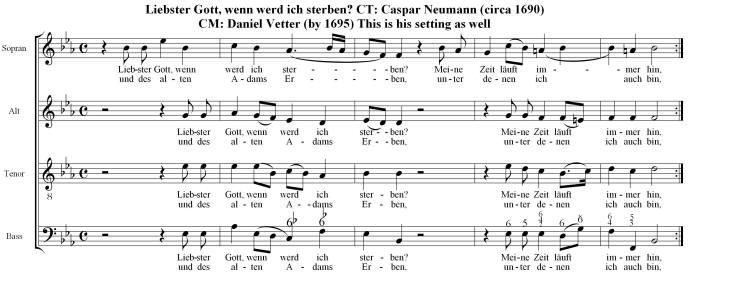
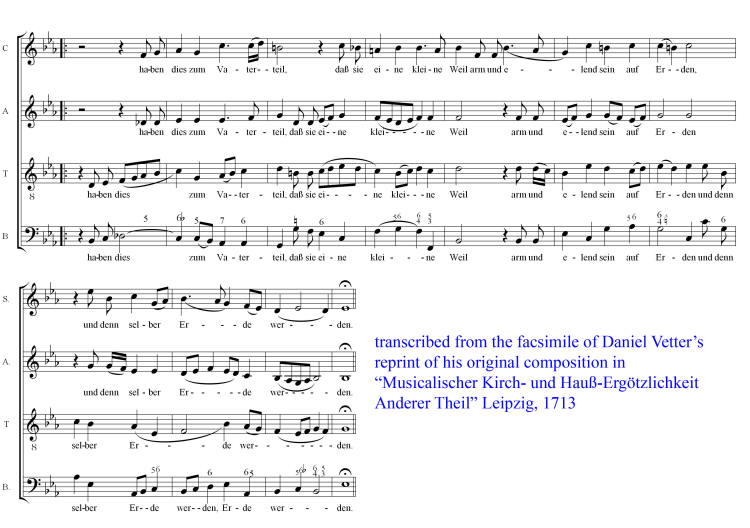
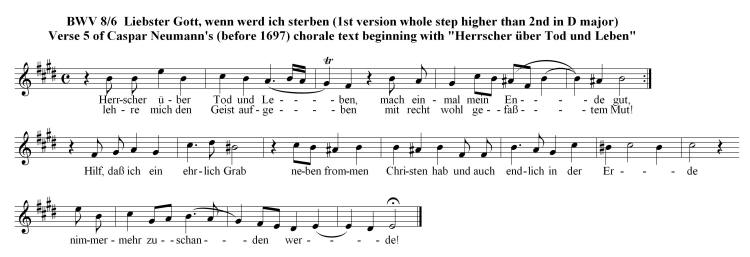
The composer of this melody is Daniel Vetter, the organist at St. Nicholas Church in Leipzig. It had been commissioned by a cantor in Breslau, Jakob Wilisius, as funeral music to be performed at the latter’s burial. It appeared in print no later than 1695. The composer published a hymnal Musicalischer Kirch- und Hauß-Ergötzlichkeit Anderer Theil….. (Leipzig, 1709), and a revised, expanded edition in 1713, in which he reprints his 4-pt. harmonization, about which he explains that it (particularly the melody) had been so distorted by others who included it in their hymnals, that he felt it had become unrecognizable and he found it necessary to set the record straight by offering it in “seine vorige Gestalt” (“in its original form”). It is this original form of the Vetter’s melody and his own setting which is given here: |
|
|
|
|
| |
|
Use of the Chorale Melody by Bach: |
|
Text: Liebster Gott, wenn werd ich sterben | EKG:
Author: Caspar Neumann (c1690) |
|
Ver |
Work |
Mvt. |
Year |
Br |
RE |
KE |
Di |
BC |
Score |
Music Examples |
|
1 |
BWV 8 |
Mvt. 1 |
1724 |
- |
- |
- |
- |
A137:1 |
- |
Mvt. 1 (CCARH) [midi] | Mvt. 1 (Leusink) [ram] |
|
5 |
BWV 8 |
Mvt. 6 |
1724 |
43 |
227 |
43 |
88
148 |
F131.1
A137:6 |
PDF |
Mvt. 6 (CCARH) [midi] | Mvt. 6 (MG) [midi] | Mvt. 6 (Leusink) [ram] |
| 1-5 |
BWV 483 |
- |
1736 |
- |
- |
- |
- |
F279 |
- |
Mvt. 2 | Mvt. 3 | Mvt. 4 | Mvt. 5 |
|
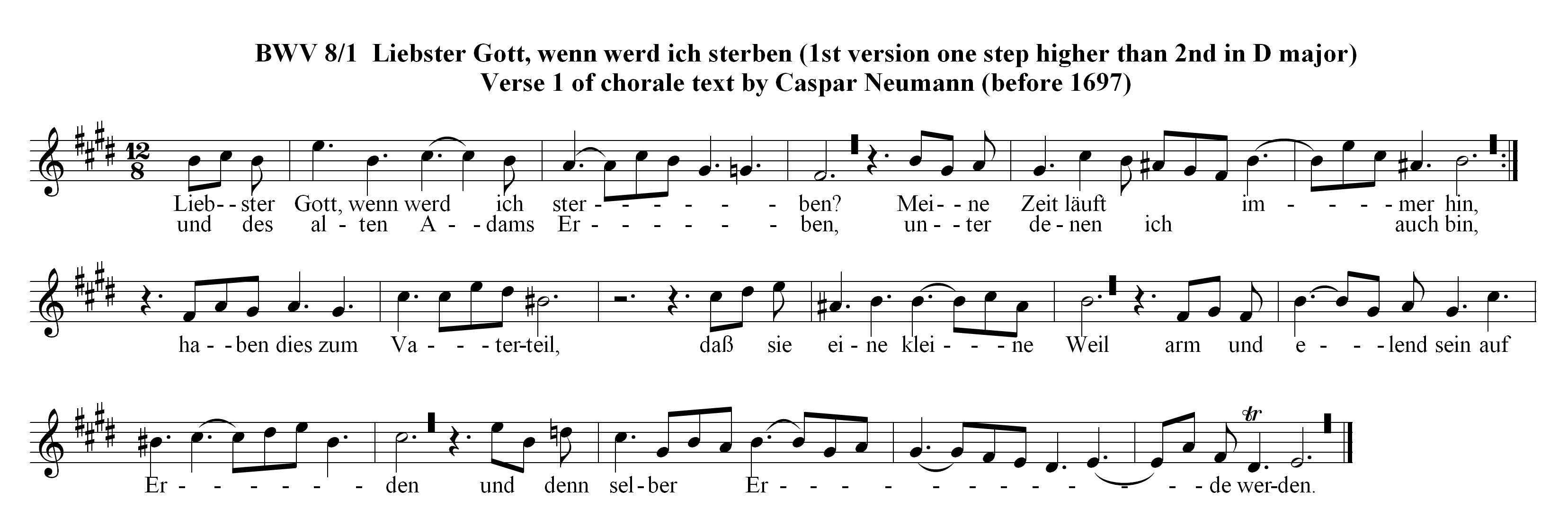
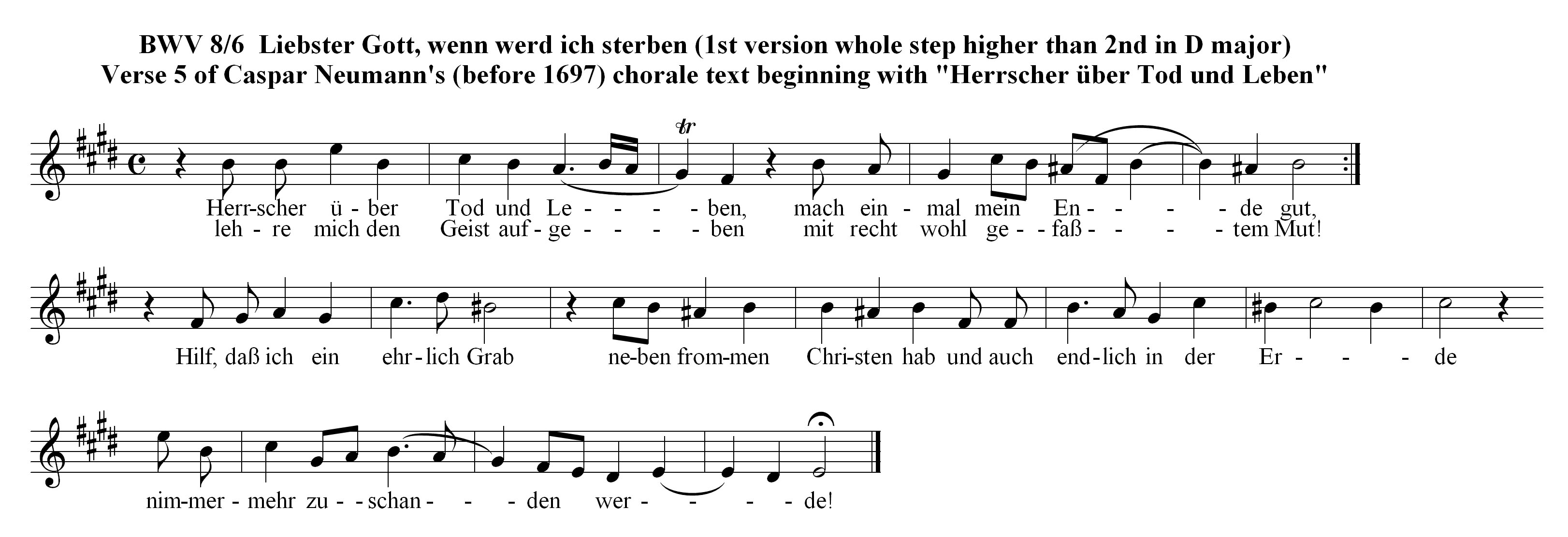
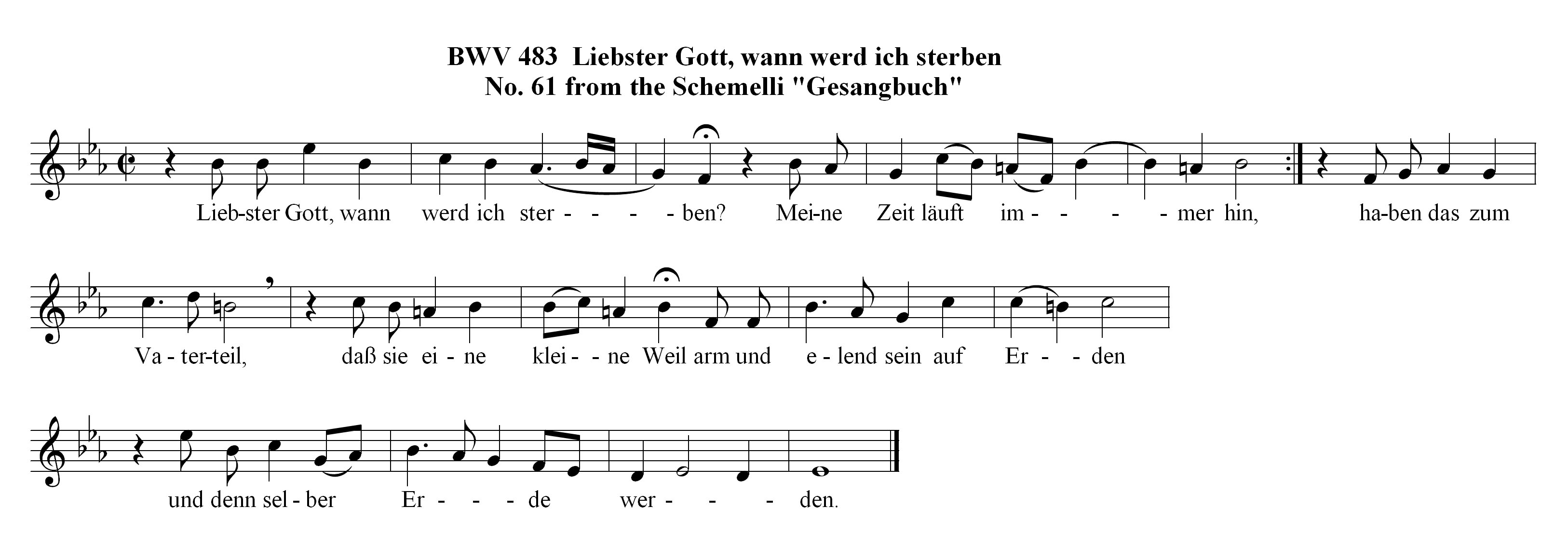
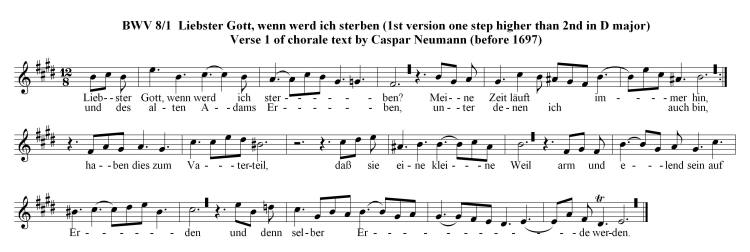
BWV 8/6: Melody and harmonization based upon Daniel Vetter’s Musicalische Kirch- und Haus-Ergötzlichkeit (Leipzig, 1713), no. 91. Dietel 88, 148 (variant) Breitkopf 43.
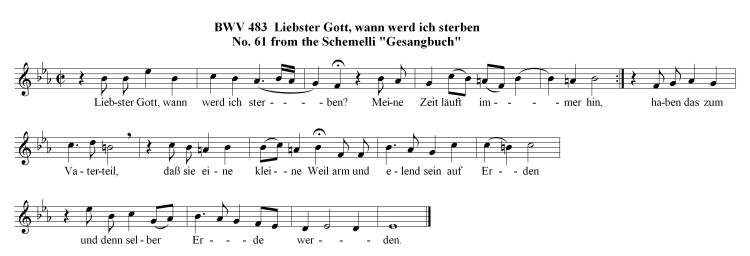
BWV 483: No. 61 of the Schemelli Gesangbuch (by 1736, the date of publication).
Note: the NBA gives a modernized text version with “wann” instead of “wenn”, but the NBA KB III/2.1 shows that in Schemelli’s original printed form a “wenn” and not a modern “wann” appeared. |
|
|
|
|
|
|
| |
|
Use of the Chorale Melody by other composers: |
|
Georg Philipp Telemann (1681-1767):
Cantata: O liebster Gott, wenn werd ich sterben (Neumeister), fragment, TWV 1:1204 |
| |
|
Footnotes: |
|
[1] „wenn“ is a dialect form (in Thuringia and a few other regions in Bach’s time) of standard German “wann” – it appears in the original CT and CM and in Bach’s treatment of this melody. |
| |
|
Sources: NBA, vols. III/2.1 & 2.2 in particular [Bärenreiter, 1954 to present] and the BWV ("Bach Werke Verzeichnis") [Breitkopf & Härtel, 1998]
The PDF files of the Chorales were contributed by Margaret Greentree J.S. Bach Chorales
Software: Capella 2004 Software, version 5.1.
Prepared by Thomas Braatz & Aryeh Oron (May 2006) |