|
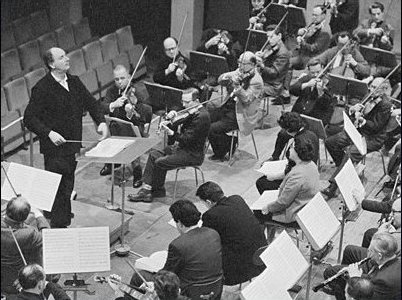
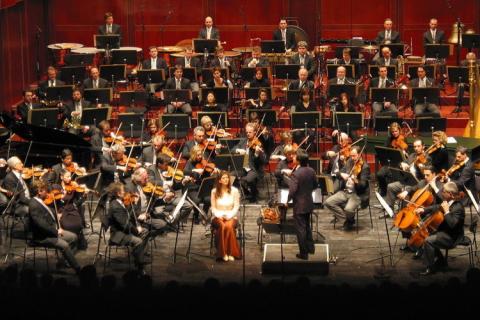
On July 1, 1949 Eugen Jochum was appointed selected as the Principal Conductor of the Bayerischer Rundfunk Symphonieorchester (Bavarian Radio Symphony Orchestra; = BRSO) (Bavarian Radio Symphony Orchestra). He structured it as a ‘orchestra of the soloists’, by engaging for example the Köckert quartet for the first string stands. With these top management he formed an elite orchestra, which acquired itself fast international fame in the area of the Classical and Romantic periods, the latter particularly with Bruckner’s symphonies. Two emphasis determines to these days the work of the BRSO: on the one hand the public symphonic concerts with the principal conductor and important guest conductors; on the other hand - new music.
The BRSO has a long tradition of performing new music. It started with the framework of Musica Viva, which was founded by the composer Karl Amadeus Hartmann in 1945. Many contemporary composers stood on the podium of the orchestra conducting their own works, including Igor Stravinsky, Darius Milhaud, Paul Hindemith, Pierre Boulez and, more recently, Karlheinz Stockhausen, Mauricio Kagel, Luciano Berio and Péter Eötvös. Even Richard Strauss conducted the newly created orchestra shortly before his death. The BRSO continues to participate in the Musica Viva concerts to this day. Starting from the 1998-1999 season Udo Carpenter is responsible as a new artistic director for the Musica Viva concerts.
For eleven years Eugen Jochum was Principal Conductor of the BRSO, then he left Munich and went to Amsterdam. Up to its death in the year 1987 he remained however connected for the orchestra as a guest conductor closely. Its successor became Rafael Kubelík, which held now 18 years to 1979 the chief position. Rafael Kubelík started up the first meal he cycle, which was brought in on disk. It extended the repertoire of the orchestra with works of Slavic composers - Smetana, Dvorák, Janácek - and put further special weight on works of the 20th Century: Thus he performed long-time neglected compositions, as Leos Janácek Aus einem Totenhaus, Arnold Schoenberg’s Gurrelieder, Hans Pfitzner’s Palestrina, Paul Hindemith’s Mathis der Maler, Arthur Honegger's Jeanne d'Arc au bûcher, Claude Debussy’s Pelléas et Mélisande and Carl Orff’s Prometheus.
Important conductors have been welcome guests at the desk of the BRSO: Igor Markevitch, Clemens Krauss, Ernest Ansermet, Charles Munch, Ferenc Fricsay, Dimitri Mitropoulos, Erich Kleiber, Hermann Scherchen, Otto Klemperer, Eugene Ormandy, Karl Böhm, Carl Schuricht, Erich Leinsdorf, Claudio Abbado, Seiji Ozawa, Bernard Haitink, Günter Wand, Zubin Mehta and again and again Leonard Bernstein. The latter conducted the orchestra regularly up to his death in 1990, and provided for lasting concert experiences in Munich. One of most remembered and exciting productions with him was Wagner's Tristan und Isolde (1981).
For health reasons Rafael Kubelík 1979 gave up his activity as a Principal Conductor, however he accompanied the symphony orchestra for further six years as a guest conductor. Kirill Kondrashin was designated as new boss and Rafael Kubelík’s successor. But before he could begin this office, he died unexpectedly 1981 in Amsterdam.
After several years of the look-up the BRSO found a new Principal Conductor in 1983: Sir Colin Davis. With L.v. Beethoven’s Missa Solemnis Colin Davis first performed in Munich, and this was also the work, with which he concluded in 1992 his service in this post. Certainly he continued to be a gladly-seen guest at the conductor desk of the orchestra. Apart from the Viennese classical period the British moved above all the works of Hector Berlioz and his French composer colleagues as well as the newer English modern composers (Edward Elgar, Michael Tippett, Ralph Vaughan Williams) into the foreground and compiled with the orchestra thereby a quite new repertoire.
From the beginning of the 1993-1994 season to 2003 Lorin Maazel was Principal Conductor of the BRSO, with which he made guest appearances several times in European countries, in addition, in Japan and China. In the 1996-1997 season he conducted, among other things, the premiere of Penderecki’s monumental work The Seven Gates of Jerusalem on the occasion of the 3000-Years Anniversary of the city of Jerusalem as well as concerts at the New York’s Carnegie Hall.
Among the outstanding Munich projects under the direction of Lorin Maazel - apart from the performance of Wagner’s Tristan und Isolde for the reopening of the Prince Regent Theatre in November 1996 - not least the L.v. Beethoven cycle at the Herkules-Saal (1995) and the open air concerts. The BRSO has co-operated in recent years with the conductors Kurt Sanderling, Sir George Solti, Carlo Maria Giulini, Riccardo Muti and Wolfgang Sawallisch, among others, as well as with renowned soloists, such as Gerhard Oppitz, Maxim Vengerov, James Galway and Mstislaw Rostropovitch. Its functions cover appearances in the transmission of the Bavarian broadcast apart from accommodations and concerts in Munich. The BRSO can also be regularly heard at Regensburger Spring, at the Summer Concerts between Danube and Altmühl, at the Kissinger Summer, and at the Richard Strauss Days.
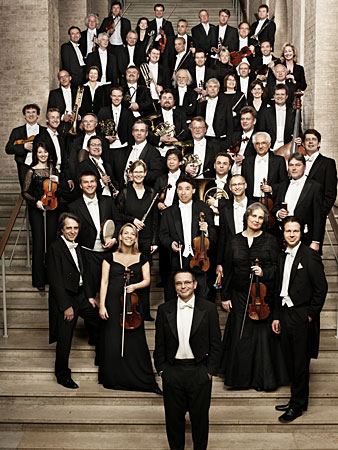
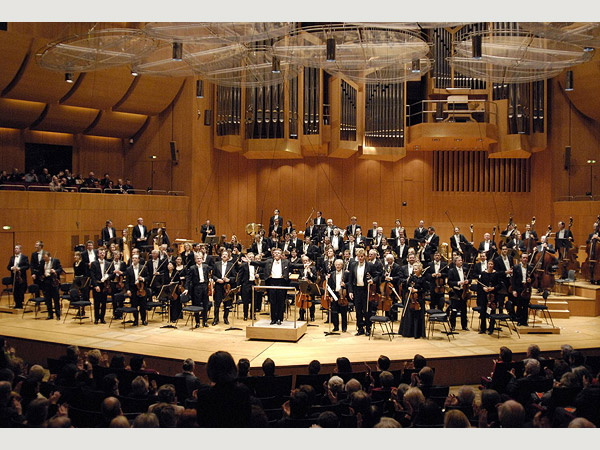
Since 2003, the BRSO's Chief Conductor is Mariss Jansons. His current contract with the orchestra is through August 2012. The orchestra received the 2006 Grammy Award for Best Orchestral Performance for its recording of Dmitri Shostakovich's 13th Symphony. It was named the 6th best orchestra in Europe in a survey for Le Monde de la Musique and 6th best orchestra in the world by The Gramophone magazine in 2008. |