|
|
Cantata BWV 174
Ich liebe den Höchsten von ganzem Gemüte
Provenance |
|
Thomas Braatz wrote (July 25, 2003):
BWV 174 - Provenance:
This report will only attempt to highlight some of the myriad details involved in the NBA KB’s analysis of the sources of this cantata. Many aspects of the provenance are unusual, but one fact that is usually open to speculation and difficult to prove (by using paper watermarks, noting the copyists involved, etc.) is here very authoritatively confirmed: the copyist of the original alto part wrote at the end: “Fine d. 5 Junii 1729. Lipsiae.” which means that the cantata was 1st performed on June 6, 1729. The text is based upon “Cantaten | Auf die Sonn- | und | Fest-Tage | durch | das gantze Jahre…Leipzig, 1728, by Christian Friedrich Henrici (Picander), who expressed a hope in the foreword that Bach would set these texts to music.
The fact that Bach left out the 1st 3 lines of the recitative has been understood (by Spitta and confirmed by the NBA editors) as just one indication among many that Bach was working very hurriedly under time pressure. Contrary to Bach’s usual method of composition, the autograph score for this cantata is not entirely autograph. Most of the string parts of mvt. 1 (based upon the 1st mvt. of BWV 1048 – the 3rd Brandenburg Concerto which is dated by Bach: March 24th, 1721) were entered into the score by Copyist 1. Essentially what happened here is that the copyist copied from an original version of the 1st mvt. of Brandenburg Concerto Nr. 3, after which Bach ‘composed in’ the horn parts (similar to ‘Vokaleinbau’ or ‘Choreinbau.’) In addition to J.S. & C.P.E. Bach, there were 6 other copyists involved in copying the original parts (not Anna Magdalena.) J.S. Bach would begin a part (ms. 1-86), such as the Violino 1 Ripieno part, after which C.P.E. Bach would copy ms. 87 to 136. Or, more typically, in another part, Copyist 2 would copy a string part from ms. 1 – 85 and Copyist 2 would finish it.
On the title page of the semi-autograph score, Bach wrote:
J. J. Feria 2. Pentecostes. Concerto à 4 Voci. 2 Corni da Caccia. 2 Hautb. | Taille. 3 Violini. 3 Violi. 3 Violoncelli e Co [ntinuo].
Other marks and titles as follows:
Sinfonia
Baßon e Violone con Cont.
DC. DCapo
Recit.
3 Violini e | 3 Viole in unisono | Tenor
Aria Violin e Viola, tutti al unisono
Choral
Fine | SDG [with a fancy paraph]
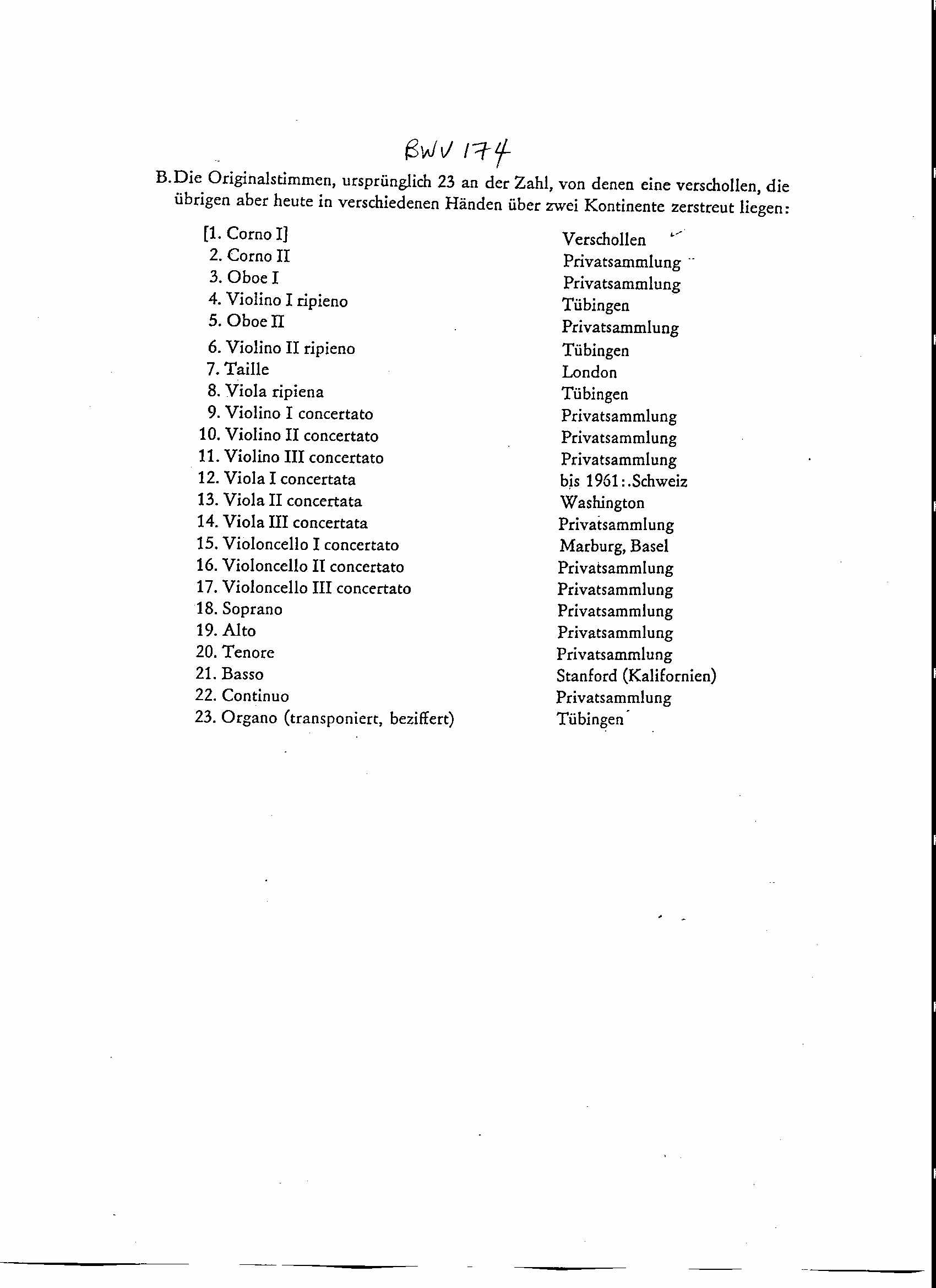
The Original Set of Parts:
These are strewn over 2 continents of which most of them are under private ownership (USA) as follows:
1. Corno I (lost)
2. Corno II Private
3. Oboe I Private
4. Violino I ripieno Tübingen
5. Oboe II Private
6. Violino II ripieno Tübingen
7. Taille London
8. Viola ripiena Tübingen
9. Violino I concertato Private
10. Violino II concertato Private
11. Violino III concertato Private
12. Viola I concertata until 1961: Switzerland (where is it now?)
13. Viola II concertata Washington
14. Viola III concertata Private
15. Violoncello I concertato Marburg, Basel
16. Violoncello II concertato Private
17. Violoncello III concertato Private
18. Soprano Private
19. Alto Private
20. Tenore Private
21. Basso Stanford, California
22. Continuo Private
23. Organo (transposed, figured) Tübingen
This cantata probably originally belonged W.F. Bach after which the dispersal of the score and parts can not be completely traced. The score appears in possession of the Berliner Singakademie at the beginning of the 19th century. In 1854 it was acquired by the BB.
Of the original set of parts, 13 parts are part of private collection in the USA. |
|
Thomas Braatz wrote (July 7, 2008):
BWV 174 Provenance Addendum
The following is the original statement from p. 99 of NBA KB I/14 written by Alfred Dürr and Arthur Mendel:
“Ferner braucht bei der großen Eile, mit der das ganze Aufführungsmaterial hergestellt wurde,* Satz 1 auch in keiner einzigen Stimme ganz aus A oder ganz aus Y geschrieben worden zu sein.
*Wie spät das Material fertig geworden ist, zeigt der Vermerk des Schreibers 1 am Ende der Altstimme (B 19): Fine d. 5 Junii 1729, Lipsiae; die Aufführung fand am 6. Juni statt. Auch die Aufteilung der Schreibarbeiten – und zwar die Partitur auf Bach und Schreiber 1 sowie der einzelnen Stimmen auf Schreiber 2 und die übrigen Schreiber – ist höchstwahrscheinlich durch die Zeitnot verursacht.”
[“In addition due to the great haste under which all the performing materials were prepared, it is not necessary to think that any one of the parts for mvt. 1 had been copied completely from source A or completely from source Y. Footnote* Just how late {how shortly before the actual performance] the performing materials were completed is evident from the note by a copyist at the end of the alto voice part: Finished on June 5, 1729, Leipzig {the first day of Pentecost on which festive performances of other cantatas took place in two main churches} ; the performance took place on June 6th {1729 at the morning services}. Also, the division of the copy work with Bach sharing the chore of score creation with Copyist 1 and dividing the copying out of the individual parts between Copyist 2 and the other copyists means, in all probability, that this was caused by being under the pressure of time.”] |
|
Teri Noel Towe wrote (July 8, 2008):
Provenance of BWV 174 performing parts
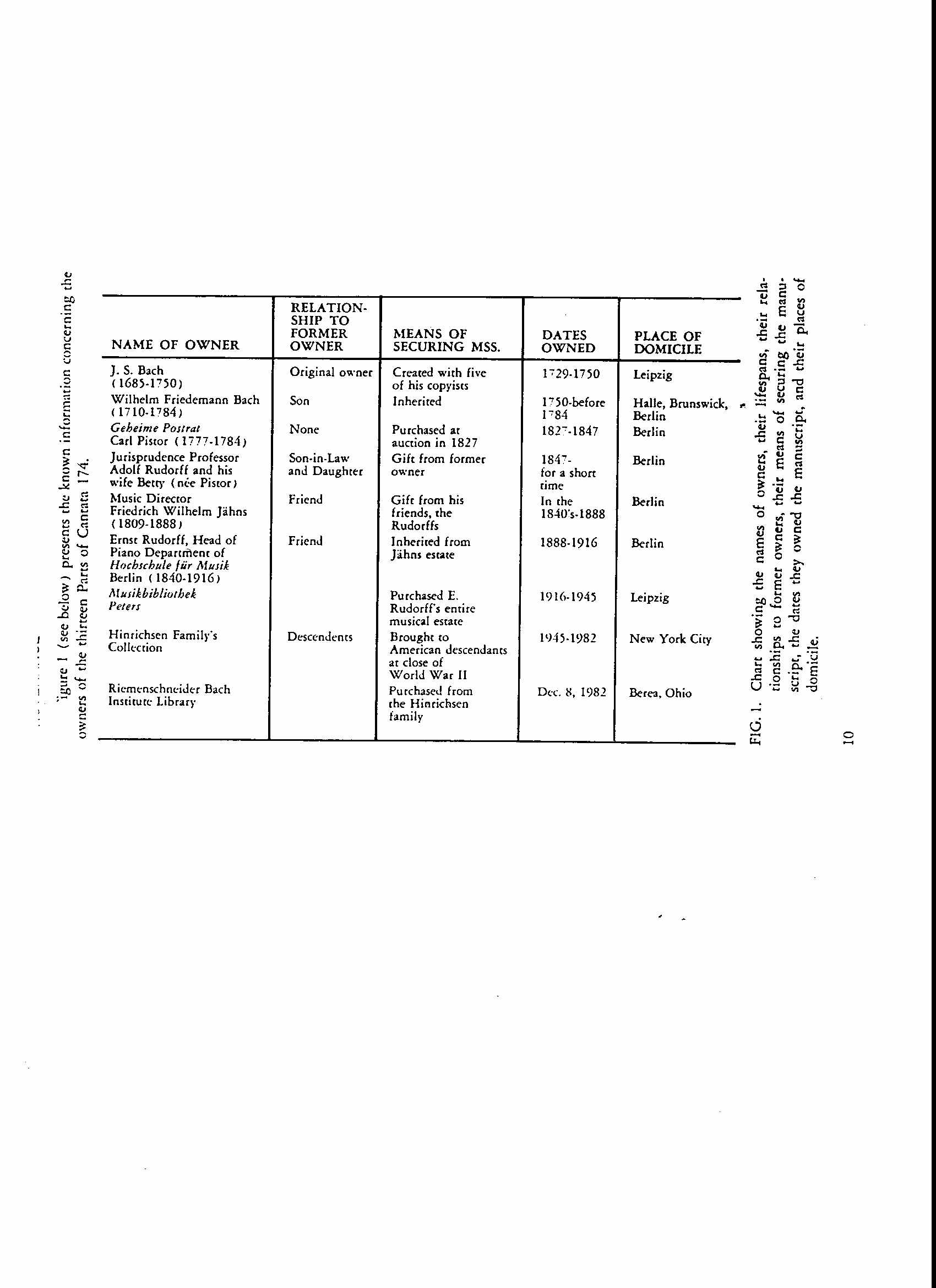
[To Aryeh Oron] My recollection is that the 13 parts that were long privately owned were acquired by the Riemenschneider Bach Institute at Baldwin-Wallace College in Berea, Ohio, around 25 years ago. |
|
Mel Unger [Director - Riemenschneider Bach Institute] wrote (July 11, 2008):
[To Aryeh Oron] Here are two documents that indicate which 13 parts we have (marked "Privatsammlung") and the provenance. |
|

|
|

|
| |
|
|