|
|
Sonatas & Partitas for Violin BWV 1001-1006
Paul Galbraith (8-String Guitar)
Review: Sonatas and Partitas for Guitar, by Paul Galbraith |
|
T-1 |
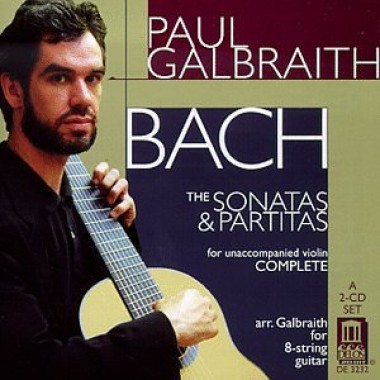
Bach: The Sonatas and Partitas for unaccompanied violin - Complete, Arranged for 8-string guitar |
 |
|
Sonata for solo violin No. 1 in G minor, BWV 1001, transposed to A minor [15:32]
Partita for solo violin No. 1 in B minor, BWV 1002 [21:34]
Sonata for solo violin No. 2 in A minor, BWV 1003, transposed to B minor [18:28]
Partita for solo violin No. 2 in D minor, BWV 1004, transposed to E minor [30:22]
Sonata for solo violin No. 3 in C major, BWV 1005, transposed to D major [19:12]
Partita for solo violin No. 3 in E major, BWV 1006 [12:31]
All arranged for 8-string guitar by Paul Galbraith |
|
Paul Galbraith (8-string Guitar) |
|
Delos 3232 |
Sep 1997; Jan 1998 |
2-CD / TT: 117:52 |
|
Recorded at First Congregational Church, Los Angeles, California, USA.
Buy this album at:
2-CD: Amazon.com | Amazon.co.uk | Amazon.de
Music Download: Amazon.com | Amazon.com | Amazon.co.uk | Amazon.co.uk | Amazon.de | Amazon.de | ClassicsOnline |
|
Kirk McElhearn wrote (November 8, 2001):
I am listening for the first time to Paul Galbraith's recording, on 8-string guitar, of the Sonatas and Partitas for solo violin. What a brilliant recording this is! He plays magnificently, and his choice of tempi (19 minutes for the chaconne) are ideal for these works to really here the melodic lines.
Is anyone familiar with this set? |
| |
|
Review: Sonatas and Partitas for Guitar, by Paul Galbraith |
|
Kirk McElhearn wrote (November 9, 2001):
Guitarist Paul Galbraith designed an 8-string guitar, that he had built specially for him, which uses the usual 6 guitar strings but is augmented by an additional high string and low string. This allows him to play the instrument in a much wider range than usual; rather than playing the highest notes further up the neck, where tone is less clear, he has an additional string for them. The extra low string allows him to have a much deeper range of bass notes.
In addition, he plays this guitar in a very unique way - it is supported by a metal endpin, like a cello, and stands on a wooden resonance box. He holds it in the same way as a cellist holds his instrument, and plays it almost vertically. Suffice it to say that this instrument looks surprising at first, but it takes but a few notes to appreciate its unique sound.
Unique is a work that describes this entire recording. Paul Galbraith has arranged Bach¹s sonatas and partitas for solo violin to be played on the guitar, as have many other players of plucked instruments (guitar, lute, theorbo). Yet the range of his instrument allows him to go much further than other arrangements (he has also change the keys of four of the suites to best exploit the range of his guitar). The low notes, such as in the beautiful A minor fugue or in the massive E minor chaconne, resonate richly, and the higher notes ring clear and sharp.
Galbraith claims that these works “were conceived as a single piece, like a Osuite of suites”. His “personal impression is that the ‘6 solo’ is an instrumental gospel story in triptych form, telling of the Birth, Passion and Resurrection of Christ.” Whether or not this is the case, this is by far the most inspired recording of these works I have ever heard, on any instrument. His playing flows so smoothly in the slower movements, with the subtlest phrasing and dynamics, and his tempi - often surprising - shed new light on these works.
Many of the movements are played far slower than other performances; the E minor chaconne, at nearly 20 minutes long, is nearly twice as long as many other renditions. Gone is the hurried sound of musicians just barely able to keep up with Bach¹s hectic score. Instead, we hear the subtle harmonies and counterpoints that lay hidden in this extraordinary work. Galbraith gives this, the grandest movement in all of Bach¹s solo works, the approach it needs to become otherworldly, to transcend mere music. From a virtuoso display of pyrotechnics it becomes a spiritual meditation; from a mad rush, it becomes a study in restraint and depth. He adds incredible emotion to this piece, playing each section at a tempo that allows the ear to appreciate the complexity of Bach¹s music and its profound spiritual intensity.
This is the finest recording of these works for any plucked instrument, and perhaps for any instrument at all. Galbraith¹s unique style, coupled with the magnificent sound of his guitar, make this one of the most essential Bach recordings I have ever heard. Buy this disc for a totally new approach to some of Bach’s finest music. |
| |
|
Feedback to the Review |
|
Harry J. Steinman wrote (November 8, 2001):
[To Kirk McElhearn] Oh boy, Kirk, you're talking about one of my favorites! I have about 15 or so recordings of the S&Ps or of the chaconne...the chaconne is my All Time Number One favorite Bach piece.
I absolutely love what Galbraith does with the S&Ps. I'm a fan of Galbraith...and I was fortunate enough to see him in concert here in Boston at a series held at the Museum of Fine Arts (great venue for music!). His S&Ps are superlative. The recording is most intimate and warm (which does provide a bit of a distraction in that his breathing comes through a bit too clearly).
Galbraith also recorded the Orchestral Suites (with his guitar quartet) and some Haydn sonatas. His lute suites are also very very well done and I recommend anything by Galbraith. |
|
Bradley Lehman wrote (November 16, 2001):
[To Kirk McElhearn] Kirk, have you heard the set of sonatas and partitas played by Hopkinson Smith on lute? (Astree Naive 8678, 2CD, 2000). I've been listening to that again, and checked some of the Galbraith samples on the web. In my opinion Galbraith doesn't hold the proverbial candle to Smith.
I like your words below:
"From a virtuoso display of pyrotechnics it becomes a spiritual meditation; from a mad rush, it becomes a study in restraint and depth. He adds incredible emotion to this piece, playing each section at a tempo that allows the ear to appreciate the complexity of Bach¹s mand its profound spiritual intensity. This is the finest recording of these works for any plucked instrument, and perhaps for any instrument at all."
But I'd apply them to Smith.
Smith's own earlier Bach sets are excellent: "lute works" with BWV 995, 996, 998, 997, 1006a, 999, 1000, and his disc of the cello suites (his own transcriptions) 1010 and 1012. I've also heard his disc where he transcribed the solo flute partita. All those are terrific. But in the violin sonatas/partitas Smith outdoes even himself. |
|
Kirk McElhearn wrote (November 16, 2001):
Bradley Lehman wrote:
< But I'd apply them to Smith. >
Interesting... Let me repost my review of the Smith set.
See: Sonatas & Partitas for Violin performed on Lute by Hopkinson Smith |
|
Harry J. Steinman wrote (March 11, 2002):
[To Kirk McElhearn] Excellent review. I, too, am a big fan of Galbraith's interpretation and performance. (I had the great pleasure of seeing Galbraith perform last year at the Boston Museum of Fine Arts.a delight) One of the things that PG does that pulls the listener into his recording is that he sometimes moves from one movement directly into the next, for example, from the Giga to the Ciaconna in the 2nd Partita. By fusing the two movements, the listener is drawn more surely into the work as a whole. There is no pause between, and it is very effective.
BTW, one might compare Galbraith's recording with that of Rafaela Smits, who also plays an 8-string guitar.and who elicits no additional benefit from the extra two strings. Her Bach, to my ears, is mechanical; her instrument unexceptional.
Kirk favors Galbraith's recording of the S&Ps for any plucked instrument. One other to consider, albeit not a complete set of the S&Ps, is the recordings of Nicola Hall, a British student of Segovia. Check out, in particular, her "Virtuoso Transcriptions" (Decca 430 839) which includes the 2nd Partita. I hear one or two missed notes, but otherwise a flawless and fiery recording. |
| |
|
S&P for Guitar, especially the Chaconne, by many others |
|
Harry J. Steinman wrote (November 24, 2001):
[To Kirk McElhearn] On last week's subject of transcriptions-guitar transcriptions-of the S&Ps, well, that strikes a chord with me. I've mentioned that the S&Ps are my favorite of the JSB works, at least of the Instrumental Works. I love them on violin and I also love them on guitar. Here's some other versions with some thoughts of mine. I've chosen to include recordings that feature one or another of the S&Ps, not the complete six, or recordings of the Chaconne from the D Minor Partita. The Chaconne is, for me, the crown jewel of the S&Ps, and therefore the apogee of all of the JSB instrumental works. It is one of the classic virtuoso works for guitarists-interesting, given its origin in the body of violin works.
Actually, having written and re-read, it looks like what I've written about is mostly about the Chaconne...and about one recording in particular. Maybe I'm a bit off-thread here...see what Bach does to me???
1. Julian Bream "Bach" (EMI Classics D 106073)
His recording of the Chaconne is brilliant. Bream's attack on the guitar's strings is sharp, almost biting (the product of his alternate career as a lutenist???) Bream takes a careful, articulate, pace (15:47). What I like best about Bream's Bach is that he is passionate, not clinical. He reminds me a bit of Casals-not romantic but playing with a great deal of emotion. Bream also highlights contrapuntal and polyphonic passages by alternating the placement of his right hand, his plucking hand, closer to the bridge for a sharper tone, or further up, closer to the fretboard for a softer tone.
2. Nicola Hall, "Virtuoso Guitar Transcriptions" (Decca, 480-8390-2) and "The Art of Guitar" (Decca 440-678-2)
Nicola Hall belongs to what I call the 'English Guitar School' that includes Bream and Galbraith, and what I find common to these artists is a greater sense of passion coupled with flawless technique. I believe that Hall showcases her technical abilities more in these recordings but does not do so at the expense of affect. "Virtuoso Guitar Transcriptions" includes the 2nd Partita, and "Art of Guitar" includes the 2nd Sonata. I love her playing. She takes a brisk, but not frantict empo (the Chaconne, for example, is 13:48). Some of the passages in the Giga are almost demonic in intensity and clarit and I love every note. She plays the 2nd Sonata at a blistering pace and loses none of the separation of Bach's voices. If you are a fan of Bach on guitar, do not overlook Nicola Hall. Her interpretation is A+; her technical abilities are a A (I think she drops a note or two in the Giga of the 2nd Partita, otherwise it would be an A+).
3. Eduardo Fernández, "Bach: Lute Suites" (London, D-205582)
Although the recording is nominally devoted to the 4 lute suites, Fernandez includes the 1st Partita and the Chachonne. For me, Fernandez is uninspired, his Chaconne a hurried 11:50. I found his playing to be flat, without affect.
4. Andrés Segovia, "The Segovia Collection (Vol 1): Bach" MCAD-42068)
Segovia started it all. His transcriptions of Bach are the first for the guitar, as far as I can tell. This recording includes 'Three Pieces From Violin Partita No. 1' (the Sarabande, Bouree and Double) and the Chaconne from the 2nd Partita. Interestingly, the Chaconne is pieced together from recordings in Madrid and New York, in 1952, 1954, 1967 and 1968. Segovia is a perfect starting point. His Bach is clearly enunciated, each note perfectly placed. After all, this is Segovia. It is not among my favorites, musically, but I revere his recordings for the paramount place they play in the world of Bach-on-guitar
.
5. Raphaella Smits, "Bach/Weiss" (Accent 2 93100 D)
In a word: Boring! Smits, like Galbraith, uses an 8-string guitar, but adds nothing to the music with the instrument. For my money, she might as well be playing a traditional 6-string: I hear no change in tone and timbre in her instrument. There is nothing that the extra strings add to the interpretation. Smits' Chaconne is hurried (12:10) as if she can't wait to finish. I believe that she is much more comfortable with the lute works of Silvius Weiss than anything by Bach. The sloppy approach to Bach manifests in the CD's artwork: Her selections from BWV 1002 in B Minor are attributed to "Partita II" rather than Partita I.
6. Angel Romero, "Angel Romero Plays Bach" (Telarc 80288)
A surprise! A delight! I would have expected this member of the famous Romero family of guitarists to be more at home with the traditional and Spanish works-Sor, Albeniz, Granada, etc. But his Bach is wonderful. A bit more restrained than Bream in terms of emotional expression, but clear and crisp. His Chaconne is a brisk 13:25, and incisive. Listen in particular to the passage of arpeggios about one-third the way through the piece.
7. Eroica Trio, "Baroque" (EMI Classics, 56873 12 6)
This one of my favorite transcriptions, accomplished by Academy Award winning composer Ann Dudley, for piano, violin and cello. I am quoting from a review I supplied to this List almost 2 years ago, and I have decided to quote in full, because I believe that this recording is so unique and original, and may not be on the top of anyone's list since it is just one of 14 or 15 tracks on this CD.
Violinist Adela Pena takes the opening chords with cellist Sara ant'Ambrogio joining for a repeat of the simple theme and then pianist Erika Nickrenz enters, quietly, at first. The three weave Bach's theme gently, at first, and with an increasing urgency and dynamics. As the three voices build, none is lost or overshadowed by any of the others. It would be easy for the piano to dominate or for the cello to become lost or relegated to a continuo role. Not so. By about 3 minutes into the work, the three instruments are trading cadenza-like passages and alternating between a fiery intensity and quiet passion.
The artists-and I include Ann Dudley here-use a variety of tone colorings to highlight the theme within all of its variations. Imagine what could be done with a violin, piano and cello! It sounds to me like an emotional counterpoint: Hope alternates with despair, sorrow with joy. At the 6'50" mark in this 14'48" recording, the three have reached a crescendo. They pause and the theme is taken up ever so gently by the piano. The next two minutes so rebuilds the theme with increasing urgency and tension.
One of the consequences of transposing this great work to three instruments is that the melodic line is freed from some of the echnical constraints of the original as the violinist no longer must manage a series of awkward double-stops to accommodate second voices, chords and arpeggios. But those of you who are especially partial to the violin, fear not! You will hear the same virtuoso passages at about the 6-minute mark, after a series of arpeggios taken largely by the piano but taken in part by the violin. At the 13-minute mark; only now, you will hear a brilliant series of cadenzas accompanied first by the sustained chords from the piano and then only the cello.
The final statement of the theme is taken up initially by the piano in a series of chords and then the piano is joined by the violin and cello. As I listen to this work, I am speechless. How could Bach combine beauty and pathos, hope and despair, joy and sorrow so seamlessly! What a gift he has given, that someone with no musical talent can carry this tune in his head and be transported to a place far more beautiful than any I have ever know upon hearing his notes. Each time I hear this work, I'm tugged from my moorings just a bit more.
Even now, as I hear the cello taking the melody (about 10'50" into the piece) I hear a new introspection in the music. I have been listening to this composition for roughly 28 years and I am still moved beyond my own understanding. |
|
Saygilarimla Can Denizci wrote (November 25, 2001):
[To Harry J. Steinman] I think Manuel Barrueco's brilliant approach and David Russell's inredible corpus collosum way of playing is admirable for Chaconne and sonatas&partitas.Sigiswald Kuijken's stylistically new approach is more convincing than others in terms of violin... |
|
Kirk McElhearn wrote (November 25, 2001):
[To Saygilarimla Can Denizci] When you say stylistically new approach, do you mean the new Kuijken recording? |
|
Francine Renee Hall wrote (November 25, 2001):
For some reason I couldn't get into Bream's Chaconne (on EMI). However, I find his baroque guitar works on RCA superb and timeless. His Dowland dances on RCA will forever be remembered. However, I find that Bream-- perhaps this is a British 'thing'? -- strikes rather hard on the strings, whether guitar or lute. I don't find this a fault at all. Segovia and N. Yepes, being Spanish, play guitar and lute with a rather light touch. Is this a 'nationalistic' trait? I don't know. For violin, I first bought Heifetz, but critics keep saying he had the virtuoso magic in him but not the feeling. I got Milstein for free which proves my point-- whatever I get for free is usually not very good. However I agree that Kujiken does a wonderful job, worthy of HIP practices. P.S. Max Reger's Chaconne is worth looking into!!! Sorry for any rambling! |
|
Kirk McElhearn wrote (November 25, 2001):
Francine Renee Hall wrote:
< However I agree that Kujiken does a wonderful job, worthy of HIP practices. >
Same question as my other post - Kuijken I or II? |
|
Francine Renee Hall wrote (November 25, 2001):
[To Kirk McElhearn] My S& P is from deutsche harmonia mundi, originally from 1983 and produced as CD in 1990 with Kuijken. So this must be Kuijken I. I didn't know about K-II, a more recent release. You're always on top of things, and that proves mighty helpful to me. |
| |
|
Paul Galbraith : Short Biography | Recordings of Instrumental Works
Reviews of Instrumental Recordings: Review: Sonatas and Partitas for Guitar, by Paul Galbraith |
|
|