|
|
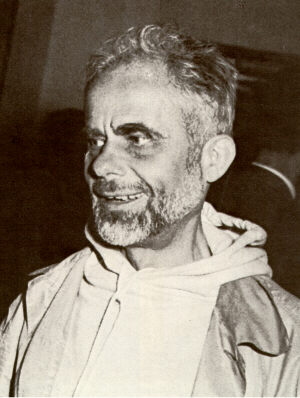
Roman Maciejewski (Composer, Arranger) |
|
Born: February 28, 1910 - Berlin, Germany
Died: April 30, 1998 - Göteburg (Gotteborg), Sweden |
|
Life |
|
The Polish-American pianist, organist, choral conductor, and composer, Roman Maciejewski, was born of Polish parents in Berlin. His mother taught him to play piano at the age of 5. from 1916 to 1919 he studied at the Stern Conservatory in Berlin with S. Goldenweiser. He then studied with Zeleski at the State Conservatory in Poznań, from which he received his diploma as a concert pianist in 1922. He also studied composition with Wiechowicz in Poznań. While still a very young man, he was director of the largest choir in Poznań (S. Moniuszko Choir) and toured with this group through Poland and Germany. In 1932 he entered the Academy of Music in Warsaw, where he studied with Szymanowski and Sikorski, but left without completing his studies to embark on a tour of the Balkan states with recitals of his own piano compositions. He went to Paris in 1934, and studied with Nadia Boulanger.
At a perfomance of his concerto for two pianos in London Roman Maciejewski met Kurt Joos who then commisioned music for two ballets. In 1939 Maciejewski began his first "Swedish" period - he married a Swedish dancer and lived in Sweden for twelve years, active as a composer and pianist. He composed music for several theatre productions of Ingmar Bergman, including Camus's Kaligula. While in Sweden, he began his life-work, the Missa pro defunctis - Requiem, which he finished fifteen years later. This monumental piece is dedicated to all the victims of all wars and remains Maciejewski's best known and highest-regarded composition. It was premiered during the International Festival of Conterporary Music in Warsaw in 1960. After World War II, in 1951 (or 1952), he moved from Sweden to the USA and spent a period of 26 years in California, living in Redondo Beach, working as the organist for two Catholic churches, and directing the "Roman Choir" which yearly toured the missions and cathedrals of California. During his American years, Maciejewski composed a number of choral pieces and masses. In 1977 he moved back to Sweden, settling in Gotteborg where he died in 1998. He is buried in his home town of Leszno, Poland. |
|
Music |
|
Roman Maciejewski's many compositions include music for ballets, piano works, a concerto and many transcriptions for two pianos, many Masses, and Macbeth and Caligula by Camus. He excelled in writing lush, resonant, protracted choruses in self-confident tonal harmonies. The Requiem is regarded as the crowning piece in his opus. The work, beginning with a motto of Christ's words uttered from the Cross, "Father, forgive them, because they do not know what they do," is dedicated to "the victims of human ignorance, to the victims of Great Wars, to the victims of tyrants' prisons, to the victims of human lawlessness, the victims of breaking God's natural order." The work calls for very large performing forces and is rarely performed, though available on CD from Polskie Nagrania; the score has been published by PWM in Krakow. Maciejewski's unique style blends neoclassicism with folk influences and bears traces of his fascination with ideas of creating a modern national style put forward and realized by Karol Szymanowski. His Mazurkas (known in recordings by Michał Wesołowski, published by Brevis Music Publishers in Poznań) are an original contribution to the history of this genre; they are worthy successors of the mazurkas by Frédéric Chopin and Szymanowski. |
|
Works |
|
Orchestral:
Allegro concertante for Piano and Orchestra (1944; Göteborg, January 11, 1945)
Chamber:
Brass Quartet (1937)
String Quartet (1938)
Violin Sonata (1940)
String Trio (1948)
Nocturne for Flute, Celesta, and Guitar (1951)
Variations for Wind Quintet (1971)
Piano:
2 sonatas (1926, 1932)
25 Mazurkas (1928-1938)
Bajka (Fairy Tale), children's ballet for 2 Pianos (1931)
Concerto for 2 Solo Pianos (1935)
Vocal:
Song of Bilitis for Soprano and Orchestra (1932)
Requiem for Soloists, Chorus, and Orchestra (1944-1960; Warsaw, September 1960)
masses; songs |
 |
|
Source: Polish Music Center Website; Baker’s Biographical Dictionary of 20th Century Classical Musicians (1997)
Contributed by Aryeh Oron (July 2007) |
|
Roman Maciejewski : Short Biography | Piano Transcriptions: Works | Recordings |
|
Links to other Sites |
|
PMRC SITES: ROMAN MACIEJEWSKI
Kultura polska: ROMAN MACIEJEWSKI [Polish] |
Roman Maciejewski (Wikipedia) [English]
Roman Maciejewski (Wikipedia) [Polish] |
|
Bibliography |
| |
|
|