|
|
Chorale Melodies used in Bach's Vocal Works
Es ist genung, so nimm, Herr, meinen Geist [1] |
|
Melody & Text | Use of the CM by Bach | Use of the CM by other composers | Footnotes |
| |
|
Melody & Text: Zahn: 7173 | EKG: |
|
Melody: |
|
The composer of this chorale melody is Johann Rudolf Ahle, the father of Johann Georg Ahle, both of whom were Bach’s predecessors as organists at the Divi Blasii Church in Mühlhausen.
Other chorale melodies by Ahle still in use today are:
Morgenglanz der Ewigkeit (1662) (EKG 349) Text by Christian Knorr von Rosenroth (1636-1689) [no settings by Bach]
and
Liebster Jesu, wir sind hier (1664) (EGK 127, 151) with slight modifications by Wolfgang Karl Briegel (1687) and texts either by Tobias Clausnizer (1618-1684) or Benjamin Schmolck (1672-1737). Settings by Bach: BWV 373, BWV 633, BWV 634, BWV 706, BWV 730 and BWV 731.
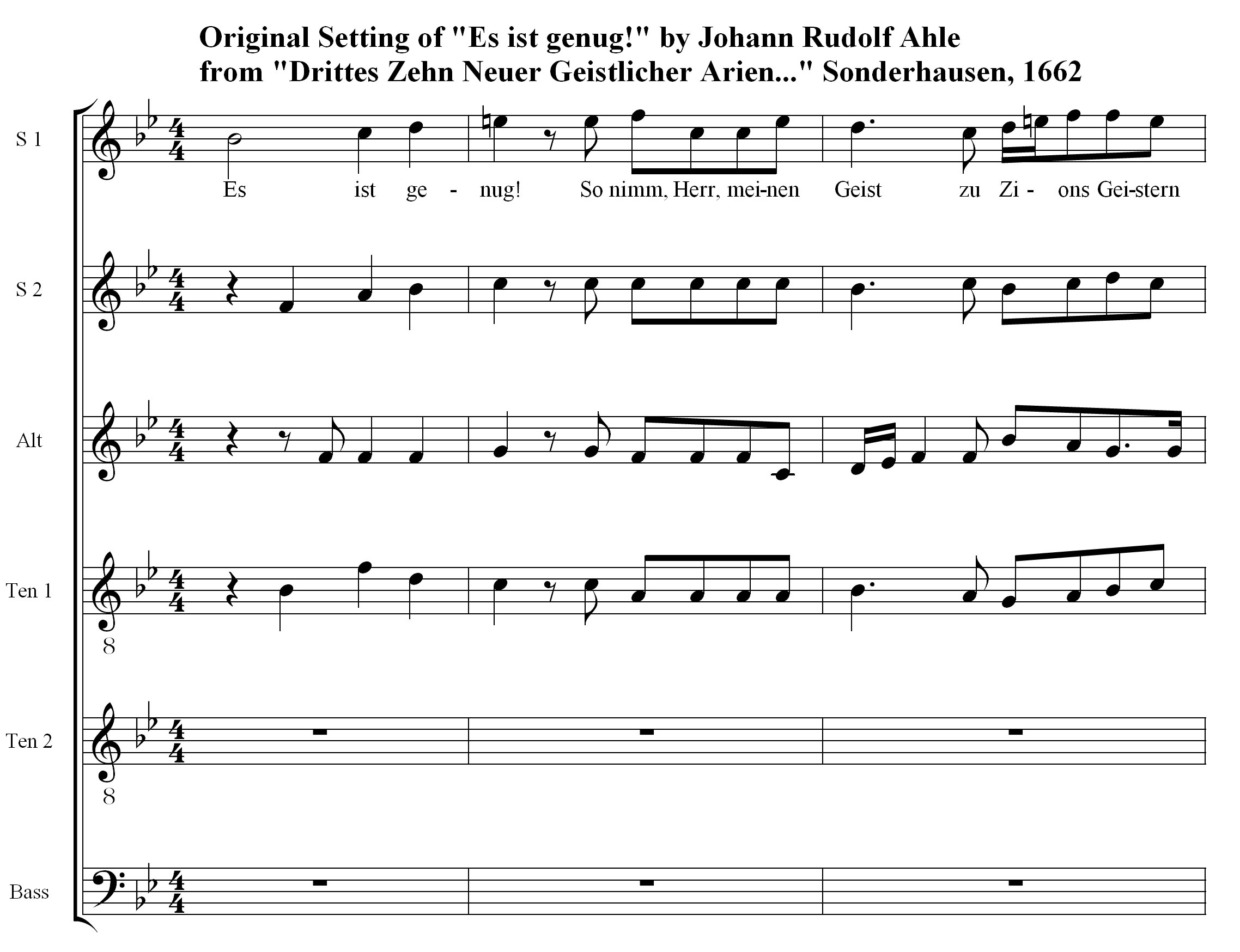
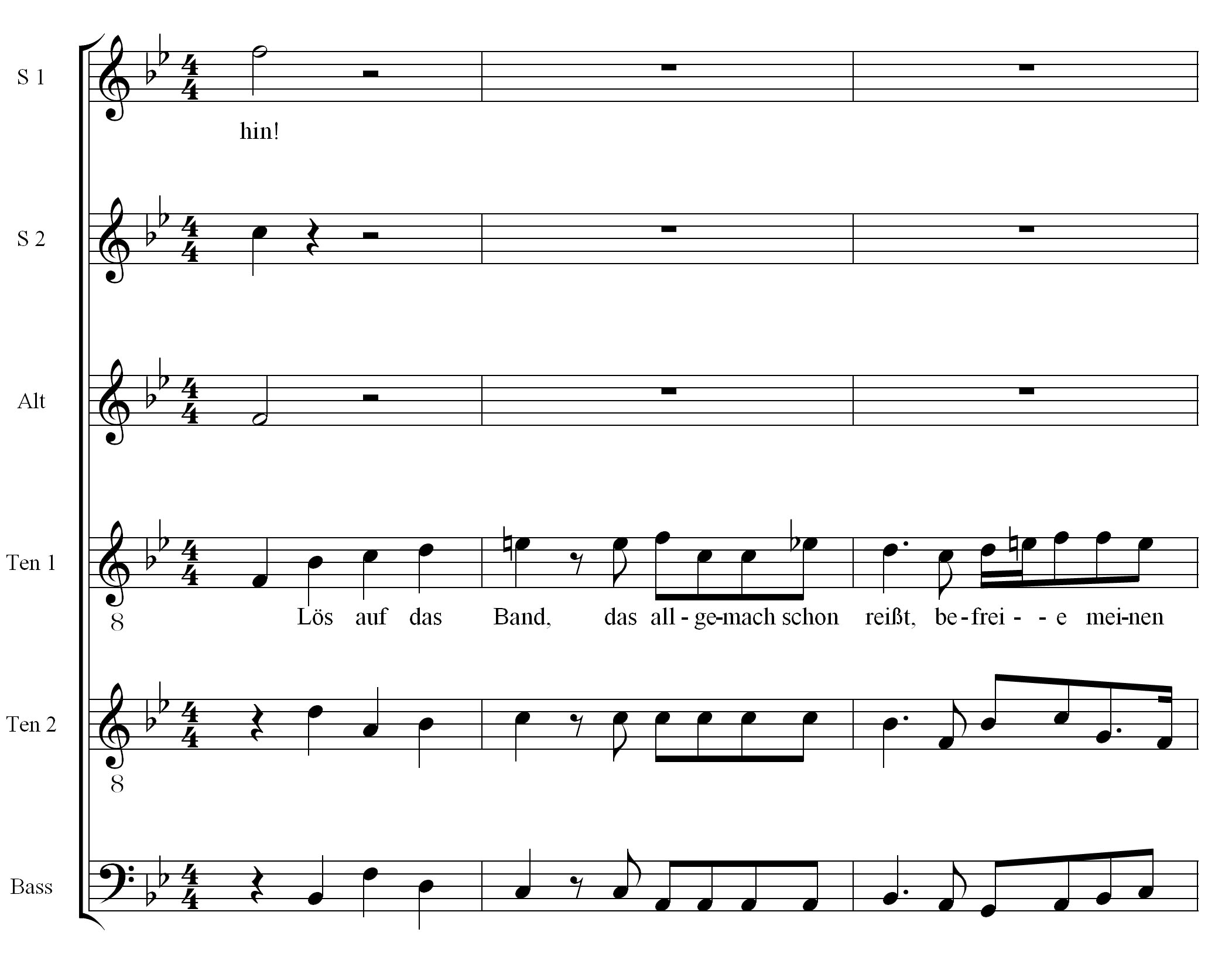
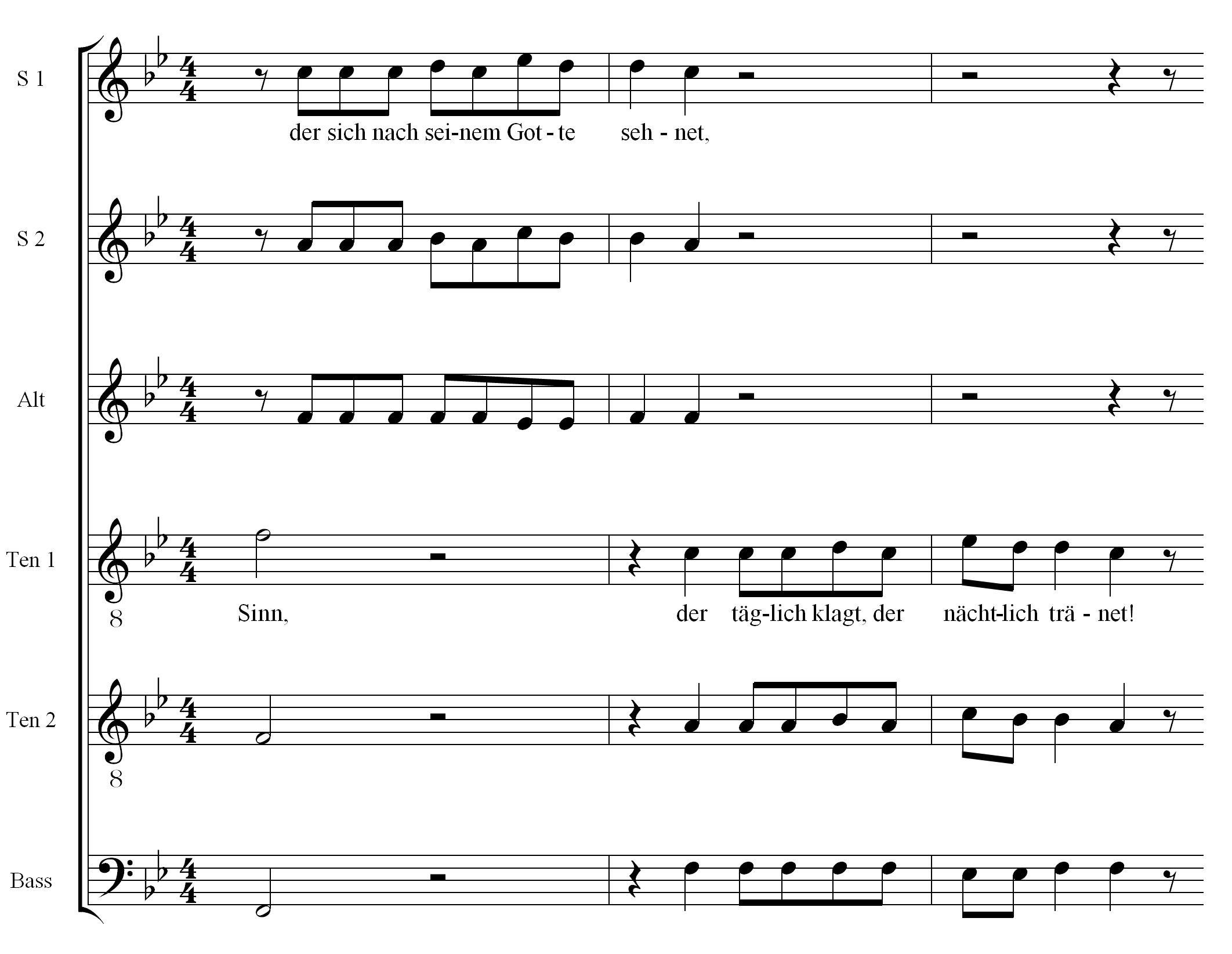
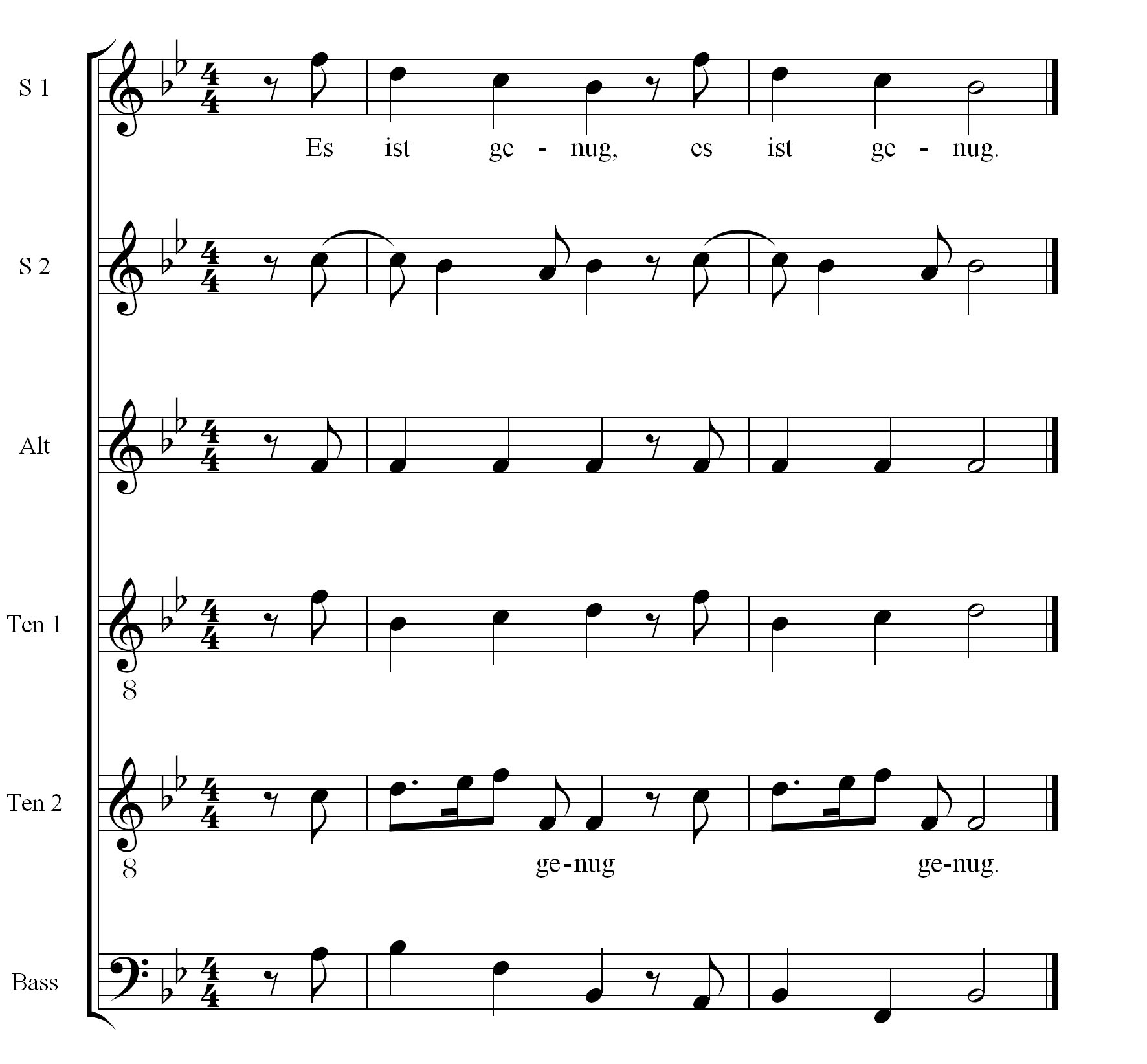
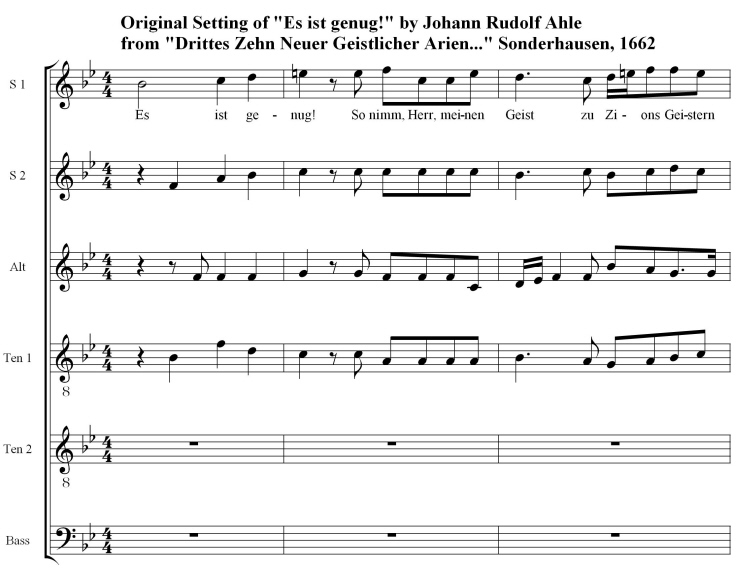
This chorale melody, “Es ist genug” first appeared in a collection of church compositions in a simple/easy style published in Sonderhausen in 1662. The collection which appeared in 4 books of ten each was entitled: “Neue Geistliche Arien” and was published between 1660 and 1662 for 4 or more voices and ritornelli for viols/strings and bc. The specific title from which Ahle’s setting below was taken can be found in “Drittes Zehn Neuer Geistlicher Arien…von Johann Rudolf Ahlen…Sonderhausen, 1662.” These arias, although deliberately composed in a simple style were not meant to be included in hymnals, but some of them eventually were accepted for such use. There is, nevertheless, something different about their nature when compared to the standard type of chorale melody.
The original setting for 6 voice parts by Johann Rudolf Ahle: |
|
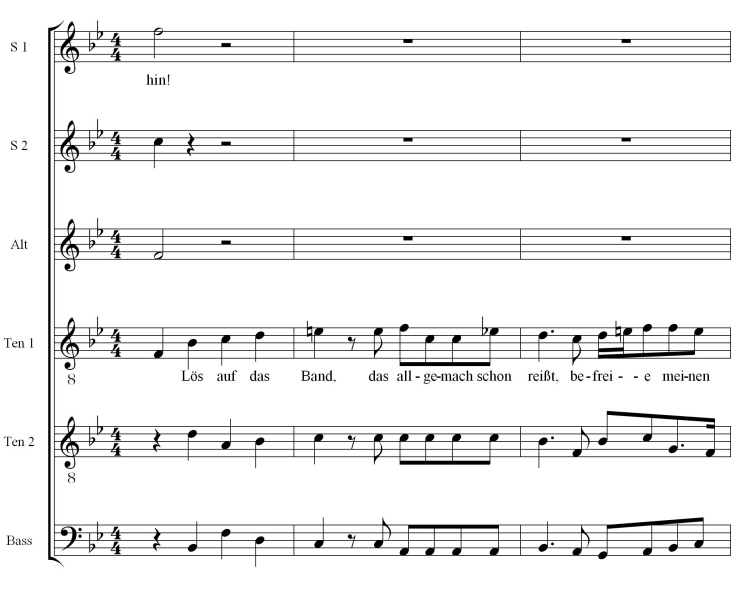
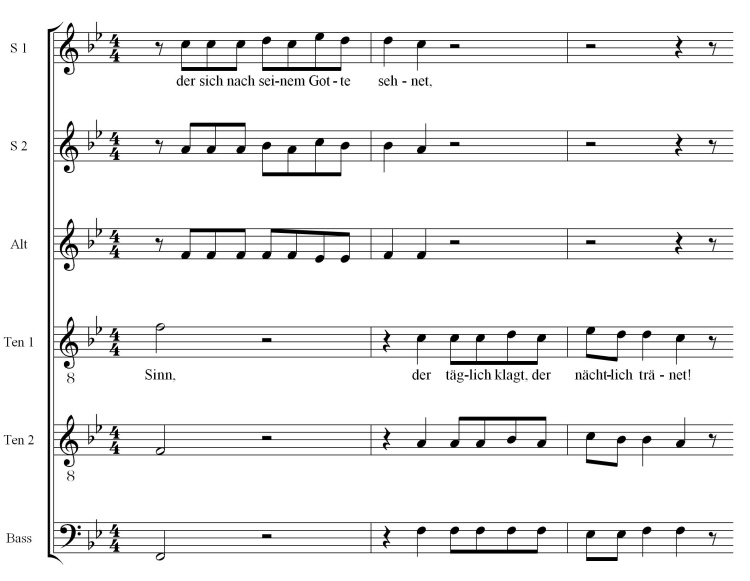
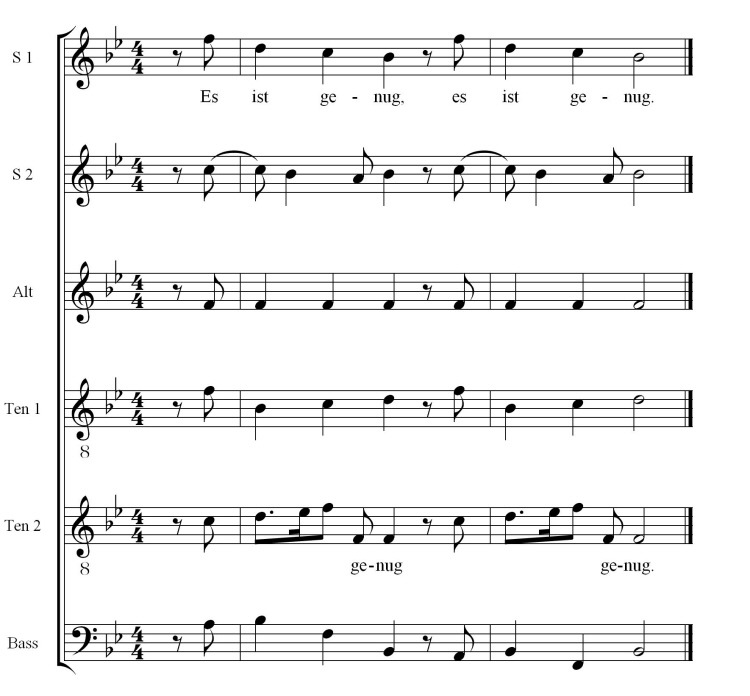
|
| |
|
Text: Es ist genug |
|
The chorale text author is Franz Joachim Burmeister (1633-1672) of Lüneburg where he was a preacher. The text was inspired by and considered to be an extension of Elijah’s prayer as found in 1 Kings 19:4. |
| |
|
Use of the Chorale Melody by Bach: |
|
Text: Es ist genug |
|
Ver |
Work |
Mvt. |
Year |
Br |
RE |
KE |
Di |
BC |
Score |
Music Examples |
|
5 |
BWV 60 |
Mvt. 5 |
1723 |
216 |
91 |
216 |
46 |
F60, A161:5 |
PDF | NBA |
Mvt. 5 (MG) [midi] | Mvt. 5 (Leusink) [ram] |
|
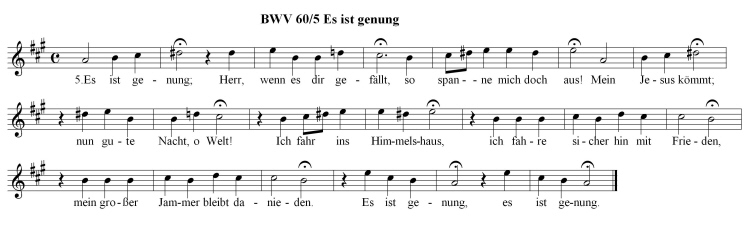
|
|
See also: Full NBA Score |
|
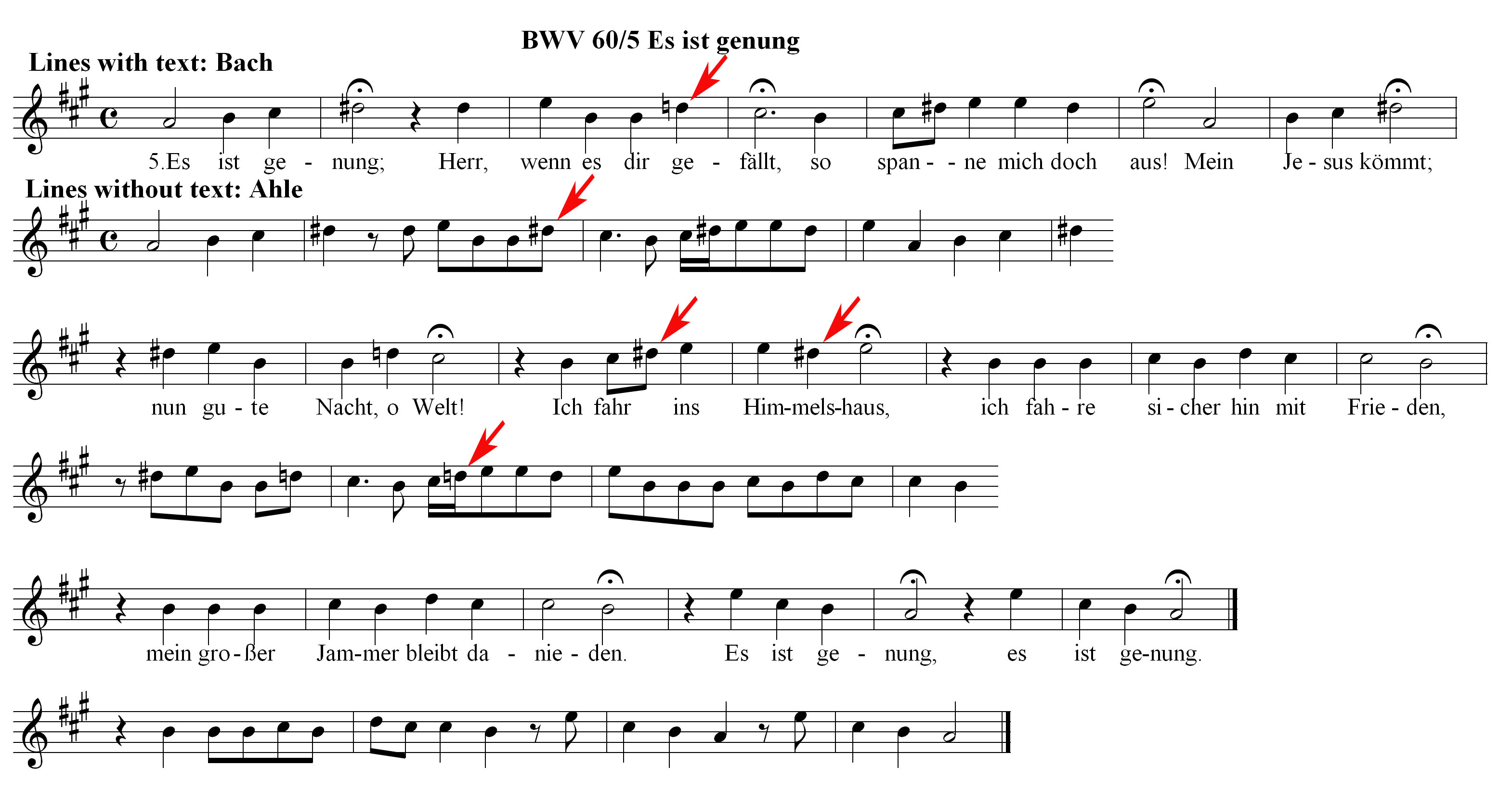
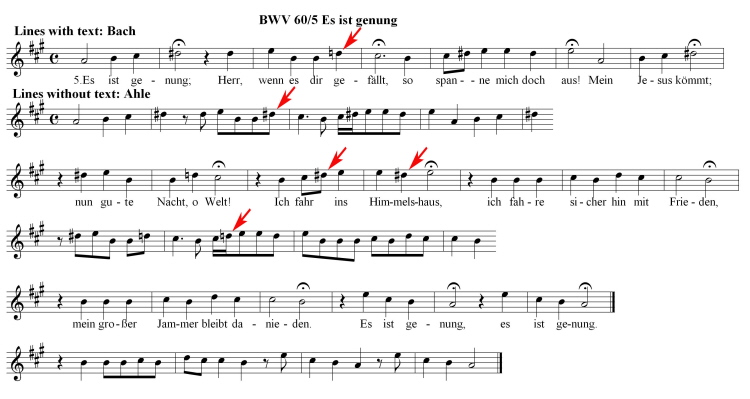
A comparison of the melody lines of Bach’s version with the original Ahle version: |
|
|
|
The Ahle version above the Bach melody line is untexted. Note not only the rhythmic changes, but also the difference between the use of the tritone [2] (marked with red arrows). |
|
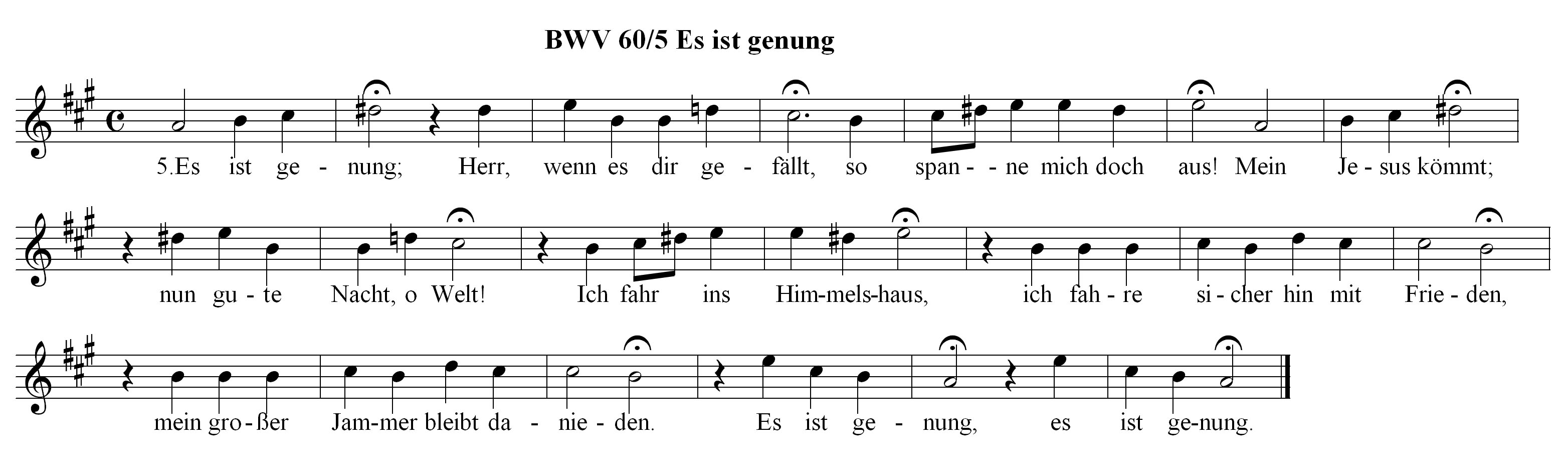
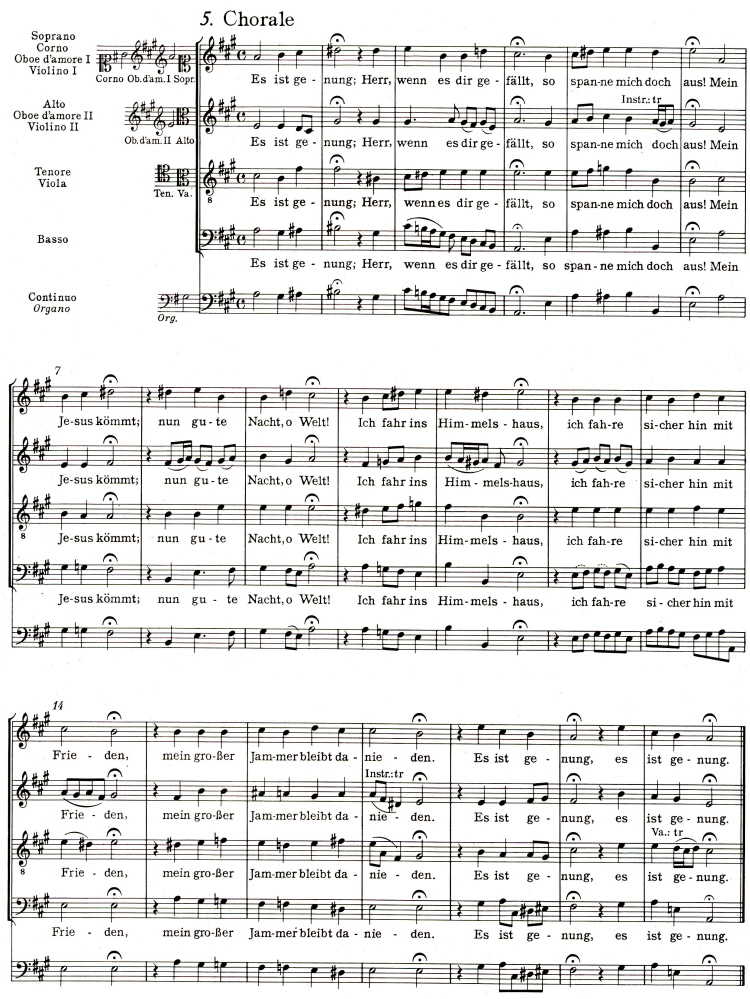
The famous final chorale, "Es ist genung," is striking both for its initial melodic tritone [2] and its unusually chromatic harmonies. The chorale ends the cantata in A major, a fifth higher than it began. As Dürr indicates, its opening phrase is a distortion of the final four tones of the first phrase of "O Ewigkeit," replacing the tone d" by d" sharp, a device that Dürr interprets as "the musical figure of the crossing over [or exceeding] of the realm of life to that of death. This interpretation is certainly correct; it relates to the modulation upward by whole tones (e, f sharp, g sharp) in the preceding recitative, the key of G sharp minor signifying there a tonal extreme, an exceeding of the E major that Bach commonly associates with salvation, and with which the bass gives its answering message of comfort. In fact, the idea of sharp ascent in this cantata is announced in the opening phrase of the first recitative, "O schwerer Gang," which distorts the first four tones of "O Ewigkeit" in just the same manner that "Es ist genung" distorts the last four. The additional sharps make the "schwerer Gang" of course, the way of the cross. Since the direction of transcendence is sharpward, the dissonant D sharp in the final chorale forces the tonality upward to the dominant of A major (third and sixth line endings), enabling the sense of resolution for the final descent to the new tonic on "Es ist genung".
Eric Chafe “Tonal Allegory in the Vocal Music of J.S. Bach”, California University Press, 1991, pp. 194-5
|
| |
|
Use of the Chorale Melody by other composers: |
|
Severus Gastorius (1646-1682):
Es ist genug, so nimm nun Herr meine Seele for 5 voices with bc (1673) |
|
Johann Schelle (1648-1701):
Es ist genug, mein matter Sinn for 3 Violette, 3 Bassoons, Soprano, Alto, Organo, Violone [This may not be the same chorale text, nor the same melody] |
|
Johannes Brahms (1833-1897):
In the triptych of Motets op. 110 a central four-part cantional hymn deriving from the chorale Es ist genug is flanked by two pieces for double choirs. The situation here is personal rather than communal: the wretched, sorrowful man, deceived by the false riches of the world, faces death, seeking comfort and salvation in God. |
|
Alban Berg (1885-1935):
Violin Concerto ("To the memory of an angel", no opus number) (1935, Berg’s last composition) based upon 4 tone rows, a Carinthian [from Kärnten, Austria] folksong and the chorale melody “Es ist genug.” In the final Adagio mvt. Berg included two variations based upon the Bach chorale setting “Es ist genug, Herr, so nimm denn meinen Geist.” The chorale, which appears near the end of the Concerto in fulfilment of its programme as a Requiem, is foreshadowed from the beginning, its opening notes embedded in the work's 12-note series. |
|
>>The Adagio finale of Berg's Violin Concerto uses the chorale melody Es ist genug from Bach's Cantata BWV 60, granting it both serial and tonal treatments; the alternation between chorale phrases in dissonant counterpoint led by the solo violin and their repetition in ‘Bach’schen Harmonisierung’ by an ensemble of three clarinets, designed to sound like a small organ, is especially compelling. Traditional segmentation is altered in two ways. First, the layout of chorale and two variations gives way to a folksong (the Carinthian song with personal resonances heard originally in movement 1b and here played ‘wie aus der Ferne’) before the coda; second, in variation 1 (bar 164), Berg introduces a new melody, the ‘Klagegesang’ of Willi Reich's original programme note, which rises to a climax, bringing along the other violins. This and the chorale return in the coda, turning it into a kind of summary variation. Thus the clear structure and multiple rhythmic levels of the chorale variations are intercut with programmatic elements that fulfil a broader role for the finale of the work.<<
Elaine Sisman Grove Music Online, Oxford University Press, 2005, acc. 11/29/05
|
|
Robert Moevs (b 1920):
Es ist genug, for organ (1970) |
|
Kenneth Leighton (1929-1988):
Fantasy on a chorale Es ist genug, op. 80, vn, org (1979) |
|
Edison Denisov (1929-1996):
Es ist genug, va, pf (1984), arr. va, fl, ob, cel, str qnt (1986) [variations on the theme of Bach's chorale] |
|
Alun Hoddinott (b 1929):
The Sun, the Great Luminary of the Universe (1970) |
|
This work was commissioned by the Swansea Festival in memory of Leonard Pinn, the Festival's secretary from its inception in 1948 until 1965,and thereafter director until his death in 1969. The piece was first performed at the 1970 Festival by the London Symphony Orchestra conducted by Vernon Handley, and takes its title from a paragraph in James Joyce's A Portrait of the Artist as a Young Man. Although not descriptive, the music is illustrative, and each of the ten sections stems from one of the ten sentences in the paragraph:
The last day had come. Doomsday was at hand. The stars of heaven were falling upon the earth like the figs cast by the figtree which the wind has shaken. The sun, the great luminary of the universe, had become as a sackcloth of hair. The moon was bloodred. The firmament was as a scroll rolled away. The archangel Michael, the prince of the heavenly host, appeared glorious and terrible against the sky. With one foot in the sea and one foot on the land he blew from the archangelical trumpet the brazen death of time. The three blasts of the angel filled all the universe. Time is, time was but time shall be no more.
The structure of the music, although progressing through a series of opposing dynamic tensions, is cumulative, with a coda ending on a quiet cadence. Thematic ideas originate in the chorale melody Es ist genug (used by Bach), of which the first four bars are quoted exactly, and the Dies Irae, which is heard in a shadowy outline at the climax of the work.
Source: Oxford University Press - Programme Notes
Contributor: Virginia Knight (April 2006)
|
|
Sten Hanson (b 1936):
Es ist genug, for organ (1985) |
|
David Del Tredici (b 1937):
On texts by L. Carroll: Pop-Pourri, amp S, chorus, 2 s sax, 2 elec gui, perc, orch (1968, rev. 1973) |
|
In 1968 Del Tredici encountered the writings of Carroll, particularly Alice's Adventures in Wonderland and Through the Looking Glass. These texts, which would inspire him for the next three decades, prompted a shift in his compositional style. Although the 12-note system was not abandoned completely until 1980, tonal relationships began to assume greater structural significance. His first work on Carroll's texts, Pop-Pourri (1968, rev. 1973), employs a pre-existing tonal source, Bach's chorale ‘Es ist genug’ from Cantata BWV 60 (also used in Berg's Violin Concerto). Del Tredici derives the work's primary 12-note row from the first four pitches of the chorale melody, pitches identical to the first four notes of the whole-tone scale.
Grove Music Online, Oxford University Press, 2005, acc. 11/29/05
|
|
Dieter Kaufmann (b 1941):
Es ist genug, op.39, variations, mixed chorus, organ (1979) |
|
Sven-David Sandström (b 1942):
Es ist genug (It is enough), for chorus (1986) |
|
Magnus Lindberg (b 1958):
Chorale for 2 flutes, 2 oboes, cor anglais, 3 clarinets in Bb, 2 bassoons (2nd doubling double bassoon), 4 horns in F, 3 trumpets in C, 3 trombones, tuba, strings. Written for the project "Related Rocks - the world of Magnus Lindberg"; based on Es ist genug by J.S. Bach (2002) |
| |
|
Footnotes: |
|
[1] All the contemporary hymnals that Bach may have used and consulted have “genug” instead of “genung.”
This form, “genung”, is somewhat puzzling for lexicographers in that it seems to indicate an opposite trend to the more common linguistic change of words where an ‘n’ is dropped like ‘pfenning’ to ‘pfennig’ and ‘köning’ to ‘könig.’ Here we have an original, older form “genug/genuk” which changes later to “genung”. The form ‘gnunk/gnunck’ appears as early as the 14th century. Luther even uses it occasionally: “so ist nu das land weit genung für sie” (“so now the country is big enough for them”); but nowhere in Luther’s 1545 unrevised translation of the Bible do these forms occur. Only the form ‘genug’ appears many times. Opitz, Fleming and Klopstock used the form as well. Lessing and even Goethe fell back to this form as an option for creating end rhyme:
“und dir, frau Eva, noch so jung!
dir war ein mann noch nicht genung?”
As late as the turn of the 19th century, this form still appears folksy prose, particularly in Thuringia where this statement is documented: “ich meint', er wär' selber alt genung” (“I thought he would be old enough.”)
Which form does Bach use when he writes letters? (this is as close as we can come to determining his preferred usage: [Bach-Dokumente 1, p. 105, item 41] “…wenn dieser ‘in musicis’ nicht geschickt genug…”
In his cantatas the both forms do appear, but it is necessary to remember that the texts in almost all of his cantatas were supplied by librettists, known and unknown. So in the case of BWV 82 “Ich habe genung”, the form most likely derives from the libretto which Bach set to music.
Walter F. Bischof’s site: http://www.cs.ualberta.ca/~wfb/bach.html is not reliable enough to do a meaningful search on ‘genug’ vs ‘genung’ as he lists corrected spellings along with uncorrected spellings, i.e., he has BWV 82 as “Ich habe genug” but the original has “Ich habe genung.” |
|
[2] >> Tritone (Lat. tritonus)
The interval equal to the sum of three whole tones. In equal temperament it is exactly half an octave and can therefore be perceived either as an augmented 4th or a diminished 5th. Since the beginnings of polyphony in the early Middle Ages theorists and composers have changed their attitudes to the tritone and its use more than to any other interval.
In the medieval system of church modes the tritone was most conspicuous as the interval between the final and the fourth degree of the modes on F, the Lydian and Hypolydian. Conjunct progressions that outline the ascending tritone or the descending diminished 5th F–B are not uncommon in Gregorian chant (although tritone leaps are rare...), and the introduction of Bb in plainsong notation seems to have been a relatively late development. The first known use of the word ‘tritonus’ occurs in the 9th- or 10th-century organum treatise Musica enchiriadis, though it was not explicitly prohibited until the development of Guido of Arezzo's hexachordal system, which made Bb a diatonic note, namely as the fourth degree of the hexachord on F. From then until the end of the Renaissance the tritone, nicknamed the ‘diabolus in musica’, was regarded as an unstable interval and rejected as a consonance by most theorists. In the 13th century it was classified as a discordantia perfecta, along with the minor 2nd and major 7th; and by the 15th century the Lydian mode was understood as having a flattened fourth degree (Tinctoris: Liber de natura … tonorum, 1476), that is, as being a transposed Ionian mode, as Glarean defined it in the Dodecachordon (1547).
Since the 16th century the instability of the tritone has led to developments in two directions. On the one hand, its presence in the dominant 7th chord in four-part counterpoint has made the authentic perfect cadence an even stronger affirmation of the tonality, providing an approach by semitone not only to the tonic degree but also to the 3rd However, because it divides the octave into two equal parts, the tritone has also assumed the role of the tonally most ambiguous interval, as opposed to the 5th, which divides the octave into unequal parts and is (apart from the octave itself) the interval most fundamental to tonality: in particular, the tritone has come to be recognized as a basic substructure within the diminished 7th chord and the whole-tone scale. In the chorale Es ist genug Bach used the tritone embedded in the major scale to create an ambiguity in the relationship between tonic and dominant. Both Mozart and Beethoven used tritones thematically or motivically to divide the octave into equal parts. In 19th-century Romantic opera the tritone regularly portrays that which is ominous or evil; an early instance isin the dungeon scene in Act 2 of Fidelio, for which the timpani are tuned A–E . Its importance in dramatic music led to further developments in the extension and suspension of tonality, particularly in Wagner’s Tristan und Isolde and Parsifal (see also the 'Tristan' chord), the late piano works of Liszt and the music of Debussy. In 12-note music, the fact that the inversion of the tritone at the interval of an octave yields another tritone (no other interval except the octave has this property) has proved fundamentally significant, both in theory and in practice.<<
From an article by William Drabkin in the Grove Music Online, Oxford University Press, 2005, acc. 11/29/05 |
| |
|
Sources: NBA, vols. III/2.1 & 2.2 in particular [Bärenreiter, 1954 to present] and the BWV ("Bach Werke Verzeichnis") [Breitkopf & Härtel, 1998]
The PDF files of the Chorales were contributed by Margaret Greentree J.S. Bach Chorales
Software: Capella 2004 Software, version 5.1.
Prepared by Thomas Braatz & Aryeh Oron (November 2005) |
|
|