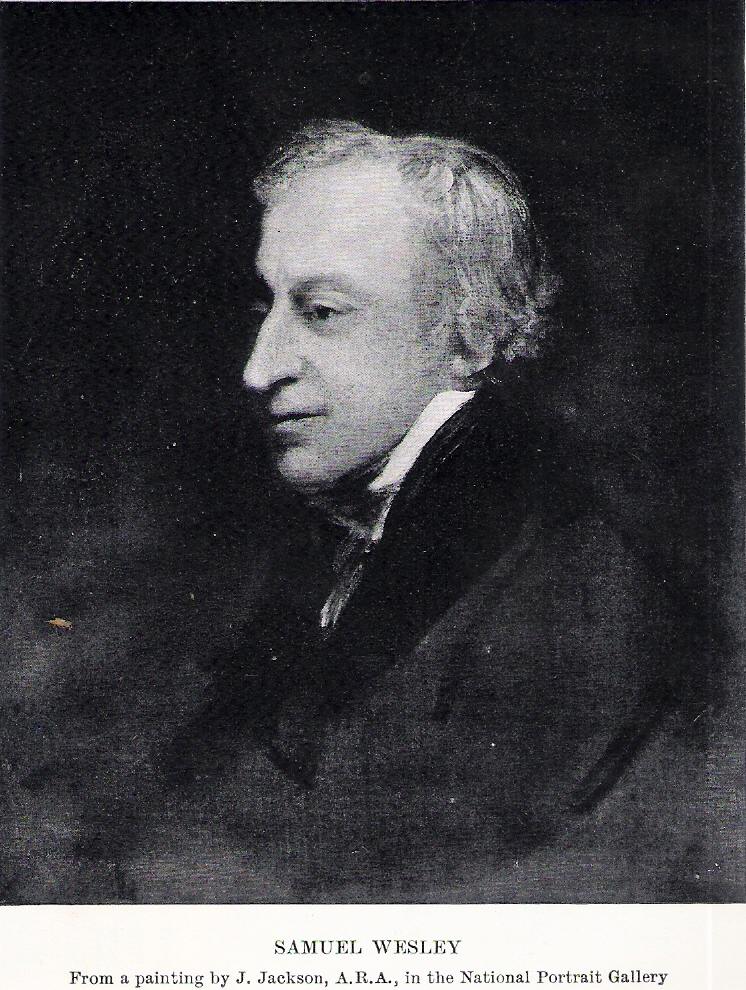
|
The English composer, Samuel Wesley, was the son of Rev. Charles and nephew of the celerbrated Rev. John Wesley. His elder brother, Charles Wesley (1757-1834), was an harpsichodist, organist and composer. Although Samuel was also a precocious performer, like his brother', he did not develop his faculties quite so early, for he was 3 years old before he played a tune, and did not attempt to put a bass to one until he had learned his notes. He proved to be, notwithstanding, the more gifted of the two brothers. From his cradle he had the advantage of hearing his brother's performances upon the organ, to which, perhaps, his superiority might be partly ascribed. Before he was 5 years old he learned to read words by poring over George Frideric Handel's oratorio, Samson, and soon afterwards learned, without instruction, to write. When between 6 and 7 years of age he was taught to play from musical notation by David Williams, a young organist of Bath. Before then (September and October 1774) he had composed some parts of an oratorio, Ruth, which he composed and wrote out when he was about 8 years of age, and which was highly commended by Dr. Boyce. About the same time he learned to play the violin, of which he became a master, but his chief delight was in the organ. He was now introduced into society as a prodigy, and excited general admiration. The brothers gave concerts in their house in London from 1779. In 1777 he published Eight Lessons for the Harpsichord, and about the same time an engraved portrait of him appeared when he was 8. Before he attained his majority he had become a good classical scholar, acquired some knowledge of modern languages, successfully cultivated a taste for literature, and obtained distinction as an extemporaneous performer upon the organ and pianoforte.
In 1784 Samuel Wesley joined the Roman Catholic Church. In 1787 an accident befell him, the consequences of which more or less affected him during for the rest of his life, and from which sprang those erratic and eccentric habits by which he was afflicted. Passing along Snow Hill one evening, he fell into a deep excavation prepared for the foundations of a new building, and severely injured his skull. He refused to undergo the operation of trepanning, and suffered for seven years from despondency and nervous irritability, which occasioned him to lay aside all his pursuits, even his favourite music. On his recovery he resumed his usual avocations, and became acquainted with the works of J.S. Bach, the study of which he pursued with enthusiasm, and to propagate the knowledge of J.S. Bach's works amongst English musicians was an undertaking assiduously carried out. During 1808 and 1809 he addressed a remarkable series of letters to Benjamin Jacon upon the subject of the works of his favourite author, which was edited by his daughter, and published in 1875. In 1810 he put forward, in conjunction with C. F. Horn, an arrangement of J.S. Bach's organ trios, and in 1813 an edition of the Wohltemperirtes Clavier, and promoted the publication of an English translation of Forkel's Life of Bach (1820).
In 1811 Samuel Wesley was engaged as conductor and solo organist at Birmingham Festival, and lectured at the Royal Institution and elsewhere. In 1816 he suffered a relapse of his malady, and was compelled to abandon the exercise of his profession until 1823, when he resumed his pursuits until 1830, becoming in 1824 organist of Camden Chapel, Camden Town; but a further attack again disabled him, and he was afterwards unable to do more than make occasional appearances. One of his latest public performances was at the concert of the Sacred Harmonic Society on .August 7, 1834, when at the organ he accompanied the anthem, All go unto one place, which he had composed upon the death of his brother Charles. His actual last appearance was at Christ Church, Newgate Street, on September 12, 1837. He had gone there to hear Felix Mendelssohn play upon the organ, and was himself prevailed upon to perform. He died a month later, and was buried October 17, in the vault in the graveyard of Old St. Marylebone Church, in which the remains of his father, mother, sister and brother had been previously interred.
Samuel Wesley was indisputably the greatest English organist of his day, and both in his extemporaneous playing and in his performance of the fugues of J.S. Bach and G.F. Handel he was unrivalled. His compositions were numerous and varied, and some are of the highest excellence. His instrumental music shows that he was to a certain extent a pioneer of the symphonic style in England, but it has sunk into oblivion. His symphonies have recently been revived by modern orchestras and his Violin Concerto in D major has been beautifully recorded for the first time since it sank into obscurity. The style he used is neither in imitation of Haydn nor of Mozart but it emits a radiance all of its own, providing vigorous movement, inventive modulations, sincere moments of tenderness and a feeling of purpose and assured design throughout. He is remembered by a few of his choral works, notably the motets, of which one, the noble eight part In exitu Israel, still receives fairly frequent performances in English cathedrals and elsewhere even in the 20th century. His religious beliefs have been subject to doubt and conjecture. At a late period of his life he disclaimed having ever been a convert to Rome, observing that although the Gregorian music had seduced him to their chapels, the tenets of the Roman Catholic Church never influenced his mind. But the letter from. Pope Pius VI in acknowledgment of a Mass is direct evidence that he had joined that Church.
Samuel Wesley left several children; his eldest son, Rev. Charles Wesley, D.D. (1795-1859), was sub-dean of the Chapel Royal, and editor of a collection of words of anthems. His younger son, Samuel Sebastian Wesley (1810-1876), was also gifted organist and composer, who inherited the genius of his father. An obituary notice appeared in the Gentleman's Magazine of November 1837. A list of the MSS. in the B.M. relating to him and containing his works is given in D.N.B. |