|
|
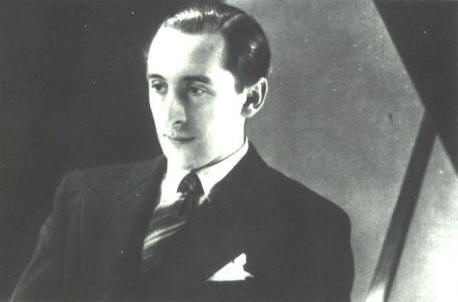
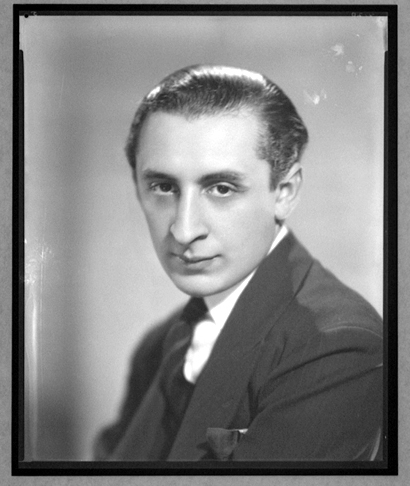
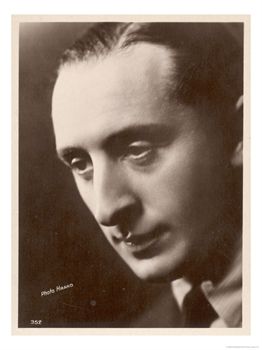
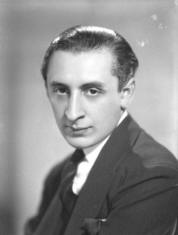
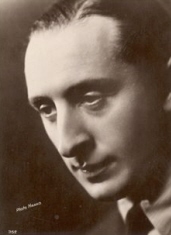
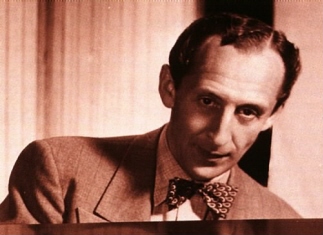
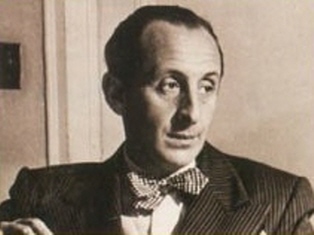
Vladimir Horowitz (Piano) |
|
Born: October 1, 1903 - Kiev, Ukraine
Died: November 5, 1989 - New York City, New York, USA |
|
Vladimir Samoylovych Horowitz [Ukrainian: Володимир Самійлович Горовиць, Russian: Владимир Самойлович Горовиц] was a Ukrainian-born, American classical pianist. In his prime, he was considered one of the most brilliant pianists of his time. His use of tone color, technique and the excitement of his playing are thought by many to be unrivaled, and his performances of works as diverse as those of Domenico Scarlatti and Alexander Scriabin were equally legendary. Though sometimes criticized for being overly mannered, he has a huge and passionate following and is widely considered one of the greatest pianists of the 20th century. |
|
Life and early career |
|
Vladimir Horowitz himself said that he was born in Kiev, Ukraine under the Russian Empire, but some sources have given Berdichev, Ukraine as his birthplace. His cousin Natasha Saitzoff, in a 1991 interview, stated that all four children were born in Kiev; Horowitz's wife, Wanda Toscanini, however, gave credence to the Berdichev possibility.
He was born in 1903, but in order to make Vladimir appear too young for military service so as not to risk damaging his hands, his father took a year off his son's age by claiming he was born in 1904. This fictitious birth year is still found in some references, but authoritative sources—including Horowitz himself - confirm the correct year as 1903.
Horowitz received piano instruction from an early age, initially from his mother, who was herself a competent pianist. In 1912 he entered the Kiev Conservatory, where he was taught by Vladimir Puchalsky, Sergei Tarnowsky, and Felix Blumenfeld. He left the conservatory in 1919 and performed the S. Rachmaninov Piano Concerto No. 3 in D minor at his graduation. He was later to become particularly associated with this concerto, and in 1930 made the premiere recording. His first solo recital followed in 1920.
His star rose rapidly, and he soon began to tour Russia where he was often paid with bread, butter and chocolate rather than money, due to the country's economic hardships.During the 1922-1923 season, he performed 23 concerts of eleven different programs in Leningrad alone. On January 2, 1926, Horowitz made his first appearance outside his home country, in Berlin. He later played in Paris, London and New York City, and it was in the USA that he eventually settled in 1940. He became a USA citizen in 1944. |
|
Career in the USA |
|
Vladimir Horowitz gave his USA debut on January 12, 1928, in Carnegie Hall. He played the Tchaikovsky Piano Concerto No. 1 b-flat minor, op. 23, with the New York Philharmonic Orchestra under the direction of Sir Thomas Beecham who made his USA debut as well. Horowitz later commented that he and T. Beecham had divergent ideas regarding tempos, and that T. Beecham was conducting the score "from memory and he didn't know" the piece. Horowitz's success with the audience was phenomenal, and a solo recital was quickly scheduled. Olin Downes, writing for the New York Times, was critical about the metric tug of war between conductor and soloist, but Downes credited Horowitz with both a tremendous technique and a beautiful singing tone in the second movement. In this debut performance, Horowitz demonstrated a marked ability to excite his audience, an ability he preserved for his entire career. As Olin Downes commented, "it has been years since a pianist created such a furor with an audience in this city." In his review of the recital, Downes characterized Horowitz's playing as showing "most if not all the traits of a great interpreter." With these performances, Horowitz's USA career was sensationally launched, and he has never since relinquished his place among the greatest pianists of all time.
In 1932, he played for the first time with the conductor Arturo Toscanini in a performance of the L.v. Beethoven Piano Concerto No. 5, Emperor. Horowitz and Arturo Toscanini went on to perform together many times, on stage and in recordings.
Despite rapturous receptions at recitals, Horowitz became increasingly unsure of his abilities as a pianist. Several times, he withdrew from public performances during 1936 to 1938, 1953 to 1965, 1969 to 1974, and 1983 to 1985. On several occasions, Horowitz had to be pushed onto the stage. After 1965 he gave solo recitals only rarely. |
|
Recordings |
|
Vladimir Horowitz made numerous recordings, starting in 1928, upon his arrival in the USA. His first recordings in the USA were made for RCA Victor. Because of the economic impact of the Great Depression, RCA Victor agreed that Horowitz's European-produced recordings would be made by HMV, RCA's London based affiliate. Horowitz's first European recording was his 1930 recording of the S. Rachmaninov Piano Concerto No. 3 with Albert Coates and the London Symphony Orchestra, the first recording of that piece. Through 1936, Horowitz continued to make recordings for HMV of solo piano repertoire, including his famous 1932 account of the F. Liszt Sonata in B minor. Beginning in 1940, Horowitz's recording activity was concentrated in the USA. During this period, in 1941, he made his first recording of the Tchaikovsky Piano Concerto No. 1 under Arturo Toscanini. In 1959, RCA issued the live 1943 performance of the concerto with Horowitz and Arturo Toscanini; some say it is superior to the commercial recording. Beginning in 1953, when Horowitz went into retirement, he made a series of recordings in his New York townhouse, including discs of Scriabin and Clementi. Horowitz's first stereo recording, made in 1959, was devoted to L.v. Beethoven piano sonatas.
In 1962, Horowitz embarked on a series of highly acclaimed recordings for Columbia Records. The most famous among them are his 1965 return concert at Carnegie Hall and a 1968 recording from his television special, Horowitz on Television, televised by CBS. Horowitz also continued to make studio recordings, including a 1969 recording of Kreisleriana by Robert Schumann, which was awarded the Prix Mondial du Disque.
In 1975, Horowitz returned to RCA Victor, and made a series of live recordings until 1982. He signed with Deutsche Grammophon in 1985, and made both studio and live recordings until 1989. Four filmed documents were made during this time, including the telecast of his April 20, 1986 Moscow recital. His final recording, for Sony Classical, was completed four days before his death. |
|
Students |
|
Beginning in 1944, Vladimir Horowitz began working with a select group of young pianists. First among these was Byron Janis, who studied with Horowitz until 1948. Byron Janis described his relationship to Horowitz during that period as that of a surrogate son, and he often traveled with Horowitz and his wife during concert tours. During his second retirement he worked with more pianists, including Gary Graffman (1953-1955), Coleman Blumfield (1956-1958), Roland Turini (1957-1963), Alexander Fiorillo (1950-1962) and Ivan Davis (1961-1962). Horowitz returned to coaching in the 1980s, working with Murray Perahia, who already had an established career, and Eduardus Halim. By this time, Horowitz was concerned that a pianist studying with him might be regarded as a Horowitz clone, so the sessions were not publicized and Horowitz insisted "I am not teaching you. I give you ti." Late in his career, Horowitz only endorsed Byron Janis, Graffman, and Turini as pupils, although he admitted a number of pianists had played for him. |
|
Personal Life |
|
In 1933, in a civil ceremony, Vladimir Horowitz married Arturo Toscanini's daughter Wanda. Their different religious backgrounds - Wanda was Catholic, Horowitz Jewish - was not an issue, as neither was observant. As Wanda knew no Russian and Horowitz knew very little Italian, their primary language became French. They had one child, Sonia Toscanini Horowitz (1934-1975).
Despite his marriage, there is considerable independant evidence that Horowitz was gay or at the least inclined towards males. He is attributed with the quote: "There are three kinds of pianists: Jewish pianists, homosexual pianists, and bad pianists."
Horowitz underwent psychological treatment in the 1950s in an attempt to alter his sexual orientation. In the early 1960's and again in the early 1970's, he underwent electroshock therapy for depression. |
|
The last years |
|
In 1982, Vladimir Horowitz began using prescribed anti-depressant medications, and his playing underwent a perceptible decline. The pianist’s 1983 performances in the USA and Japan were marred by memory lapses and a loss of physical control. By 1985, Horowitz, no longer taking medication, returned to concertizing and recording and was back on form. In many of his later performances, the octogenarian pianist substituted finesse and coloration for bravura, although he was still capable of remarkable technical feats.
In 1986, Horowitz returned to the Soviet Union to give a series of concerts in Moscow and Leningrad. In the new atmosphere of communication and understanding between the USSR and the USA, these concerts were seen as events of some political, as well as musical, significance. The Moscow concert, which was internationally televised, was released on a compact disc entitled Horowitz in Moscow, which reigned at the top of Billboard's Classical music charts for over a year. His final tour was to Europe in the spring of 1987 with a video recording of one of his last public recitals, Horowitz in Vienna released in 1991. He continued to record for the remainder of his life.
Vladimir Horowitz died on November 5, 1989 in New York of a heart attack. He was buried in the Toscanini family tomb in Cimitero Monumentale, Milan, Italy. |
|
Repertoire and technique |
|
Vladimir Horowitz is best known for his performances of the Romantic piano repertoire. His first recording of the F. Liszt's sonata in 1932 is still considered by some aficionados as the definitive reading of that piece, after almost 75 years and over 100 performances committed to disc by other pianists. Other pieces with which he was closely associated were the Scriabin Etude Op. 8, No. 12 in D-sharp minor, Frédéric Chopin Ballade No.1 Op. 23 in G minor, and many S. Rachmaninov miniatures, including Polka de W.R. He is also acclaimed for his recordings of the S. Rachmaninov Piano Concerto No. 3 and the F. Liszt Hungarian Rhapsodies, as well as for his famous hair-raising transcriptions, particularly of the F. Liszt Hungarian Rhapsodies Nos. 15 and No. 2. Towards the end of the “Friska” section of the latter, Horowitz gives the illusion of playing with three hands as he combines all the themes of the piece. It was recorded in 1953, during his 25th anniversary concert at Carnegie Hall, and he stated that it was the most difficult of his transcriptions. Horowitz's other transcriptions of note include Variations on a Theme from Carmen by Georges Bizet and The Stars and Stripes Forever by John Philip Sousa. The latter became a favourite with audiences, who would anticipate its recital during encores. Later in life, he refrained from playing it altogether, feeling, "the audience would forget the concert and only remember Stars and Stripes, you know." Other well-known recordings include works by Robert Schumann, Scriabin, F. Chopin, Schubert and Domenico Scarlatti. During World War II, Horowitz championed contemporary Russian music, giving the American premieres of the Prokofiev Piano Sonatas Nos. 6, 7 and 8 and Dmitry Kabalevsky's Piano Sonata No 2. Horowitz also premiered the Piano Sonata and Excursions of Samuel Barber.
Horowitz's extravagances were always well received by concert audiences, but not by critics. Virgil Thomson was famous for his consistent criticism of Horowitz as a "master of distortion and exaggeration" in his reviews in appearing in the New York Herald Tribune. The style of Horowitz frequently involved vast dynamic contrasts, with overwhelming double-fortissimos followed by sudden delicate pianissimos. He was able to produce an extraordinary volume of sound from the piano, without producing a harsh tone. He could elicit an exceptionally wide range of tonal color from the piano, and his taut, precise, and exciting attack was noticeable even in his renditions of technically undemanding pieces such as the F. Chopin's Mazurkas. He is also famous for his octave technique; he could play precise scales in octaves extraordinarily fast. When asked by the pianist Tedd Joselson how he practiced octaves, Joselson reports, "He practiced them exactly as we were all taught to do." Horowitz's hand position was unusual in that the palm was often below the level of the key surface. He frequently played chords with straight fingers, and the little finger of his right hand was always curled tight until it needed to play a note; as New York Times music critic Harold C. Schonberg put it, “it was like a strike of a cobra.” Sergei Rachmaninov himself commented that Horowitz plays contrary to how they had been taught, yet somehow with Horowitz it worked. Another account has it that when asked by an interviewer why he played his octaves so loud and so fast, his response was, “Because I can!”
Vladimir Horowitz's had the crucial ability to suffuse each piece with his own personality and thereby to somehow make each piece sound "right" in his hands, even though they could sound equally "right" when played in a different way. As performance style became increasingly comformist during the 20th Century, Horowitz continued to inject emotion and individuality into everything he did. (Some critics took exception: in the 1980 Grove's Dictionary of Music and Musicians, Michael Steinberg wrote that Horowitz "illustrates that an astounding instrumental gift carries no guarantee about musical understanding.")
For all the aural excitement of his playing, Horowitz rarely raised his hands higher than the piano's fallboard. His body was immobile, and his face seldom reflected anything other than intense concentration. |
|
|
|
More Photos |
|
Source: Wikipedia Website
Contributed by Aryeh Oron (April 2007) |
|
Vladimir Horowitz : Short Biography | Recordings of Instrumental Works |
|
|