|
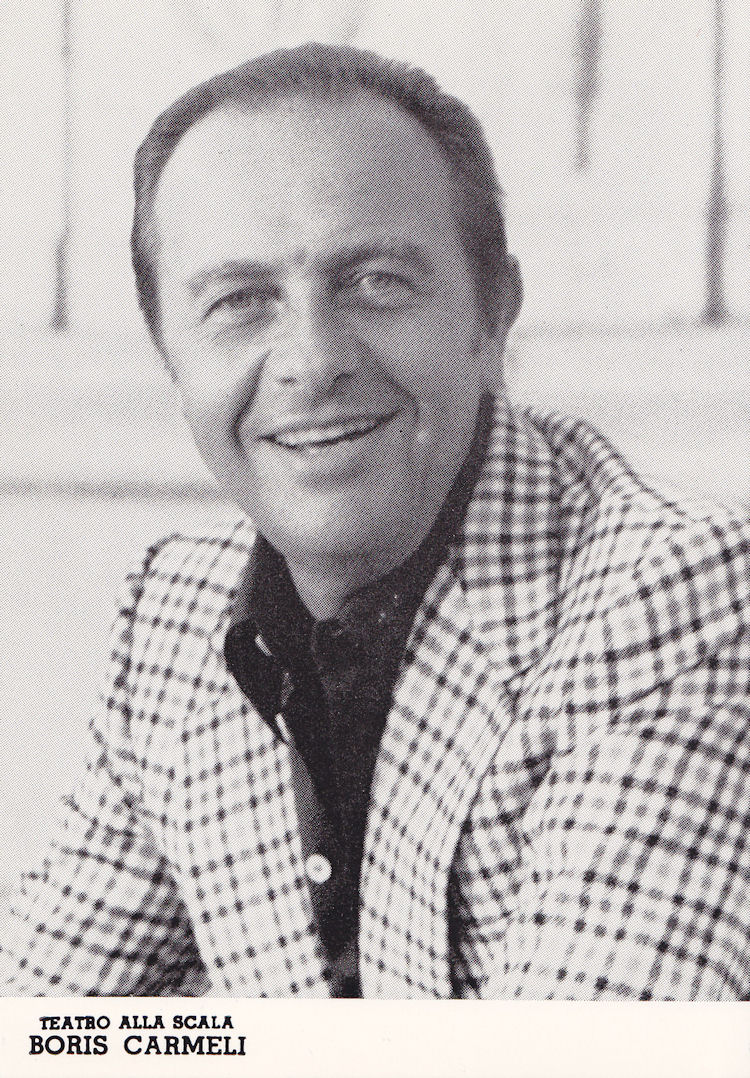
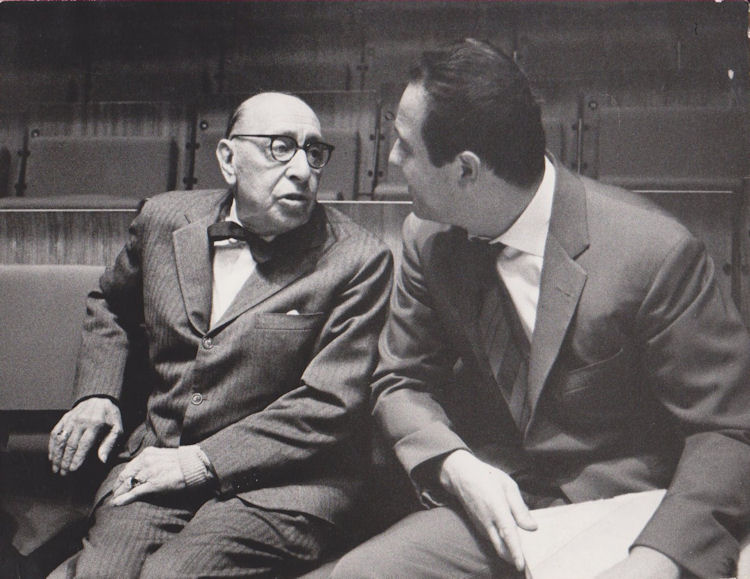
The Polish-born Italian bass, Boris Carmeli, was born as Norbert Wolfinger to Hermann and Genya Wolfinger. His parents, brother and himself fled from Germany to Brussels and France in 1939 over the borders with a guide and sheperd dog. First they stopped close to Pau where Boris absolved his Certificat d'étude and then stayed for quite a time in Saint Martin Vésubie with a group of Jewish rufugees. (See books of the Holocaust by Susan Zucotti and Danielle Lakaine; both ladies describe it very well, detailed and with photos). In 1943 after the taking over of southern France by the Italians, the whole familiy escaped to Borgo San Dalmazzo, where a modest good-hearted local peasant, Pietro, hided them in a barn in the mountains, bringing something to eat for them every day. Boris suffering from an ear-sore went down alone from the mountains towards evening to get some medicine and leaving the drug-store was caught by Italian fashist Milizia men and put in a temporary assembly-camp. Boris' father would have had an opportunity to free him, but Boris wrote him a note saying that if he would do so, ten of his companions would be deported at once, and that he would rather face then same fate. (Mrs. Sonja Carmeli wrote: "I have seen and read this note and Boris' father kept it carefully until his death"). After some days, Boris was transported to the Assembly-Camp of Drancy from where he was deported to Auschwitz. Liberated by the allies he joined his family in Israel, learned Hebrew and started to take singing lessons, convinced he was a Tenor and being disappointed to be told that he was a Basso Profondo. He has the opportunity to participate on a young singers competition with a grant to study Belcanto in Italy, won the first prize and arrived in Milan at Easter 1950. He stated studying Belcanto with Ubaldo Carrozzo and Giovanni Binetti, and at the Conservatorio Rossini in Pessaro. When his grant almost comes to an end, he met the first honorary consul of Israel Astorre Mayer who engaged him as his secretary for half a day; the other half-day was free for studying, until his debut in Faenza.
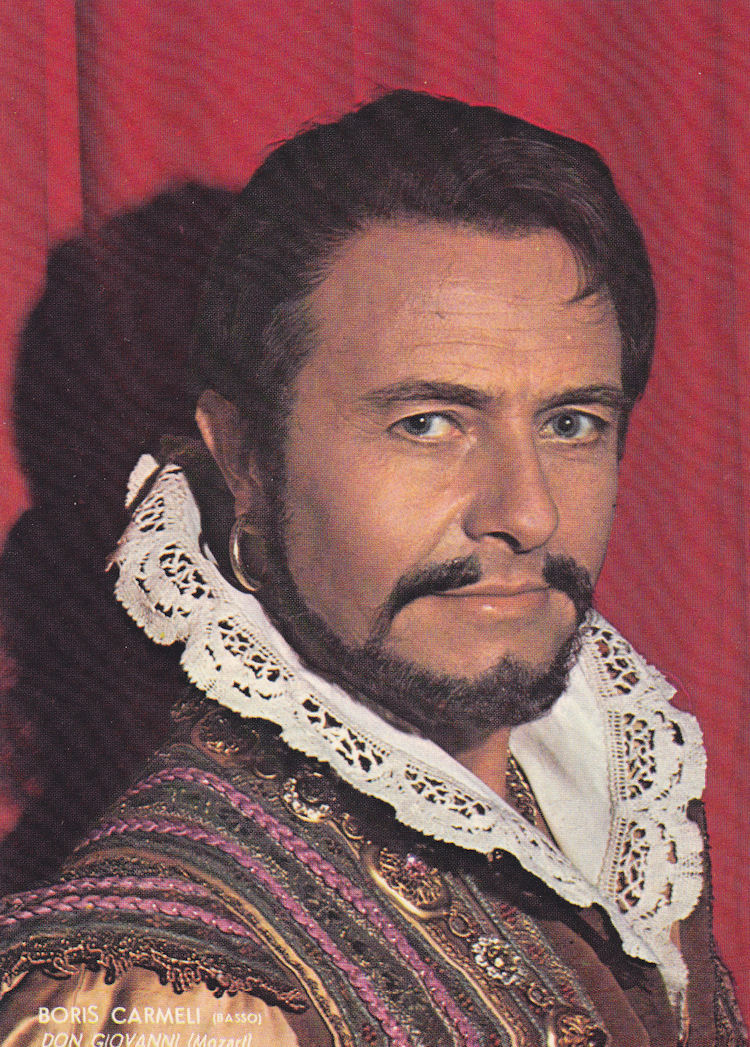
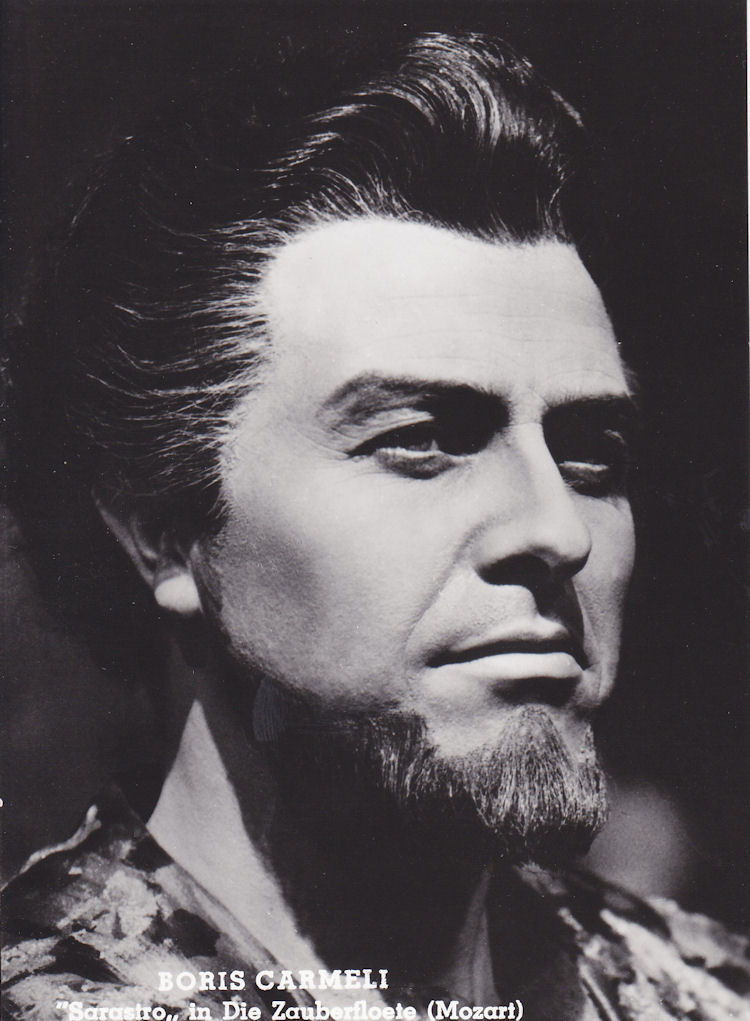
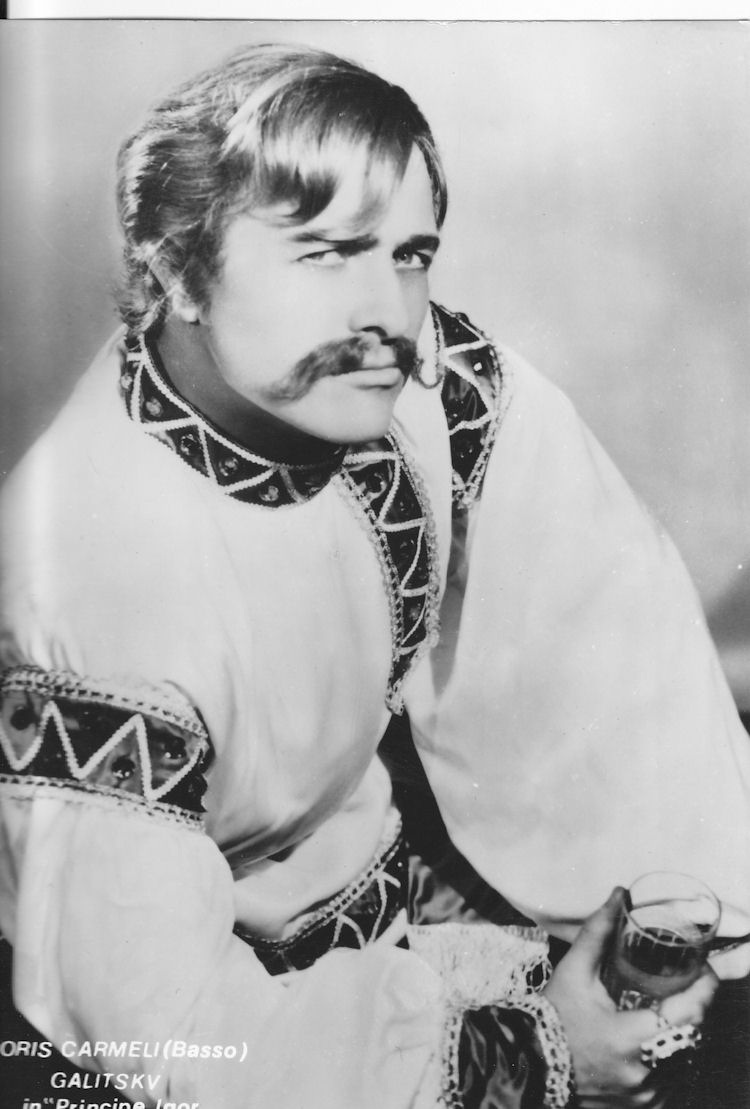
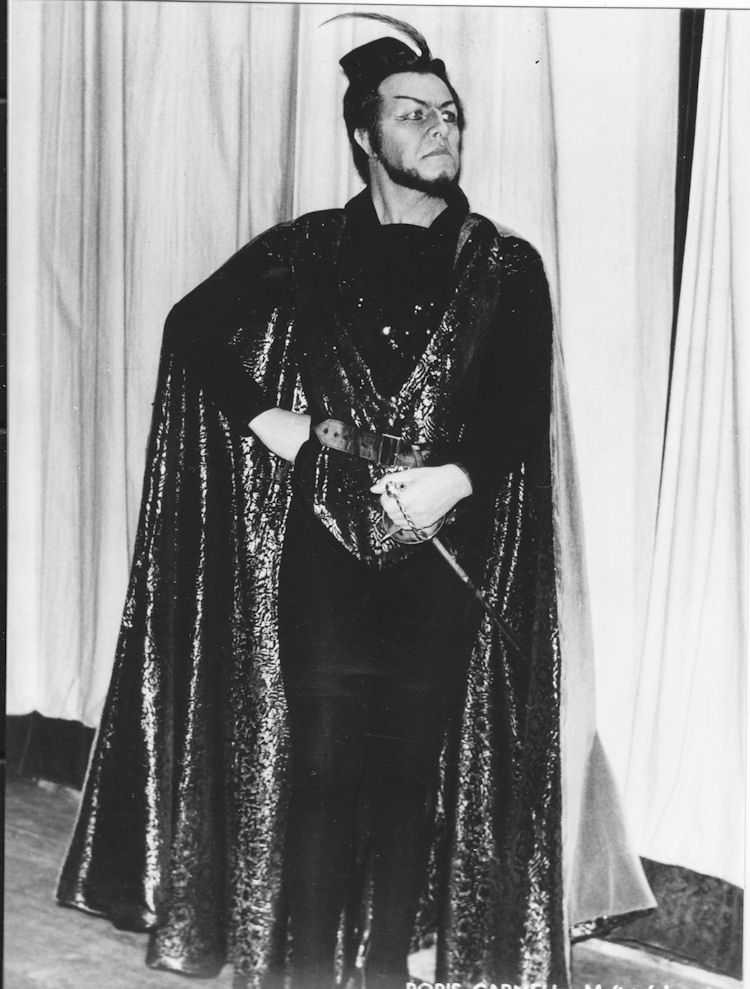
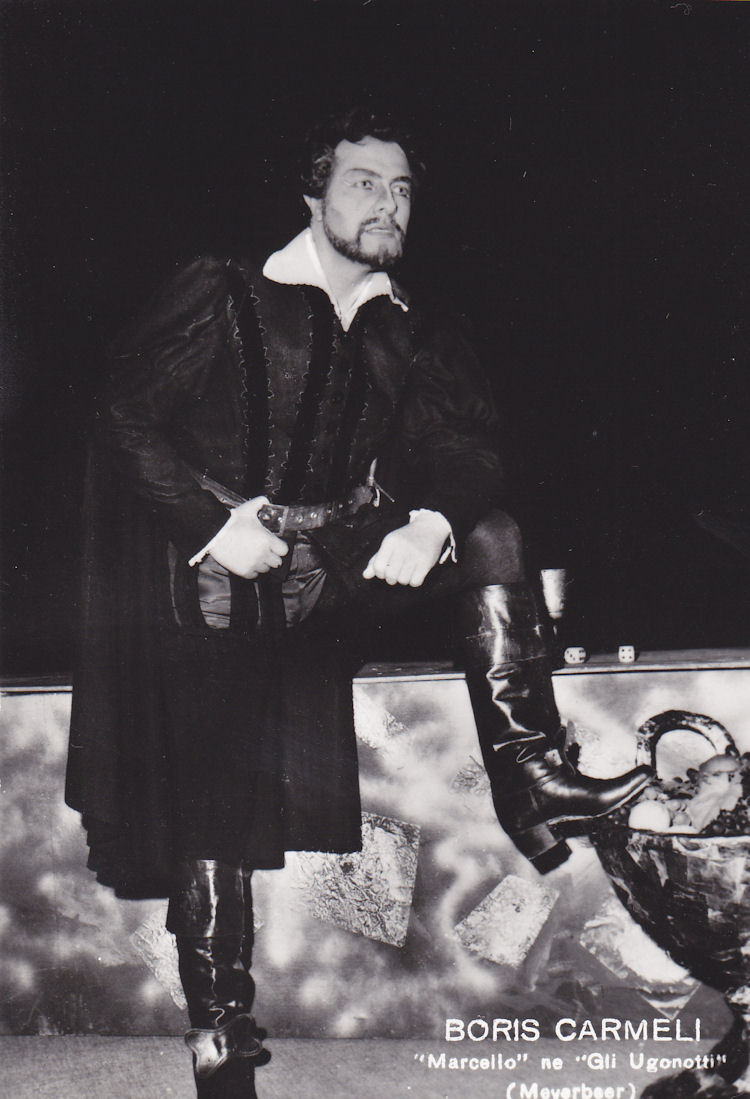
Boris Carmeli's debut took place in 1956 at the Festival in Arena Faenza in Bologna as Colline in Puccini's La Bohème. He was discovered by Tullio Serafin, who first brought him to La Scala in Milan. With a repertoire of over seventy operas and sixty oratorios, his credits are as distinguished as they are lengthy. He had a successful career at the important Italian stages: at Milan's La Scala, at the opera houses of Rome, Florence, Bologna, Naples, Palermo, Parma, Genoa, Turin, Venice and at the Maggio Musicale Fiorentino. He has appeared regularly in the major opera houses in the world, such as Paris, Vienna, Berlin, Munich, Hamburg, Köln, Madrid, Tokyo, Osaka, Rio de Janeiro, Amsterdam, Brussels, Bordeaux, Nice, Marseille, Rouen and Geneva. In North America he could be heard at the opera houses of Boston, New Orleans, Carnegie Hall, Philadelphia and San Francisco, and was a sought-after participant for international festivals such as those of Salzburg, Holland, the Berliner Festwochen, Wiener Festwochen, Maggio Musicale Fiorentino, Sacra Musicale Umbra in Perugia, and Aix-en-Provence, among others.
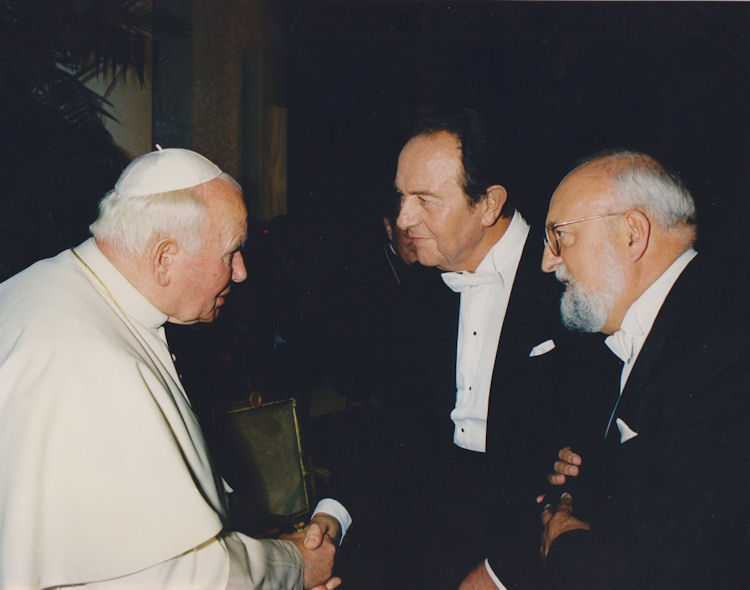
Apart from the classical bass repertoire Boris Carmeli dedicated himself gladly to the contemporary music works. Thus he sang at the Salzburg Festival of 1973 in the premiere of De temporum fine comoedia by Carl Orff (the role of Anachoreten). He appeared in 1984 at the same festival in a concert performance of Fr. Schreker's Die Gezeichneten. He sang in the European premiere of Krzysztof Penderecki's Paradise Lost under the direction of the composer at Milan's La Scala and at the Vatican for the Pope. He participated also in premieres of contemporary Italian operas by Bartoluzzi, Allegra and Chailly.
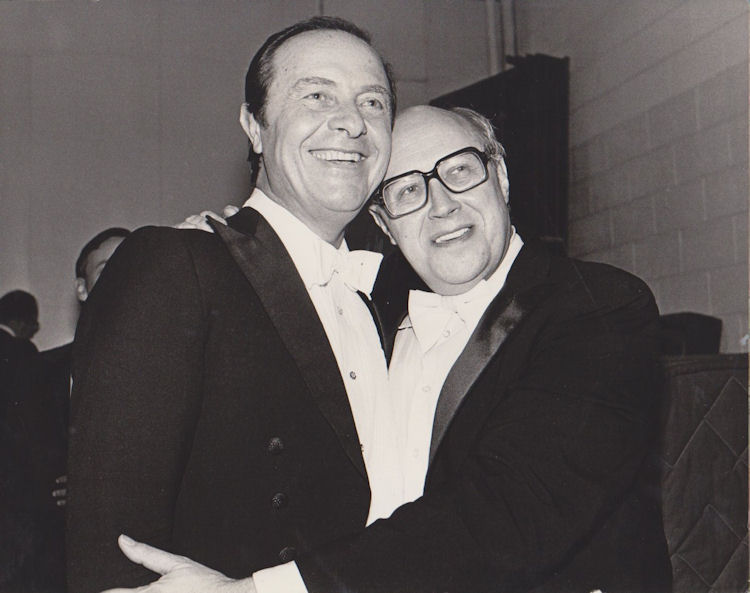
Boris Carmeli has performed with virtually all the leading conductors of our day, including Herbert von Karajan, Carlo Maria Giulini, Zubin Mehta, Gary Bertini, Leonard Bernstein, Yuri Ahronovitch, Sergiu Celibidache, Marc Albrecht, Miltiades Caridis, Aldo Ceccato, Riccardo Muti, Lorin Maazel, Wolfgang Sawallisch, Rafael Kubelík, Hermann Scherchen, John Barbirolli, Yehudi Menuhin, Antal Doráti, Ernest Ansermet, Igor Markevitch, Georges Prêtre, Jerzy Semkow, Richter, Krzysztof Penderecki, Eugen Jochum, Stanislaw Skrowaczewski, Mstislav Rostropovich, Riccardo Chailly, Charles Dutoit, Harley Maga, Lothar Zagrosek, David Zinman, Zdeněk Mácal, Rafael Frühbeck de Burgos, and Henri Pantillion. He continued his concert appearances until the beginning of the 1990's.
Boris Carmeli performed frequently in Israel: Italiana in Algier and L.v. Beethoven's 9th Symphony with Carlo Maria Giulini, Samson and Dalilah in Cesarea under Zubin Mehta, Barber of Seville and Rake's Progress with Gary Bertini, 2 recitals under the Patronage of the Italian Embassy in Tel Aviv with pianist Jonathan Zak, W.A. Mozart-Arias at the Museion, Dmitri Shostakovich and Mussorsky with Krzysztof Penderecki with whom he had a special friendship and a very close working relationship, since the Italian Première in 1966 of Lukas Passion in Rome and the Première of Utremja in Germany. In Jerusalem 1997 was the Première of Krzysztof Penderecki's 7th Symphony Seven Gates of Jerusalem with a narrator-part for Boris in Hebrew on a text of the Prophet Ezechiel he liked especially; it was performed in the major cities of Europe, including New York, Caracas and Auschwitz.
Mrs. Sonja Carmeli wrote: "What comforts me in my big sorrow is that Boris performed almost until his last breath; we were supposed to leave in August 2009 for the 7 Gates of Jerusalem in Poland, and alas, I had to cancel it because of his unexpected and sudden death; it though permitted him to stay in his so much beloved music-world and I'm grateful to fate that I could stay close for 48 years to such an exceptional human being."
Boris Carmeli frequently appeared on Italian television and starred in many opera films, including Puccini's Turandot with Birgit Nilsson at La Scala, The Life of Puccini and Rossini's La Scala di Seta. His recordings appeared on DGG (Sirius by Stockhausen, De temporum fine comoedia). Telefunken-Decca (Die Verurteilung des Lukullus by Paul Dessau), RCA (La Scala di seta by Rossini), MRF (Le Prophète by Meyerbeer), Fonit Cetra (Works by J.S. Bach). |