|
|
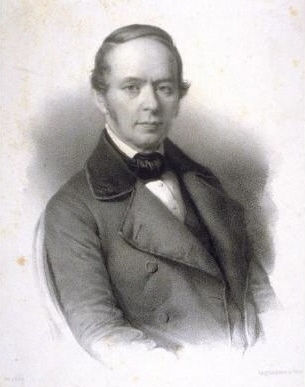
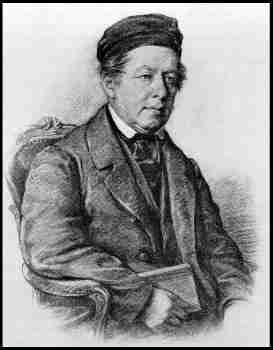
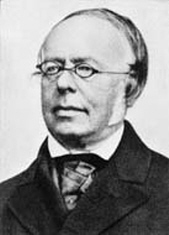
Moritz Hauptmann (Composer, Thomaskantor)
|
|
Born: October 13, 1792 - Dresden, Germany
Died: January 3, 1868 - Leipzig, Germany |
|
Moritz Hauptmann was a German violinist, composer, teacher and eminent theorist, and Kantor of the Thomasschule at Leipzig. |
|
Life |
|
Moritz Hauptmann's education was conducted mainly with a view to his father's profession of architecture; but he was also well grounded in music at an early age. He studied the violin under Scholz, and harmony and coniposition under Grosse, and subsequently under Morlacchi. For a time he was also employed as an architect, but all other pursuits gave place to music, and as he grew up he determined to adopt music as a profession. To perfect himself in the violin and composition he went in 1811 to Gotha, where Spohr was Konzertmeister, and the two then contracted a lifelong friendship. He completed his education as a violinist and composer under Spohr, and till 1821 held various appointments in private families, varying his musical occupations with mathematical and other studies bearing chiefly on acoustics and kindred subjects. He was for a short time violinist in the court band at Dresden (1812), and soon afterwards entered the household of Prince Repnin, Russian Governor of Dresden, with whom he went to Russia for four years in 1815.
On his return to Germany Moritz Hauptmann became in 1822 violinist in Spohr's band at Kassel, and here gave the first indications of his remarkable faculty for teaching the theory of music. Ferdinand David, Curschmann, Burgmüller, Kufferath and Kiel are among the long list of his pupils at that time. His compositions at this time chiefly consisted of motets, masses, cantatas and songs. His opera Mathilde was performed at Tasst with great success.
In 1842, after 20 years as violinist under Spohr, on Felix Mendelssohn's recommendation, Moritz Hauptmann was appointed Kantor and Musikdirector of the Thomasschule, and professor of counterpoint and composition at the new conservatonum at Leipzig, where he thenceforward resided. It was in this capacity that his unique gift as a teacher developed itself and was acknowledged by a crowd of enthusiastic and more or less distinguished pupils. He became the most celebrated theorist and most valued teacher of his day. Among his pupils will be found such names as Joachim, Von Bülow, Cossmann, the Baches, Sullivan, Cowen. He also edited the Allgemeine musikalische Zeitung (1843) and, with Otto Jahn and Schumann, founded the Bach Gesellschaft in 1850. He died on the January 3, 1868, and the universal regret felt at his death at Leipzig is said to have been all but equal to that caused by the loss of his friend Felix Mendelssohn many years before. |
|
Works |
|
Moritz Hauptmann's works are characterised by deep thought, philosophic treatment, imagination and much sense of humour. His chief work is Die Nutur der Harmonik und Metrik (1853, 2nd ed. 1873); English translation as The Nature of Harmony and Metre, by W. E. Heathcote (London, 1888). His mathematical and philosophical studies had given a strictly logical turn to his mind, and in this book he applies Hegel's dialectic method to the study of music. Gifted with an ear of unusual delicacy, he speculated deeply on the nature of sound, applying to the subject Hegel's formulas of proposition, counter-proposition and the ultimate unity of the two. His theoretical system stresses the dualism of major and minor. The book is not intended for practical instruction, and is indeed placed beyond the reach of ordinary musicians by its difficult.terminology. But by those who have mastered it it is highly appreciated, and its influence on later theoretical works is undeniable. His other works are: an Erläuterung zu der Kunst der Fuge van J.S. Bach; various articles on acoustics in Chrysander's Jahrbücher; Die Lehre von der Harmonik, a posthumous supplement to the Harmonik und Metrik, edited by his pupil, Dr. Oscar Paul, in 1868; Opuscula, a small collection of articles musical and philosophical, edited by his son in 1874; and his Letters, of which two vols. (1871) are addressed to Hauser, the director of the Munich Conservatorium, and the third, edited by Hiller (1876), to Spohr and others. A large selection from these, translated by A.D. Coleridge, was published as Letters of a Leipzig Cantor in 1892.
Moritz Hauptmann's compositions are marked by symmetry and perfection of workmanship rather than by spontaneous invention. Heublished some sixty compositions, mainly interesting from the characteristic harmony between the whole and its parts, which pervades them. In early life he wrote chiefly instrumental music - sonatas for Pianoforte and violin (opp. 5,6,23); duos for two violins (opp. 2, 16, 17), quartets, etc., which betray the influence of Spohr. During the latter half of his life he wrote exclusively for the voice. Among his vocal compositions - more important as well as more original than the instrumental - may be named his well-known motets and psalms; a Mass (op. 18); a Mass with orchestra (op. .43); choruses for mixed voices (opp. 25, 32, 47), perfect examples of this style of writing; two-part songs (op. 46); and three-part canons (op. 50). Op. 33, six sacred songs, were published in English by Ewer & Co. Early in life he composed an opera, Mathilde, which was repeatedly performed at Kassel, where it was produced in 1826. His partsongs are eminently vocal and widely popular, and are stock pieces with all the associations and church choirs throughout Germany. |
 |
|
Source: Grove Concise Dictionary of Music (© 1994 by Oxford University Press); Grove’s Dictionary of Music and Musicians (1952 Edition, by Herr A. Maczewsky); Wikipedia Website (from 1911 Encyclopædia Britannica)
Contributed by Aryeh Oron (September 2005, February 2006) |
|
| |
|